Spring Surge and Resonance: Avoiding Dynamic Failure
Short answer: Spring surge is a standing compression wave that travels up and down a helical spring when its excitation frequency approaches the spring's own natural frequency. When that happens, coils no longer deflect uniformly: some coil groups close early, local stress can exceed the static design value by 2x or more, and fatigue failure appears after a fraction of the expected life. The fix is to detune the spring so its first natural frequency sits at least 15-20x above the driving frequency, or to add damping and preload. In practice this means changing coil count, wire diameter, end conditions, or adding a friction damper — decisions best made at design review, not after field failures.
What Is Spring Surge, and Why Does It Break Springs?
A compression spring is not a rigid force generator. It is an elastic column of wire with mass distributed along its length. Push one end and the disturbance does not arrive at the other end instantly — it propagates as a wave at the speed of sound in steel (roughly 5,100 m/s for spring steel wire). When the excitation at one end repeats at a rate that matches the round-trip time of that wave, the reflected waves reinforce each other. The spring starts to "ring" like a plucked string.
This is surge. The visible symptom is that individual coils close and reopen out of phase with the applied load. The invisible symptom is worse: the coils that close first carry far more stress than a static calculation predicts, and they carry it cyclically, millions of times.
Surge matters because it converts a benign static design into a fatigue problem. A spring sized at 60% of allowable static stress can fail in surge conditions because the dynamic stress amplitude at the surging coils multiplies. Typical outcomes are:
- Early fatigue fracture, usually 2-6 coils from the moving end
- Noise and vibration transmitted into the surrounding assembly
- Loss of load accuracy in valves, clutches, and actuators
- Fretting wear and contact marks between adjacent coils
Surge is not a manufacturing defect. A perfectly made spring will surge if the application excites it. That is why detuning belongs in the design phase.
How Do You Calculate a Spring's Natural Frequency?
The standard engineering approach treats the spring as a uniform elastic rod with one end fixed and one end free, giving a fundamental natural frequency of:
f_n = (1/4L) × √(k / m)
Where L is the active length, k is the spring rate, and m is the active mass of the coils. The factor 1/4 applies to the fixed-free case; use 1/2 for fixed-fixed (both ends constrained against rotation and translation).
For quick shop-floor estimation, a widely used practical form is:
f_n ≈ 1.55 × 10⁷ × d / (N_a × D²) (Hz, with d and D in mm)
Where d is wire diameter, D is mean coil diameter, and N_a is the number of active coils. This form makes the design levers obvious: fewer active coils, larger wire, and smaller mean diameter all raise natural frequency.
| Parameter | Effect on natural frequency | Practical adjustment |
|---|---|---|
| Active coils (N_a) | Strongly inverse | Reduce coil count; use stiffer wire |
| Wire diameter (d) | Direct | Increase d, reduce D to hold rate |
| Mean diameter (D) | Inverse squared | Smaller D raises f_n sharply |
| End condition | Factor of 2 | Constrain both ends where possible |
| Material modulus | Weak (√G) | Steel vs stainless changes little |
| Preload / installed length | Moderate | Shorter installed length raises f_n |
The practical rule used in most valve-train and reciprocating machinery work: keep the spring's first natural frequency at least 15-20x the highest significant excitation frequency. Below 13x, surge is considered likely; below 10x, it is almost certain.
What Excites a Spring in Real Machinery?
Surge needs a periodic input. Common sources in production equipment:
Reciprocating and rotating machinery
Engine valve springs, compressor valves, pump plungers, and cam-driven mechanisms all deliver one impulse per revolution or per stroke. At 3,000 rpm that is 50 Hz. A spring with a 400 Hz natural frequency gives a ratio of 8 — well inside the surge zone.
Solenoid and actuator cycling
Solenoid valves, contactors, and electromagnetic actuators switch at rates from a few Hz to several hundred Hz. The armature impact excites the return spring at every cycle. This is one of the most common causes of surge failures in industrial control hardware.
Assembly and transport vibration
A spring packaged in a vibrating assembly can be excited by structural resonances of the housing rather than the nominal drive frequency. If the frame resonates at 180 Hz and the spring's natural frequency is 200 Hz, the spring will surge even though the "official" drive frequency is 25 Hz.
Impact and step loads
A dropped load or a hard mechanical stop produces a broadband impulse containing energy at every frequency, including the spring's natural frequency. The spring rings down at its own frequency. Repeated impacts accumulate fatigue damage fast.
How Do You Detune a Spring to Avoid Resonance?
Detuning means moving the spring's natural frequency away from the excitation frequency. There are five levers, listed roughly in order of cost-effectiveness.
1. Reduce active coils. Natural frequency scales inversely with N_a. Going from 8 active coils to 5 raises f_n by 60%. To hold the same spring rate, increase wire diameter. This is the single most common detuning move.
2. Increase wire diameter and reduce mean diameter. Because f_n scales with d/D², a modest change in geometry produces a large frequency shift. A spring at 12 mm mean diameter and 1.6 mm wire has roughly 2.3x the natural frequency of one at 20 mm mean diameter and 1.6 mm wire at the same coil count.
3. Constrain the ends. A spring with both ends closed and ground, seated in pockets that prevent end rotation, behaves closer to fixed-fixed, roughly doubling f_n compared with a free-end assumption. End condition is free detuning if the housing allows it.
4. Add preload and shorten installed length. Installing the spring to a shorter working length raises effective stiffness and reduces the mass participating in the wave. Both push f_n up.
5. Add damping. Friction dampers, nested springs with opposing helix, or elastomer inserts dissipate surge energy. Damping does not move the natural frequency, but it limits amplitude at resonance. It is the fallback when geometry is locked by envelope constraints.
| Detuning method | Frequency change | Cost impact | When to use |
|---|---|---|---|
| Reduce active coils | Large (+40-80%) | Low | First choice in most redesigns |
| Larger wire, smaller D | Large (+50-150%) | Low-medium | When rate must stay constant |
| Constrain both ends | ~2x | Low | When housing can be modified |
| Increase preload | Moderate (+10-30%) | Low | When installed height allows |
| Add friction damper | Amplitude only | Medium-high | Envelope locked, high cycle count |
Surge vs. Other Dynamic Failure Modes
Surge is often confused with two neighbours. Separating them saves diagnostic time.
| Failure mode | Root cause | Signature | Fix |
|---|---|---|---|
| Surge / resonance | Excitation near natural frequency | Coil closure waves, mid-span fractures | Detune, damp, preload |
| Rotational fatigue | Cyclic torsion in bending applications | Fractures at 1-2 coils from ends | Stress relief, surface finish |
| Overload yield | Static stress above yield | Permanent set, free length loss | Larger wire, fewer coils, better material |
| Corrosion fatigue | Cyclic stress plus aggressive environment | Pitting at fracture origin | Material upgrade, coating, drainage |
If a spring fails at mid-span with a flat, wave-like fracture face and the assembly runs at a fixed speed, surge is the first hypothesis. If it fails at the ends with a 45° shear lip, look at rotational fatigue or end-condition stress concentration instead.
Design Review Checklist for Surge-Sensitive Springs
Before releasing a spring drawing for production, confirm:
- Excitation frequency is known, including harmonics up to the 3rd order
- Spring natural frequency is at least 15x the highest significant excitation
- End conditions are specified (closed, closed and ground, open, constrained)
- Installed length and preload are defined, not left to the assembler
- Maximum dynamic stress amplitude is checked, not just static stress
- Surface condition is specified — shot peening raises fatigue limit where surge cannot be eliminated
- Sample springs are load-tested at rate and at installed height
For teams working through the fatigue side of this, spring rotational fatigue covers the bending-torsion interaction, and spring overload yield covers the static limit that surge damage sits on top of. Verifying the finished part against the drawing is covered in spring load testing.
Where Manufacturing Tolerances Fit In
Surge calculations assume nominal dimensions. Real springs have tolerances on wire diameter, coil count, free length, and end squareness. Those tolerances shift the natural frequency, which is why a design sitting at exactly 15x ratio can still surge in some units of a production lot.
Typical indicative tolerance effects on natural frequency:
| Variable | Typical tolerance | Approx. f_n shift |
|---|---|---|
| Wire diameter | ±0.02 mm on 1.5 mm | ±2% |
| Active coils | ±0.25 coil | ±3% |
| Free length | ±1% | ±1% |
| End squareness | 3° | ±1-2% |
| Material modulus | ±3% between heats | ±1.5% |
Stacked worst case, a nominal 15x margin can drop to 13x in the tail of the distribution. Designing to 18-20x nominal gives real margin. This is one reason BQUQ specifies active coil count and end condition explicitly on spring drawings rather than leaving them to shop discretion — the four production lines in our Dongguan factory run compression, extension, and torsion springs with controlled coil count and documented load testing.
When to Redesign vs. When to Damp
Not every surge problem justifies a new spring. A useful decision rule:
Redesign when the frequency ratio is below 13x, when the spring is still in prototype, or when the housing envelope can absorb a geometry change. Redesign is almost always cheaper over the life of the program.
Damp when the ratio is between 13x and 15x, when the housing is fixed tooling, or when the excitation is broadband rather than a single tone. In these cases a friction damper or a nested counter-wound spring pair limits amplitude without changing the frequency.
Accept and monitor only when cycle count is low (under roughly 10⁴ cycles) and the consequence of failure is not safety-related. Even then, verify with a load test at the installed height and a short endurance run.
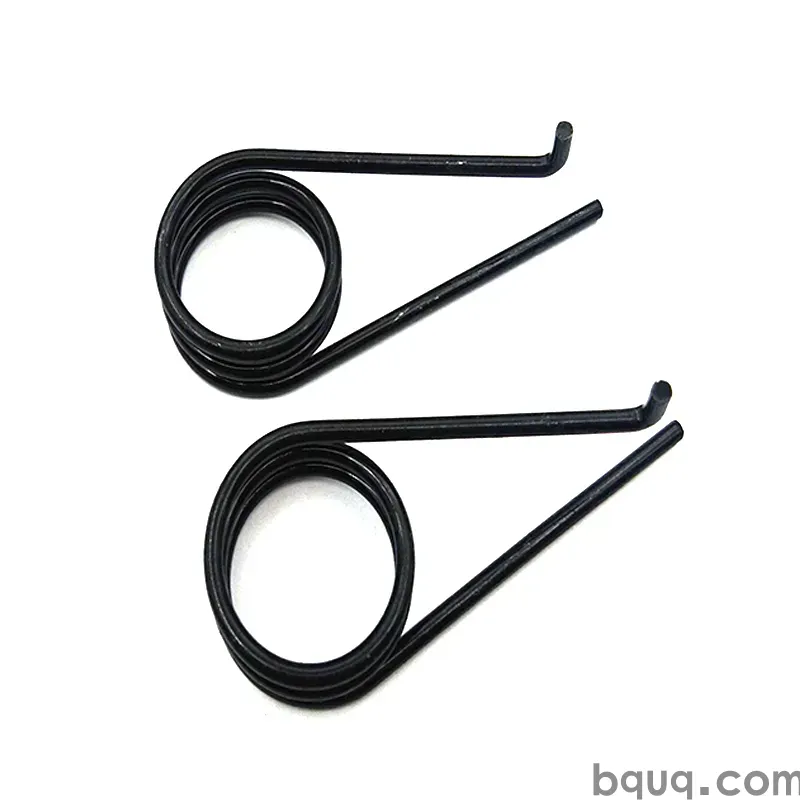
For custom compression springs and extension springs, the detuning decision is best made with the supplier at the quoting stage, because coil count and wire diameter choices interact with rate, stress, and solid height simultaneously. Torsion springs have their own dynamic behaviour — the leg geometry adds a second resonant mode that is easy to miss.
Frequently Asked Questions
Q: What frequency ratio is safe for a compression spring?
A: Most machinery design practice treats 15x as the minimum ratio between the spring's first natural frequency and the highest significant excitation frequency, with 20x preferred for high-cycle applications. Below 13x, surge is likely; below 10x it is essentially certain. Because manufacturing tolerances shift natural frequency by a few percent, designing to 18-20x nominal gives genuine margin rather than a paper pass.
Q: Can a spring surge at a frequency other than its natural frequency?
A: Yes. Surge can be excited at subharmonics and at higher harmonics of the fundamental, not only at the exact natural frequency. Broadband impulses from impacts or hard stops contain energy across the whole spectrum, so a spring can ring at its natural frequency even when the nominal drive frequency is far away. This is why frame and housing resonances matter as much as the drive frequency itself.
Q: Does shot peening prevent spring surge failure?
A: Shot peening raises the fatigue limit by inducing compressive residual stress at the surface, so it delays or prevents crack initiation at the surging coils. It does not stop surge from occurring and does not reduce the dynamic stress amplitude. Use peening as a supplement when detuning is not fully achievable, not as a substitute for getting the frequency ratio right in the first place.
Q: How do I measure whether a spring is surging?
A: Strain gauges bonded to individual coils, or a high-speed load cell at the moving end, will show load oscillations at frequencies well above the drive frequency. A simpler field check is a strobe or high-speed camera on the coil stack: surging coils show a travelling closure wave rather than uniform deflection. Acoustic measurement also works, since surge radiates a characteristic tone at the natural frequency.
Q: Can changing the material fix a surge problem?
A: Rarely on its own. Natural frequency depends on the square root of the shear modulus divided by density, and most spring steels sit within a few percent of each other on that ratio. Switching from music wire to chrome silicon or 302 stainless changes fatigue strength and corrosion resistance, which affects how long the spring survives surge, but it will not move the natural frequency enough to detune the design.
Related Resources
- About BQUQ and our Dongguan ISO9001 factory: /about/
- Custom compression, extension, and torsion springs: /compression-springs/, /extension-custom-springs/, /torsion-springs/
- Industry trends in spring and metal component sourcing: /industry-dynamics/
- Technical articles on spring design and manufacturing: /bquq-blog/
- Frequently asked questions about quoting and tolerances: /faq/
- Case studies from production programs: /case/
- Contact the engineering team for a 12-hour quote: /contact/
Authored by the BQUQ Engineering Team. BQUQ (Dongguan) runs CNC machining (±0.005 mm), metal stamping, custom springs, and heat sink production in one ISO9001 factory. Source-direct from Dongguan, China — quote in 12 hours: sc@bquq.com | WhatsApp +86 13713157787 | www.bquq.com