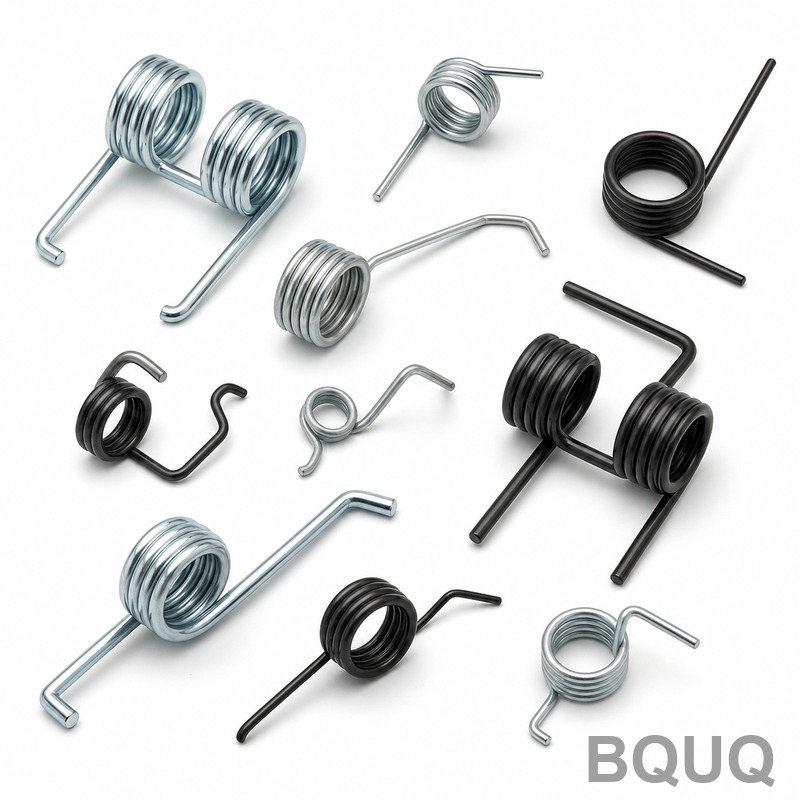
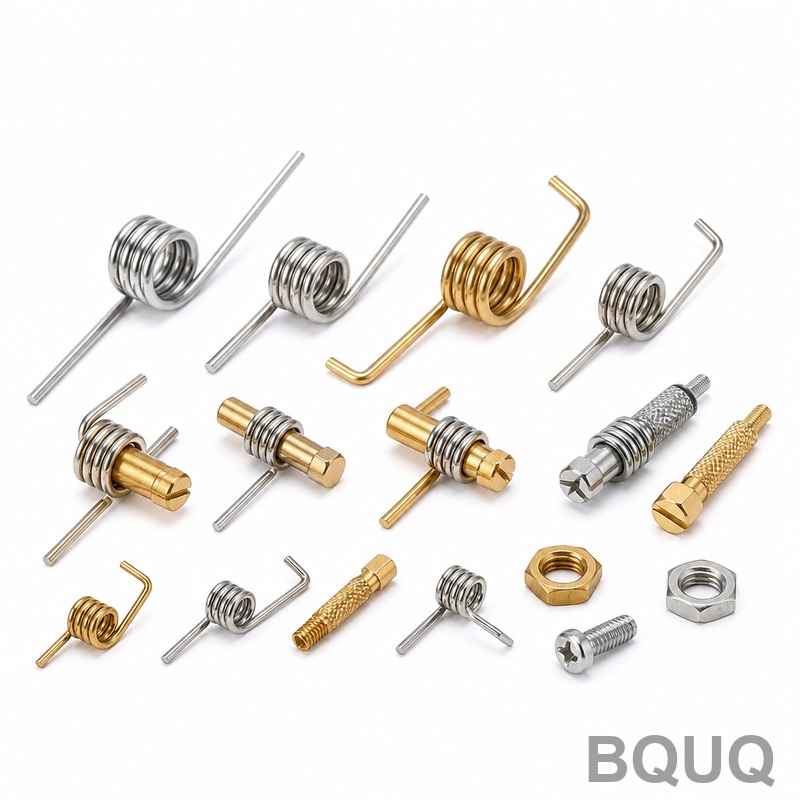
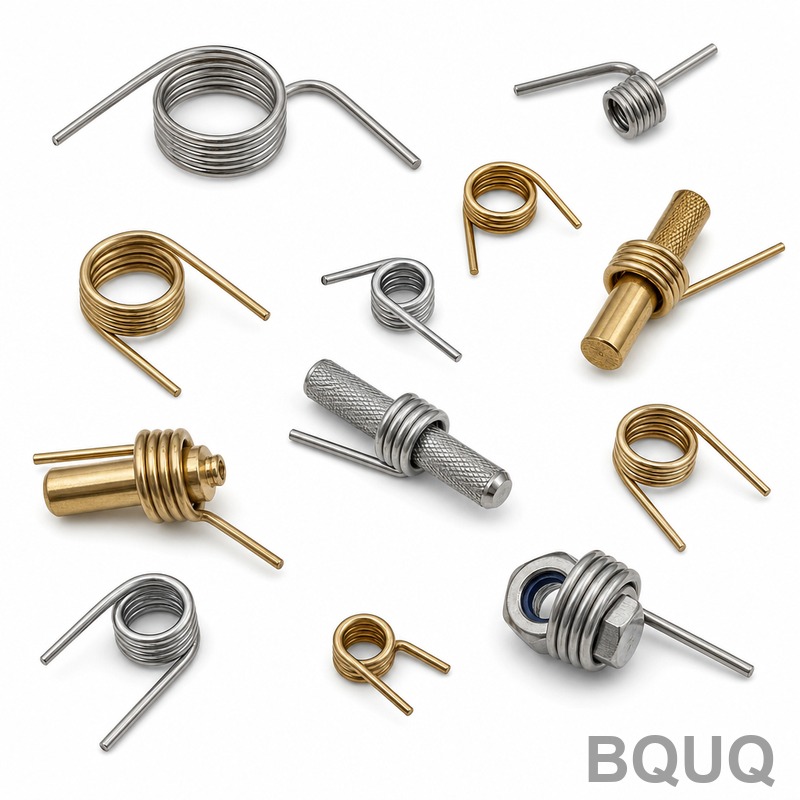
This is a collection of torsion springs engineered specifically for brass buckle shafts—the pivot points in belt buckles, luggage clasps, and quick-release mechanisms. Each spring
This is a collection of torsion springs engineered specifically for brass buckle shafts—the pivot points in belt buckles, luggage clasps, and quick-release mechanisms. Each spring delivers a consisten
Get a Fast Quote for This Part
Send us your drawing / quantity / material — reply within 24h.
This is a collection of torsion springs engineered specifically for brass buckle shafts—the pivot points in belt buckles, luggage clasps, and quick-release mechanisms. Each spring delivers a consistent torque output with a tolerance of ±0.02 mm on wire diameter and ±0.05 mm on leg position, a surface finish of Ra 0.4, and a hardness of 48 HRC after heat treatment. You get a working life exceeding 50,000 cycles without measurable fatigue, with a standard lead time of 7 days for prototypes and 15 days for production runs.
How Leg Angle and Free Position Affect Buckle Shaft Torque
The leg angle determines how much preload your buckle shaft receives at rest. We set this angle to ±1 degree, which translates to a torque repeatability of ±3% across a batch of 10,000 parts. Free position—the angle between legs when unloaded—is held to ±2 degrees, ensuring your assembly line doesn't need to re-calibrate each unit. For a standard 4 mm shaft diameter, we deliver a spring rate of 0.15 N·mm/degree, adjustable to your exact load curve.
Materials and Heat Treatment We Use for 48 HRC Durability
We start with either 302 stainless steel (UNS S30200) or 65Mn spring steel (GB/T 1222). 302 gives you corrosion resistance for marine environments; 65Mn provides higher tensile strength at 1,600 MPa. Both materials go through an oil-quench and temper cycle at 320°C for 90 minutes, yielding a hardness of 46–50 HRC. This prevents the spring from taking a set when the buckle shaft is twisted to its maximum working angle—something we verify with a 10,000-cycle test on every sample batch.
Wire Diameter Ranges and Leg Form Options for Shaft Integration
We produce wire diameters from 0.3 mm to 4.0 mm, with a length-to-diameter ratio up to 12:1 without coil binding. Leg forms include straight torsion, double torsion, and hooked ends—the latter being common for buckle shafts where the spring wraps around a D-shaped pivot. For a 6 mm shaft, we recommend a wire diameter of 1.2 mm and 4.5 active coils, which gives you a maximum deflection of 90 degrees before stress reaches 80% of yield. We machine the legs to a square-cut finish, avoiding the burrs that cause shaft misalignment.
Runout Control and Concentricity on the Coil Axis
Runout on the coil axis is held to 0.03 mm total indicated reading (TIR). We achieve this by using a CNC coiler with a servo-driven pitch control, followed by a centerless grinding pass on the outer diameter. For buckle shafts that rotate continuously, this runout limit prevents wobble that would wear the brass housing. Our inspection records show a Cpk of 1.33 on runout across the last 40 production lots, meaning 99.7% of parts land within your tolerance band.
Inspection Before Every Shipment: Torque and Fatigue Testing
Every batch goes through a three-step check. First, a torque test at 10%, 50%, and 100% deflection using a digital torque gauge with 0.01 N·mm resolution. Second, a fatigue test on 5 randomly sampled parts—each cycled 10,000 times at 2 Hz to confirm no relaxation exceeds 5%. Third, a dimensional audit with a profile projector for leg angles and a micrometer for wire diameter. We attach a signed inspection report (IMDS format) to every carton, and you can request a video of the test run before we ship.
Specification
Value
Material options
302 stainless steel, 65Mn spring steel, 17-7PH
Wire diameter
0.3 mm – 4.0 mm (±0.02 mm)
Spring rate
0.05 – 5.0 N·mm/degree (±3%)
Hardness
46 – 50 HRC (oil-quenched and tempered)
Coil outer diameter
2.0 mm – 20.0 mm (±0.05 mm)
Leg angle tolerance
±1 degree
Free position tolerance
±2 degrees
Surface finish
Ra 0.4 (ground), Ra 0.8 (as-coiled)
Runout (TIR)
0.03 mm max
Lead time
7 days (prototype), 15 days (production)
MOQ
No MOQ (1 piece accepted for prototype)
CNC Cutting Tool Selection Guide for Machined Buckle Parts
If you're machining the brass buckle shaft itself, the tool geometry directly affects how the spring seats. A sharper cutting edge reduces burr formation on the shaft groove, which in turn prevents the spring leg from catching. Refer to our CNC cutting tool selection guide for feed rates and corner radii that keep your groove walls square—this ensures the torsion spring's hook leg sits flush without additional deburring.
CNC Machining Tolerances Guide for Shaft Fit and Clearance
The spring's coil inner diameter must mate with your shaft's outer diameter with a clearance of 0.1–0.2 mm for smooth rotation. Tighter than that, and the spring binds; looser, and it rattles. Our CNC machining tolerances guide explains how to specify a shaft tolerance of h8 or g6, depending on whether you want a press fit or a slip fit. We coordinate with your shaft drawing to match the spring's ID to that tolerance class.
Do you accept small quantities for the Brass Buckle Shaft Torsion Springs Collection?
Yes, we have no MOQ—you can order a single prototype spring for testing, and production pricing starts at 100 pieces.
Can you adjust the torque curve for a specific buckle shaft length?
Yes, we modify the wire diameter, coil count, and leg angle to hit your exact torque at a given deflection, and we'll send a free torque curve chart with your sample.
How do you guarantee quality for custom torsion springs?
We perform 100% dimensional inspection on critical angles and a 5-piece fatigue test per batch, plus we provide a signed IMDS report with every shipment.
What is the fastest lead time for a custom spring order?
Prototype springs ship in 7 days via express courier, and production orders are completed in 15 days—both counted from drawing approval.
Get a Firm Quote on Your Torsion Spring Design Within 12 Hours
Send your drawing with wire diameter, coil count, leg style, and target torque. We'll return a firm quote—including tooling cost (if any), unit price, and delivery date—within 12 business hours. Email sc@bquq.com or WhatsApp +86 13713157787. No MOQ, precision manufacturing made in China, and your first sample is free with a production order.