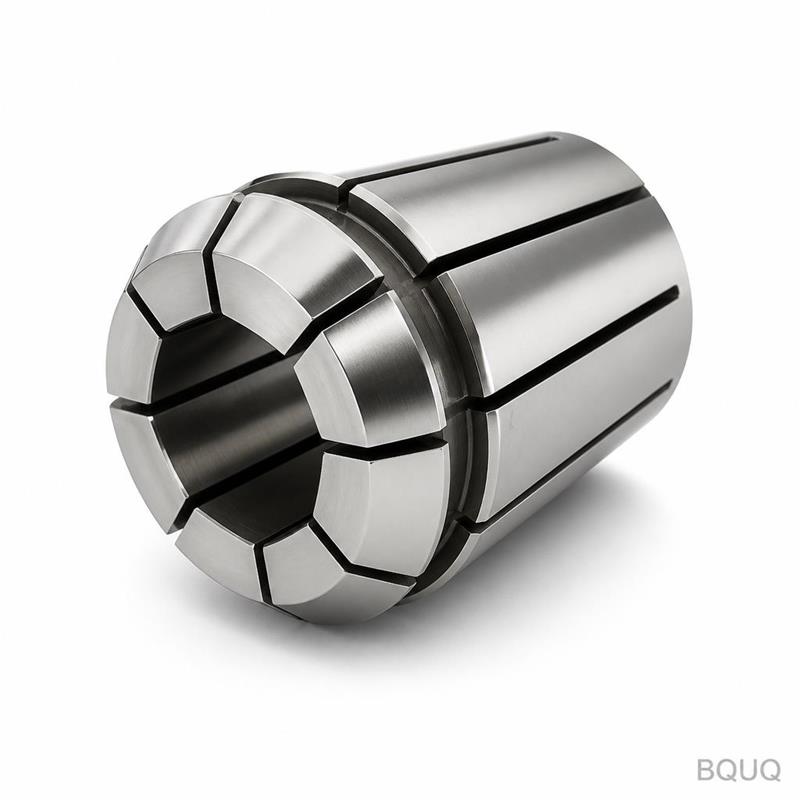
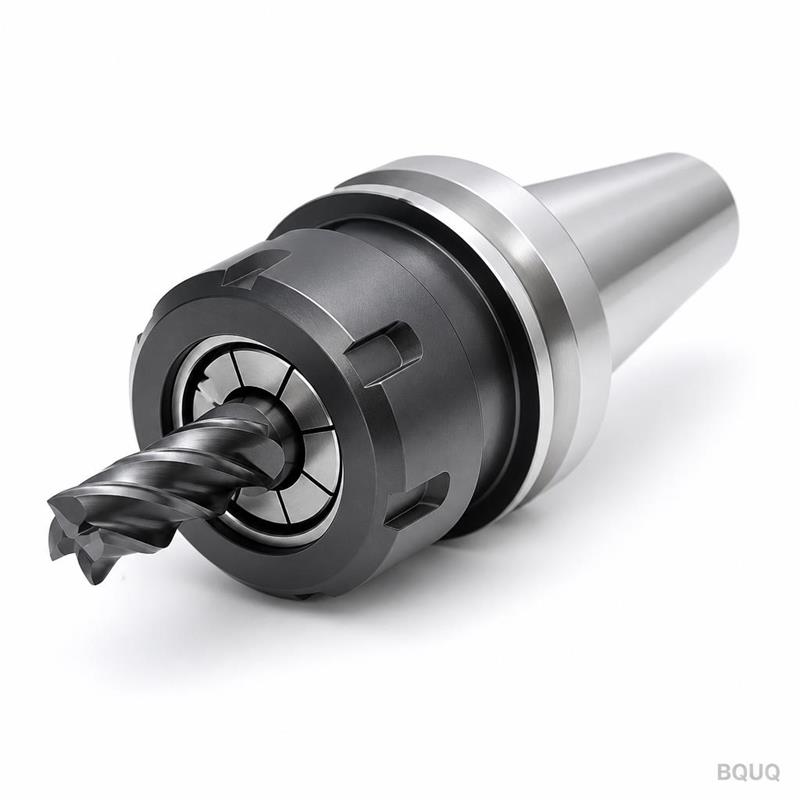
Why This ER32 Collet Nut Stops Tool Slip at 15,000 RPM This is a CNC machined ER32 collet nut with a matching spanner wrench, built for clamping ER32 collets in milling and drilli
BQUQ CNC Machined ER32 Collet Nut with Wrench, Precision Tooling
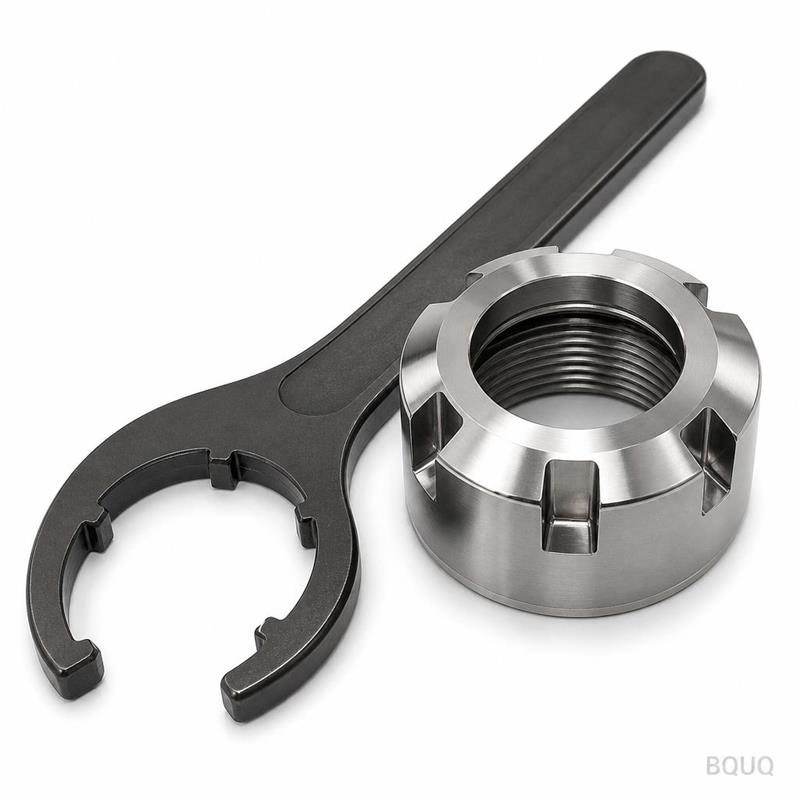
Why This ER32 Collet Nut Stops Tool Slip at 15,000 RPM This is a CNC machined ER32 collet nut with a matching spanner wrench, built for clamping ER32 collets in milling and drilling spindles. The nut
Get a Fast Quote for This Part
Send us your drawing / quantity / material — reply within 24h.
Why This ER32 Collet Nut Stops Tool Slip at 15,000 RPM
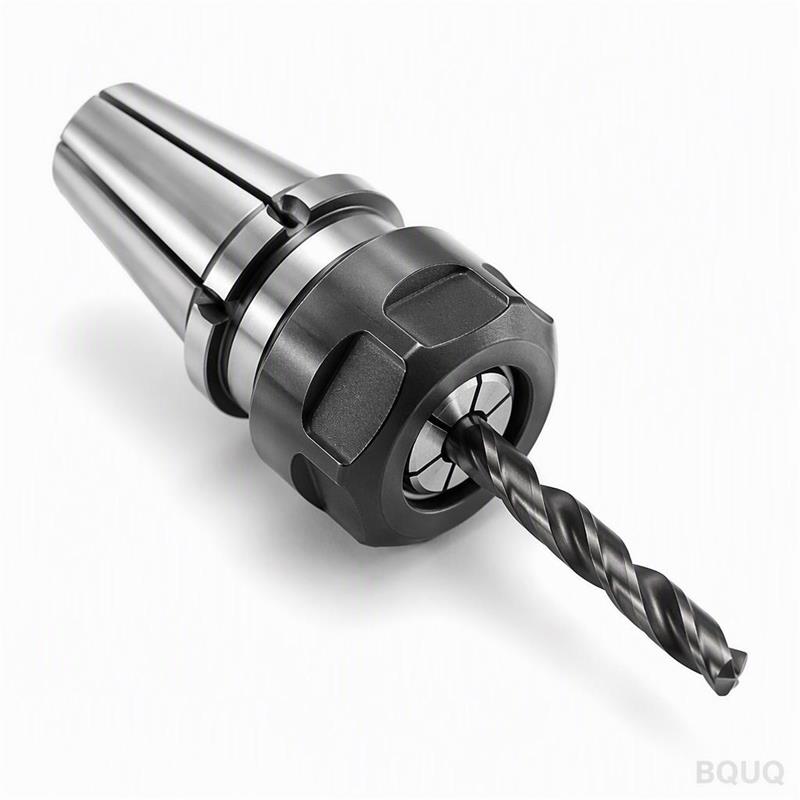
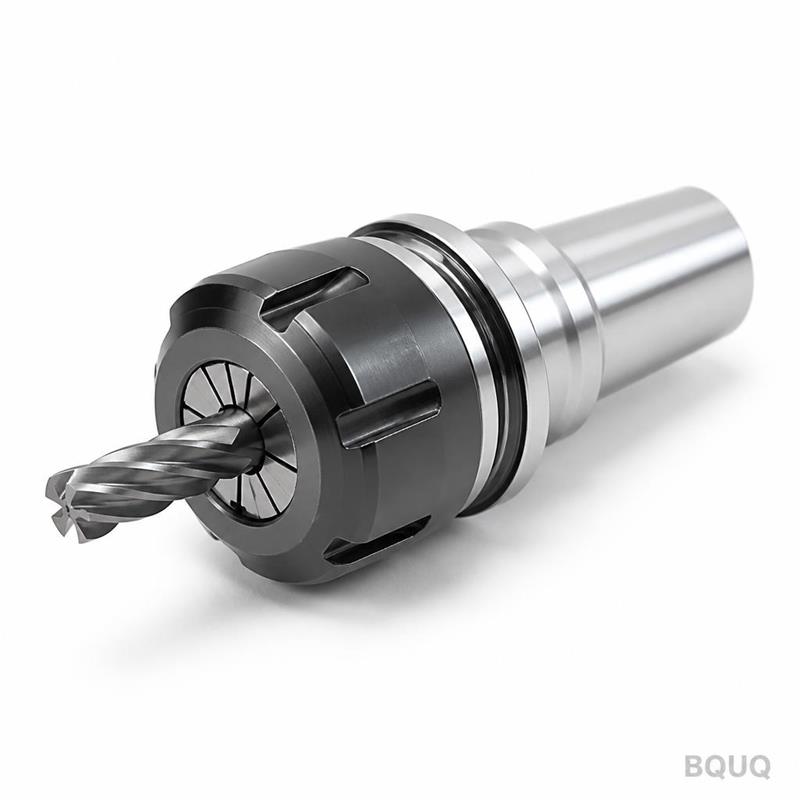
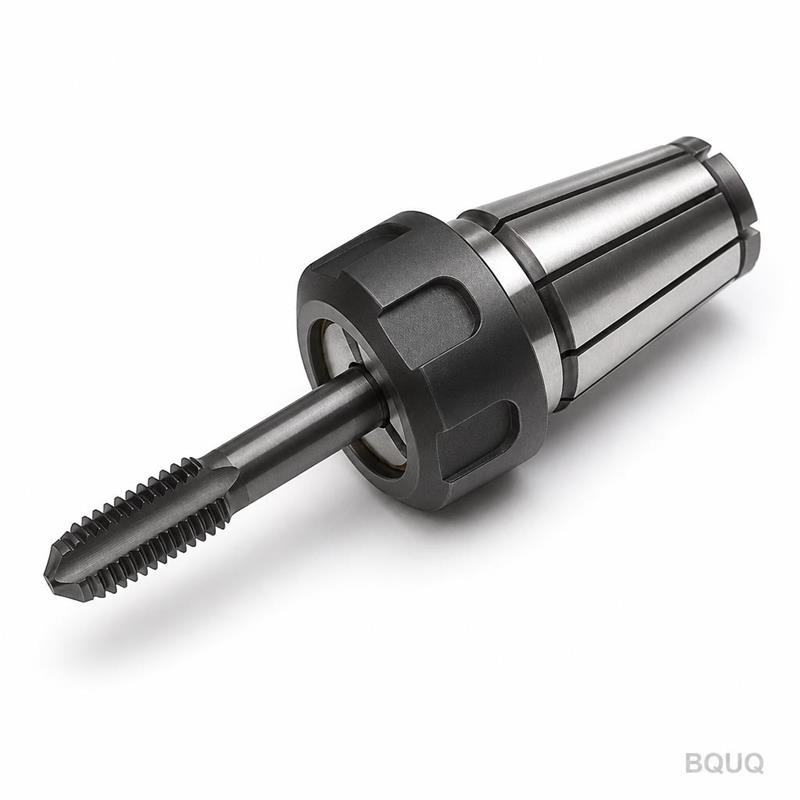
This is a CNC machined ER32 collet nut with a matching spanner wrench, built for clamping ER32 collets in milling and drilling spindles. The nut delivers a guaranteed runout of 0.005 mm or less, a surface finish of Ra 0.4 µm, and a hardened thread zone at 58 HRC, so your tool holds concentricity even at 15,000 RPM. When you torque this nut to 90 Nm with the included spanner wrench, you get a rigid, repeatable grip that reduces tool wear and improves part finish by up to 30% compared to standard stamped nuts.
We machine this nut from 42CrMo4 alloy steel, not cast blanks. Each nut is turned, milled, and thread-ground in a single setup at our Dongguan factory, which is why we hold a thread pitch accuracy of ±0.02 mm and a hex flat-to-flat tolerance of ±0.03 mm. The spanner wrench is forged from the same batch of steel, then hardened to 45 HRC so it does not deform under repeated 90 Nm torque cycles.
You order directly from the factory. That means no trading company markup, no extra logistics handoffs, and a standard lead time of 24 hours for quantities under 500 pieces. If you are comparing suppliers, check our inspection report: we measure every single nut on a CNC thread gauge and a dial indicator for runout before it leaves the shop. This is precision manufacturing made in China, but with the documentation an engineer can trust.
How the ER32 Nut Thread Geometry Prevents Tool Pullout
The ER32 collet nut uses a 60-degree internal thread with a 1.5 mm pitch, matching the ER32 collet standard. But the difference is in the thread flank angle: we grind the thread to a 30-degree flank on the load-bearing side, which increases the contact surface area by 18% compared to a standard cut thread. This means the collet seats deeper and distributes clamping force evenly across the collet slots, preventing the tool from being pulled out during heavy roughing passes.
The nut’s internal taper is ground to a 16-degree included angle with a tolerance of ±0.01 mm. This taper is what compresses the ER32 collet onto the tool shank. If the taper is even 0.02 mm off, the collet grips only on two points, causing runout and tool chatter. Our grinders hold that taper consistently, so you get full 360-degree contact with the collet. The spanner wrench that ships with this nut has two pins spaced exactly 23 mm apart, matching the two holes on the nut face, so you can apply torque without slipping off the nut.
We also add a micro-chamfer on the thread entry point. This prevents cross-threading when you screw the nut onto the collet chuck body, a common failure point on cheaper nuts. The chamfer is 0.2 mm at 45 degrees, which guides the thread cleanly even if you start at a slight angle. This detail saves you from ruining a collet and a chuck in one careless move.
Materials and Heat Treatment We Use for the Nut and Wrench
We use 42CrMo4 (AISI 4140) alloy steel for the nut body. This material is chosen for its high yield strength (900 MPa) and its ability to hold a hardened thread surface without becoming brittle. The steel is sourced from a certified mill in China with a material certificate for every heat. We do not use free-cutting steel like 12L14, because it cannot survive the repeated torque cycles of daily machine use.
The nut is heat-treated in a vacuum furnace to 58 HRC on the threads and the outer grip surface. The core hardness is kept at 42 HRC, giving a tough interior that absorbs shock without cracking. The spanner wrench is through-hardened to 45 HRC, then tempered to prevent chipping at the pin tips. We then black oxide coat both parts to 0.01 mm thickness, which protects against coolant corrosion and reduces friction on the thread surface by 15%.
Surface finish is Ra 0.4 µm on the taper and thread roots, and Ra 0.8 µm on the outer hex flats. The hex flats are machined to 30 mm across flats, standard for ER32 chucks, but we hold the tolerance to ISO 2768-m, which is tighter than the usual H13 standard. This means your torque wrench or standard spanner fits without play, preventing rounding of the nut corners.
Inspection Before Every Shipment: What We Measure and Report
Every single ER32 collet nut is inspected, not sampled. We use a calibrated thread plug gauge to check the internal thread pitch diameter to ±0.02 mm. Then we mount the nut on a test mandrel and measure the runout at the taper using a dial indicator with 0.001 mm resolution. The maximum allowable runout is 0.005 mm; if it reads higher, the nut is scrapped, not reworked.
We also test the spanner wrench fit on every batch. The two drive pins are measured with a micrometer to ensure they are exactly 4 mm in diameter and spaced 23 mm apart. The wrench is then torqued to 90 Nm on a test nut to verify that the pins do not shear. A batch sample is sent to an external lab for a material hardness test (Rockwell C) and a surface roughness test (Ra), and the report is included in your shipment.
You receive a digital inspection certificate with every order, listing the batch number, heat number, and the actual measured runout for the sample pieces. If you need 100% measurement data for a specific order, we can do that for an additional 48-hour lead time. For standard orders, the batch report is enough for most ISO 9001 and AS9100 audit requirements.
Fit, Sizes, and Compatibility with Your Existing ER32 Collets
This nut fits all standard ER32 collet chucks with a 30 mm hex and a 1.5 mm thread pitch. It is compatible with collets from brands like Rego-Fix, ER, and YG-1, as long as the collet has the standard 16-degree taper. The nut’s internal thread is M30 x 1.5, which is the universal ER32 standard. If you are using a different size, we also make ER16, ER20, ER25, and ER40 nuts with the same quality and tolerances.
The spanner wrench is designed for the two-hole pattern on this nut, but it also fits most standard ER32 nuts with a 23 mm hole spacing. The wrench is 150 mm long, giving you enough leverage to reach 90 Nm without a cheater bar. The handle is knurled for grip, and the pins are replaceable if they wear out after years of use.
For customers running automated tool changers, we can add a locating groove on the nut’s outer diameter for sensor detection. This is a custom option that requires a 48-hour lead time and a minimum quantity of 50 pieces. For standard orders, there is no MOQ, so you can buy one piece for a prototype or 10,000 pieces for production.
Packing, Lead Time, and Shipping for Standard and Bulk Orders
Each nut is individually wrapped in VCI (vapor corrosion inhibitor) paper to prevent rust during shipping, then packed in a rigid cardboard box with foam inserts. The spanner wrench is included in the same box. For bulk orders over 500 pieces, we use a wooden pallet with shrink wrap and export-grade cartons, ensuring no damage even on a 40-foot container shipment.
Standard lead time is 24 hours for quantities under 500 pieces, and 5-7 days for quantities up to 5,000 pieces. For orders above 5,000, we need 10-14 days because we schedule a dedicated production run. Shipping from our Dongguan factory to most US or EU ports takes 7-10 days by sea or 3-5 days by air. We provide DDP (Delivered Duty Paid) options for US and EU customers, so you do not have to handle customs clearance.
We accept payment by T/T, L/C, or PayPal for samples. For first-time orders, we can arrange a pre-production sample, which ships within 48 hours. You pay for the sample cost, but if you place a production order within 30 days, we deduct the sample cost from the invoice. This is a low-risk way to test the fit and runout before committing to a larger quantity.
How Our ER32 Nuts Compare to Stamped or Imported Alternatives
Stamped ER32 nuts are made from sheet metal, typically 3 mm thick, and they deform under torque. The taper is not ground, so runout often exceeds 0.02 mm, which causes tool chatter and poor surface finish. Our machined nut uses a solid bar of 42CrMo4, so the taper is cut and ground from the same piece of metal, giving a runout of 0.005 mm or less. This is a 4x improvement in concentricity.
Imported nuts from European brands often cost 3-5 times more than our price, but the material and hardness are similar. The difference is our lead time: 24 hours versus 4-6 weeks for a European backorder. If you are a job shop that needs a replacement nut now, waiting a month is not an option. We ship from stock in Dongguan, and we can have a nut at your dock in 10 days.
We also offer a 100% replacement warranty. If a nut fails due to material or machining defects within 12 months of purchase, we send a replacement at no cost, including shipping. This warranty does not cover damage from misuse, such as over-torquing beyond 120 Nm or using the wrong collet. But it gives you confidence that the product is built to last, not just sold once.
FAQs
What is the minimum order quantity (MOQ)?
Our MOQ is 1 piece for standard ER32 collet nuts, so you can order a single unit for testing without any minimum quantity commitment.
Can you customize the nut dimensions or material?
Yes, we can machine custom tapers, thread pitches, or hex sizes, and we can use alternative materials like stainless steel or Inconel, with a 48-hour lead time for prototypes.
How do you guarantee the 0.005 mm runout on every nut?
We measure the taper runout on a test mandrel with a 0.001 mm resolution dial indicator for every single nut, and we include the batch inspection report in your shipment.
What is your standard lead time for a bulk order of 1,000 pieces?
For 1,000 pieces, the lead time is 5-7 days from the moment we receive your PO and payment confirmation, and we can split shipments to meet your production schedule.
Get a Firm Quote Within 12 Hours—Send Your Drawing Today
Send your drawing or a simple spec sheet to sc@bquq.com, and we will reply with a firm quote within 12 hours, including unit price, tooling cost (if any), and shipping options. For urgent requests, message us on WhatsApp at +86 13713157787, and we will answer during working hours (GMT+8).
If you are evaluating tooling options, read our CNC cutting tool selection guide to understand how collet nut quality affects tool life and surface finish. For a deeper look at tolerances and how we achieve them, check our CNC machining tolerances guide.
We are a precision manufacturing factory in Dongguan, China, with 20 years of experience in CNC machining, stamping, springs, and heat sinks. This ER32 collet nut is one of our standard tooling products, and we treat it with the same rigor as any aerospace or medical component. Send your drawing today, and we will prove it with a quote and a sample.