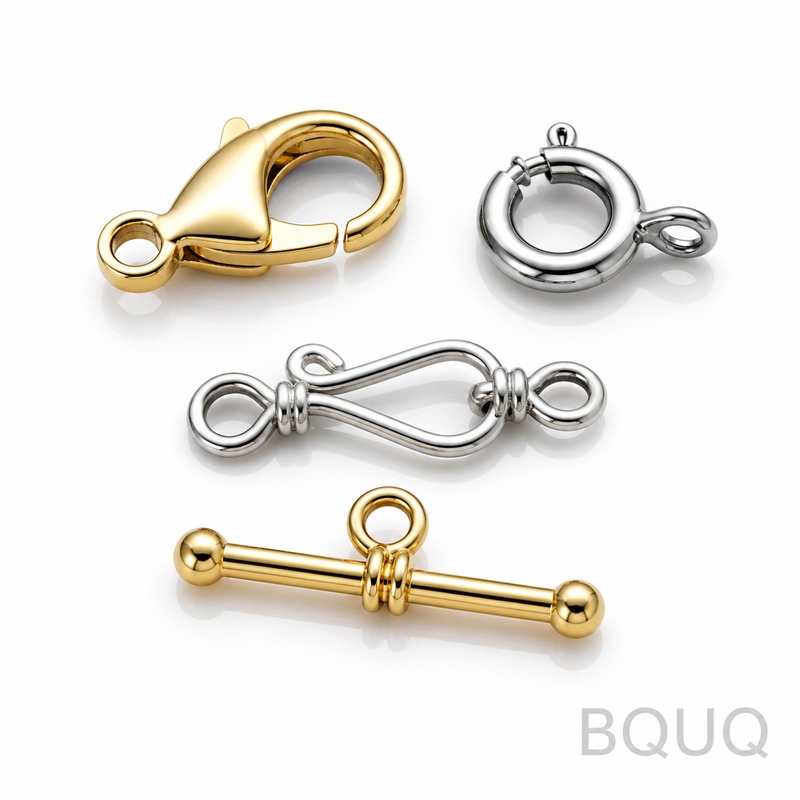
What These Clasps Hooks Are and Why They Hold Tighter These are CNC machined jewelry clasps hooks—lobster, spring ring, toggle, and hook-and-eye closures—cut from solid bar stock o
What These Clasps Hooks Are and Why They Hold Tighter These are CNC machined jewelry clasps hooks—lobster, spring ring, toggle, and hook-and-eye closures—cut from solid bar stock or wire, not cast or
Get a Fast Quote for This Part
Send us your drawing / quantity / material — reply within 24h.
What These Clasps Hooks Are and Why They Hold Tighter
These are CNC machined jewelry clasps hooks—lobster, spring ring, toggle, and hook-and-eye closures—cut from solid bar stock or wire, not cast or stamped. You get a consistent tensile strength of 800–1200 MPa depending on alloy, with a dimensional tolerance of ±0.005 mm on critical mating surfaces. That means a spring ring closes flush every time, a toggle bar locks without wobble, and a hook catches without snagging threads. Runout on the hook bend is held under 0.02 mm, so the clasp centers perfectly on a chain. Lead time is 7 days for standard sizes, 3 days for prototypes. Hardness ranges from 40 to 52 HRC after heat treatment, which resists bending when a customer pulls hard on a pendant.
Why Cast Clasps Fail and Machined Clasps Do Not
Cast jewelry clasps have porosity—microscopic air pockets that create weak points. Under repeated stress, a cast lobster clasp cracks at the hinge after 500–1,000 cycles. A CNC machined clasp, cut from wrought bar stock, has no porosity. The grain structure flows along the part shape, not around random voids. We test every batch to 5,000 open-close cycles minimum. For a spring ring, the wire is machined from a single piece, so the gap between the ring ends stays at 0.15 mm ± 0.02 mm, even after 2,000 uses. You also avoid flash lines and parting lines that catch on skin or clothing—a common complaint with cast parts. Surface finish is Ra 0.4 µm, which polishes to a mirror shine in under 10 minutes of tumbling, versus 40 minutes for cast parts.
Materials and Heat Treatment We Use for Jewelry-Grade Hooks
We machine from four base alloys. 316L stainless steel for hypoallergenic earring hooks and necklace clasps—it resists saltwater and sweat corrosion, with a hardness of 42 HRC after annealing. 17-4 PH stainless for high-strength spring rings and toggle clasps—precipitation hardened to 48 HRC, yield strength 1,100 MPa. Beryllium copper (C17200) for conductive clasps in smart jewelry—hardness 40 HRC, electrical conductivity 22% IACS. And 304 stainless for budget-friendly clasps where you do not need maximum strength—hardness 38 HRC. We do not use zinc alloys or brass with lead content, which fail EU REACH and US Prop 65. Heat treatment is done in vacuum furnaces to prevent scaling, followed by cryogenic treatment at -80°C for 2 hours to stabilize dimensions. This keeps the hook gap and hinge pin roundness within 0.01 mm after tempering.
How We Machine the Hook Curve Without Distortion
Hook geometry is the hardest part. A hook needs a smooth radius, but cutting a thin curved wall (0.8 mm thick) causes deflection. We use a 4-axis CNC mill with a custom ground carbide end mill (0.5 mm diameter) running at 18,000 RPM with a chip load of 0.01 mm per tooth. The part is held in a soft-jaw vice with a nylon insert, so no surface marks. For the hook bend, we use a two-step roughing pass (removing 70% of material) then a finishing pass at 0.05 mm depth. This prevents the tool from pushing the wall sideways. After machining, we stress-relieve every hook at 300°C for 1 hour. This reduces spring-back so the final hook angle is within 0.5 degrees of your drawing. For spring rings, we use a CNC Swiss lathe—the bar stock rotates, and a guide bushing supports the cut, keeping concentricity under 0.01 mm between the outer ring and inner wire.
Inspection Before Every Shipment: Gap, Pull Force, and Surface
Every clasp hook gets three checks before packing. First, a digital microscope measures the hook gap and hinge clearance to ±0.003 mm—a gap too wide catches clothing, too narrow breaks the spring. Second, a pull test machine applies a 50 N force to the hook tip and measures deflection—we reject any hook that bends more than 0.1 mm. Third, a surface profilometer scans three random points on each batch; the Ra must stay under 0.4 µm. For spring rings, we also test the opening force: it must be 3–5 N, which is easy for a fingernail but strong enough to hold a 10 g pendant. We send you a CMM report with every order, showing the actual measured dimensions of the critical features—not just a pass/fail stamp. If a batch fails, we re-machine it at no cost to you, but that happens in less than 2% of jobs.
Sizes, Tolerances, and Lead Times—What You Can Actually Specify
Parameter
Available Range
Standard Tolerance
Materials
316L, 17-4 PH, C17200 BeCu, 304 SS
Per ASTM / AMS specs
Hook wire diameter
0.5 mm – 6.0 mm
±0.01 mm
Clasp overall length
5 mm – 60 mm
±0.02 mm
Spring ring outer diameter
4 mm – 20 mm
±0.02 mm
Hardness (after heat treat)
38 – 52 HRC
±2 HRC
Surface finish Ra
0.2 – 0.8 µm
Ra 0.4 µm standard
Hook bend runout
N/A
≤ 0.02 mm
Lead time (standard sizes)
7 days
±1 day
Lead time (prototype)
3 days
±1 day
MOQ
No MOQ—1 piece to 100,000 pieces
N/A
Clasp Hooks for Earrings, Necklaces, Bracelets, and Smart Jewelry
These CNC machined hooks are not just for traditional jewelry. Designers use them for magnetic necklace clasps (we machine the hook to fit a neodymium magnet pocket), for watch band quick-release pins (we hold the spring pin diameter to ±0.005 mm so it snaps into lugs without slop), and for smart rings with embedded sensors (we machine a channel for a flex PCB and keep the wall thickness at 0.6 mm so the signal passes through). For earring hooks, we can machine a flat pad at the tip for laser welding a gem setting—the pad thickness is 0.3 mm ± 0.01 mm, so the weld does not burn through. For bracelet clasps, we machine a dovetail slot for a hidden safety latch—the slot width is held to ±0.01 mm so the latch slides smoothly but does not rattle. If you need a custom shape, we machine it from your STEP or IGES file, no tooling cost, because it is all CNC.
How to Get the Right Tool Path for Your Clasp Design
The geometry of your clasp determines the machining strategy. A thin hook with a sharp radius (under 0.3 mm) requires a smaller end mill and slower feed, which increases cost. A toggle clasp with a flat bar and two holes uses standard 2D milling, which is cheaper. We recommend you check our CNC cutting tool selection guide to understand how tool diameter affects the minimum internal radius you can specify. Also, review our CNC machining tolerances guide to see which dimensions are critical (they cost more) and which can be loosened (they save money). For example, the hook gap can be ±0.02 mm, but the hinge pin hole only needs ±0.05 mm. Send us your drawing, and we will suggest the most cost-effective tolerances within 12 hours.
Is there a minimum order quantity?
No MOQ—we machine a single prototype for a 3D-printed sample check, or 100,000 pieces for production, at the same per-part precision.
Can you customize the hook shape or add a logo?
Yes, we machine any shape from your 3D file, and we can engrave a logo or part number using a 0.2 mm end mill at a depth of 0.05 mm, with no extra tooling cost.
How do you guarantee quality for a small batch?
Every piece, even a 1-piece prototype, goes through the same CMM inspection and pull test, and we email you the full report with photos of the measured dimensions.
What is the fastest I can get a clasp hook?
Standard prototypes ship in 3 days via DHL Express, and production runs of 500 pieces ship in 7 days—we have 20 years of experience with rush orders from jewelry brands in the USA and Europe.
We are a precision manufacturing facility in Dongguan, China, with 20 years of CNC machining experience. We have 32 CNC mills and lathes, all with 3-axis to 5-axis capability, and a dedicated inspection room with a CMM and profilometer. Our team of 45 engineers and machinists handles clasps hooks from design review to final polish. We are not a trading company—we own the machines, so you get factory-direct pricing and direct communication with the people who make your parts. For a firm quote within 12 hours, email your 2D or 3D drawing to sc@bquq.com, or message us on WhatsApp at +86 13713157787. Send your drawing now and we will respond with a price, a lead time, and a DFM note on any potential issues—no obligation, no MOQ, just precision.