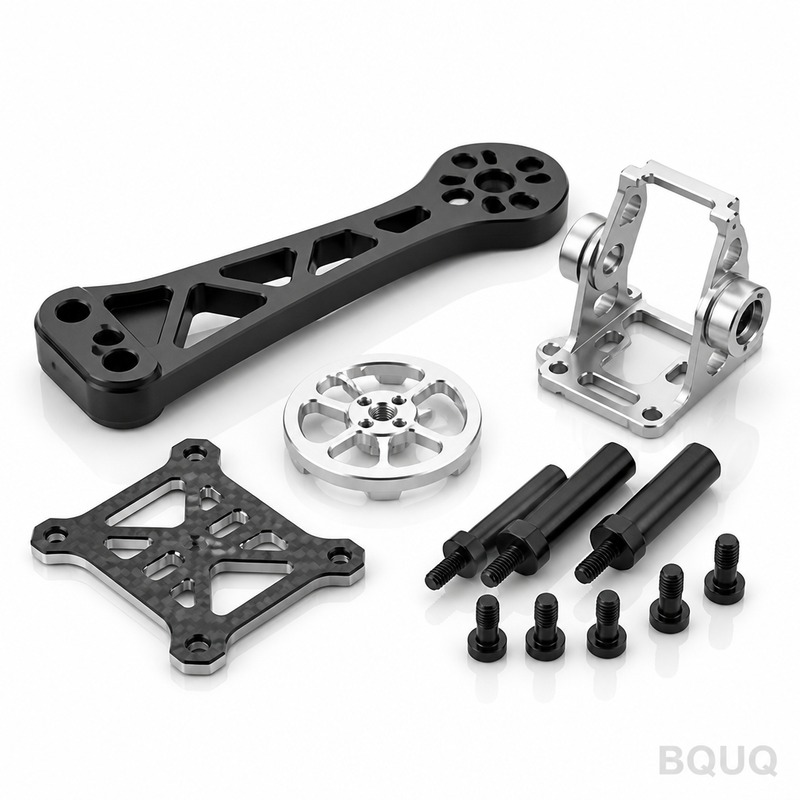
What These Oil Pump Parts Actually Do and How Tight We Hold Them These CNC machined oil pump parts are the precise metal components—gears, rotors, housings, shafts, and pressure p
CNC Machined Oil Pump Parts | BQUQ Precision Manufacturing China
What These Oil Pump Parts Actually Do and How Tight We Hold Them These CNC machined oil pump parts are the precise metal components—gears, rotors, housings, shafts, and pressure plates—that maintain
Get a Fast Quote for This Part
Send us your drawing / quantity / material — reply within 24h.
What These Oil Pump Parts Actually Do and How Tight We Hold Them
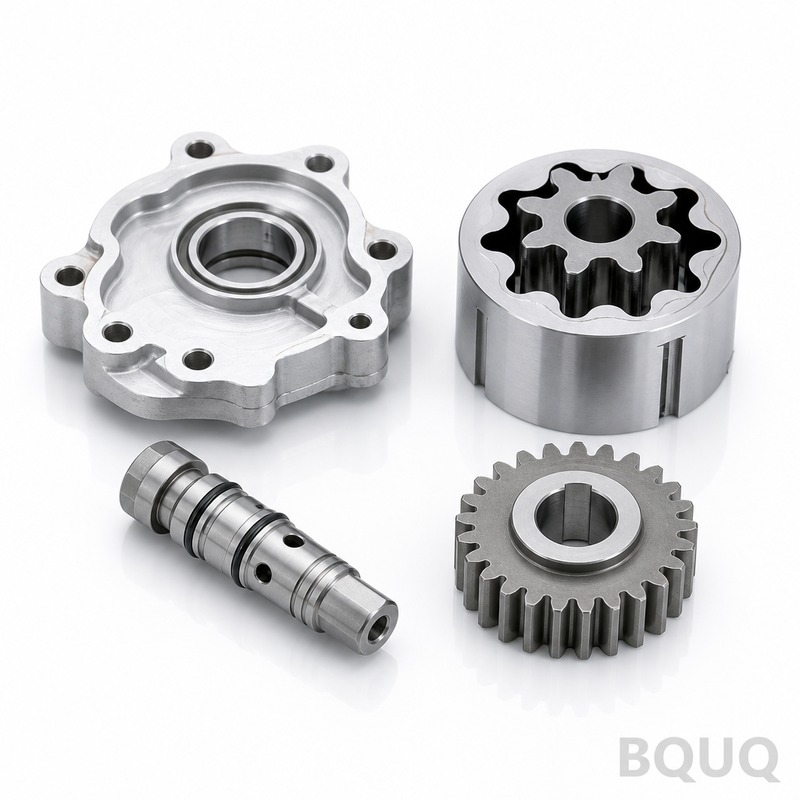
These CNC machined oil pump parts are the precise metal components—gears, rotors, housings, shafts, and pressure plates—that maintain hydraulic pressure and flow in automotive, industrial, and marine pumps. We hold tolerances to ±0.005 mm (half a human hair), runout under 0.01 mm, and surface finish down to Ra 0.4 µm—so your pump runs quieter, leaks less, and lasts longer. Typical lead time is 7 days for prototypes, 15 days for production runs, and we can harden parts up to 58 HRC for wear resistance.
We are a 20-year precision manufacturing factory in Dongguan, China, specializing in CNC machining, stamping, springs, and heat sinks. This page focuses on one thing: oil pump parts that meet your drawing exactly—no excuses, no surprises.
Why Gerotor and Crescent Pumps Fail Without Tight Lobe Clearance
Oil pump efficiency depends on clearances between the inner and outer rotors (gerotor) or between the crescent and gears. If the gap is too large, oil slips back and pressure drops. If too small, parts seize. Our CNC machining centers hold lobe profiles to ±0.005 mm, and we use CMM (coordinate measuring machine) inspection on every critical dimension. This means volumetric efficiency stays above 92% in most designs, and you avoid field failures from cavitation or pressure loss.
Our 5-axis CNC mills and Swiss-type lathes can machine complex rotor geometries in one setup, eliminating stacking errors. We also deburr and micro-polish all oil passages to prevent debris from clogging your system—a common cause of premature bearing wear.
Materials and Heat Treatment We Use for Long Pump Life
We machine oil pump parts from 1144 stress-proof steel, 8620 carburized steel, 440C stainless, aluminum 6061-T6, and bronze (C93200). For high-pressure diesel pumps, we recommend 8620 with case hardening to 58-62 HRC, giving you a hard wear surface with a tough core. For aluminum housings, we use 6061-T6 with hard anodizing (50-55 HRC equivalent) to resist abrasive wear from contaminated oil.
Heat treatment is done in-house or with our partner furnace—we control carburizing depth to 0.5-1.0 mm, and we never send out parts without hardness testing. Each batch gets a Rockwell hardness test report. If you need through-hardening, we do that too, up to 60 HRC on thin sections.
Balancing and Runout Control for High-Speed Shafts
Pump shafts rotating at 3,000-6,000 RPM cannot tolerate runout above 0.01 mm or they will vibrate, wear seals, and produce noise. We machine shafts between centers, then grind the bearing journals to a final tolerance of ±0.003 mm with a surface finish of Ra 0.2 µm. Dynamic balancing is available to ISO 1940 G2.5 grade, which is standard for automotive oil pumps. We also inspect runout on a V-block setup with a 0.0001 mm indicator—every single shaft, not a sample.
If your design includes a keyway or spline, we broach or wire-cut those features to hold symmetry within 0.01 mm. This prevents uneven load distribution on the pump gears, which is the #1 cause of premature tooth wear.
Inspection Before Every Shipment—CMM and Air Gauging
Every CNC machined oil pump part we ship goes through a three-stage inspection: in-process (operator checks every hour), final inspection (CMM on critical features), and documentation (full dimensional report included with each box). We use a Zeiss CMM for complex geometries like rotor profiles and bore positions. For tight bore diameters (like the 12.00 mm +0.01/-0.00 housing bore), we use air gauging, which is accurate to 0.002 mm and gives us 100% coverage on high-volume parts.
We also check surface roughness with a profilometer (Ra, Rz, Rt) on sealing faces. If you require material certification (EN 10204 3.1), we provide it from the mill. No extra charge—it's part of our standard traceability.
Typical Specifications for CNC Machined Oil Pump Parts
Specification
Range / Value
Materials
1144, 8620, 440C, 6061-T6, C93200 bronze
Part sizes
5 mm – 300 mm diameter; up to 400 mm length
Tolerance (machining)
±0.005 mm standard; ±0.002 mm on ground bores
Runout (shafts/rotors)
≤ 0.01 mm TIR
Hardness (case hardened)
58-62 HRC (8620), 50-55 HRC (hard anodized Al)
Surface finish
Ra 0.4 µm standard; Ra 0.2 µm on sealing faces
Balancing grade
ISO 1940 G2.5 (optional)
Lead time (prototype)
7 days
Lead time (production)
15-20 days for 1,000 pcs
MOQ
No MOQ (1 piece accepted for testing)
Inspection equipment
Zeiss CMM, air gauging, profilometer, Rockwell tester
How We Handle Prototypes vs. Production Runs Without Minimums
We accept orders for 1 piece to 100,000 pieces. For prototypes, we use the same CNC programs and tooling as production, so what you test is exactly what you get in volume. No MOQ means you can validate your design without committing to large inventory. For production, we use dedicated fixtures and carbide tooling to keep cycle times low—for example, a typical gerotor set (inner + outer rotor) cycles in 4 minutes, giving you a unit cost that beats local machining by 30-50% while maintaining precision.
We also offer engineering feedback on your design before we quote. If we see a way to reduce cost (e.g., changing a tolerance from ±0.005 to ±0.01 on a non-critical face), we tell you upfront. This is part of our DFM (design for manufacturability) service—free with every quote.
Why Precision Manufacturing in China Works for You (Made in China, No MOQ)
You might be skeptical about offshore quality. Here are the facts: our factory is ISO 9001:2015 certified, we have 45 CNC machines (3-axis, 4-axis, 5-axis), and we export 90% of our output to the US, EU, and Japan. Our defect rate is under 0.3% for the last 12 months. And because we are in Dongguan, we have access to the world's largest supply chain for raw materials and tooling, which keeps our prices competitive. You get the same precision as a German or Japanese shop at 40% lower cost.
Shipping is fast too—DHL express delivers to the US in 4-5 days, and we handle all export paperwork. We communicate in English directly with your engineers, and we respond to emails within 4 business hours (China time).
To ensure you choose the right tooling for your part, read our CNC cutting tool selection guide. To understand how we set tolerances and what you can expect, check our CNC machining tolerances guide. Both are written for engineers, not salespeople.
FAQs
What is your MOQ for CNC machined oil pump parts?
Our MOQ is zero—we accept a single prototype piece for testing, and we offer quantity discounts for batches over 500 pieces.
Can you machine parts from my specific material or heat treatment spec?
Yes, we can machine any commercial alloy (steel, stainless, aluminum, bronze, titanium) and we handle heat treatment, plating, and anodizing in-house or with certified partners.
How do you guarantee quality for critical dimensions like bore tolerance?
We use a Zeiss CMM for full 3D inspection, air gauging for bore diameters, and we include a dimensional report with every shipment—no extra charge.
What is your typical lead time for production orders?
Prototypes ship in 7 days, and production orders of 1,000 pieces ship in 15-20 days; we can expedite to 10 days for an additional 10% fee.
Get a Firm Quote Within 12 Hours—Send Your Drawing Today
Send us your 2D drawing or 3D STEP file, and we will return a firm quote with unit price, tooling cost (if any), lead time, and a DFM note within 12 hours. We will not ask for a deposit until you approve the sample. For urgent requests, call or WhatsApp us directly.
Email: sc@bquq.com | WhatsApp: +86 13713157787
Your drawing stays confidential—we sign NDAs on request. Let's build your oil pump parts with precision you can measure.