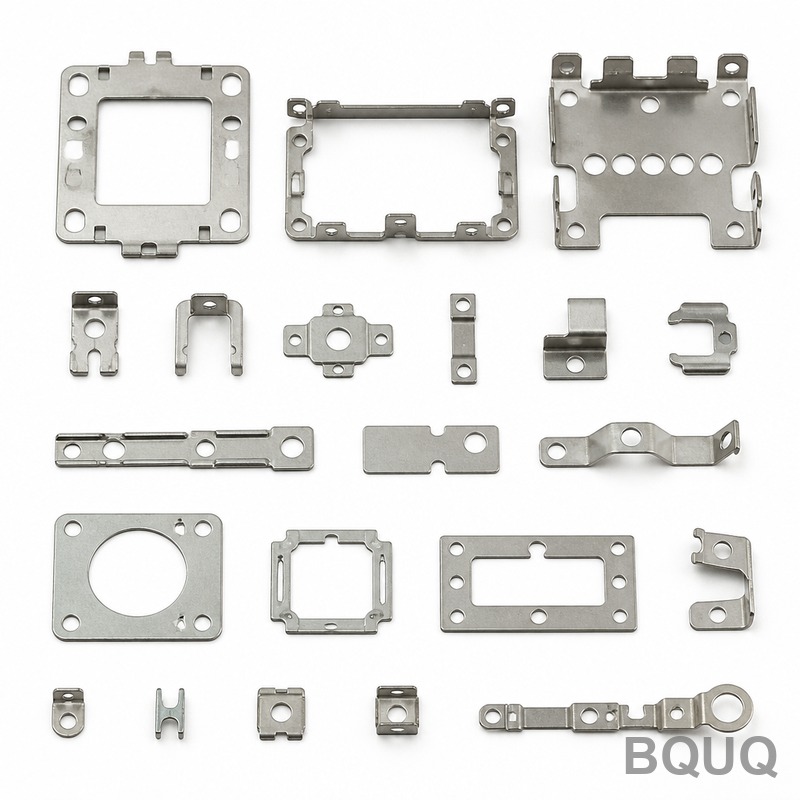
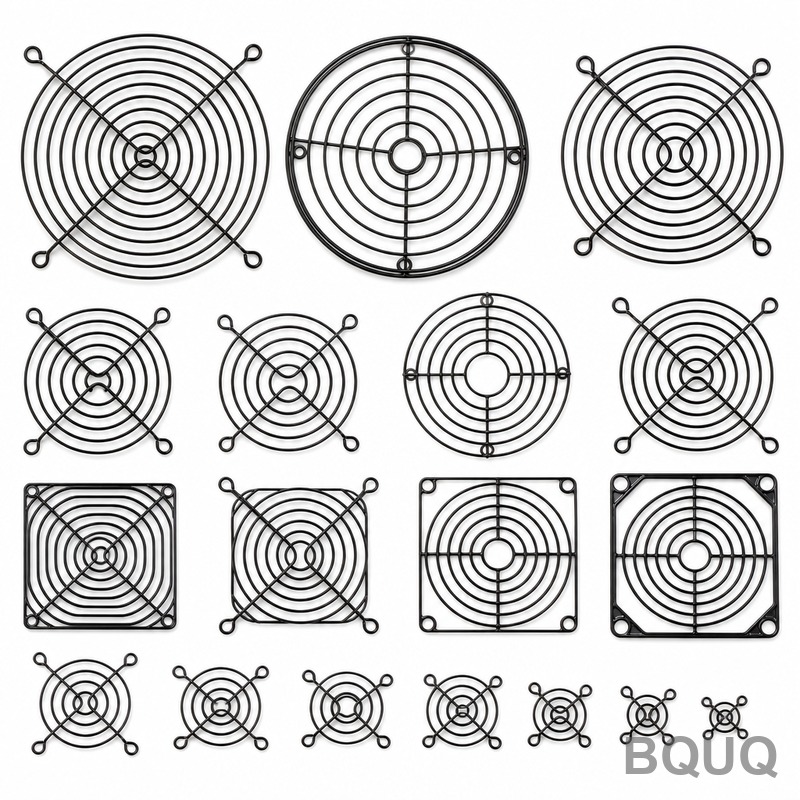
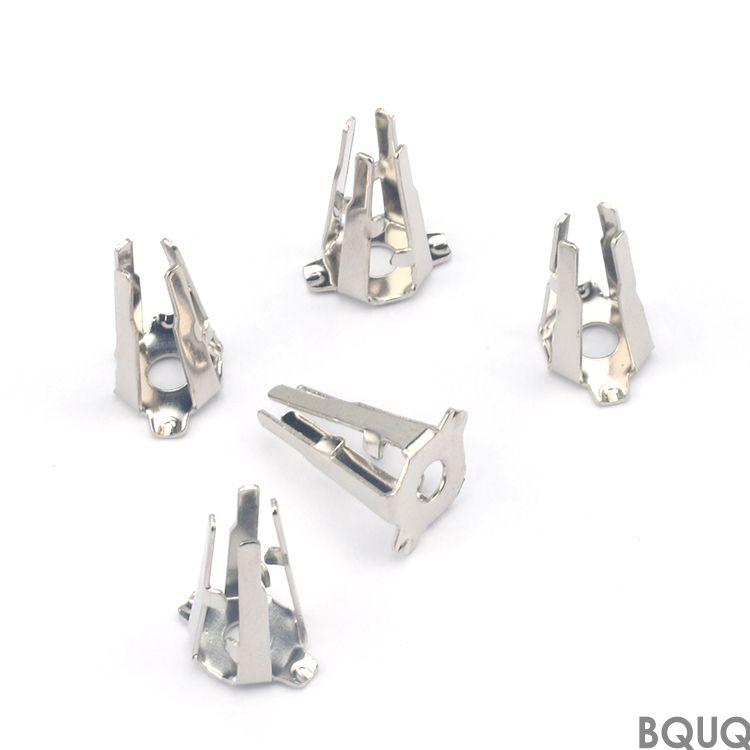
What This Collection Delivers for Your Fluid or Air System This is a direct catalog of stamped micro filter screens, not a vague capability statement. We produce flat, conical, and
What This Collection Delivers for Your Fluid or Air System This is a direct catalog of stamped micro filter screens, not a vague capability statement. We produce flat, conical, and stepped screens wit
Get a Fast Quote for This Part
Send us your drawing / quantity / material — reply within 24h.
What This Collection Delivers for Your Fluid or Air System
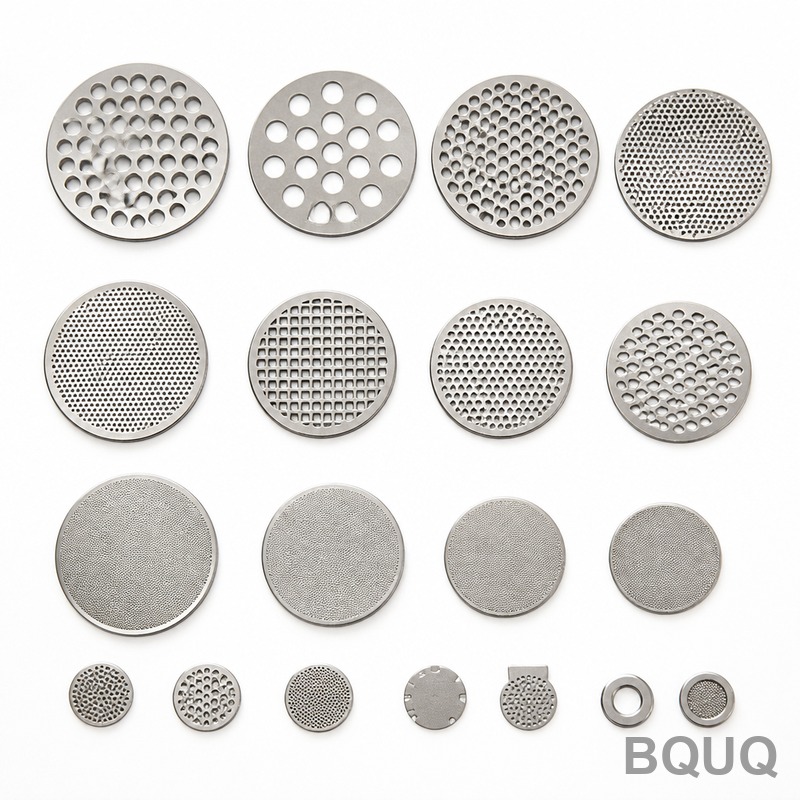
This is a direct catalog of stamped micro filter screens, not a vague capability statement. We produce flat, conical, and stepped screens with hole diameters from 0.05 mm to 2.0 mm, held to a positional tolerance of ±0.005 mm. The concrete benefit is simple: you get a filter element that stops particles at a precise micron rating without restricting flow, and you get it in 48 hours for standard sizes. Because we stamp instead of etch or laser cut, the burr height stays under 0.01 mm, which means no loose metal flakes breaking off into your valve or nozzle.
Every screen we ship comes from a 20-year-old stamping plant in Dongguan, China. We run 25-ton to 160-ton high-speed presses at 400 strokes per minute. The tool steel we use for dies is heat-treated to 58-62 HRC, giving you repeatable edge quality across millions of parts. If you are designing a fuel injector, a pneumatic muffler, or a medical vent, these screens hold their shape and their pore size under pressure and vibration.
Hole Geometry and Burr Control: The Difference Between a Filter and a Choke
Stamped micro screens fail when the punch pushes material out instead of shearing it clean. We solve this with a custom-built die clearance of 4% to 6% of material thickness. That number is critical. Too much clearance creates a large rollover burr; too little cracks the punch. Our process holds the shear zone to within 0.008 mm, so the hole edge is sharp and square.
We produce round holes, square holes, and hexagonal holes. For round holes, the diameter tolerance is ±0.005 mm. For square holes, the side length tolerance is ±0.008 mm. The open area ratio can be tuned from 15% to 45% depending on your flow requirement. If you need a stepped screen for a press-fit assembly, we add a coining step to control the thickness transition within ±0.01 mm. The micro burr on the exit side is removed by a two-stage tumbling process, and we verify burr height with a laser profilometer on every production run.
Materials and Heat Treatment We Use for Corrosion and Fatigue
We stock seven materials for this collection. Stainless steel 304 and 316L are the default for most fluid applications. For higher temperature or higher strength, we use 17-7PH stainless steel, which we precipitation harden to 45 HRC. For electrical conductivity or specific thermal properties, we offer beryllium copper C17200, hardened to 38-42 HRC. Nickel alloy 200 is available for caustic environments.
All stainless steel screens are passivated after stamping. This removes free iron and restores the chromium oxide layer, which prevents pitting. If your application involves salt spray, we add a 500-hour neutral salt spray test to the QC protocol. We do not use any lubricants that leave residue—we use a volatile synthetic oil that evaporates completely in a vacuum oven, leaving the surface clean to a Ra of 0.4 micrometers on the flat areas. The stamped edges themselves have a micro-roughness of Ra 1.2 micrometers, which is fine for sealing surfaces but may need a secondary lapping if you require a wiper seal.
How We Maintain Flatness and Runout on Thin Gauge Parts
Thin metal (0.03 mm to 0.3 mm) distorts easily after stamping. We control this with a two-stage straightening process. First, the coil is leveler-fed into the press to remove coil set. Second, after stamping, the parts go through a roller leveler set to a specific gap that produces a flatness of 0.02 mm over a 25 mm length. For screens that will be stacked or welded, this flatness prevents misalignment.
Runout on the outer diameter (OD) relative to the hole pattern is held to 0.015 mm total indicated reading (TIR). We achieve this by using a pilot pin in the die that registers off a previously pierced pilot hole. This is not an afterthought—the pilot hole is pierced in the first station and used to locate every subsequent station. If your drawing specifies a Datum A and Datum B, we will hold that relationship. For parts larger than 50 mm in diameter, we can hold TIR to 0.02 mm, but we recommend designing for the tighter 0.015 mm if possible.
Inspection Before Every Shipment: Data You Can Rely On
We do not ship a single lot without a full dimensional report. Our in-house lab has a Zeiss CMM (coordinate measuring machine) with a resolution of 0.0005 mm, and a Keyence optical comparator for hole geometry. Every lot of 5,000 parts or fewer gets a 100% optical inspection for missing holes or torn bridges. For larger lots, we use an AQL (acceptance quality limit) of 0.65 based on ISO 2859-1.
We also check material hardness on a Vickers scale for every heat-treat batch. You get a certificate of conformance that lists the material lot number, the die number, the press speed, and the actual measured dimensions from 5 random samples. If you need a PPAP Level 3 submission, we can provide that within 5 working days after the first article inspection.
Production Speed, Tooling, and Cost Per Part
Stamping is the fastest way to make micro filter screens if you have volume. Our high-speed presses run at 400 to 600 parts per minute for simple flat screens. For complex shapes with 4 or more form steps, the speed drops to 150 parts per minute. Tooling cost for a new progressive die ranges from $1,800 to $6,500 depending on the number of stations and the material thickness.
Once the die is built, the piece price is extremely low. For example, a 10 mm diameter flat screen in 0.1 mm thick 304 stainless steel, with 200 holes of 0.1 mm diameter, costs $0.04 per part at 100,000 pieces. At 10,000 pieces, the same part costs $0.12 each. Because we hold tooling in-house, we can also offer a "die maintenance" program where we re-sharpen the punches every 500,000 strokes, extending the die life to 5 million parts or more. This keeps your ongoing cost predictable.
Design Rules for Your Micro Screen: What We Can and Cannot Do
To get the best part from us, follow these rules. Minimum hole diameter is 0.05 mm, but we recommend 0.08 mm for reliable stamping. The hole diameter must be at least 1.2 times the material thickness. If the material is 0.1 mm thick, the smallest hole is 0.12 mm. The distance between hole edges (the bridge) must be at least 0.08 mm. If you need a finer mesh than 0.05 mm, we can produce it, but it will require a chemical etching process instead of stamping—that is a different product line.
We can add a rolled rim or a curled edge for strength. A rolled rim on a 0.1 mm thick screen increases the stiffness by 3x. We can also insert a support mesh (a coarse grid) and weld it to the fine mesh using projection welding. This is common for high-pressure differential applications. If you are unsure about your design, send us your drawing and we will flag any feature that will break the die or cause burrs.
Packaging and Logistics: From Dongguan to Your Line
We know that scratched screens are a rejection reason. We pack each screen in a separated cell inside a rigid plastic tray, then vacuum-seal the tray in an anti-static bag. For high-volume orders, we use continuous reel-to-reel packaging if you have an automated assembly line. This reduces your manual handling and we can supply the parts on a plastic carrier tape that meets EIA-481 standards.
Shipping from our Dongguan factory to the US West Coast takes 3-4 days by air (DHL or FedEx) and 12-15 days by sea. For urgent prototypes, we offer a 24-hour express service for parts under 200 grams. We handle all export documentation, including the commercial invoice and the certificate of origin. There is no brokerage fee for our standard DDP (Delivered Duty Paid) service to the USA and EU.
What is the minimum order quantity (MOQ)?
There is no MOQ for this collection—we accept prototype orders of 1 piece, but the tooling cost is fixed, so a single prototype is about $500 while a 10,000-piece order drops the unit price significantly.
Can you customize the hole pattern or the outer shape?
Yes, we can make any 2D shape you define in a DXF or STEP file, including non-circular holes, tapered holes, and irregular outer profiles, as long as the minimum feature size rules are followed.
How do you guarantee the quality of a stamped micro screen?
We use a Zeiss CMM and a Keyence optical comparator on every lot, plus an AQL of 0.65 for visual defects, and we send you a dimensional report with the shipment.
What is your typical lead time for a custom screen?
Standard sizes ship in 48 hours, custom die fabrication takes 7-10 working days, and the first article inspection report is sent to you within 24 hours after the die is ready.
Get a Firm Quote Within 12 Hours
Send us your drawing in DXF, STEP, or PDF format. We will reply with a firm unit price, tooling cost (if any), and a delivery date within 12 hours, Monday to Saturday. Do not wait for a vague estimate—we give you a locked number based on your actual geometry and material.
For more background on how to choose the right cutting tools for your overall assembly, read our CNC cutting tool selection guide. And if you are setting tolerances on the mating parts, check the CNC machining tolerances guide to avoid over-specifying.
Email your drawing to sc@bquq.com or reach us on WhatsApp at +86 13713157787. This is precision manufacturing made in China, with no MOQ, and we are ready to quote you today.
| Parameter | Specification / Range | |-----------|-----------------------| | Product Type | Precision Stamped Micro Filter Screens Collection | | Material Options | 304 SS, 316L SS, 17-7PH SS, C17200 BeCu, Nickel 200 | | Material Thickness | 0.03 mm to 0.30 mm | | Hole Diameter (Round) | 0.05 mm to 2.0 mm (±0.005 mm) | | Hole Position Tolerance | ±0.005 mm (true position) | | Burr Height | ≤ 0.01 mm (standard), ≤ 0.005 mm (deburred) | | Flatness (25 mm length) | 0.02 mm max | | Outer Diameter Runout (TIR) | 0.015 mm max | | Surface Finish (Flat Area) | Ra 0.4 µm (standard) | | Hardness (17-7PH) | 45 HRC (precipitation hardened) | | Open Area Ratio | 15% to 45% | | Standard Lead Time | 48 hours (stock sizes), 7-10 days (custom die) | | MOQ | No MOQ (1 piece prototype accepted) | | Inspection | Zeiss CMM + Keyence optical, AQL 0.65 | | Packaging | Anti-static tray or EIA-481 tape & reel |