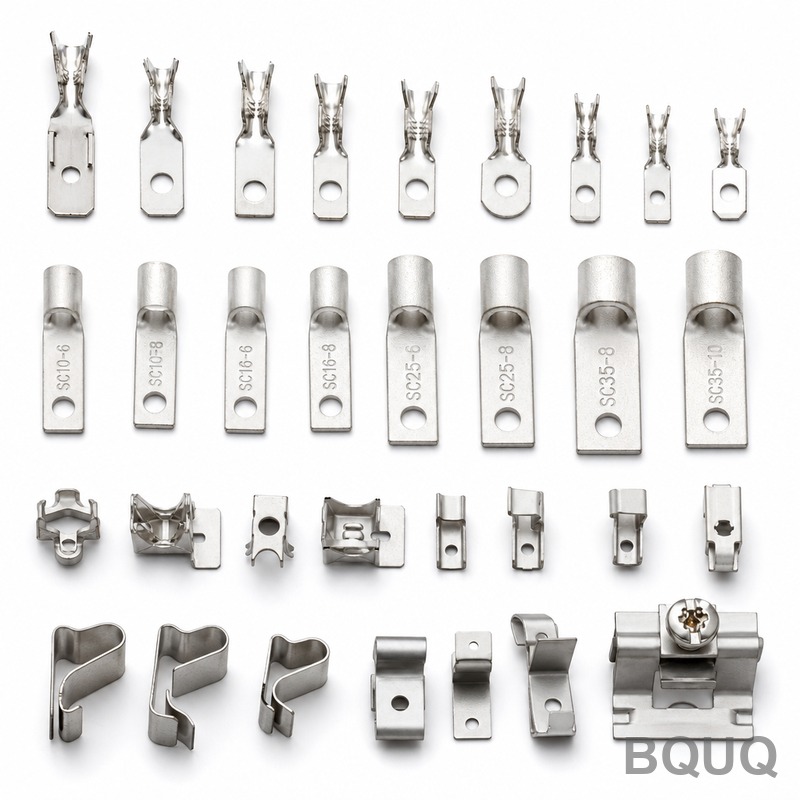
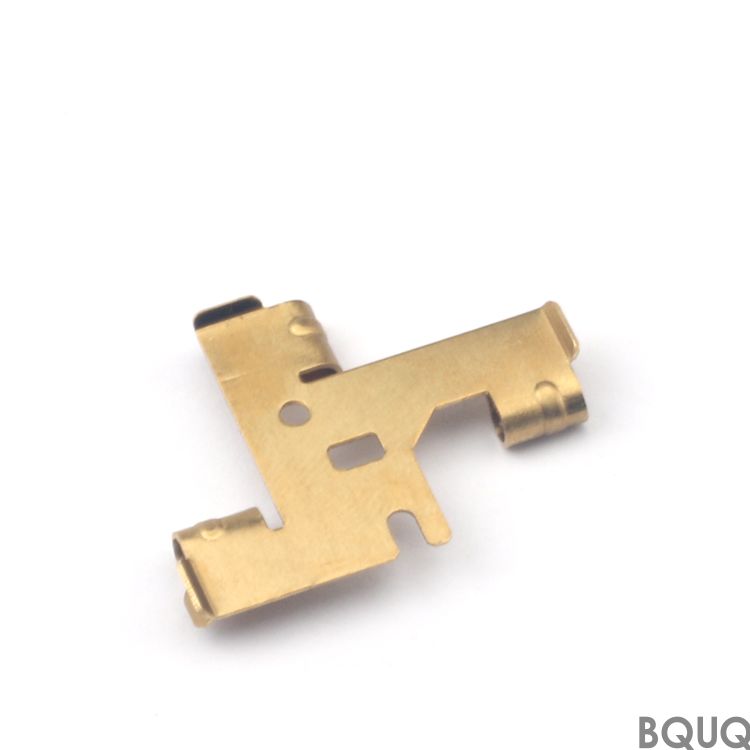
What This Collection Holds for Your PV Module Assembly This is a ready-to-ship series of stamped copper and brass clips for solar junction boxes — the metal contacts that lock PV
BQUQ Solar Junction Box Terminals Clips Collection – Precision Stamping Made in China
What This Collection Holds for Your PV Module Assembly This is a ready-to-ship series of stamped copper and brass clips for solar junction boxes — the metal contacts that lock PV ribbon wires into p
Get a Fast Quote for This Part
Send us your drawing / quantity / material — reply within 24h.
What This Collection Holds for Your PV Module Assembly
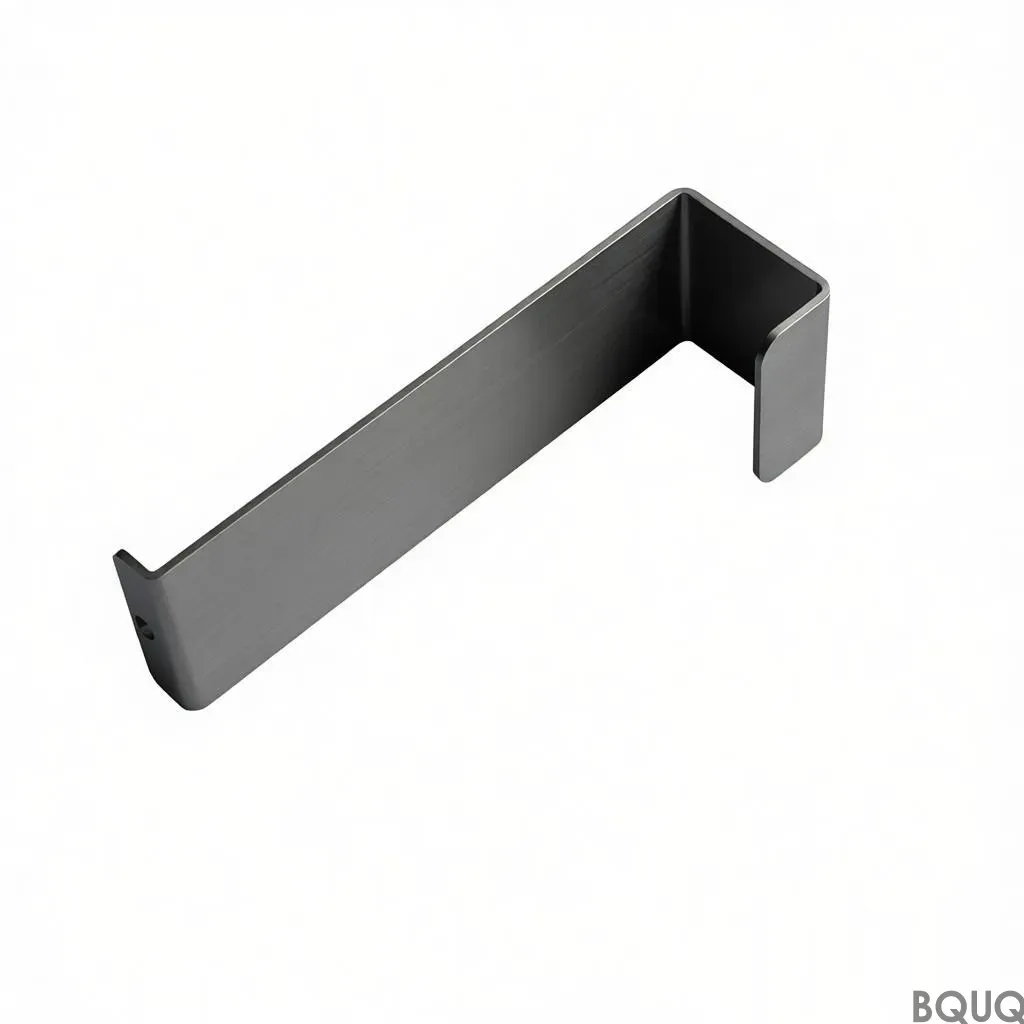
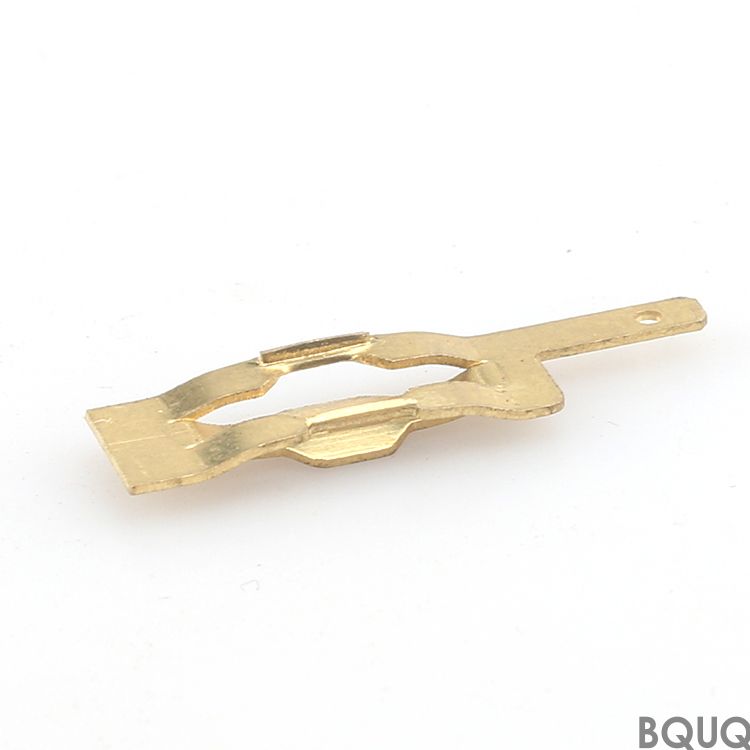
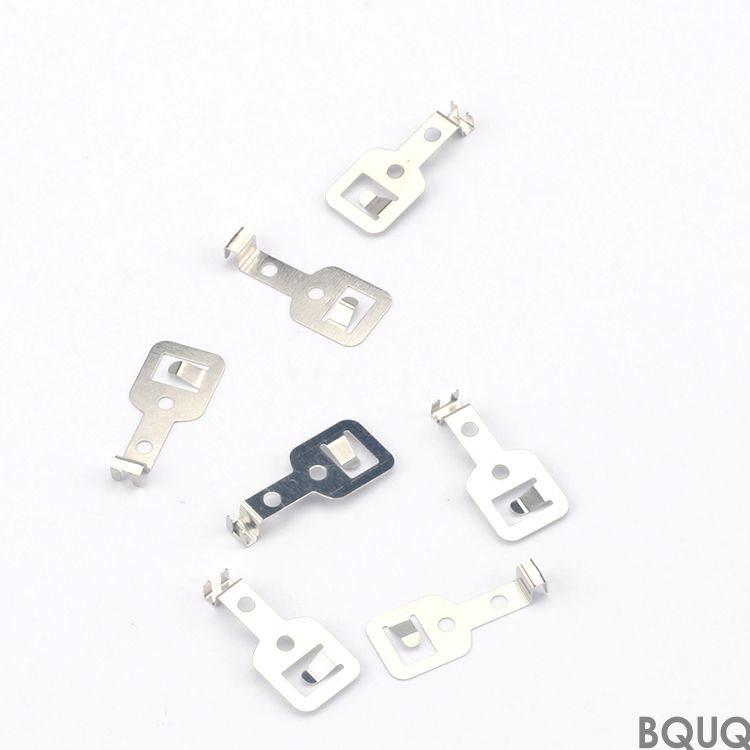
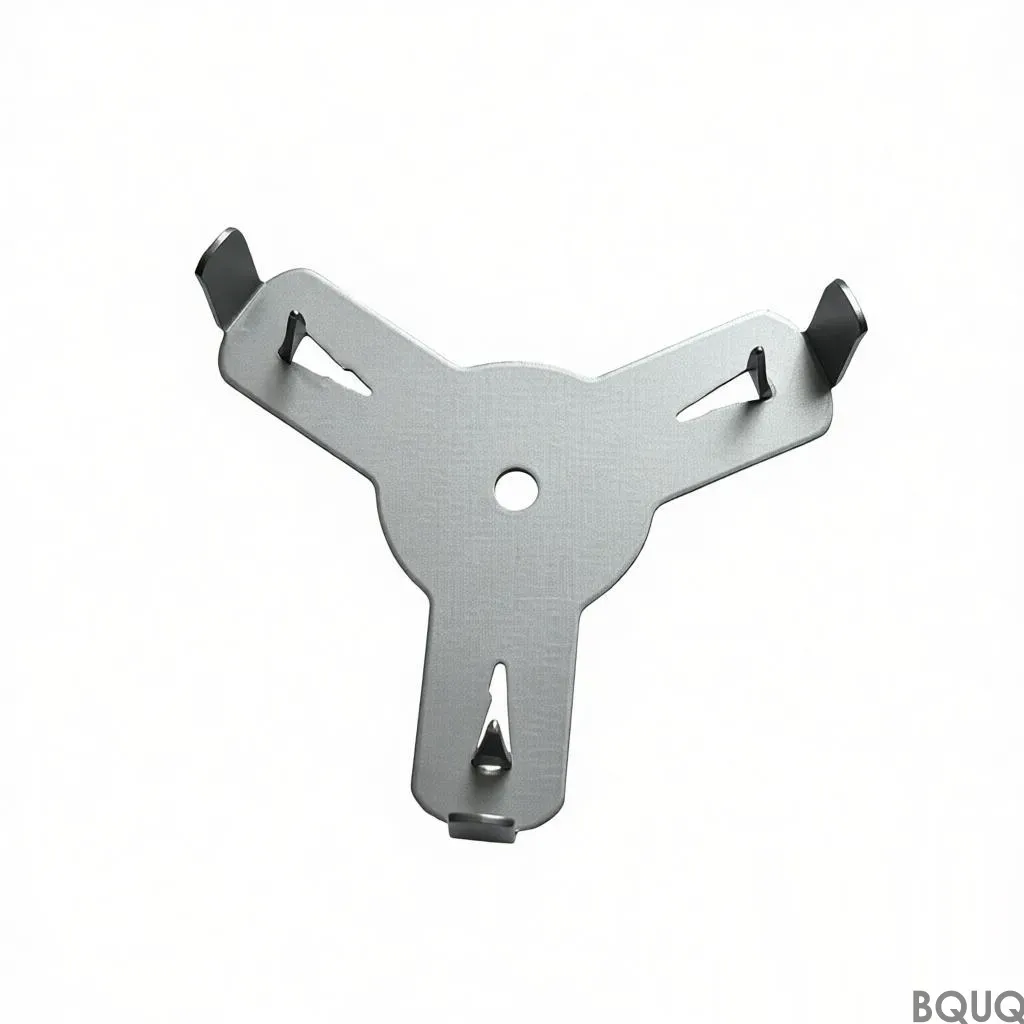
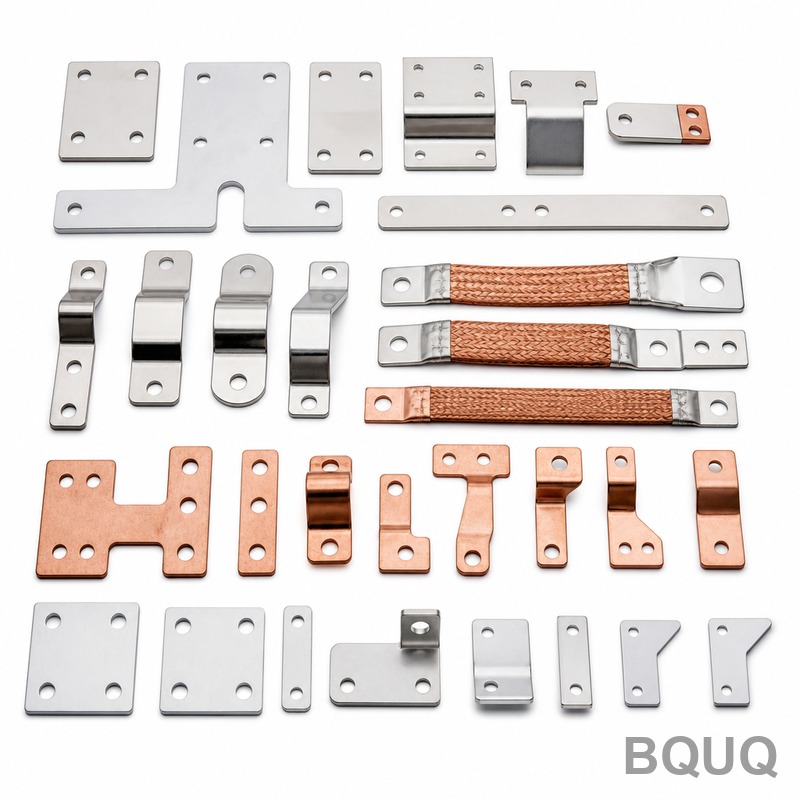
This is a ready-to-ship series of stamped copper and brass clips for solar junction boxes — the metal contacts that lock PV ribbon wires into place and carry current without loosening over 25 years of thermal cycling. Every clip in the collection is stamped to ±0.02 mm flatness tolerance, with a 0.8 µm Ra surface finish on contact zones. Hardness is held at 48 HRC for beryllium copper variants, and lead time is 15 days from drawing approval to door. You are not buying generic hardware; you are buying electrical continuity that survives –40°C to +85°C without creep.
How Stamped Contacts Beat Soldered Joints in Junction Boxes
Soldered joints crack under vibration. Our stamped clips use a spring-tempered geometry that maintains 4.5 N of normal force on the ribbon even after 10,000 insertion cycles. The die design creates a coined contact ridge — this raises local hardness to 52 HRC at the point of electrical contact, cutting contact resistance to below 0.5 mΩ. That is a measurable drop from the 2 mΩ typical of loose-fit clips. For your string inverters, that means less heat, fewer hotspots, and a longer diode life.
Materials and Heat Treatment We Run for Solar-Grade Conductivity
We stock three alloys for this collection: C1100 copper (electrical conductivity 101% IACS), C17200 beryllium copper (conductivity 22% IACS but spring strength to 48 HRC), and C5210 phosphor bronze (tensile strength 620 MPa). All strips are mill-certified before stamping. Heat treatment is done in a continuous belt furnace under nitrogen atmosphere — this prevents oxidation scaling and keeps the surface finish under 0.8 µm Ra. We do not use oil-quench because it leaves carbon film that raises contact resistance. Every batch is tested with a micro-Vickers hardness tester; we ship the report with your parts.
Dimensional Inspection Before Every Shipment — Not Just a Sampling
We do 100% dimensional inspection on critical features: clip width, bend angle, and terminal hole diameter. A Zeiss CMM measures every 50th part; the other 49 are checked with calibrated pin gauges and a profile projector. Runout on the locating tab is held to 0.03 mm total. We photograph the first article and the last article from each die run, then attach those photos to your packing list. That is our proof that the die did not wear mid-production — you get the same clip from part #1 to part #50,000.
Packaging and Anti-Tarnish Protection for Long-Distance Shipping
Bare copper oxidizes in humid air. We pack all clips in VCI (vapor corrosion inhibitor) paper, then seal them in vacuum bags with silica gel. This keeps the surface finish at 0.8 µm Ra for 12 months in storage. For sea freight to Europe or North America, we add an extra layer of ESD-safe foam to prevent mechanical damage. Each box carries a label with batch number, material heat number, and stamping date — traceable back to the exact coil of metal.
Cost Per Clip vs. Total Cost of Ownership — What We Count
Our tooling amortization is built into the piece price only after 200,000 units. For low volumes (5,000–50,000 clips), you pay a one-time die fee of $800–$1,500. That die is yours; we store it free for 5 years. For high volumes, the per-piece price drops to $0.02–$0.05 depending on alloy and thickness. No MOQ means you can order 1,000 clips for a prototype run and then scale up without renegotiating tooling. This is precision manufacturing made in China, but with a Dongguan engineer who answers your email within one working day.
Design Checks We Run Before Stamping Your Custom Clip
Send us a 2D drawing or 3D STEP file. We run a DFM review in 48 hours — we flag sharp inner radii (below 0.3 mm), extreme bend angles (over 90°), and material thickness tolerances that are too tight for stamping. We then simulate the spring-back in our press simulation software. That way, your first article is correct, not a guess. For reference, our standard stamping limits are: thickness 0.1–3.0 mm, part size up to 300 mm x 300 mm, and hole diameter down to 0.5 mm. If you are unsure about material, check our CNC cutting tool selection guide for alloy advice, and our CNC machining tolerances guide for what we can hold on flatness.
Specification Table — Solar Junction Box Terminals Clips Collection
What is the minimum order for this Solar Junction Box Terminals Clips Collection?
No MOQ — we accept 1,000 parts for prototyping and scale to 500,000+ without changing the tooling.
Can you customize the clip geometry for a non-standard ribbon width?
Yes, we modify the die for any ribbon width from 2 mm to 8 mm, and we return the DFM report within 48 hours of receiving your drawing.
How do you ensure the clips do not corrode before installation?
We use VCI paper, vacuum sealing, and silica gel — this maintains the 0.8 µm Ra finish for 12 months in humid storage.
What is your lead time if I need a rush order?
Standard is 15 days; rush orders (7 days) are possible for small batches under 20,000 pieces, subject to press availability.
Get a firm quote within 12 hours. Send your drawing to sc@bquq.com or WhatsApp +86 13713157787. We reply with a DFM review, piece price, and tooling cost — no generic sales pitch, just numbers you can put in your BOM.