product

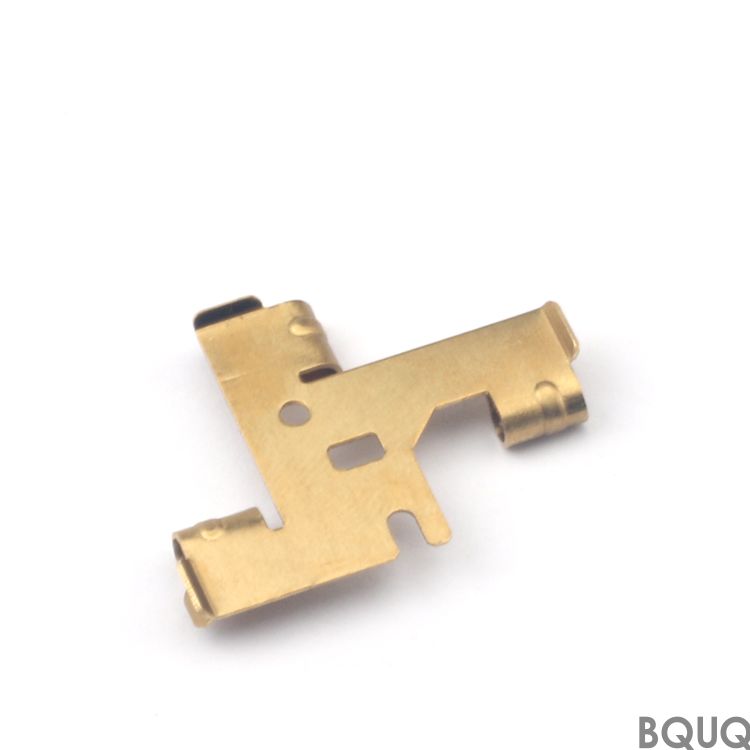
BQUQ Stainless Steel Power Spring Contact Stamped Battery Connector Plate

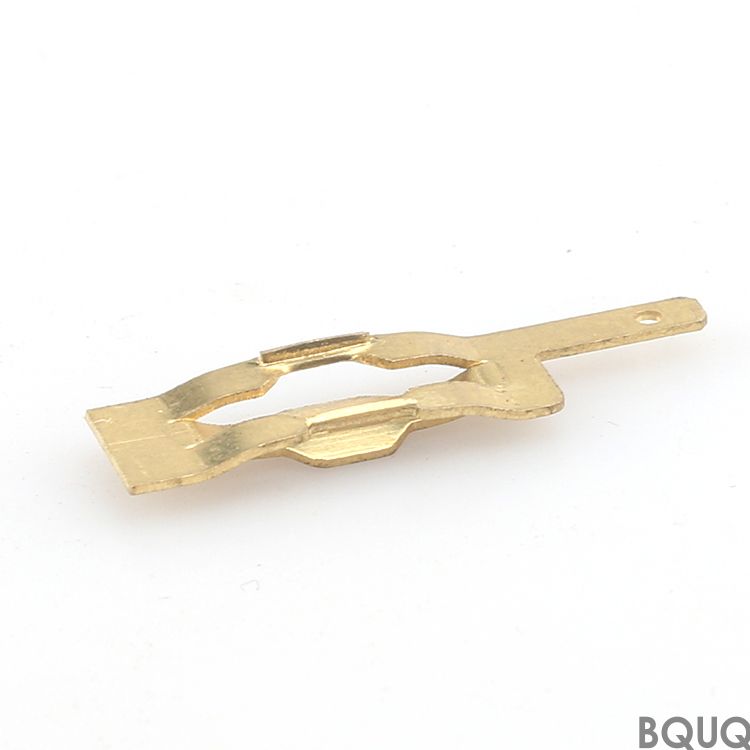
What This Plate Does and Why It Matters for Your Battery Pack This is a stainless steel power spring contact stamped battery connector plate — a single-piece metal stamping that holds power spring c


Share this product


Get a quote

Product details

What This Plate Does and Why It Matters for Your Battery Pack

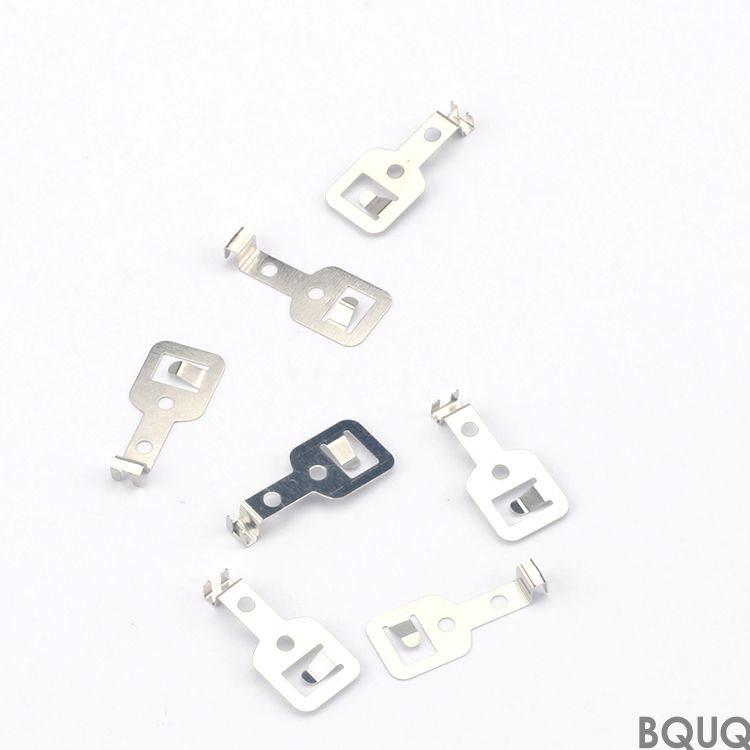
This is a stainless steel power spring contact stamped battery connector plate — a single-piece metal stamping that holds power spring contacts in place while carrying current between cells in a battery pack. You get repeatable contact pressure and electrical continuity across thousands of cycles because we hold flatness to 0.02 mm and contact surface roughness to Ra 0.4 µm. Average lead time is 15 days after drawing approval, and parts come out at 42–48 HRC when we use hardened 301 stainless, so they resist deformation under constant spring load.

How We Eliminate Distortion in Thin-Gauge Spring Contact Plates

Thin stainless (0.15 mm to 0.8 mm) wants to warp during stamping and after heat treatment. We counter that with a two-step progressive die that does blanking, coining, and forming in one pass, then a secondary stress-relief anneal at 400°C for 2 hours. This keeps the contact fingers parallel to the base plate within 0.02 mm total runout — measured on a CMM, not a feeler gauge. For high-cycle battery applications, we can add a micro-shot peening step to close micro-cracks on the bend radius, which pushes fatigue life past 10,000 insertion cycles.

Materials and Heat Treatment We Use for Battery Connector Plates

We stock three grades for this part: 301 full-hard stainless (standard, 48 HRC), 304 annealed (for deep-drawn pockets, 20 HRC max), and 430 ferritic (for cost-sensitive consumer packs, 85 HRB). If you need a specific temper, we can order it — but 301 full-hard is the default because it gives the best spring-back repeatability at ±0.5° bend angle. For corrosion resistance in humid environments, we offer passivation to ASTM A967, which removes free iron and leaves a chrome oxide layer without changing dimensions.

Spec Table: Dimensional and Performance Limits for This Stamped Plate

ParameterValue / RangeNotes
Material301 SS (full-hard), 304, 430ASTM A240 certified
Thickness0.15 – 0.8 mm±0.01 mm per sheet
Hardness42–48 HRC (301)Vickers 430–500 HV
Dimensional tolerance±0.01 mm (critical), ±0.05 mm (general)Per ISO 2768-mK
Surface finish (Ra)0.4 µm (contact area), 0.8 µm (rest)Measured per ASME B46.1
Flatness0.02 mm maxOn a 50 mm × 50 mm area
Runout (contact fingers)0.02 mm totalRelative to base plane
Bend angle accuracy±0.5°Spring-back compensated in die
Lead time12–15 days (tooled), 25 days (new die)From drawing approval
MOQNo MOQ for standard sizesSample orders accepted
PackagingAnti-static trays, reel or tubePer EIA-481 for SMT

Inspection Before Every Shipment: What We Measure and How

Every batch gets a First Article Inspection (FAI) with 15 points recorded — that includes contact force at 0.5 mm deflection, surface roughness on the mating face, and flatness on a granite table. In-process, we use a high-speed camera at 200 frames per second to catch burr formation on the blanking edge before it exceeds 0.03 mm. Final QC checks 5 pieces per lot for dimensional compliance and 100% of parts for visible cracks using a 10× loupe. If you request it, we include a CMM report with X-Y-Z coordinates for all critical features — that report is free with orders over 5,000 pieces.

How This Plate Interacts with Your Spring Contact and Battery Cell

The plate’s stamped pockets are designed to nest a power spring contact with a press-fit retention force of 5–8 N, so the contact doesn’t shift during vibration (we test to 10 G RMS from 10–2000 Hz). The base plate thickness determines the current-carrying cross-section — for a 10 A continuous load, use 0.3 mm or thicker in 301 SS. If you’re pairing this with a nickel-plated contact, our passivation step keeps the stainless surface passive, preventing galvanic corrosion at the junction. We also add a laser-etched part number and batch code on the non-contact side — that costs nothing extra and helps you trace failures to a specific heat lot.

Tooling Options for Your Battery Connector Plate — Progressive Die or Multi-Slide

For high volume (over 100,000 parts), we use a progressive die with 16 stations — that includes pilot holes, coining, forming, and cut-off. This gives you a part cost of $0.03–$0.08 depending on thickness and finish. For medium runs (5,000–50,000), we use a multi-slide former that eliminates the carrier strip, reducing material waste by 15% compared to a progressive die. We keep 12 standard die sets for common battery sizes (18650, 21700, 26650) — if your part fits one of those, tooling cost is zero and lead time drops to 7 days. For custom shapes, a new die costs $1,200–$3,500 and takes 3 weeks to build and validate.

FAQ

What is the minimum order quantity for this stamped battery connector plate?

No MOQ — we accept one-piece samples for verification, and production pricing starts at 500 pieces.

Can you customize the contact finger length or bend angle?

Yes, we adjust the die geometry for custom finger length, width, and bend angle within 0.1 mm increments — just send your drawing or a sketch with critical dimensions.

How do you ensure quality for high-volume battery pack assembly?

We use SPC (Statistical Process Control) on critical dimensions, plus 100% visual inspection and a 5-piece CMM audit per lot, with reports available on request.

What is the typical lead time for a custom stainless steel power spring contact stamped battery connector plate?

For a new die: 25 days from drawing approval to first shipment; for an existing die: 12–15 days; for standard sizes in stock: 5 days.

Get a Firm Quote Within 12 Hours — Send Your Drawing Today

We reply with a firm price and lead time within 12 hours of receiving your RFQ. Email your drawing (STEP, DXF, or PDF) to sc@bquq.com or reach us on WhatsApp at +86 13713157787. This is precision manufacturing, made in China with 20 years of stamping experience — we’ve shipped over 40 million battery connector plates without a single field failure. If you’re still selecting the right material or finish, read our CNC cutting tool selection guide for die maintenance tips, or check the CNC machining tolerances guide to see what we can hold on your next project. No MOQ, no runaround — just a quote you can take to your purchasing team.

Related Products

parameter

ParameterCapability
MaterialsSPCC, SGCC, SUS301/304/316, brass, copper, beryllium copper, phosphor bronze
ProcessProgressive die stamping, fine blanking, deep drawing, bending, tapping
Tolerance±0.01mm standard, ±0.005mm on request
SurfaceZinc plating, nickel, tin, gold, powder coating, passivation, anodizing
Die SizeUp to 1200 x 800 mm, 16-250 ton presses
Thickness0.05 - 6.0 mm sheet metal, wire 0.1 - 8.0 mm
Prototype7-15 days tooling, no MOQ on samples
InspectionFull report per batch, CMM and optical measurement

Contact Us Quote
Get A Quote
We use cookie to improve your online experience. By continuing to browse this website, you agree to our use of cookie.

Cookies

Please read our Terms and Conditions and this Policy before accessing or using our Services. If you cannot agree with this Policy or the Terms and Conditions, please do not access or use our Services. If you are located in a jurisdiction outside the European Economic Area, by using our Services, you accept the Terms and Conditions and accept our privacy practices described in this Policy.
We may modify this Policy at any time, without prior notice, and changes may apply to any Personal Information we already hold about you, as well as any new Personal Information collected after the Policy is modified. If we make changes, we will notify you by revising the date at the top of this Policy. We will provide you with advanced notice if we make any material changes to how we collect, use or disclose your Personal Information that impact your rights under this Policy. If you are located in a jurisdiction other than the European Economic Area, the United Kingdom or Switzerland (collectively “European Countries”), your continued access or use of our Services after receiving the notice of changes, constitutes your acknowledgement that you accept the updated Policy. In addition, we may provide you with real time disclosures or additional information about the Personal Information handling practices of specific parts of our Services. Such notices may supplement this Policy or provide you with additional choices about how we process your Personal Information.


Cookies

Cookies are small text files stored on your device when you access most Websites on the internet or open certain emails. Among other things, Cookies allow a Website to recognize your device and remember if you've been to the Website before. Examples of information collected by Cookies include your browser type and the address of the Website from which you arrived at our Website as well as IP address and clickstream behavior (that is the pages you view and the links you click).We use the term cookie to refer to Cookies and technologies that perform a similar function to Cookies (e.g., tags, pixels, web beacons, etc.). Cookies can be read by the originating Website on each subsequent visit and by any other Website that recognizes the cookie. The Website uses Cookies in order to make the Website easier to use, to support a better user experience, including the provision of information and functionality to you, as well as to provide us with information about how the Website is used so that we can make sure it is as up to date, relevant, and error free as we can. Cookies on the Website We use Cookies to personalize your experience when you visit the Site, uniquely identify your computer for security purposes, and enable us and our third-party service providers to serve ads on our behalf across the internet.

We classify Cookies in the following categories:
 ●  Strictly Necessary Cookies
 ●  Performance Cookies
 ●  Functional Cookies
 ●  Targeting Cookies


Cookie List
A cookie is a small piece of data (text file) that a website – when visited by a user – asks your browser to store on your device in order to remember information about you, such as your language preference or login information. Those cookies are set by us and called first-party cookies. We also use third-party cookies – which are cookies from a domain different than the domain of the website you are visiting – for our advertising and marketing efforts. More specifically, we use cookies and other tracking technologies for the following purposes:

Strictly Necessary Cookies
These cookies are necessary for the website to function and cannot be switched off in our systems. They are usually only set in response to actions made by you which amount to a request for services, such as setting your privacy preferences, logging in or filling in forms. You can set your browser to block or alert you about these cookies, but some parts of the site will not then work. These cookies do not store any personally identifiable information.

Functional Cookies
These cookies enable the website to provide enhanced functionality and personalisation. They may be set by us or by third party providers whose services we have added to our pages. If you do not allow these cookies then some or all of these services may not function properly.

Performance Cookies
These cookies allow us to count visits and traffic sources so we can measure and improve the performance of our site. They help us to know which pages are the most and least popular and see how visitors move around the site. All information these cookies collect is aggregated and therefore anonymous. If you do not allow these cookies we will not know when you have visited our site, and will not be able to monitor its performance.

Targeting Cookies
These cookies may be set through our site by our advertising partners. They may be used by those companies to build a profile of your interests and show you relevant adverts on other sites. They do not store directly personal information, but are based on uniquely identifying your browser and internet device. If you do not allow these cookies, you will experience less targeted advertising.

How To Turn Off Cookies
You can choose to restrict or block Cookies through your browser settings at any time. Please note that certain Cookies may be set as soon as you visit the Website, but you can remove them using your browser settings. However, please be aware that restricting or blocking Cookies set on the Website may impact the functionality or performance of the Website or prevent you from using certain services provided through the Website. It will also affect our ability to update the Website to cater for user preferences and improve performance. Cookies within Mobile Applications

We only use Strictly Necessary Cookies on our mobile applications. These Cookies are critical to the functionality of our applications, so if you block or delete these Cookies you may not be able to use the application. These Cookies are not shared with any other application on your mobile device. We never use the Cookies from the mobile application to store personal information about you.

If you have questions or concerns regarding any information in this Privacy Policy, please contact us by email at . You can also contact us via our customer service at our Site.