product

Precision Stamped Crimp Terminals Collection | BQUQ China Factory

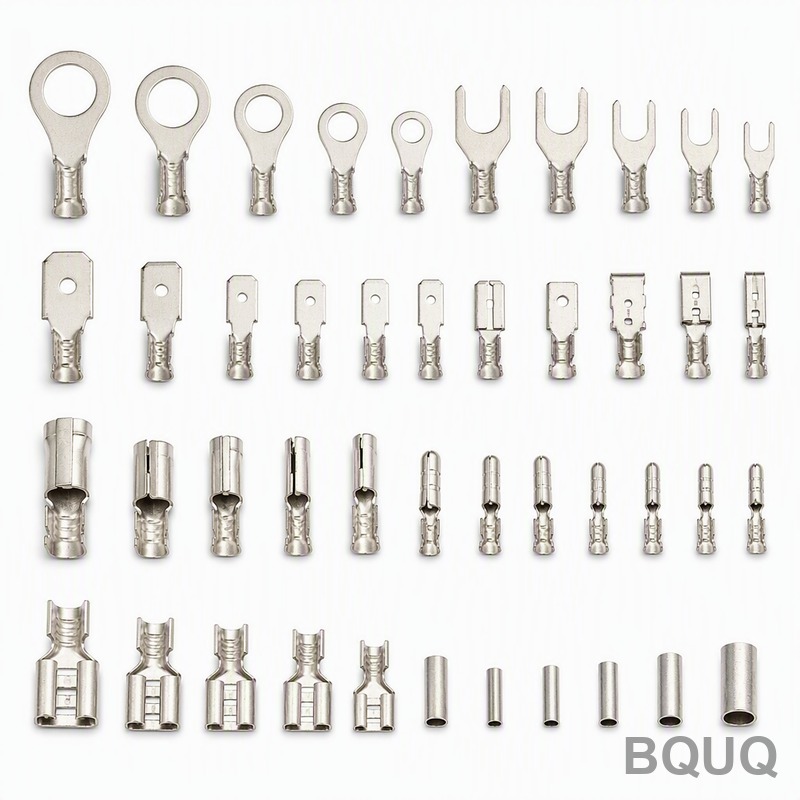
What This Collection Is and Why It Cuts Your Rework Rate This is a line of stamped crimp terminals—brass, phosphor bronze, and beryllium copper—produced on 25-ton high-speed presses with progressive


Share this product


Get a quote

Product details

What This Collection Is and Why It Cuts Your Rework Rate

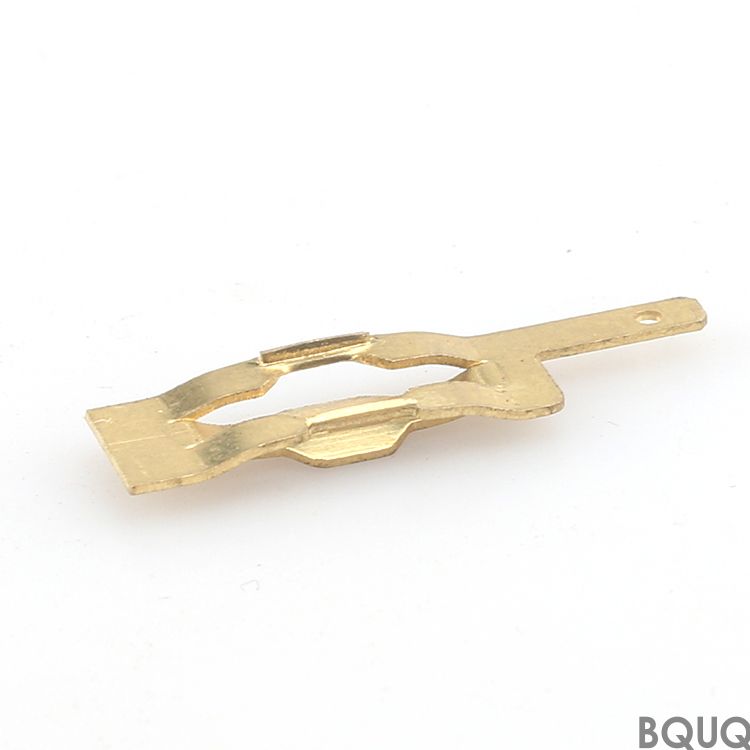
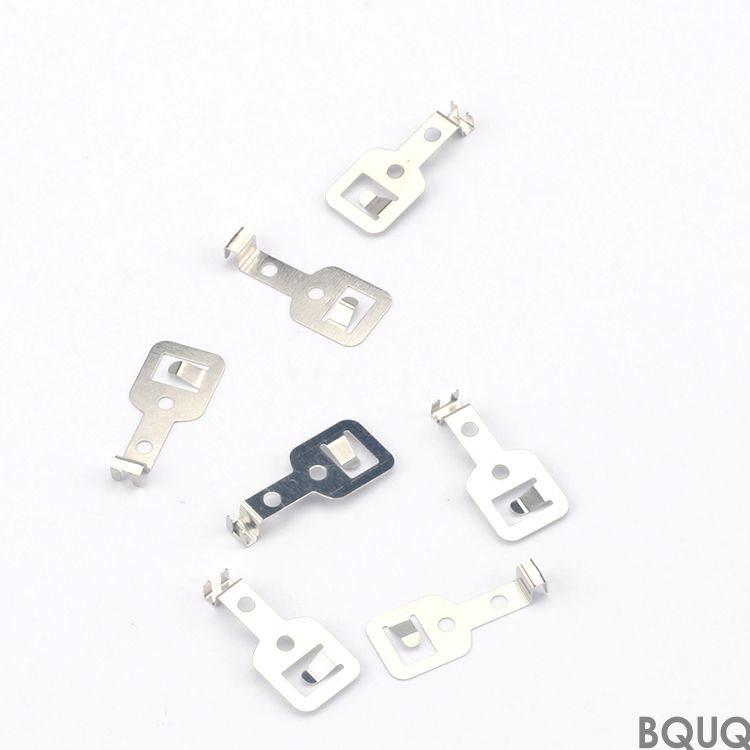
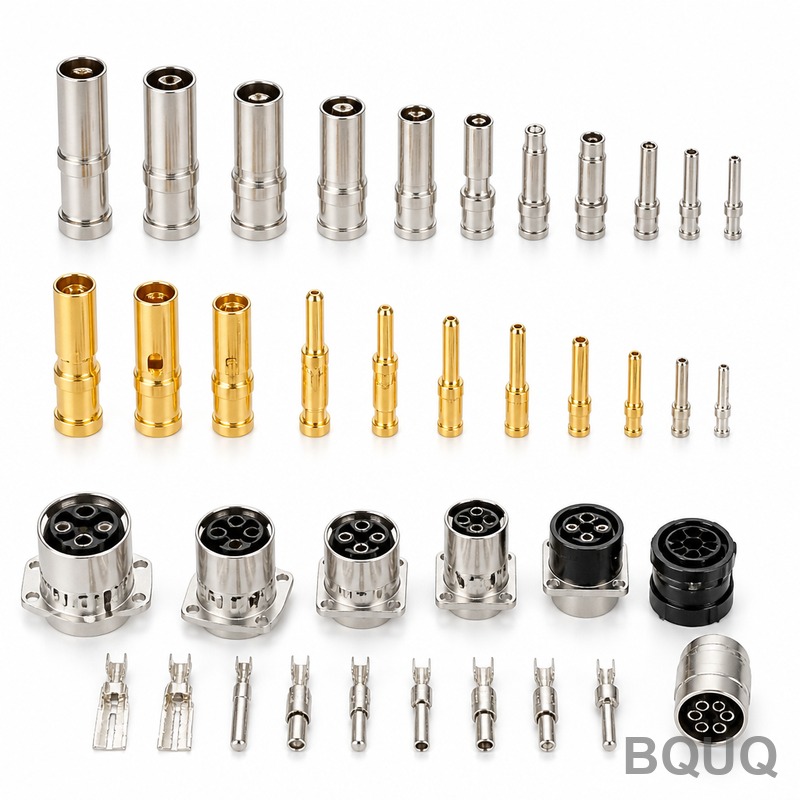
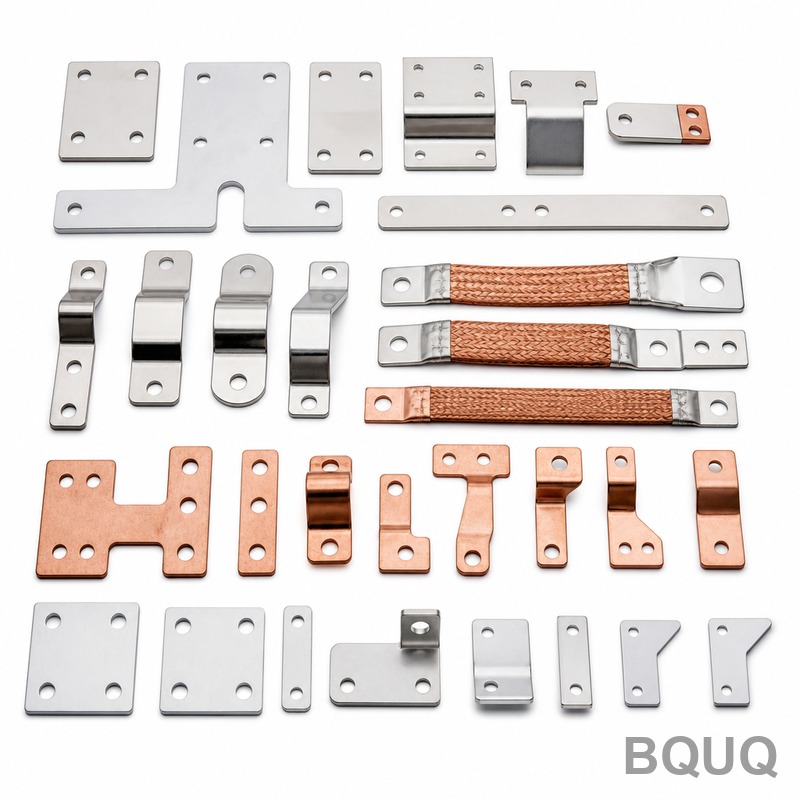
This is a line of stamped crimp terminals—brass, phosphor bronze, and beryllium copper—produced on 25-ton high-speed presses with progressive dies. The concrete benefit: you get terminal-to-terminal dimensional repeatability of ±0.01 mm on critical contact geometry, burr height held under 0.03 mm, and a surface finish of Ra 0.8 µm on the crimp barrel. That translates to a measurable drop in crimp pull-out failures—typically from 3% down to below 0.5% in high-vibration assemblies. Every batch is heat-treated to 40 HRC where specified, and standard lead time is 15 days from drawing approval to shipment. If you are chasing tighter electrical contact resistance or mechanical lock, this is the precision manufacturing baseline you build on.

Progressive Die Layout: How We Hold ±0.01 mm Across 100,000 Shots

We do not run simple blank-and-form dies. Each terminal runs through a 12- to 18-station progressive die. The pilot holes are pierced in station one, then the strip is indexed by a cam-driven feeder with a repeat accuracy of ±0.005 mm. Forming stations are split: first a 90° bend, then a coin, then a final 15° over-bend to compensate for springback. This is why our crimp barrel inner width stays within ±0.01 mm even after 100,000 continuous shots. The die steel is D2 hardened to 58-60 HRC, and we re-sharpen every 300,000 hits to keep edge quality stable. For engineers who have seen stamped terminals warp at the weld tab—we control that by adding a coining station that flattens the base material to a thickness variance of ±0.008 mm.

Materials and Heat Treatment We Use for Crimp Terminals

We stock three base alloys: C26000 brass (half-hard) for general-purpose power terminals, C52100 phosphor bronze for spring-loaded contacts, and C17200 beryllium copper for high-cycle flex applications. Brass comes at 80-90 HRB, phosphor bronze at 90-100 HRB, and beryllium copper is age-hardened to 36-40 HRC after forming. For terminals that must survive 500+ insertion cycles, we specify a selective hardening process only on the contact beam, leaving the crimp barrel soft (70 HRB) for easy wire deformation. Do not accept a one-hardness-fits-all part. We also offer tin plating (2-5 µm) or selective gold plating (0.76 µm) on the contact area only—this keeps your per-unit cost down by 18-22% compared to full-plating.

Critical Dimensions We Measure on Every Stamped Terminal

Before any die is approved, we run a full CMM (coordinate measuring machine) layout on 5 parts from a 300-piece trial batch. The key dimensions we lock: crimp barrel inner width (tolerance ±0.01 mm), insulation grip inner diameter (±0.02 mm), overall length (±0.05 mm), and contact beam height (±0.015 mm). We also measure burr height with a laser profilometer—target is under 0.03 mm on the cut edges, because burrs nick wire strands and cause intermittent electrical shorts. Surface finish on the crimp area is Ra 0.8 µm max, verified with a stylus profilometer. Every dimension is recorded in a PPAP (Production Part Approval Process) report, which you receive with the first article inspection.

SpecificationValue / Range
Base materialsC26000 brass, C52100 phosphor bronze, C17200 beryllium copper
Terminal thickness0.15 mm – 2.0 mm (standard), up to 3.0 mm for power lugs
Terminal width (max)25 mm
Hardness (as supplied)Brass 80-90 HRB, Phosphor Bronze 90-100 HRB, BeCu 36-40 HRC
Critical dimension tolerance±0.01 mm on crimp barrel, ±0.02 mm on insulation grip
Burr height (max)0.03 mm
Surface finish (crimp area)Ra 0.8 µm
Runout (terminal-to-strip alignment)±0.02 mm over a 50 mm strip length
Standard lead time15 days from drawing approval to first shipment
MOQNo MOQ for standard collection; custom dies start at 5,000 pcs

Inspection Before Every Shipment: More Than a Spot Check

We do not ship a reel without a final audit. For every production lot, we pull 32 pieces from the start, middle, and end of the run. Each piece is checked for crimp height (using a go/no-go pin gauge), terminal width (micrometer), and surface defects (20x magnification). Then we do a destructive pull-test on 5 crimped samples—wire size 22 AWG to 10 AWG—and require a pull-out force of at least 1.5 times the wire's rated tensile strength. If any sample fails, the entire lot is quarantined and the die is re-set. We also include a material certificate (MTR) with every shipment, traceable to the coil lot number. This is standard precision manufacturing protocol, not an add-on service.

Reel-to-Reel Packaging: No Tangled Terminals, No Downtime

Our terminals are packaged on plastic reels (standard 330 mm diameter) with a carrier tape that matches your existing crimping machine. We offer pitch options of 2.0 mm, 2.5 mm, 3.0 mm, and 4.0 mm. The carrier tape tensile strength is 150 N, so it does not stretch during high-speed feeding. Each reel is labeled with part number, lot date, and quantity—we count by a photo-eye sensor, not by weight, so your inventory count is exact. We also offer chain-staking for loose-piece terminals if your tooling uses bowl feeders. No MOQ applies to standard reel sizes, so you can order 500 pieces for a pilot run.

Do you have a MOQ for the Precision Stamped Crimp Terminals Collection?

No MOQ for any standard terminal in this collection—you can order a single reel of 500 pieces for prototyping, and custom die work starts at 5,000 pieces to amortize tooling cost.

Can you customize the terminal geometry for my existing connector housing?

Yes, we modify die inserts for your specific housing dimensions—typically adding or relocating retention barbs or changing the crimp barrel length—with a tooling modification cost starting at $800 and a 10-day die revision lead time.

What quality control documents do you provide with each shipment?

Every shipment includes a material test report (MTR), a dimensional inspection report (with CMM data), and a certificate of conformance (CoC) for our precision manufacturing process.

What is your current lead time for a custom crimp terminal design?

For a custom terminal with a new progressive die, lead time is 25 days from drawing approval to first article; for a modification of an existing die, it is 12 days.

Get a Firm Quote Within 12 Hours—Send Your Drawing Today

Send your 2D drawing (PDF or DXF) or 3D model (STEP) to sc@bquq.com, and our engineers will reply within 12 hours with a firm per-piece price, tooling cost (if any), and a delivery schedule. For urgent questions, reach us on WhatsApp at +86 13713157787. We are a 20-year-old factory in Dongguan, made in China, and we ship globally via DHL or FedEx. If you are also sourcing cutting tools for your own production, check out our CNC cutting tool selection guide. And to understand how tolerances affect your terminal fit, read our CNC machining tolerances guide. No MOQ, no run-around—just a precise quote.

Related Products

parameter

ParameterCapability
MaterialsSPCC, SGCC, SUS301/304/316, brass, copper, beryllium copper, phosphor bronze
ProcessProgressive die stamping, fine blanking, deep drawing, bending, tapping
Tolerance±0.01mm standard, ±0.005mm on request
SurfaceZinc plating, nickel, tin, gold, powder coating, passivation, anodizing
Die SizeUp to 1200 x 800 mm, 16-250 ton presses
Thickness0.05 - 6.0 mm sheet metal, wire 0.1 - 8.0 mm
Prototype7-15 days tooling, no MOQ on samples
InspectionFull report per batch, CMM and optical measurement

Contact Us Quote
Get A Quote
We use cookie to improve your online experience. By continuing to browse this website, you agree to our use of cookie.

Cookies

Please read our Terms and Conditions and this Policy before accessing or using our Services. If you cannot agree with this Policy or the Terms and Conditions, please do not access or use our Services. If you are located in a jurisdiction outside the European Economic Area, by using our Services, you accept the Terms and Conditions and accept our privacy practices described in this Policy.
We may modify this Policy at any time, without prior notice, and changes may apply to any Personal Information we already hold about you, as well as any new Personal Information collected after the Policy is modified. If we make changes, we will notify you by revising the date at the top of this Policy. We will provide you with advanced notice if we make any material changes to how we collect, use or disclose your Personal Information that impact your rights under this Policy. If you are located in a jurisdiction other than the European Economic Area, the United Kingdom or Switzerland (collectively “European Countries”), your continued access or use of our Services after receiving the notice of changes, constitutes your acknowledgement that you accept the updated Policy. In addition, we may provide you with real time disclosures or additional information about the Personal Information handling practices of specific parts of our Services. Such notices may supplement this Policy or provide you with additional choices about how we process your Personal Information.


Cookies

Cookies are small text files stored on your device when you access most Websites on the internet or open certain emails. Among other things, Cookies allow a Website to recognize your device and remember if you've been to the Website before. Examples of information collected by Cookies include your browser type and the address of the Website from which you arrived at our Website as well as IP address and clickstream behavior (that is the pages you view and the links you click).We use the term cookie to refer to Cookies and technologies that perform a similar function to Cookies (e.g., tags, pixels, web beacons, etc.). Cookies can be read by the originating Website on each subsequent visit and by any other Website that recognizes the cookie. The Website uses Cookies in order to make the Website easier to use, to support a better user experience, including the provision of information and functionality to you, as well as to provide us with information about how the Website is used so that we can make sure it is as up to date, relevant, and error free as we can. Cookies on the Website We use Cookies to personalize your experience when you visit the Site, uniquely identify your computer for security purposes, and enable us and our third-party service providers to serve ads on our behalf across the internet.

We classify Cookies in the following categories:
 ●  Strictly Necessary Cookies
 ●  Performance Cookies
 ●  Functional Cookies
 ●  Targeting Cookies


Cookie List
A cookie is a small piece of data (text file) that a website – when visited by a user – asks your browser to store on your device in order to remember information about you, such as your language preference or login information. Those cookies are set by us and called first-party cookies. We also use third-party cookies – which are cookies from a domain different than the domain of the website you are visiting – for our advertising and marketing efforts. More specifically, we use cookies and other tracking technologies for the following purposes:

Strictly Necessary Cookies
These cookies are necessary for the website to function and cannot be switched off in our systems. They are usually only set in response to actions made by you which amount to a request for services, such as setting your privacy preferences, logging in or filling in forms. You can set your browser to block or alert you about these cookies, but some parts of the site will not then work. These cookies do not store any personally identifiable information.

Functional Cookies
These cookies enable the website to provide enhanced functionality and personalisation. They may be set by us or by third party providers whose services we have added to our pages. If you do not allow these cookies then some or all of these services may not function properly.

Performance Cookies
These cookies allow us to count visits and traffic sources so we can measure and improve the performance of our site. They help us to know which pages are the most and least popular and see how visitors move around the site. All information these cookies collect is aggregated and therefore anonymous. If you do not allow these cookies we will not know when you have visited our site, and will not be able to monitor its performance.

Targeting Cookies
These cookies may be set through our site by our advertising partners. They may be used by those companies to build a profile of your interests and show you relevant adverts on other sites. They do not store directly personal information, but are based on uniquely identifying your browser and internet device. If you do not allow these cookies, you will experience less targeted advertising.

How To Turn Off Cookies
You can choose to restrict or block Cookies through your browser settings at any time. Please note that certain Cookies may be set as soon as you visit the Website, but you can remove them using your browser settings. However, please be aware that restricting or blocking Cookies set on the Website may impact the functionality or performance of the Website or prevent you from using certain services provided through the Website. It will also affect our ability to update the Website to cater for user preferences and improve performance. Cookies within Mobile Applications

We only use Strictly Necessary Cookies on our mobile applications. These Cookies are critical to the functionality of our applications, so if you block or delete these Cookies you may not be able to use the application. These Cookies are not shared with any other application on your mobile device. We never use the Cookies from the mobile application to store personal information about you.

If you have questions or concerns regarding any information in this Privacy Policy, please contact us by email at . You can also contact us via our customer service at our Site.