Additive vs Subtractive Manufacturing: When to Use What for CNC Parts
Choosing between additive manufacturing (AM) and subtractive manufacturing (SM) is not a matter of which technology is newer, but which one delivers the required part geometry, material properties, and cost profile at the required production volume. For production runs above 100 units, subtractive CNC machining is almost always the correct choice due to its superior dimensional accuracy (±0.005 mm), repeatability, and surface finish (Ra 0.4 µm). Additive manufacturing wins for prototypes, internal lattice structures, and low-volume runs under 50 units where material waste and tooling costs dominate the decision. This article provides a quantitative framework for engineers selecting between these two manufacturing paradigms.
Material Properties and Structural Integrity
Subtractive manufacturing preserves the original wrought material microstructure, which means mechanical properties remain isotropic and consistent with published material datasheets. For example, 6061-T6 aluminum machined from bar stock retains its 310 MPa yield strength and 570 MPa tensile strength without any post-processing. Additive manufacturing, particularly powder bed fusion (PBF), creates anisotropic parts with layer-by-layer fusion zones. As-built Inconel 718 produced via laser PBF typically shows 20-30 percent lower fatigue strength than wrought material, requiring hot isostatic pressing (HIP) at 1120°C and 100 MPa to recover properties.
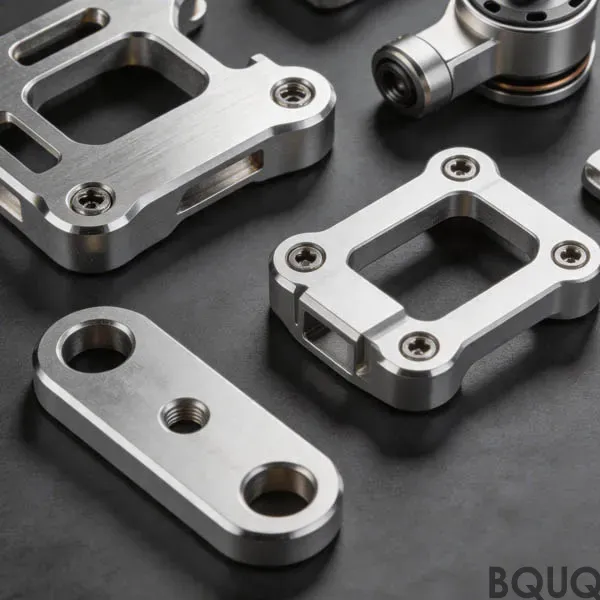
The maximum part size also differs dramatically. CNC machining centers at BQUQ handle parts up to 2000 mm x 800 mm x 600 mm in aluminum and steel. Metal additive machines (e.g., SLM 500) have build volumes around 500 mm x 280 mm x 365 mm. For large structural brackets, enclosures, or heat sink bases, subtractive is the only practical option. Polymer AM (SLS or MJF) can reach 380 mm x 330 mm x 460 mm, but these parts lack the thermal and mechanical performance of machined metals.
Tolerance and Surface Finish Capabilities
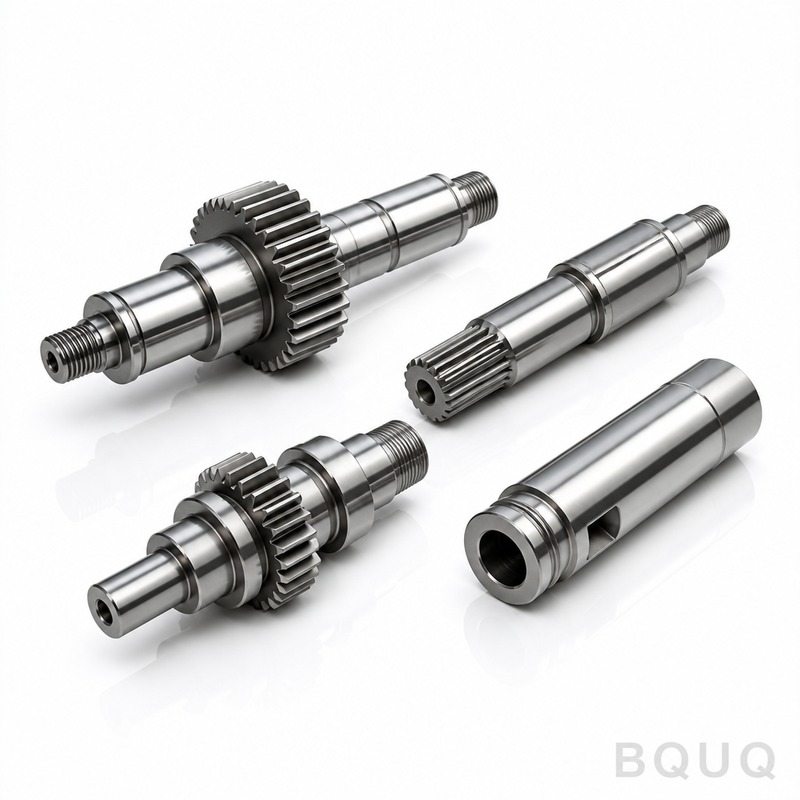
The dimensional accuracy gap between AM and SM remains significant despite advances in additive process control. Standard CNC machining tolerances at BQUQ are ±0.025 mm for general features and ±0.005 mm for precision ground surfaces. In contrast, metal AM parts typically hold ±0.1 mm to ±0.2 mm as-built, with ±0.05 mm achievable only after CNC finish machining. Surface roughness follows a similar pattern: machined surfaces reach Ra 0.4 µm to Ra 0.8 µm, while as-printed AM surfaces range from Ra 6 µm to Ra 12 µm due to partially melted powder particles.
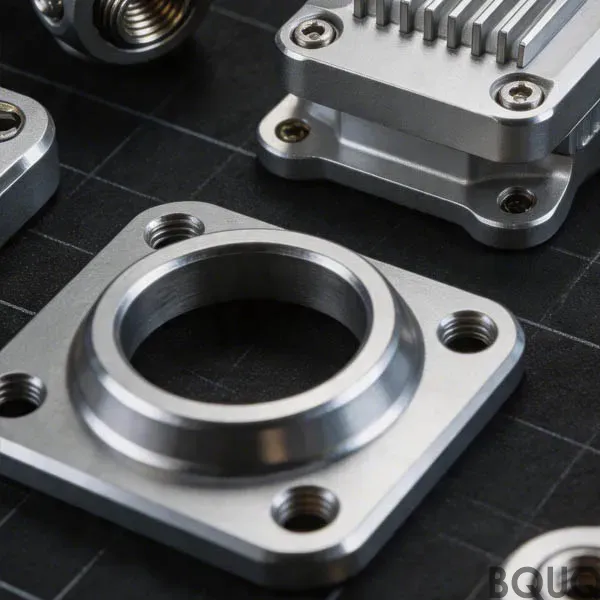
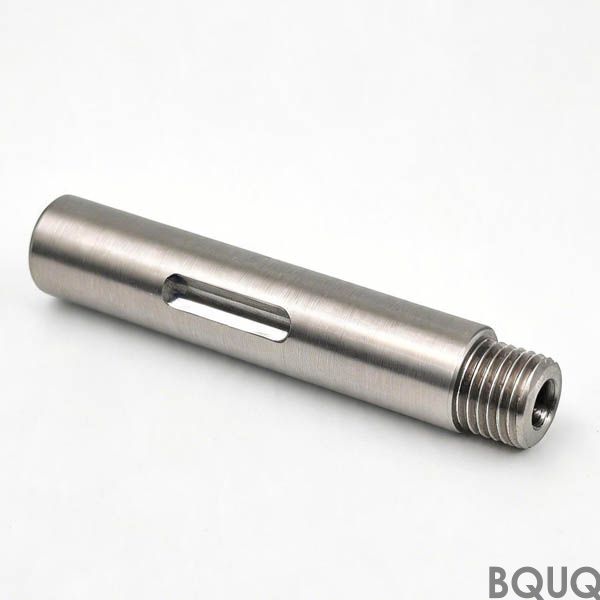
For mating surfaces, sealing faces, bearing journals, or threaded holes, subtractive machining is mandatory. A thread milled into an AM part requires the hole to be oversized and then machined, which negates the geometric freedom of printing. The practical rule is: if a feature needs to interface with another component, machine it. If a feature exists solely for weight reduction or internal cooling channels, print it.
Cost Breakdown at Different Production Volumes
The economic crossover point between AM and SM depends on setup costs, material costs, and per-part cycle time. For CNC machining, setup includes CAD/CAM programming (2-6 hours), fixturing (50-300 USD), and tooling (20-150 USD). Per-part cost scales with machining time (80-120 USD per hour) and material utilization. For AM, the dominant costs are machine time (30-80 USD per hour for metal PBF), powder material (60-120 USD per kg for titanium, 30-50 USD per kg for aluminum), and post-processing (support removal, stress relief, HIP).
The following table shows representative costs for a 100 mm x 60 mm x 20 mm aluminum bracket with four mounting holes and a 5 mm thick web:
| Cost Parameter | CNC Machining (Subtractive) | SLM Printing (Additive) |
| Setup and Programming | 180 USD (one-time) | 350 USD (one-time, including build prep) |
| Material Cost per Part | 8 USD (0.2 kg from 0.5 kg billet) | 35 USD (0.3 kg powder, 50 percent waste) |
| Machine Time per Part | 25 minutes (15 USD at 36 USD/hr) | 8 hours (320 USD at 40 USD/hr) |
| Post-Processing per Part | 5 USD (deburring) | 45 USD (support removal, stress relief) |
| Total Cost for 10 Units | 180 + 10 x 28 = 460 USD | 350 + 10 x 400 = 4350 USD |
| Total Cost for 100 Units | 180 + 100 x 28 = 2980 USD | 350 + 100 x 400 = 40350 USD |
| Total Cost for 1000 Units | 180 + 1000 x 28 = 28180 USD | 350 + 1000 x 400 = 400350 USD |
The crossover is clear: beyond 10 to 20 units, CNC machining becomes overwhelmingly cost-effective. Additive manufacturing only competes when the part geometry is impossible to machine, such as conformal cooling channels in a mold insert or a topology-optimized aerospace bracket.
Lead Time Comparison for Prototypes and Production
For a single prototype part, AM offers a faster path to physical validation. A metal AM part can be printed in 1 to 3 days including build setup and post-processing. CNC machining of the same part requires programming (0.5 day), material procurement (1-2 days), and machining (0.5 day), totaling 2 to 3 days. The lead times converge at around 5 units. For production runs, CNC machining is consistently faster because multiple parts can be machined sequentially with minimal setup change, while AM builds are limited by the machine build volume and layer time.
At BQUQ, standard CNC machining lead times are 3-5 days for prototypes and 10-15 days for production orders of 500-5000 pieces. Additive service bureaus typically quote 5-7 days for prototype prints but 3-4 weeks for production quantities due to batch scheduling. For urgent requirements, CNC machining with in-house material stock (6061, 7075, 304, 316, 4140, POM, PTFE) allows same-day start.
Design for Manufacturing Rules for Each Process
Subtractive manufacturing requires designers to respect tool access, minimum wall thickness, and internal corner radii. Minimum wall thickness for CNC machined aluminum is 0.8 mm, steel is 0.5 mm, and plastic is 1.0 mm. Internal corners must have a radius equal to at least one-third of the tool diameter; a 6 mm end mill leaves a 3 mm radius. Deep pockets with depth-to-width ratios above 4:1 require special tooling and increase cost.
Additive manufacturing allows internal channels, lattice structures, and undercuts, but imposes its own constraints. Minimum wall thickness for metal AM is 0.4 mm, minimum hole diameter is 0.5 mm, and unsupported overhangs above 45 degrees require support structures that must be removed. Powder removal from internal channels requires access ports of at least 3 mm diameter. When designing for AM, the engineer must also consider that heat treatment (stress relief at 350-650°C for aluminum, 980-1060°C for steel) is mandatory to prevent distortion.
Hybrid Approach: Combining Both Processes
The most effective strategy for complex components is to combine AM and SM. Print a near-net-shape blank with internal cooling channels or lattice structures, then CNC machine the critical mating surfaces, threaded holes, and datum features. This hybrid approach captures the geometric freedom of AM while achieving the precision of subtractive machining. A typical hybrid part costs 60-70 percent more than a fully machined part but enables performance that neither process can achieve alone.
For example, a heat sink for a high-power IGBT module can be printed with internal pin-fin arrays (impossible to mill), then the mounting face is machined to Ra 0.8 µm and flatness of 0.02 mm for proper thermal interface contact. BQUQ regularly executes this hybrid workflow for power electronics customers, using our in-house CNC capacity for the finish machining step.
Conclusion and Practical Recommendation
Select subtractive manufacturing when your part requires tight tolerances below ±0.05 mm, has mating surfaces, is larger than 300 mm in any dimension, or requires production volumes above 50 units. Select additive manufacturing when the part has internal channels, lattice structures, or organic shapes that cannot be machined, when you need a single prototype within 48 hours, or when material waste is a critical cost factor for exotic alloys like titanium. For most industrial components, CNC machining remains the default choice due to cost, speed, and reliability.
For a definitive assessment of your specific part, send us your 2D drawings or 3D STEP files. BQUQ provides a 12-hour quoting service with detailed DFM feedback, covering CNC machining, metal stamping, springs, and heat sinks. Our 20 years of manufacturing experience in Dongguan ensures you receive the most cost-effective process recommendation. Email your inquiry to sc@bquq.com, or contact us via WhatsApp at +86 13713157787. Visit www.bquq.com to review our capabilities and material certifications.
Related Articles
- CNC Turn-Mill Composite Machining, Turn-Mill Machine Tools, One-Time Forming, B-Axis Turn-Mill Center, Multi-Process Integration, Complex Rotary Part Machining, Medical Device Precision Machining
- High-speed machining technology: principles, tool path optimization, and industrial applications
- Analysis of the core technology of five-axis linkage machining: from motion to high-precision curved surface manufacturing