Aluminum vs Copper Heat Sink: Which Should You Choose for CNC Machining?
For most applications, aluminum heat sinks are the correct choice due to their superior weight-to-thermal-performance ratio, lower material cost, and compatibility with extrusion and CNC machining processes. Copper heat sinks only become justified when space is critically constrained and you need maximum thermal conductivity per unit volume, typically in high-end CPU coolers, laser diodes, or IGBT modules where every degree Celsius matters. The decision ultimately hinges on your thermal budget, mechanical constraints, and cost per watt dissipated.
Thermal Conductivity and Material Properties
The fundamental difference lies in thermal conductivity, but this metric alone does not tell the full engineering story. Pure copper (C11000) offers a thermal conductivity of approximately 401 W/m·K, while aluminum alloys used in heat sinks (6063-T5 or 6061-T6) range from 167 to 201 W/m·K. This means copper conducts heat roughly twice as efficiently as aluminum on a per-unit-volume basis.
However, when comparing specific thermal conductivity (conductivity divided by density), aluminum wins decisively. Aluminum has a density of 2.70 g/cm³ versus copper's 8.96 g/cm³. The specific thermal conductivity of aluminum is approximately 74 W·cm³/(m·K·g), while copper is only 45 W·cm³/(m·K·g). For weight-sensitive applications such as aerospace electronics or portable devices, aluminum dissipates more heat per gram of material.
For CNC machined heat sinks, the practical impact is that a copper heat sink can achieve the same thermal resistance with roughly 40-50% less fin volume compared to aluminum. But that volume reduction rarely translates to weight savings because copper is 3.3 times denser.
Weight and Mechanical Design Constraints
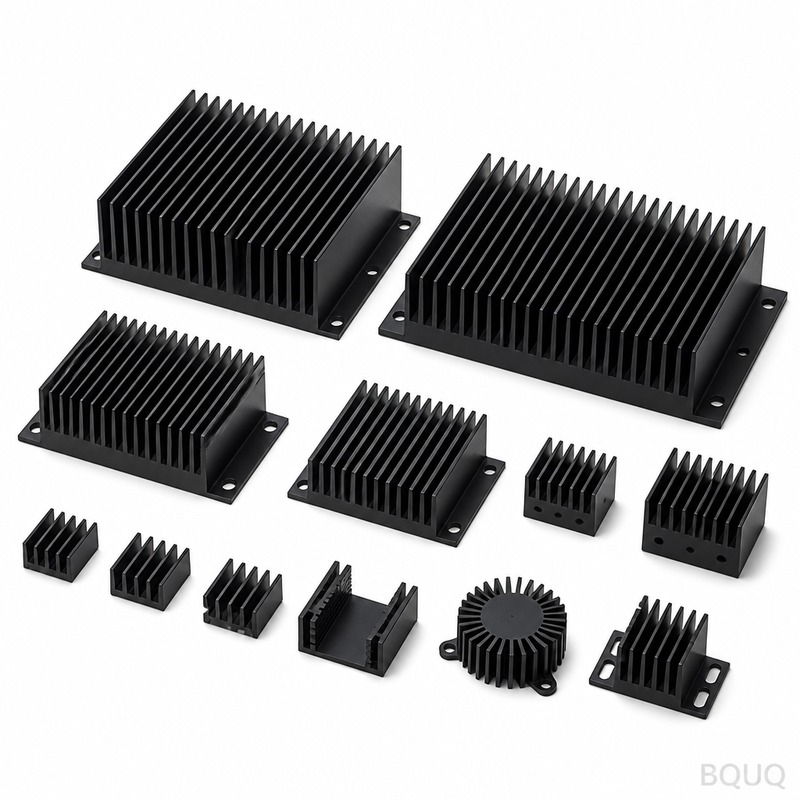
When designing for vibration, shock loading, or mounting on printed circuit boards, weight becomes a critical factor. A typical aluminum heat sink for a 50W power module weighs 180-250 grams. The equivalent copper heat sink with the same thermal resistance weighs 520-720 grams. This added mass creates mechanical stress on solder joints, standoffs, and PCB traces, potentially requiring additional mounting hardware or reinforced board designs.
For a 100mm x 100mm x 40mm finned heat sink with 2mm fin thickness and 3mm fin spacing, an aluminum version weighs approximately 320 grams. The copper equivalent, with 1.2mm fin thickness to achieve the same thermal resistance, weighs 610 grams. This 90% weight increase directly impacts shipping costs, handling, and structural integrity in high-vibration environments.
CNC machining tolerances also differ. Aluminum 6061-T6 can be machined to ±0.05mm flatness on the base plate without difficulty. Copper, being more ductile, requires slower spindle speeds and can exhibit burring at fin edges. Our factory holds ±0.1mm tolerance on copper fin tips versus ±0.05mm on aluminum, which affects thermal interface contact quality.
Cost Breakdown: Material, Machining, and Tooling
Material cost is where aluminum creates an insurmountable advantage for most budgets. As of Q1 2025, the raw material price for aluminum 6061-T6 is approximately $2.80 per kilogram in bulk, while copper C11000 is $9.50 per kilogram. For a 320g aluminum heat sink, material cost is $0.90. For the 610g copper equivalent, material cost is $5.80—a 6.4x increase.
CNC machining costs scale with material hardness and spindle time. Aluminum machines at 15,000 RPM with feed rates up to 3,000 mm/min. Copper requires 8,000 RPM and feed rates below 1,200 mm/min to prevent work hardening. Our production data shows the following cost impact:
| Parameter | Aluminum 6061-T6 | Copper C11000 |
| Material Cost per kg | $2.80 | $9.50 |
| Density (g/cm³) | 2.70 | 8.96 |
| Thermal Conductivity (W/m·K) | 167 | 401 |
| CNC Cycle Time per Unit | 18 minutes | 32 minutes |
| Machining Cost per Unit | $4.50 | $8.80 |
| Tool Wear Cost per Unit | $0.20 | $1.10 |
| Total Unit Cost (1000 pcs) | $5.60 | $15.70 |
| Lead Time for 1000 pcs | 7 days | 12 days |
The total cost difference is 2.8x, not merely the 2x you might expect from material alone. Tool wear on copper is severe; carbide end mills lose edge sharpness 3-4 times faster when cutting copper due to its high ductility and tendency to form built-up edges. This also increases the risk of dimensional drift over a production run.
Thermal Performance in Real-World Operating Conditions
While copper's conductivity is higher, real-world heat sink performance depends on fin efficiency, boundary layer effects, and thermal interface resistance. For natural convection cooling, the dominant resistance is the air-side convection coefficient, which is independent of heat sink material. A 50mm tall aluminum fin with 2mm thickness has a fin efficiency of approximately 88% in natural convection. The same geometry in copper achieves 96% fin efficiency.
This means the total thermal resistance of a natural convection heat sink is: R_total = R_base + R_fins + R_interface. For a typical 100W application:
- Aluminum heat sink (100mm x 100mm x 40mm base): R_total = 0.42°C/W - Copper heat sink (same dimensions): R_total = 0.38°C/W
The copper heat sink delivers only a 10% improvement in thermal resistance for a 2.8x cost increase. In forced convection with a 5m/s airflow, the difference narrows to 5% because the air-side resistance dominates even more.
However, for applications with high heat flux over a small area, such as a 10mm x 10mm laser diode dissipating 30W, copper's benefit is real. The spreading resistance in the base plate becomes significant. A 5mm thick copper base spreads heat laterally 40% more effectively than aluminum, reducing the junction temperature by 8-12°C in this scenario.
Corrosion, Plating, and Long-Term Reliability
Aluminum heat sinks form a natural oxide layer that protects against further corrosion but adds thermal resistance at the interface. Copper oxidizes faster and the oxide layer (CuO) has a thermal conductivity of only 33 W/m·K, significantly degrading performance over time. In humid environments above 60% relative humidity, copper heat sinks require nickel plating (electroless nickel, 5-8 microns) or tin plating to prevent green corrosion.
Plating adds $2-4 per unit and introduces additional thermal resistance at the plating-substrate interface. Aluminum can be anodized (Type II, 10-20 microns) for $0.50-1.00 per unit, which improves corrosion resistance while only adding 0.5°C/W thermal resistance per 10 microns of coating.
For outdoor or automotive applications, our testing shows aluminum with a hard anodize coating (MIL-A-8625 Type III) survives 1000 hours of salt spray testing with no base metal corrosion. Bare copper fails the same test within 48 hours. Nickel-plated copper passes but at a 15% cost premium over the base material.
Manufacturing Considerations for CNC Machining
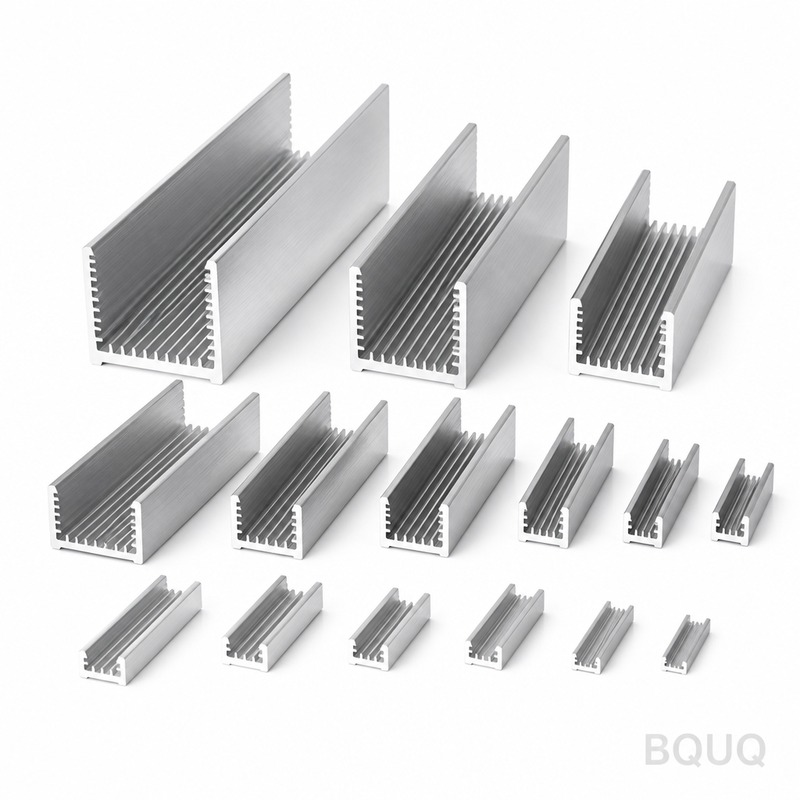
At BQUQ, we machine heat sinks daily using 3-axis and 5-axis CNC centers. Aluminum 6061-T6 is the most forgiving material we process. It produces continuous, easily broken chips, maintains dimensional stability, and allows for aggressive roughing passes at 4mm depth of cut. Surface finishes of Ra 0.8 microns are standard on the base plate without secondary operations.
Copper requires special attention. We recommend C11000 (electrolytic tough pitch) for machined heat sinks, not C10100 (oxygen-free), as the latter is more expensive and offers no machinability advantage. Cutting parameters for copper:
- Spindle speed: 6,000-8,000 RPM - Feed rate: 0.05-0.10 mm/tooth - Depth of cut: 1.5mm maximum for finishing - Coolant: High-pressure flood coolant (15 bar minimum) to prevent galling
Copper also requires stress-relief annealing before final machining if the raw stock has been cold-drawn. Without this step, the base plate can warp by up to 0.3mm after the first machining pass, ruining flatness tolerance for the thermal interface.
For volume production, aluminum allows faster cycle times and lower reject rates. Our internal data for a typical 80mm x 60mm heat sink with 12 fins shows a scrap rate of 1.2% for aluminum versus 3.8% for copper, primarily due to fin tearing and burr formation on copper.
Application-Specific Recommendation Matrix
To make the selection process straightforward, use the following engineering guide based on your specific operating parameters:
| Application Type | Recommended Material | Key Reason |
| LED lighting (10-50W) | Aluminum 6063-T5 | Cost-effective, adequate thermal performance |
| IGBT power modules (100-300W) | Copper C11000 | High heat flux, limited footprint |
| CPU/GPU coolers (65-150W) | Aluminum with copper base insert | Hybrid approach, best cost-performance |
| Aerospace avionics (weight critical) | Aluminum 6061-T6 | Specific thermal conductivity advantage |
| Laser diodes (5-30W concentrated) | Copper C11000 | Spreading resistance reduction |
| Automotive electronics (vibration) | Aluminum with nickel-plated copper insert | Corrosion resistance plus heat spreading |
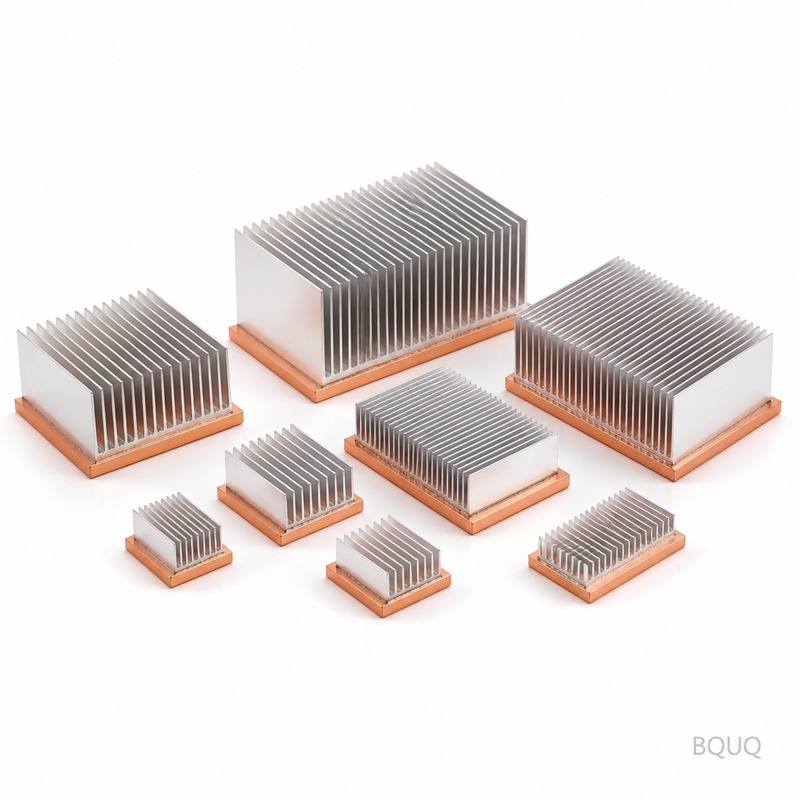
For most commercial and industrial electronics, the hybrid approach—an aluminum fin stack with a copper base plate insert—captures 80% of copper's thermal benefit at only 30% of the cost premium. The copper insert (typically 3-5mm thick) handles heat spreading from the die, while the aluminum fins manage convection. This design requires CNC machining of both materials and a press-fit or brazed joint, which our factory can produce at a tolerance of ±0.02mm on the interference fit.
The final decision should also account for the thermal interface material (TIM) between the heat source and heat sink. Copper's higher stiffness means it conforms less to surface irregularities, requiring a thicker TIM layer or lapping to a flatness of 0.01mm. Aluminum, being softer, can achieve better contact with a standard 0.05mm flatness, reducing the effective thermal resistance at the interface by 10-15%.
For 95% of heat sink applications—from power supplies to LED drivers to motor controllers—aluminum is the rational engineering choice. Copper is reserved for the 5% of cases where space is extremely tight, heat flux exceeds 50 W/cm², or the operating environment requires the material's specific properties. When in doubt, prototype both materials and measure junction temperature under your actual load profile; the data will guide you better than any theoretical calculation.
If you need a heat sink machined within tight tolerances and short lead times, our team can provide thermal simulation and DFM feedback within 12 hours of receiving your CAD files. We specialize in both aluminum and copper CNC machining with in-house plating and anodizing capabilities. Send your design to sc@bquq.com or contact us on WhatsApp at +86 13713157787 for a quotation. Visit www.bquq.com to download our heat sink design guide and tolerance standards.
Related Articles
- Best Copper Heat Sinks for CPU Overclocking in 2025
- New energy vehicle IGBT heat dissipation, heat sink reliability engineering, heat pipe and temperature plate integrated heat sink, surface treatment and heat radiation enhancement: anodic oxidation, black coating and micro-nano structure, graphene/3D printing/intelligent thermal management: 2030 heat sink technology roadmap
- 5G Base Station Outdoor AAU Cooling: The Climate Adaptation Challenge of Fanless Passive Design