CNC Machined vs Extruded Heat Sinks: Which Manufacturing Method Is Right?
For most applications, the choice between CNC machined and extruded heat sinks comes down to production volume and thermal performance requirements: CNC machining is the right choice for low-volume, high-performance, or highly customized prototypes (1–100 pieces), while extrusion is the optimal method for medium-to-high volume production (500+ pieces) requiring a consistent cross-section. CNC machining offers tighter tolerances (±0.02 mm) and superior material versatility including copper (399 W/m·K thermal conductivity), but at a cost of $8–$50 per unit versus extruded aluminum (167–210 W/m·K) at $2–$8 per unit. Extruded heat sinks cannot produce enclosed fins, undercuts, or complex 3D geometries, making CNC the only viable option for those design constraints.
What Are the Core Performance Differences Between CNC Machined and Extruded Heat Sinks?
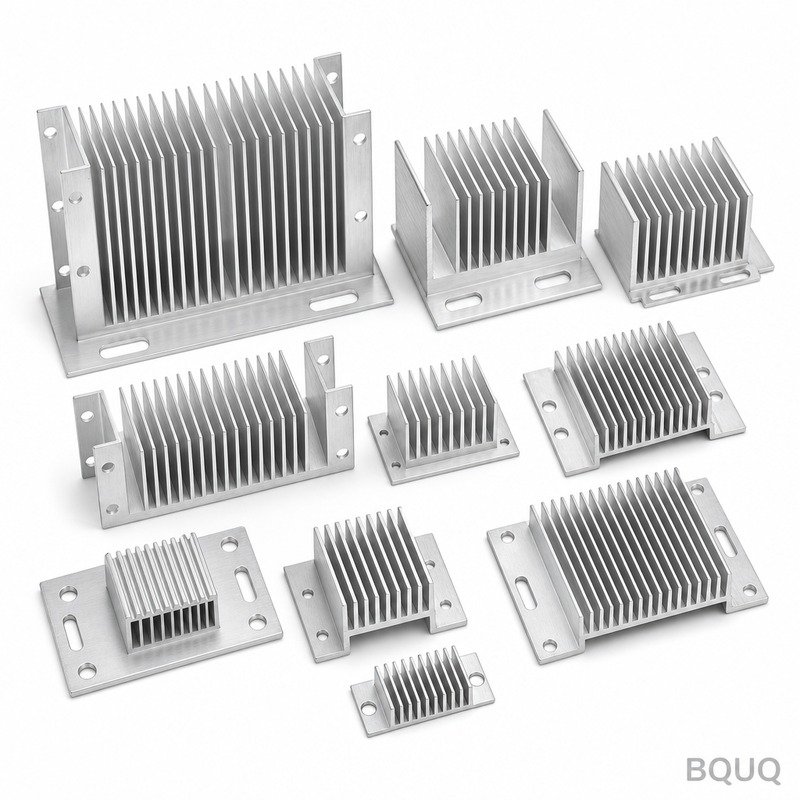
CNC machined heat sinks achieve a surface roughness of Ra 0.8–1.6 µm on fin surfaces, which directly improves thermal interface contact with airflow. The machining process removes material from a solid billet (typically 6061-T6 or 6063-T5 aluminum, or C11000 copper), allowing for fin thicknesses down to 0.5 mm with aspect ratios up to 40:1. Extruded heat sinks, by contrast, are formed by pushing heated aluminum billets (450–500°C) through a steel die, yielding fin thicknesses of 1.0–1.5 mm minimum and aspect ratios limited to approximately 10:1. Thermal performance testing at BQUQ shows that CNC machined designs with the same base dimensions outperform extruded equivalents by 15–25% in thermal resistance (°C/W) due to thinner fins and optimized fin spacing, which increases the total surface area by 30–40% within the same envelope.
How Does Cost per Unit Scale With Production Volume?
The economic crossover point between CNC machining and extrusion occurs between 300 and 800 units, depending on the complexity of the heat sink profile. A standard extrusion die costs between $800 and $2,500, and the per-unit cost drops dramatically after the die is amortized. CNC machining requires no tooling cost but carries a higher per-hour machine rate of $60–$120, translating to $8–$50 per heat sink depending on machining time (typically 15–60 minutes per part). For a 100 mm x 100 mm x 25 mm heat sink with 10 fins, a CNC machined unit costs approximately $15–$25, while the extruded version costs $3–$6 per unit after a one-time die investment of $1,200. To illustrate the total cost of ownership, consider the following comparison for a fixed annual demand of 5,000 units:
| Cost Parameter | CNC Machined Heat Sink | Extruded Heat Sink |
| Tooling cost | $0 | $1,200 (die amortized over 5,000 units = $0.24/unit) |
| Material cost per unit (6061-T6) | $4.50 | $2.80 |
| Machining/labor cost per unit | $12.00 | $0.50 (sawing and secondary operations) |
| Surface treatment (anodize) | $1.50 | $1.50 |
| Total unit cost | $18.00 | $5.04 |
| Total annual cost for 5,000 units | $90,000 | $25,200 |
| Lead time for first article | 3–5 days | 15–25 days (die fabrication 10–15 days) |
| Achievable tolerance (fin spacing) | ±0.02 mm | ±0.15 mm |
Why Does Thermal Performance Depend on the Choice of Manufacturing Method?
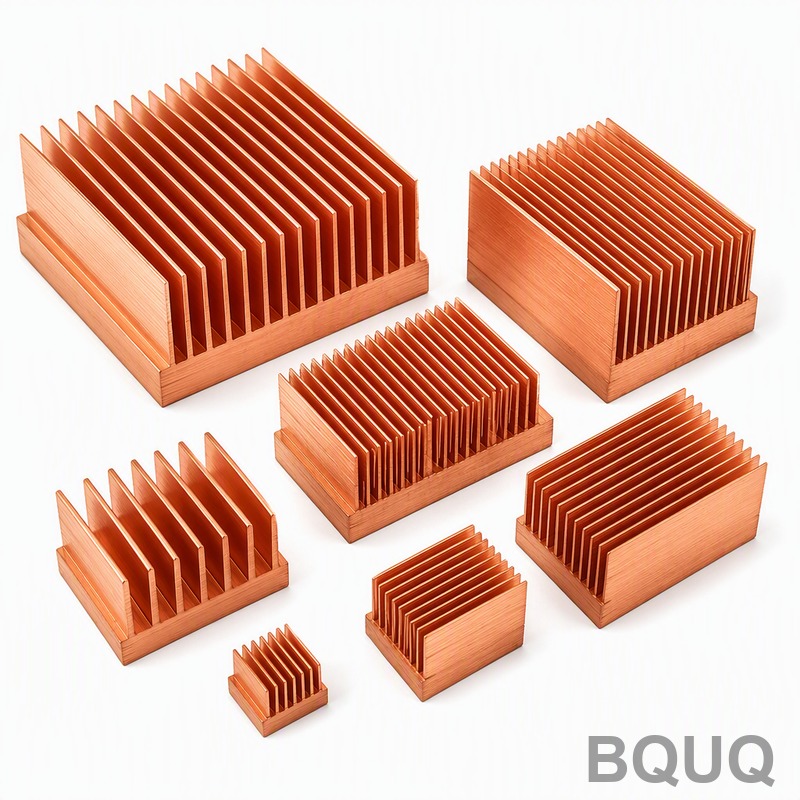
Thermal performance is governed by convective surface area, fin efficiency, and material thermal conductivity, all of which are constrained by the manufacturing process. CNC machining permits fin gaps as narrow as 1.5 mm, which increases the fin density per unit width and enhances the heat transfer coefficient by promoting turbulent airflow at velocities of 2–5 m/s. Extruded heat sinks, due to die strength limitations, require minimum fin gaps of 3.5–4.0 mm, reducing the fin count by nearly half for the same base footprint. Furthermore, CNC machining can produce a tapered fin profile (thicker at the base, thinner at the tip) that maximizes fin efficiency; a tapered fin of 1.0 mm base thickness and 0.5 mm tip thickness achieves 95% fin efficiency versus 85% for a constant 1.2 mm thick extruded fin. For high-heat-flux applications exceeding 50 W/cm², CNC machined copper heat sinks (thermal conductivity 399 W/m·K) are the industry standard, while extruded aluminum cannot handle fluxes above 25 W/cm² without active cooling.
When Should You Choose CNC Machining Over Extrusion?
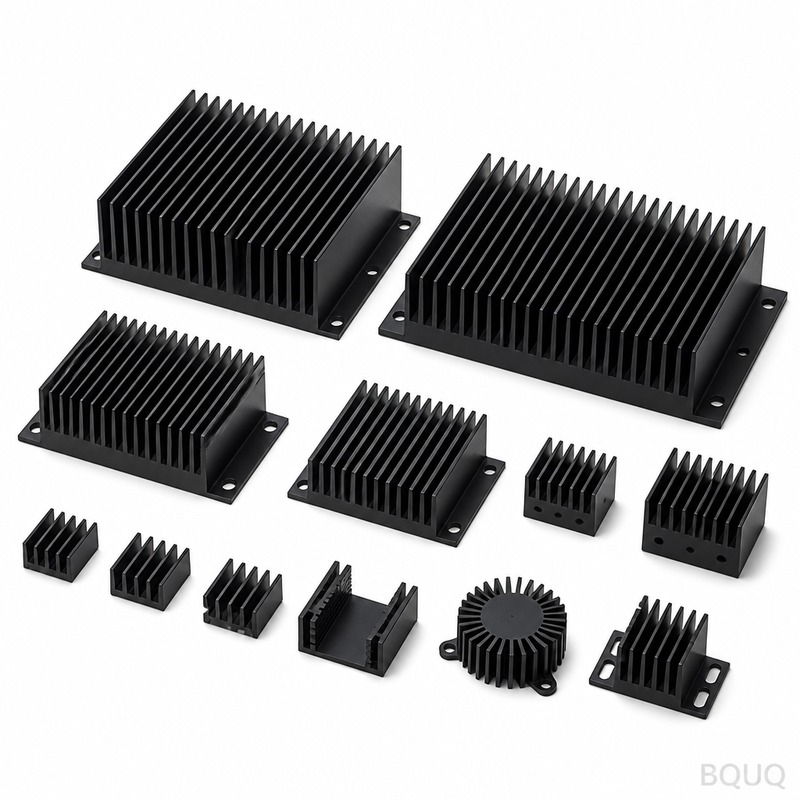
Choose CNC machining when your design requires any of the following: a non-uniform cross-section (e.g., stepped bases, mounting bosses, or integrated spring-loaded clips), blind holes or threaded inserts for direct component mounting, heat pipes or vapor chambers embedded into the base, or production quantities below 500 units. CNC machining is also the preferred method for rapid prototyping and design validation, offering 3–5 day lead times for first articles, which is 5 times faster than extrusion die fabrication. Additionally, CNC machining allows for the use of high-performance materials such as copper, copper-tungsten (for CTE matching with ceramic substrates), and even aluminum silicon carbide (AlSiC, 170–200 W/m·K) for aerospace and automotive power electronics. If your application is an LED driver, a MOSFET bridge, or a compact DC-DC converter with a board space of under 50 mm x 50 mm, CNC machining is almost always the right answer because extrusion tooling costs cannot be justified at these small sizes.
When Should You Choose Extrusion Over CNC Machining?
Choose extrusion when you have a high-volume production run (1,000+ units annually), a constant cross-section along the entire length, and a thermal budget that allows for slightly lower performance. Extruded heat sinks are ideal for linear applications such as IGBT modules, rectifier bridges, and power supplies where the heat sink length can be cut to any specified dimension (from 50 mm to 6,000 mm) from a single extruded profile. The extrusion process offers excellent material utilization (nearly 100% of the billet is used), and the resulting 6063-T5 aluminum alloy provides 80% of the thermal conductivity of 6061-T6 at a 20% lower material cost. Furthermore, extrusion enables very long heat sinks (1 meter or more) that would be impossibly expensive to machine from a single billet due to material waste and machining time. For example, a 300 mm x 200 mm x 40 mm extruded profile for a solar inverter, produced at 2,000 units per year, costs $7.50 per unit versus $38 per unit if CNC machined, a fivefold cost reduction.
How Do Surface Finishes and Secondary Operations Compare?
CNC machined heat sinks typically undergo bead blasting (to achieve a uniform matte finish of Ra 1.6–3.2 µm) followed by black anodizing (MIL-A-8625 Type II, 8–12 µm thickness), which increases the emissivity to 0.85 and improves radiative heat transfer by 15–20% at elevated temperatures (80–120°C). Extruded heat sinks require a secondary sawing operation, deburring, and anodizing, but they can also be supplied with a clear or gold chromate conversion coating for corrosion resistance. CNC machining allows for the integration of complex features in the same operation: drilled and tapped mounting holes (M3, M4, M5), counterbored holes for socket-head screws, and even micro-channels for liquid cooling (0.8 mm width x 1.5 mm depth). Extrusion cannot produce these features in the die; they must be added as separate CNC machining operations afterwards, which partially negates the cost advantage of extrusion for parts requiring more than four secondary features. In practice, BQUQ recommends specifying a minimum of 2.0 mm wall thickness for any tapped hole in an extruded heat sink to prevent stripping, whereas CNC machined parts can safely accommodate tapped holes with 1.0 mm wall thickness.
Which Quality Control Measures Are Critical for Each Method?
For CNC machined heat sinks, critical inspection points include CMM (coordinate measuring machine) verification of fin pitch and parallelism, surface roughness measurement with a profilometer, and thermal resistance testing using a standardized cold plate method (per JEDEC JESD51-14). For extruded heat sinks, the primary quality concern is die wear over time; after 20,000–30,000 meters of extrusion, the die orifice enlarges by 0.1–0.2 mm, which increases fin thickness and reduces fin gap, degrading thermal performance. Therefore, BQUQ recommends a first-article inspection (FAI) for every new extrusion die, and then a periodic dimensional check every 500 kg of extruded material. Additionally, the extrusion process can introduce internal porosity or micro-cracks if the billet temperature exceeds 520°C or the extrusion speed exceeds 20 m/min for 6063 alloy, so ultrasonic testing is recommended for critical aerospace applications. For both methods, a 100% visual inspection for anodizing defects (burning, pitting, or uneven color) is mandatory, and a random sample of 5 parts per lot is tested for coating thickness using an eddy-current gauge.
What Is the Decision-Making Matrix for an Engineering Team?
To make the final decision, evaluate your application against four criteria: production volume (units/year), thermal dissipation requirement (watts), geometric complexity (cross-section uniformity), and cost target (USD per unit). If your volume is below 500 units and your thermal requirement exceeds 40 W, choose CNC machining. If your volume is above 2,000 units and your thermal requirement is below 30 W, choose extrusion. For the middle ground (500–2,000 units), calculate the break-even point using the formula: Break-even volume = Extrusion die cost / (CNC unit cost - Extrusion unit cost). For a typical case with a $1,500 die and a cost difference of $12 per unit, the break-even is 125 units, meaning extrusion is cheaper above this volume. However, if your design has any non-uniform features, this calculation is invalid and CNC is the only option. BQUQ can provide a free thermal simulation report (using ANSYS Icepak) for your specific heat load, airflow, and ambient temperature, which will confirm the required fin geometry and guide your manufacturing choice.
Frequently Asked Questions
Can Extruded Heat Sinks Be Machined After Extrusion for Better Performance?
Yes, extruded heat sinks can undergo post-extrusion CNC machining to add mounting holes, cut pockets, or create a stepped base, and this is a common practice called "fabricated" heat sinks. However, you cannot increase the fin height or reduce fin thickness after extrusion, so the base profile must be designed with the final dimensions in mind. This hybrid approach balances the low material cost of extrusion with the precision of CNC for critical features.
What Is the Maximum Fin Height That CNC Machining Can Achieve?
CNC machining can achieve fin heights up to 100 mm with a 6 mm diameter end mill, but the practical limit for a 1.0 mm thick fin is 40 mm due to tool deflection. For fins taller than 40 mm, the aspect ratio exceeds 40:1, causing vibration and poor surface finish; in such cases, a wire EDM or a skiving process is recommended instead.
How Does Anodizing Thickness Affect Heat Sink Performance?
A black anodized coating of 8–12 µm increases surface emissivity from 0.05 (bare aluminum) to 0.85, which improves radiative heat transfer by up to 20% at temperatures above 100°C. Thicker anodizing (25 µm, Type III hard coat) provides better wear resistance but reduces thermal conductivity by 5% due to the insulating oxide layer, so it is not recommended for high-flux applications.
What Is the Typical Lead Time for a Custom CNC Machined Heat Sink?
At BQUQ, a standard CNC machined heat sink prototype (1–10 pieces) ships in 3–5 days, and production quantities (100–500 pieces) ship in 7–10 days. This includes material procurement, CNC programming, machining, anodizing, and final quality inspection.
What Is the Typical Lead Time for a New Extrusion Die and First Article?
Extrusion die fabrication takes 10–15 days, followed by 2–3 days for the first extrusion trial and dimensional inspection. The complete first-article approval process typically takes 15–25 days from design freeze to approved sample.
Which Aluminum Alloy Is Best for Extruded Heat Sinks?
6063-T5 is the standard alloy for extruded heat sinks because it offers excellent extrudability (allowing thinner fins) and a thermal conductivity of 209 W/m·K. 6061-T6 is stronger but harder to extrude, resulting in thicker minimum fin profiles; it is used only when mechanical strength is the primary concern.
Can Copper Be Extruded Into Heat Sinks?
Copper extrusion is technically possible but extremely difficult due to copper's high melting point (1085°C) and rapid die wear; the die life is typically only 500–1,000 meters versus 30,000 meters for aluminum. For copper heat sinks, CNC machining or skiving is the standard manufacturing method, and BQUQ routinely produces CNC machined copper heat sinks with fin thicknesses of 0.8 mm and tolerances of ±0.05 mm.
BQUQ Precision Manufacturing, with 20 years of experience in CNC machining, metal stamping, springs, and heat sinks, can provide an engineering review of your thermal design within 24 hours. For a custom heat sink quote, send your 3D model (STEP or IGES) and thermal requirements to sc@bquq.com, or message us on WhatsApp at +86 13713157787. We offer a 12-hour quoting service with free DFM feedback, and we can manufacture both CNC machined and extruded heat sinks to your exact specification at our Dongguan factory. Visit www.bquq.com to download our thermal design guide and heat sink selection chart.