CNC Machining Aluminum vs Stainless Steel: Which Metal Is Right for Your Part?
For CNC machined parts, aluminum is the right choice for applications requiring rapid production, lightweight components, high thermal conductivity, and cost efficiency, while stainless steel is the right choice for applications demanding maximum strength, corrosion resistance, and wear endurance. If your part operates in a corrosive environment or faces high mechanical stress, choose stainless steel; if you prioritize speed, budget, and weight reduction, choose aluminum. This decision impacts your per-unit cost, lead time, and part longevity, so we break down the engineering data below.
What Are the Key Mechanical Property Differences Between Aluminum and Stainless Steel?
Aluminum alloys (typically 6061-T6 or 7075-T6) offer a yield strength of 276 MPa (40,000 psi) and 503 MPa (73,000 psi) respectively, while stainless steel grades (303, 304, 316) provide yield strengths from 207 MPa (30,000 psi) for annealed 304 to over 965 MPa (140,000 psi) for hardened 17-4 PH. Hardness differs significantly: aluminum 6061-T6 rates 95 on the Brinell scale (HB), whereas stainless steel 304 rates 123 HB, and 17-4 PH in H900 condition reaches 420 HB. For fatigue resistance, stainless steel outperforms aluminum by a factor of 1.5 to 2.0 in cyclic loading, making it superior for springs, shafts, and high-vibration components.
How Does Machinability Affect Cost and Lead Time for Each Metal?
Aluminum machines at 2 to 3 times faster cutting speeds than stainless steel, typically 300 to 600 m/min for aluminum versus 60 to 120 m/min for stainless steel, which directly reduces CNC machining time and cost. A standard aluminum part (100 mm x 100 mm x 25 mm) with moderate complexity takes approximately 15 minutes of machine time, costing between USD 15 and 25 per part in a high-volume run; the same part in stainless steel takes 35 to 45 minutes, costing USD 35 to 60 per part. Tool wear is the primary cost driver: carbide tools machining aluminum last for 2,000 to 3,000 parts, while the same tools machining stainless steel last only 200 to 400 parts, increasing tooling costs by a factor of 5 to 10.
Which Metal Offers Better Corrosion Resistance in Real-World Environments?
Stainless steel provides superior corrosion resistance, especially grades 316 and 304 which withstand salt spray exposure for over 1,000 hours in ASTM B117 testing, whereas aluminum 6061 requires anodizing to survive beyond 300 hours. In marine environments, 316 stainless steel exhibits a corrosion rate of less than 0.01 mm/year, while untreated aluminum corrodes at 0.1 to 0.5 mm/year, depending on alloy and surface treatment. For food processing, chemical handling, or outdoor architectural parts, stainless steel is mandatory; for dry indoor applications with minimal exposure, aluminum with a clear anodize coating (5 to 10 microns) offers adequate protection at a lower cost.
How Do Thermal and Electrical Conductivity Requirements Influence Material Selection?
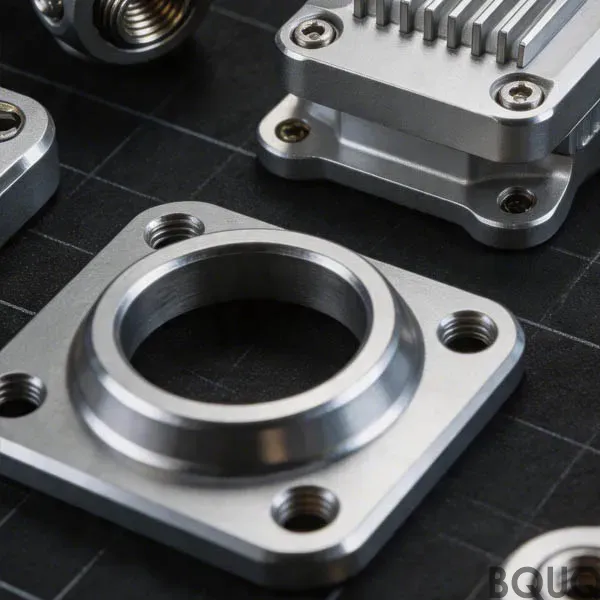
Aluminum 6061 conducts heat at 167 W/m·K and electricity at approximately 37.7 MS/m, while stainless steel 304 conducts heat at 16.2 W/m·K and electricity at 1.45 MS/m, meaning aluminum transfers heat 10 times better than stainless steel. If your part is a heat sink, LED housing, or electronic enclosure, aluminum is the only logical choice; BQUQ produces CNC machined heat sinks in aluminum 6061-T6 with a thermal conductivity of 180 W/m·K and achieves fin thickness down to 0.8 mm with a 0.05 mm tolerance. Conversely, stainless steel is selected for components requiring thermal insulation or high-temperature resistance, as it maintains structural integrity up to 870°C continuous use, while aluminum loses strength above 150°C.
What Surface Finishing Options Are Available for Each Metal?
Aluminum parts can receive Type II anodizing (5 to 25 microns) in clear, black, or custom colors, hard anodizing (25 to 50 microns) for wear resistance, and chromate conversion for electrical grounding, with anodizing adding USD 0.50 to 2.00 per part depending on surface area. Stainless steel can be electropolished to achieve a surface roughness of Ra 0.2 to 0.4 microns, passivated to remove free iron and enhance corrosion resistance, or mechanically bead-blasted for a uniform matte finish. A critical difference: aluminum cannot be easily welded after anodizing without stripping the coating, while stainless steel can be welded, ground, and re-passivated in post-machining operations.
When Should You Choose Aluminum Over Stainless Steel for Your Specific Application?
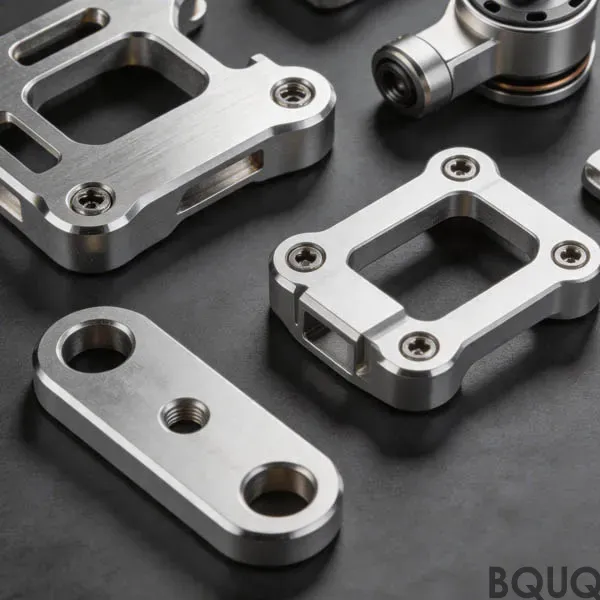
Choose aluminum when your part weight must be under 2 kg, when your production volume exceeds 500 units, when your budget is below USD 30 per part, or when your component requires rapid thermal dissipation. Specific examples include drone frames, automotive brackets, robotic arms, camera housings, and all types of heat sinks. BQUQ has produced aluminum CNC machined parts with tolerances of +/- 0.02 mm on critical features and surface finishes of Ra 0.8 microns, achieving a 95% first-pass yield rate on runs of 10,000 pieces.
When Should You Choose Stainless Steel Over Aluminum for Your Specific Application?
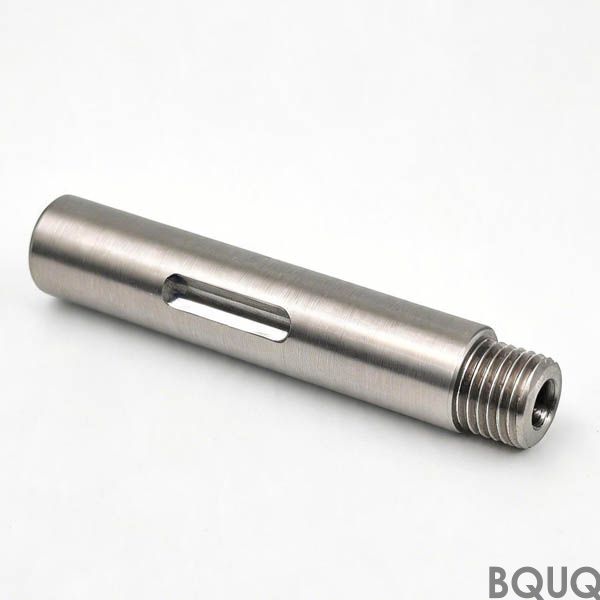
Choose stainless steel when your part operates in a saltwater, chemical, or medical environment, when it must withstand temperatures above 200°C, when it requires a hardness above 200 HB, or when it must maintain dimensional stability under heavy loads. Examples include surgical instruments, marine fittings, valve bodies, pump shafts, and structural aerospace components. For stainless steel parts, BQUQ recommends grade 303 for high-speed machining of simple geometries, grade 304 for general-purpose corrosion resistance, and 17-4 PH for applications requiring yield strength above 1,000 MPa.
How Do Fabrication and Post-Processing Costs Compare Between the Two Metals?
A comparative cost analysis for a typical bracket part (150 g finished weight, 200 mm x 50 mm x 10 mm) shows that material cost for aluminum 6061 is approximately USD 3.50 per kg versus USD 6.00 per kg for stainless steel 304, but the machining cost ratio is more significant. The table below summarizes the key differences for a production run of 1,000 parts:
| Parameter | Aluminum 6061-T6 | Stainless Steel 304 |
| Material Cost per kg | USD 3.50 | USD 6.00 |
| Machining Time per Part | 15 minutes | 40 minutes |
| Machine Hourly Rate | USD 60 per hour | USD 60 per hour |
| Machining Cost per Part | USD 15.00 | USD 40.00 |
| Tool Life (carbide) | 2,500 parts | 300 parts |
| Surface Finish (as-machined) | Ra 0.8 microns | Ra 1.6 microns |
| Achievable Tolerance | +/- 0.01 mm | +/- 0.02 mm |
| Weight per Part | 0.15 kg | 0.45 kg |
| Corrosion Resistance (salt spray) | 300 hours (anodized) | 1,000+ hours (passivated) |
| Maximum Service Temperature | 150°C | 870°C |
What Are the Practical Recommendations for Selecting the Right Metal?
Engineers should first define the operating environment, specifically humidity, chemical exposure, and temperature range, and then calculate the required yield strength and fatigue life for the part. If both metals meet the mechanical requirements, request a DFM (Design for Manufacturing) review from BQUQ, as our engineering team can often reduce part weight by 30% through ribbing and pocketing in aluminum, or reduce wall thickness in stainless steel to lower material cost. For prototypes, we recommend aluminum 6061-T6 due to its 2-day lead time and lower cost, then validate the design before committing to stainless steel production tooling. Always specify a surface treatment for aluminum (anodizing) and stainless steel (passivation) to maximize lifespan, and provide a tolerance of +/- 0.1 mm on non-critical dimensions to reduce machining time by up to 20%.
How Does Weight Impact Material Choice for Moving Parts?
Weight directly affects inertia, energy consumption, and structural loading, where aluminum has a density of 2.70 g/cm³ versus stainless steel at 7.90 g/cm³, making aluminum 65% lighter for the same volume. For moving components like robotic arms, spindles, or automotive linkages, reducing mass by using aluminum can lower energy costs by 15 to 20% and reduce bearing wear.
Can Stainless Steel Be Anodized Like Aluminum?
No, stainless steel cannot be anodized because the process relies on aluminum's natural oxide layer formation, but stainless steel can be passivated, electropolished, or coated with PVD (Physical Vapor Deposition) for colored or hardened finishes. For wear resistance, stainless steel can also be nitrided to achieve a surface hardness of 1,200 HV.
Which Stainless Steel Grade Is Best for CNC Machining?
Grade 303 is the best for machining due to its added sulfur content, which improves chip breakage and reduces tool wear, allowing cutting speeds up to 120 m/min. Grade 304 is more corrosion-resistant but slightly harder to machine, while 17-4 PH offers the best combination of machinability in the annealed state and high strength after heat treatment.
What Is the Typical Lead Time for Aluminum vs Stainless Steel Parts?
At BQUQ, standard aluminum CNC machining lead time is 5 to 7 days for quantities up to 500 parts, while stainless steel requires 7 to 10 days due to slower machining speeds. For urgent requirements, expedited 3-day delivery is available for aluminum parts with a 20% surcharge, and 5-day delivery for stainless steel.
How Does Surface Roughness Affect Part Performance in Each Metal?
A smoother surface finish (Ra 0.4 microns) reduces friction and wear in sliding applications, but achieving this on stainless steel costs 30% more due to longer polishing times. Aluminum can achieve Ra 0.2 microns with diamond turning, but this finish is typically only necessary for optical or sealing surfaces.
Can I Weld CNC Machined Aluminum and Stainless Steel Parts?
Aluminum can be welded using TIG or MIG processes, but requires cleaning of the oxide layer and the use of argon shielding gas, and the heat-affected zone will have reduced strength. Stainless steel is easier to weld with standard TIG or MIG, but 303 grade is not recommended for welding due to its sulfur content, which causes hot cracking.
What Are the Environmental and Recycling Considerations for Each Metal?
Aluminum is infinitely recyclable and requires only 5% of the energy of primary production, making it a preferred choice for sustainability-focused projects, while stainless steel also has high recyclability, with over 80% of new stainless steel containing recycled content. Both metals are non-toxic and safe for food contact when properly treated, but aluminum recycling is more economically viable due to its higher scrap value per weight.
For a definitive material selection for your next CNC machining project, send your 3D model and performance requirements to BQUQ for a free engineering review. Our team in Dongguan, China, with 20 years of experience in CNC machining, metal stamping, springs, and heat sinks, will provide a detailed comparison of cost, lead time, and manufacturability for both aluminum and stainless steel within 12 hours. Contact us at sc@bquq.com or WhatsApp +86 13713157787, or visit www.bquq.com to start your quote today.