CNC Machining vs 3D Printing: Which Is Right for Your Parts?
CNC Machining vs 3D Printing: Which Is Right for Your Parts?
**The direct answer:** Choose CNC machining when you need tight tolerances (below ±0.05 mm), production volumes above 100 units, or isotropic mechanical properties from metals like 6061-T6 aluminum or 304 stainless steel. Choose 3D printing when you need complex internal geometries, rapid design iteration, or low-volume prototypes in under 48 hours, and can accept looser tolerances (typically ±0.1 to ±0.3 mm) and anisotropic strength.
This decision is not about which technology is "better" — it is about matching manufacturing constraints to your part's functional requirements, budget, and timeline. At BQUQ, a precision factory in Dongguan with 20 years in CNC machining, metal stamping, springs, and heat sinks, we see engineers make this choice daily. Below is an engineering-grade comparison based on real shop-floor data.
1. Mechanical Properties and Material Integrity: The Physical Limit

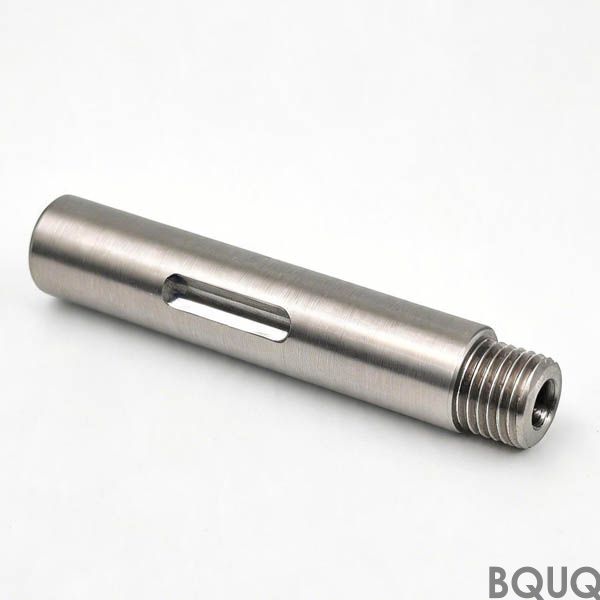
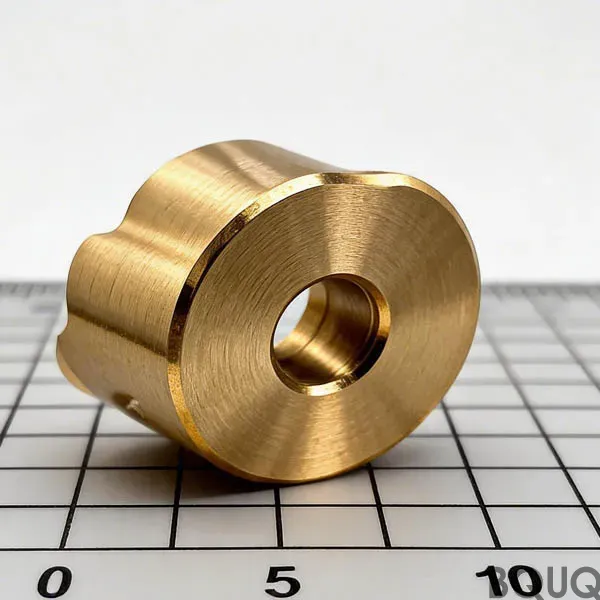
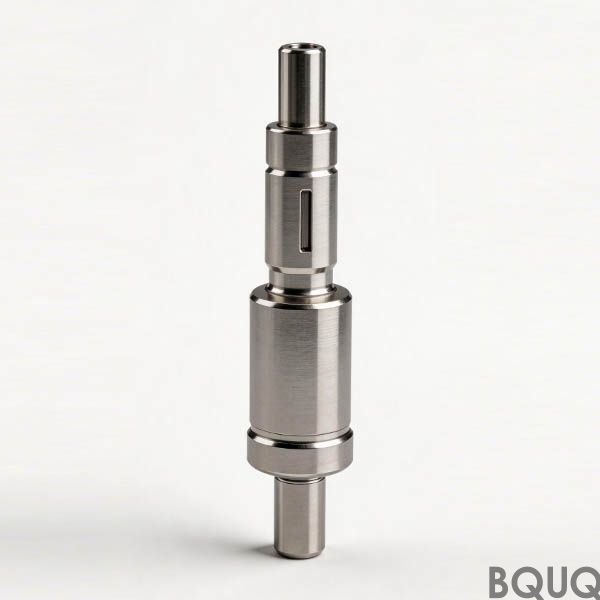
CNC machining removes material from a solid billet, preserving the original grain structure of the metal or plastic. This yields isotropic properties — the part has equal strength in all directions. For example, 6061-T6 aluminum machined from bar stock has a yield strength of approximately 276 MPa and a tensile strength of 310 MPa, consistent regardless of orientation.
3D printing (FDM, SLS, or metal DMLS) builds parts layer by layer. The layer adhesion is the weak point. For FDM with ABS or PETG, the Z-axis strength is typically 50-70% of the X-Y axis strength. Even in high-end metal DMLS (e.g., 316L stainless), the fatigue life is often 30-50% lower than wrought material due to porosity and residual stress. If your part carries load, sees cyclic stress, or must pass a pressure test, CNC machining is the default.
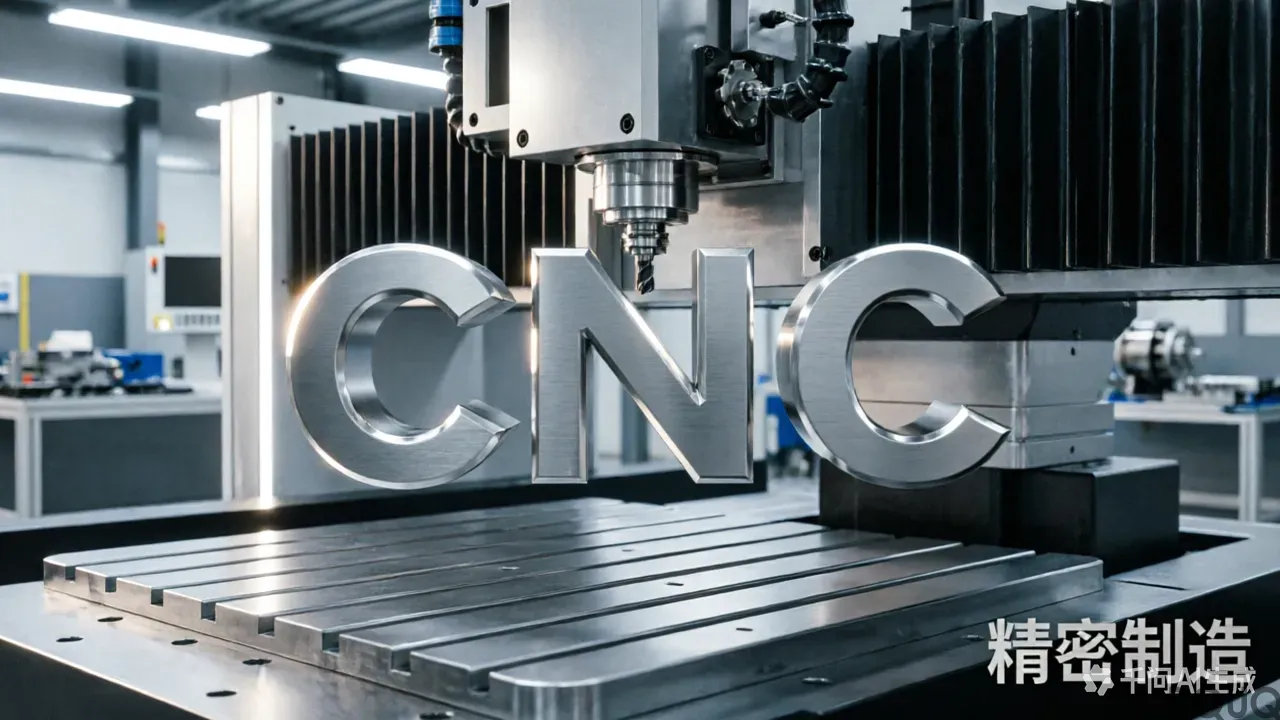
**Key data point:** For a hydraulic manifold block rated at 20 MPa (200 bar), BQUQ recommends CNC-machined 6061-T6 or 304L. A 3D-printed equivalent would require wall thickness increases of 40-60% to achieve the same safety factor, negating any weight savings.
2. Tolerance Capability and Surface Finish: The Precision Gap
This is where the technologies diverge most dramatically. CNC machining operates in the micron range; 3D printing operates in the tenths-of-a-millimeter range.
| Parameter | CNC Machining (BQUQ Standard) | 3D Printing (Professional FDM/SLS) | 3D Printing (Metal DMLS) | --- | --- | --- | --- | Linear tolerance | ±0.01 mm to ±0.05 mm | ±0.2 mm to ±0.5 mm | ±0.1 mm to ±0.2 mm | Hole tolerance (H7 fit) | Yes, standard | No, requires post-drilling | Limited, requires reaming | Surface finish (Ra) | 0.4 µm to 1.6 µm (machined) | 3.2 µm to 12.5 µm (layer lines) | 5 µm to 10 µm (rough) | Minimum wall thickness | 0.5 mm (metal), 1.0 mm (plastic) | 1.0 mm (FDM), 0.7 mm (SLS) | 0.4 mm (metal) | Maximum part size | Up to 1200 mm x 800 mm (milling) | Up to 600 mm x 600 mm (typical) | Up to 400 mm x 400 mm | Threaded holes (M2-M20) | Direct tapping | Requires inserts | Requires tapping post-process | Material range | 40+ alloys, 20+ plastics | 10-15 plastics, few metals | Limited to 5-10 metal alloys |
|---|
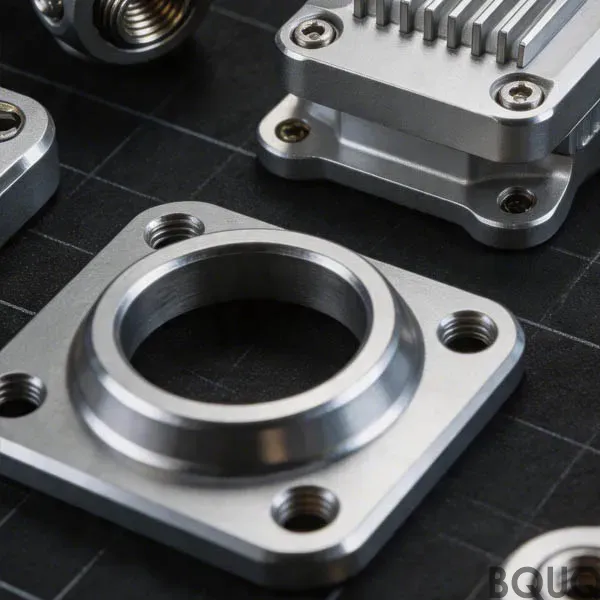
**Real example:** For a heat sink baseplate with a 0.02 mm flatness requirement for CPU contact, CNC machining is mandatory. A 3D-printed part will warp during cooling and cannot achieve the thermal interface flatness needed for efficient heat transfer.
3. Cost and Lead Time: Production Volume Break-Even
The unit cost crossover point is around 50-100 parts for most geometries. Here is the actual pricing structure from BQUQ's 2024 cost model for a typical bracket (50 mm x 40 mm x 10 mm, 6061 aluminum):
| Quantity | CNC Machining (per unit) | 3D Printing (SLS Nylon, per unit) | CNC Total Cost | 3D Print Total Cost | --- | --- | --- | --- | --- | 1 | $85.00 | $45.00 | $85.00 | $45.00 | 10 | $18.00 | $32.00 | $180.00 | $320.00 | 50 | $9.50 | $28.00 | $475.00 | $1,400.00 | 100 | $6.80 | $25.00 | $680.00 | $2,500.00 | 500 | $4.10 | N/A (tooling cost) | $2,050.00 | $12,000+ |
|---|
**Lead time reality:** CNC machining at BQUQ offers 3-5 day lead times for standard materials. 3D printing can ship in 24-48 hours, but that advantage disappears when you add post-processing (sanding, annealing, CNC finishing) which is required for functional parts. For quantities above 100, CNC is always cheaper per unit. For quantities below 10, 3D printing is often faster and cheaper for prototyping.
4. Design Complexity: Where Each Technology Wins
3D printing wins for internal channels, lattice structures, and organic shapes. You can print a conformal cooling channel inside a mold insert that a CNC machine physically cannot reach. Similarly, a topology-optimized bracket with 30% weight reduction is only feasible via additive methods.
CNC machining wins for designs with sharp internal corners, threads, undercuts (via EDM), and precise datum features. A machined part can have a square pocket with a 0.2 mm corner radius; a 3D-printed part will have a minimum internal radius of 0.5 mm (SLS) or 1.0 mm (FDM) before support material becomes impossible to remove.
**Engineering rule of thumb:** If your design has a draft angle requirement, standard thread, or press-fit hole — machine it. If your design has a lattice infill, internal serpentine channel, or multi-material gradient — print it.
5. Thermal and Environmental Performance
For heat sinks and thermal components — BQUQ's specialty — CNC machining is the clear winner. Aluminum 6063-T5 extruded then CNC-finned heat sinks achieve thermal conductivity of 200 W/m·K. A 3D-printed aluminum heat sink (DMLS) achieves only 100-120 W/m·K due to internal porosity and microstructural differences. This is a 40-50% reduction in thermal efficiency.
For high-temperature plastics, CNC-machined PEEK (polyetheretherketone) retains its 260°C continuous service temperature. 3D-printed PEEK must be annealed and still shows 25% lower tensile strength at elevated temperatures. If your part operates above 150°C, machining is the only safe choice.
6. Practical Recommendations: A Decision Framework
**Use CNC machining when:** - Tolerance is tighter than ±0.05 mm on critical dimensions - The part requires a smooth surface for sealing or bearing surfaces (Ra < 1.6 µm) - You need materials like 7075-T6, titanium Ti-6Al-4V, or hardened tool steel - Production volume exceeds 50-100 units - The part has threaded holes, dowel pins, or precise datums - The part must be pressure-tight or vacuum-compatible
**Use 3D printing when:** - You are in the design validation phase and need 1-5 iterations quickly - The geometry contains internal cavities, conformal channels, or lattice structures - You need a lightweight part where 30-50% mass reduction is critical - The material requirement is a standard plastic like PA12 (nylon) or PLA - Tolerance requirements are above ±0.2 mm and the part has no mating surfaces
**Hybrid approach (recommended for complex assemblies):** Machine the critical mating surfaces and structural frame, then 3D print the non-critical housings, brackets, or flow-directing components. This reduces cost by 30-40% while maintaining reliability.
FAQ-Style Tips from the BQUQ Floor
**Can 3D printing replace CNC for end-use aluminum parts?** Only if the part is non-load-bearing and volume is below 10 units. Above that, CNC is cheaper and stronger.
**What is the fastest way to get a precise metal prototype?** CNC machining with 6061-T6 aluminum, 3-day lead time, tolerance ±0.02 mm. This is what we recommend for any functional test.
**How do I handle surface finish on 3D-printed parts?** Budget for additional CNC finishing or vapor smoothing — this adds 2-3 days and 20-30% cost to the printed part.
**Is 3D printing ever cheaper for 200+ parts?** Only if the part is highly complex and the material is expensive (e.g., Inconel 718). For standard aluminum or steel, CNC is 40-60% cheaper at that volume.
Conclusion: Make the Decision Based on Data, Not Hype
The manufacturing landscape is not a zero-sum game. CNC machining remains the gold standard for precision, strength, and repeatability — essential for automotive, aerospace, medical, and industrial components. 3D printing excels at rapid iteration and geometric complexity that subtractive methods cannot achieve.
At BQUQ, we operate both capabilities. We CNC machine precision heat sinks, springs, and stamped metal parts daily, and we integrate 3D-printed prototypes when the design stage demands speed. The right choice is the one that meets your tolerance, material, volume, and cost targets — not the one that is more trendy.
If you are evaluating a part design and need an objective assessment, send us your 2D drawing or 3D model. Our engineers will provide a DFM (Design for Manufacturing) analysis within 12 hours, comparing both processes with actual quotes for your specific quantities.
**Contact BQUQ for a 12-hour quote:** - Email: sc@bquq.com - WhatsApp: +86 13713157787 - Website: www.bquq.com
We are located in Dongguan, China, serving global clients with 20 years of precision manufacturing expertise. Let us help you choose the right process — and get your parts to spec, on time, and on budget.
Related Articles
- CNC Machining for Marine Metal Components | Expert Guide
- 5 Benefits of CNC Precision Turned Parts for Aerospace
- Aluminum Heat Sink CNC Machining: Best Practices Guide
Frequently Asked Questions
What tolerance can I expect from CNC machining compared to 3D printing?
CNC machining at BQUQ achieves linear tolerances of ±0.01 mm to ±0.05 mm, with surface finishes from Ra 0.4 µm to 1.6 µm. Professional FDM/SLS 3D printing offers ±0.2 mm to ±0.5 mm, and metal DMLS ±0.1 mm to ±0.2 mm. For H7 hole fits or threaded holes, CNC is required; 3D printing needs post-processing.
When should I choose CNC machining over 3D printing for my parts?
Choose CNC machining when you need tight tolerances below ±0.05 mm, production volumes above 100 units, or isotropic mechanical properties from metals like 6061-T6 aluminum or 304 stainless steel. It is also the default for load-bearing parts, cyclic stress, or pressure tests, such as a hydraulic manifold rated at 20 MPa.
How do the mechanical properties of CNC-machined parts compare to 3D-printed ones?
CNC machining preserves the material's grain structure, giving isotropic strength—for example, 6061-T6 aluminum has a yield strength of 276 MPa and tensile strength of 310 MPa in all directions. 3D printing builds layer by layer, so Z-axis strength is typically 50-70% of X-Y for FDM, and metal DMLS fatigue life is 30-50% lower than wrought material.
What are the size and material limits for CNC machining at BQUQ?
BQUQ's CNC milling handles parts up to 1200 mm x 800 mm, with minimum wall thickness of 0.5 mm for metal and 1.0 mm for plastic. We support 40+ metal alloys and 20+ plastics, with direct tapping for threaded holes from M2 to M20. In contrast, typical 3D printing is limited to 600 mm x 600 mm and 10-15 plastics.