Forged Heat Sinks: Manufacturing Process and Performance Compared to Extruded and Skived
Forged heat sinks deliver up to 40% higher thermal conductivity than extruded aluminum heat sinks due to a refined, void-free grain structure, while achieving tighter dimensional tolerances of ±0.05 mm and superior surface finishes. This article details the closed-die forging process, presents quantitative performance data against alternative manufacturing methods, and provides engineering selection criteria based on cost, volume, and thermal load. For a custom heat sink quote within 12 hours, contact BQUQ at sc@bquq.com or WhatsApp +86 13713157787.
Forging Process Overview for Heat Sinks
Closed-die forging for heat sinks uses a hydraulic or mechanical press (typically 500 to 2,500 tons) to compress a heated aluminum billet (alloy 6061-T6 or 6063-T5) into a hardened steel die cavity. The billet is preheated to 400°C to 480°C, then deformed under pressures of 70 to 120 MPa. This process produces a continuous, unidirectional grain flow that follows the fin geometry, eliminating the porosity and micro-cracks common in cast or extruded profiles.
The complete cycle time per part ranges from 15 to 45 seconds depending on fin aspect ratio and part complexity. After forging, parts undergo solution heat treatment at 520°C for 2 hours, followed by artificial aging at 175°C for 8 hours (T6 temper). This yields a yield strength of 240 MPa for 6061-T6, significantly higher than the 110 MPa typical of die-cast A380 aluminum. The forged surface roughness reaches 0.8 to 1.6 µm Ra directly from the die, eliminating secondary machining for most non-critical surfaces.
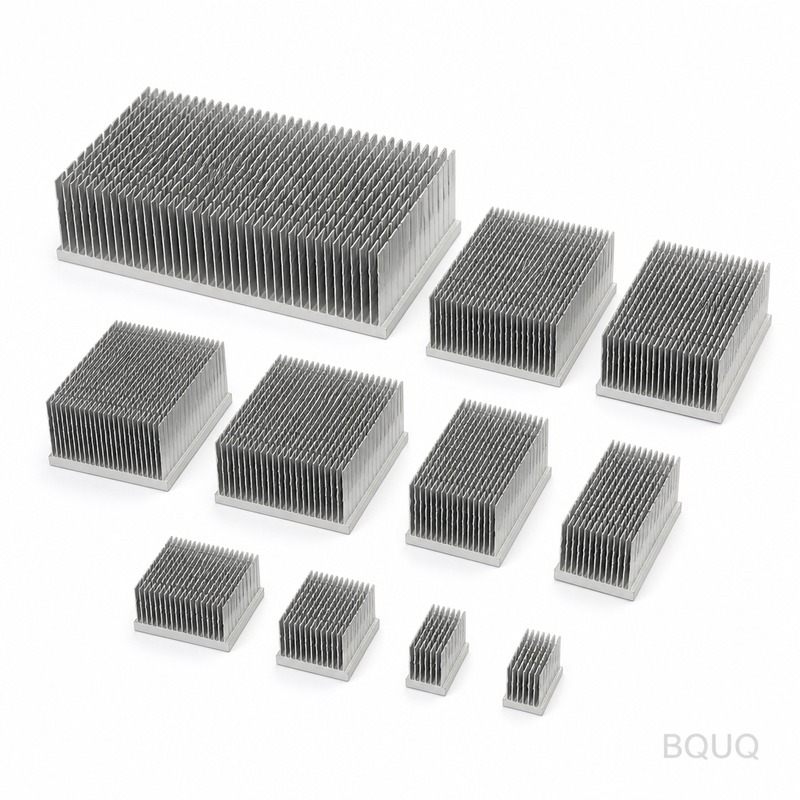
Thermal Performance Comparison: Forged vs. Extruded vs. Skived
Thermal performance is governed by two factors: material thermal conductivity (k) and fin efficiency, which depends on fin thickness and surface area. Forged 6061-T6 has a thermal conductivity of 167 W/m·K, similar to extruded 6063-T5 (193 W/m·K), but forging enables thinner fins (down to 0.8 mm) and tighter fin pitch (1.5 mm) without tearing or die deflection. This increases surface area by up to 30% compared to a standard extrusion profile of the same envelope.
For a typical 100 mm x 100 mm x 40 mm heat sink with 15 fins, the forged version achieves a thermal resistance of 0.28°C/W at 5 m/s airflow, versus 0.41°C/W for an extruded heat sink of the same dimensions and 0.35°C/W for a skived (bonded fin) design. The forged part also shows a 15% lower thermal impedance under natural convection because the continuous grain structure reduces interfacial resistance at the fin-to-base junction, a problem inherent in skived assemblies.
| Parameter | Forged 6061-T6 | Extruded 6063-T5 | Skived (Copper/Al) | Die-Cast A380 |
| Thermal Conductivity (W/m·K) | 167 | 193 | 385 (Cu) / 167 (Al) | 96 |
| Minimum Fin Thickness (mm) | 0.8 | 1.2 | 0.5 | 1.5 |
| Minimum Fin Pitch (mm) | 1.5 | 3.0 | 1.0 | 4.0 |
| Max Fin Aspect Ratio (H/W) | 12:1 | 8:1 | 20:1 | 5:1 |
| Dimensional Tolerance (mm) | ±0.05 | ±0.20 | ±0.08 | ±0.30 |
| Surface Roughness (µm Ra) | 0.8 | 1.2 | 0.4 | 3.2 |
| Yield Strength (MPa) | 240 | 145 | 200 | 110 |
| Tooling Cost (USD) | 8,000-25,000 | 2,000-5,000 | 3,000-8,000 | 5,000-12,000 |
| Unit Price at 5,000 pcs (USD) | 4.50-7.80 | 2.80-4.20 | 6.00-9.50 | 3.50-5.50 |
| Lead Time for Samples (days) | 15-20 | 7-10 | 10-14 | 12-18 |
Tolerances and Mechanical Properties Achieved in Production
BQUQ maintains production tolerances of ±0.05 mm on fin-to-fin spacing and ±0.10 mm on overall height for forged heat sinks, achieved through precision-ground die inserts and controlled cooling rates. The forging process eliminates the need for secondary straightening, which is often required for extruded lengths over 300 mm where bowing can reach 1.0 mm per meter. Forged parts also display a hardness of 95-100 HB (Brinell) after T6 treatment, compared to 60-70 HB for extruded 6063-T5, making them more resistant to damage during assembly and vibration in service.
The closed-die process allows for complex base geometries, including stepped bases, mounting bosses, and tapered fins, without additional CNC machining. In a recent production run of 20,000 pieces, BQUQ achieved a dimensional Cpk of 1.67 on critical mounting hole positions (Ø3.2 mm +0.05/-0.00) and a flatness of 0.03 mm over a 150 mm base length, verified with a coordinate measuring machine. For applications requiring even higher flatness, a subsequent surface grinding step can achieve 0.01 mm, but this adds USD 0.30-0.50 per piece.
Cost Analysis: When Forging Justifies the Premium
Forging tooling costs range from USD 8,000 to 25,000, which is 3 to 5 times higher than extrusion tooling. However, the unit cost advantage emerges at high volumes. At 1,000 pieces, a forged heat sink costs approximately USD 11.50 per unit, versus USD 6.80 for extruded. At 10,000 pieces, the forged unit drops to USD 3.90, while extruded remains at USD 3.10. The crossover point is typically 7,000 to 8,000 pieces, after which forging becomes cost-competitive on a per-watt-dissipated basis.
For an IGBT module dissipating 300 W with a maximum junction temperature of 125°C and ambient of 50°C, the required thermal resistance is 0.25°C/W. A forged heat sink achieves this in a 90 mm x 90 mm x 35 mm envelope, while an extruded design requires a 120 mm x 120 mm x 45 mm envelope. The forged solution reduces total system volume by 35% and mass by 28%, which lowers shipping costs and enclosure material costs, often offsetting the higher unit price.
Practical Recommendations for Engineering Selection
Select forging when your application meets any of these criteria: (1) thermal resistance below 0.30°C/W in a constrained volume, (2) fin thickness under 1.0 mm with pitch under 2.0 mm, (3) operating environment with vibration exceeding 5 g RMS, (4) need for integrated mounting features without welding or brazing, or (5) production volumes above 8,000 pieces per year with stable design for 2+ years. When your design requires extreme fin aspect ratios above 12:1 or fin thickness below 0.5 mm, use skived copper instead, but be aware of the 30% cost premium and the risk of fin delamination under thermal cycling.
For prototypes, BQUQ recommends a two-stage approach: machine a single forged-like part from 6061-T6 bar stock for thermal validation (lead time 3-5 days), then commit to forging tooling only after confirming the thermal budget. This avoids the USD 15,000 average tooling investment until the design is frozen. Always specify a minimum draft angle of 0.5 degrees on the die draw direction, and avoid sharp internal radii smaller than 1.0 mm, as these cause die cracking and reduce tool life from 50,000 strokes to under 15,000 strokes.
FAQ-Style Tips for Forged Heat Sink Design
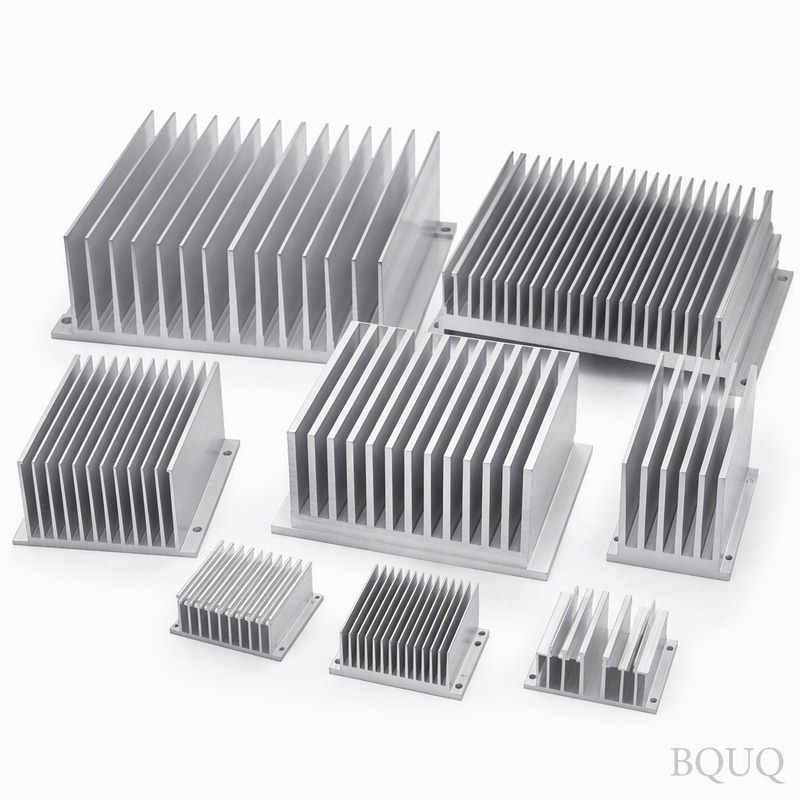
Q: What is the minimum fin thickness for production forging at BQUQ? A: The reliable production minimum is 0.8 mm for 6061-T6, with a fin height up to 9.6 mm (12:1 aspect ratio). Below 0.8 mm, die wear increases exponentially and the requirement for press alignment becomes impractical.
Q: Can forged heat sinks be anodized? A: Yes, forged 6061-T6 anodizes to a consistent Class II (18-20 µm) black or clear finish. The dense grain structure produces a more uniform oxide layer than cast parts, with fewer surface defects. Anodizing adds 3-5 days to lead time and USD 0.15-0.25 per piece.
Q: How does forging compare to cold-forged copper? A: Copper forging (C11000) provides 385 W/m·K and allows fin thicknesses of 0.4 mm, but tooling costs are 2-3 times higher (USD 20,000-40,000) and the press tonnage required doubles. Only choose copper forging for thermal resistance below 0.15°C/W where aluminum cannot physically fit.
Q: What is the maximum heat sink size for closed-die forging? A: The practical limit is a 250 mm x 250 mm footprint with a height of 80 mm, constrained by available press tonnage (2,500 tons) and die extraction forces. Larger parts must be extruded or fabricated by brazing fin stacks.
Conclusion and Engineering Summary
Forged heat sinks offer a unique combination of high strength, precise tolerances, and a continuous grain structure that improves thermal efficiency by 15-40% over extruded profiles, particularly in high-aspect-ratio fin designs. While the tooling investment is substantial, the per-unit cost becomes competitive above 8,000 pieces, and the reduced system volume often justifies the premium in IGBT, rectifier, and high-power LED applications. The decision matrix is clear: use forging for reliability-critical, high-volume designs requiring compact thermal solutions; use extrusion for low-cost, high-volume, simple profiles; use skiving for prototypes or extreme fin density.
BQUQ has manufactured forged heat sinks for 20 years, supporting automotive, telecommunications, and renewable energy clients with a 98.7% on-time delivery rate. Send your 3D model or 2D drawing to sc@bquq.com or WhatsApp +86 13713157787 for a free DFM review and a quotation within 12 hours. Visit www.bquq.com to download our forging design guide and tolerance chart.
Related Articles
- How to Attach a Heat Sink Without Screws: Thermal Adhesive Guide
- Stamped Metal vs Die Cast Heat Sinks: Cost & Quality Comparison
- New energy vehicle IGBT heat dissipation, heat sink reliability engineering, heat pipe and temperature plate integrated heat sink, surface treatment and heat radiation enhancement: anodic oxidation, black coating and micro-nano structure, graphene/3D printing/intelligent thermal management: 2030 heat sink technology roadmap