Heat Sink Manufacturing Process: From Extrusion to Finished Product
The heat sink manufacturing process transforms raw aluminum billet into a precision cooling component through six core stages: extrusion, cutting, machining, surface treatment, assembly, and quality inspection. A typical aluminum extrusion heat sink reaches production in 3-5 days for prototypes and 15-20 days for full production runs, with dimensional tolerances held to ±0.1 mm on critical mounting surfaces and flatness within 0.05 mm per 100 mm length. This article details each process step with real production data, tolerance specifications, and cost benchmarks from a 20-year precision manufacturing facility.
Material Selection and Billet Preparation
The process begins with selecting the correct aluminum alloy, which determines thermal conductivity, mechanical strength, and extrusion speed. The most common alloys for heat sinks are 6063-T5 and 6061-T6, with thermal conductivity values of 209 W/m·K and 167 W/m·K respectively. For high-performance applications exceeding 200 W/m·K, copper (thermal conductivity 385 W/m·K) or A380 die-cast aluminum (96 W/m·K) may be specified, though at significantly higher cost and weight.
| Alloy | Thermal Conductivity (W/m·K) | Yield Strength (MPa) | Relative Cost Index | Typical Application |
| 6063-T5 | 209 | 145 | 1.0 | Standard CPU coolers, LED housings |
| 6061-T6 | 167 | 276 | 1.2 | Vibration-prone environments, automotive |
| A380 (die-cast) | 96 | 159 | 0.8 | High-volume, complex geometries |
| C11000 Copper | 385 | 69 | 3.5 | High-end IGBT, laser diodes |
Billets are preheated to 450-500°C in a gas furnace for 2-4 hours to achieve uniform temperature, ensuring consistent metal flow during extrusion. The billet diameter is matched to the press capacity: a 1500-ton press handles billets up to 200 mm diameter, producing profiles up to 150 mm wide with a maximum extrusion length of 6 meters.
Extrusion Process and Die Design
Extrusion forces heated aluminum through a shaped die under pressures of 500-1500 tons, creating the basic fin profile. The die is made from H13 tool steel, hardened to 48-52 HRC, and costs between $300 and $1200 depending on complexity. Fin thickness directly affects extrusion difficulty: minimum fin thickness for standard extrusion is 1.2 mm, while precision extrusion achieves 0.8 mm with a 15% higher die cost and 20% slower extrusion speed.
The extrusion speed for 6063 alloy ranges from 15 to 30 meters per minute, with thinner fins requiring slower speeds to prevent tearing. The exit temperature must be maintained at 500-550°C, followed by a controlled air or water quench to achieve the T5 temper. After extrusion, the profile undergoes artificial aging at 175-185°C for 6-8 hours, which increases yield strength from 90 MPa (as-extruded) to 145 MPa (T5 condition).
Cutting, Machining, and Finishing Operations
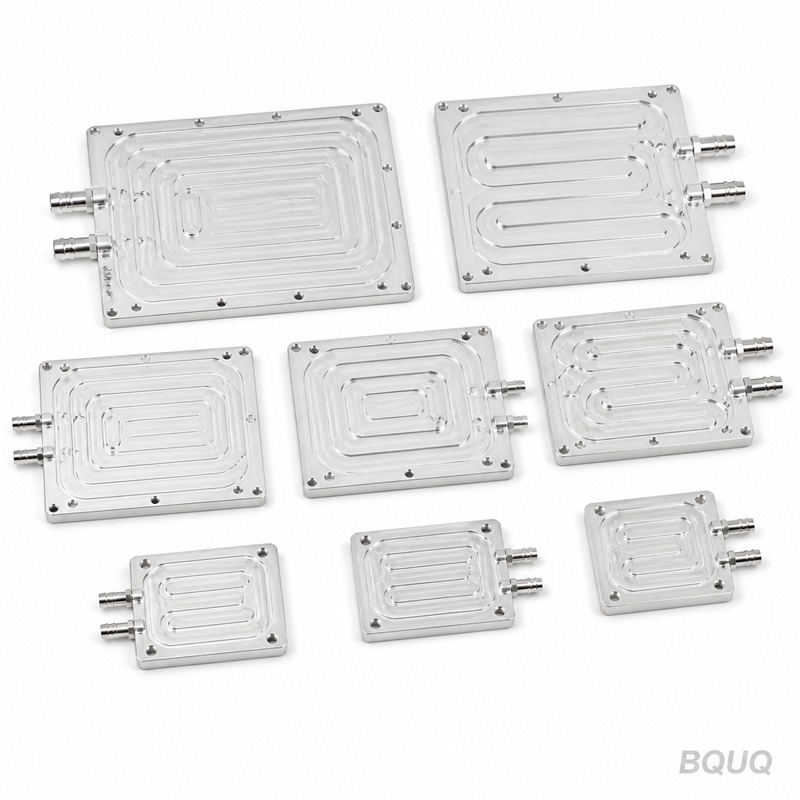
Extruded profiles are cut to length using automatic circular saws with carbide-tipped blades, achieving a length tolerance of ±0.5 mm. For critical mounting surfaces, a CNC milling operation is required. Precision machining on a 3-axis or 4-axis CNC center holds tolerances of ±0.02 mm on hole positions, ±0.05 mm on pocket depths, and surface finish of Ra 1.6 µm on mating faces.
The cutting and machining stage typically costs $0.50-$2.00 per piece depending on feature count. A standard heat sink with 6 mounting holes, 2 tapped threads (M3), and a mirror-finish base requires approximately 90 seconds of CNC cycle time. For high-volume production above 5000 pieces, custom fixtures reduce loading time by 40% and improve repeatability to ±0.01 mm.
Surface Treatment Options and Cost Impact
Surface treatment serves three purposes: corrosion protection, emissivity enhancement, and cosmetic appearance. Black anodizing is the industry standard, creating an aluminum oxide layer of 8-25 µm thickness that increases surface emissivity from 0.04 (bare aluminum) to 0.85, improving radiative heat transfer by up to 40% in natural convection applications.
| Treatment | Thickness (µm) | Thermal Impact | Cost per dm² | Lead Time |
| Clear anodize | 5-15 | None | $0.80-$1.20 | 1-2 days |
| Black anodize | 8-25 | Emissivity 0.85 | $1.00-$1.50 | 2-3 days |
| Hard anodize | 25-75 | Slight insulation | $2.50-$4.00 | 3-5 days |
| Powder coat | 60-120 | Emissivity 0.90, insulation | $1.50-$2.50 | 2-4 days |
| None (bare) | 0 | Emissivity 0.04 | $0 | 0 days |
For maximum performance, black anodize is recommended because the oxide layer is thin enough to not impede conduction while providing a high-emissivity surface. Hard anodize above 50 µm should be avoided on the mounting base, as it adds thermal resistance of approximately 0.5°C/W per 25 µm.
Assembly and Joining Techniques
Many heat sinks require secondary assembly, including press-fit heat pipes, soldered fins, or bonded base plates. Heat pipes are pressed into CNC-machined grooves with an interference fit of 0.02-0.05 mm, achieving a contact resistance below 0.1°C/W. For fin-to-base attachment, two methods dominate: epoxy bonding and vacuum brazing.
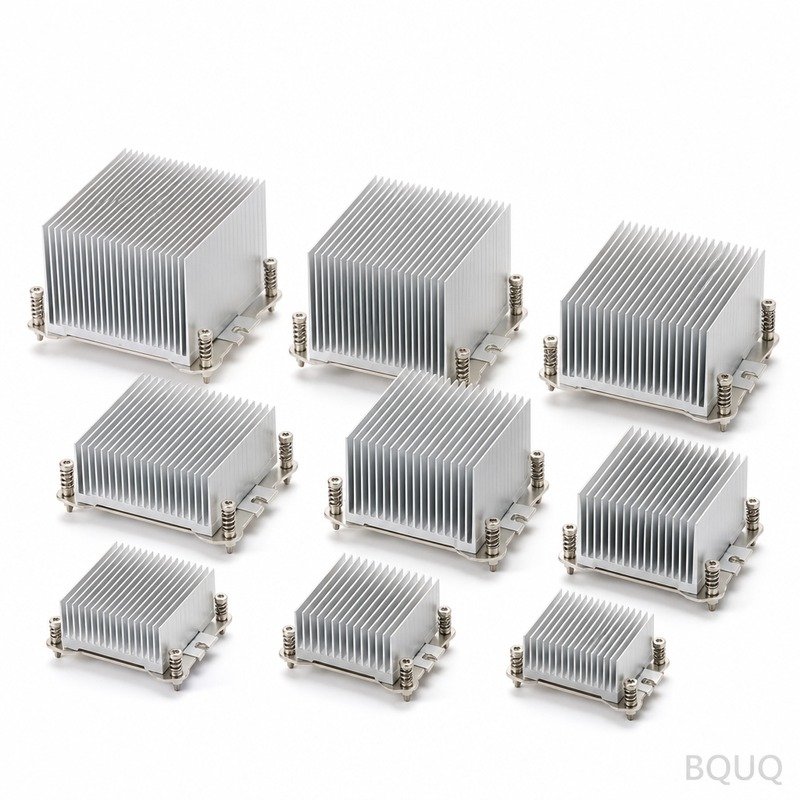
Vacuum brazing uses a 4047 aluminum-silicon filler alloy with a melting point of 577°C, creating a metallurgical bond with thermal resistance of 0.01°C/W. This process costs $0.30-$0.60 per joint and is essential for high-power applications above 200 W. Epoxy bonding with thermally conductive adhesive (1.5-3.0 W/m·K) costs only $0.05-$0.15 per joint but introduces 10-20 times higher thermal resistance. Skived fin heat sinks, produced by cutting fins from a solid copper or aluminum block using a specialized skiving machine, offer fin densities up to 50 fins per inch with no interface resistance.
Quality Control and Dimensional Verification
Final inspection ensures every heat sink meets specified tolerances before shipping. The critical checks include base flatness, which must be within 0.05 mm across the entire mounting surface to minimize interface thermal resistance with the heat source. Surface roughness on the base is held to Ra 1.6 µm or better, verified with a profilometer.
| Inspection Parameter | Standard Tolerance | High-Precision Tolerance | Measurement Method |
| Base flatness | 0.10 mm per 100 mm | 0.03 mm per 100 mm | Granite surface plate with dial indicator |
| Fin height variation | ±0.30 mm | ±0.10 mm | Height gauge |
| Hole position | ±0.10 mm | ±0.02 mm | CMM (coordinate measuring machine) |
| Surface roughness | Ra 3.2 µm | Ra 0.8 µm | Profilometer |
| Fin straightness | 0.5 mm over 100 mm | 0.2 mm over 100 mm | Optical comparator |
A CMM check is performed on the first article and then at every 50th piece during production. Thermal performance validation uses a test fixture with a calibrated heater block and thermocouples measuring junction temperature at a fixed power input of 50 W, confirming thermal resistance within ±5% of the design specification.
Cost Breakdown and Lead Time Optimization
Understanding the cost structure helps engineers make informed design decisions. For a typical aluminum extrusion heat sink measuring 120 mm x 90 mm x 40 mm with 20 fins and 4 mounting holes, the production cost at 1000 pieces breaks down as follows: material cost $0.80-$1.20 per piece, extrusion $0.40-$0.70, cutting $0.10-$0.20, CNC machining $0.60-$1.20, anodizing $0.30-$0.60, and inspection $0.05-$0.10. Total cost per piece ranges from $2.25 to $4.00.
Tooling costs are separate: extrusion die $400-$800, CNC fixtures $150-$400, and measurement gauges $50-$150. For prototype quantities of 10-50 pieces, rapid prototyping via CNC machining from solid billet costs $15-$40 per piece with 3-5 day lead time, while production extrusion tooling requires 7-10 days for die fabrication before samples are available.
Design for Manufacturability Recommendations
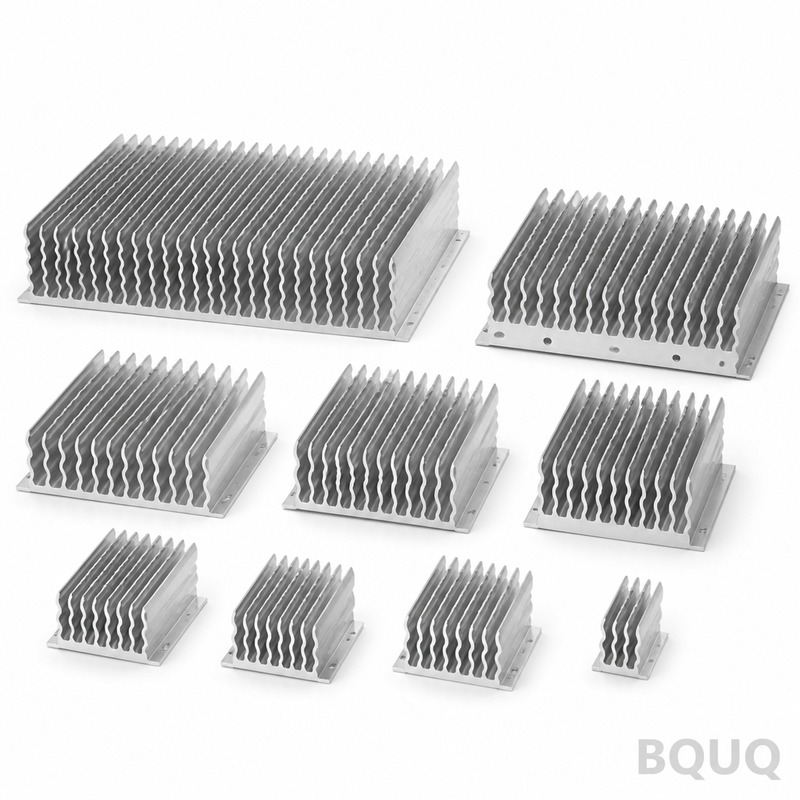
Engineers should follow these guidelines to reduce cost and improve yield. Maintain fin thickness above 1.2 mm for standard extrusion; the cost increases linearly below this threshold. Keep fin height-to-gap ratio below 10:1 to avoid die deflection and non-uniform fin spacing. Avoid sharp internal corners; specify a minimum radius of 0.5 mm to extend die life and prevent stress concentrations.
For tapped holes, use M3 or larger; smaller threads require slower tapping speeds and increase tool breakage. Specify the minimum number of holes needed, as each hole adds 15-20 seconds of CNC time. If flatness below 0.05 mm is required, specify a post-machining stress-relief treatment (2 hours at 250°C) to prevent distortion after machining.
FAQ-Style Tips for Procurement Engineers
What is the minimum order quantity for custom extrusion heat sinks? Most factories accept 200-500 pieces for production, with prototype orders of 10-50 pieces machined from solid billet at 3-5 times the unit price. How quickly can I get a quote? A detailed quotation with tooling costs and unit pricing requires 24-48 hours after receiving a 2D or 3D drawing. What information is essential for accurate quoting? Provide the thermal dissipation requirement in watts, maximum allowable heat sink dimensions, ambient temperature, airflow conditions, and any mounting hole specifications.
What tolerance should I specify for the base surface? For standard applications, ±0.10 mm flatness is sufficient and cost-effective. Only specify ±0.03 mm if you are using a high-performance thermal interface material like liquid metal or phase-change pads, which require near-perfect contact. Is black anodizing always necessary? If the heat sink operates in forced convection with airflow above 2 m/s, the emissivity benefit is negligible, so clear anodize or bare aluminum is acceptable. For natural convection or enclosed applications, black anodize provides significant performance improvement.
Conclusion
The heat sink manufacturing process from extrusion to finished product involves six critical stages, each with specific tolerance, cost, and lead time implications. By understanding that extrusion die costs $400-$800, production tolerances of ±0.1 mm are standard, and black anodizing adds $1.00-$1.50 per square decimeter, engineers can design components that balance thermal performance with manufacturability. The key to a successful project lies in specifying realistic tolerances, selecting the appropriate alloy and surface treatment, and partnering with a manufacturer experienced in both standard and precision processes.
BQUU Precision Manufacturing in Dongguan, China, has 20 years of experience in CNC machining, metal stamping, springs, and heat sinks. We provide free design-for-manufacturability feedback on your drawings, with quotation within 12 hours. Email your 2D or 3D files to sc@bquq.com or contact us on WhatsApp at +86 13713157787. Visit www.bquq.com to download our heat sink design guide and request a sample.
Related Articles
- Best Copper Heat Sinks for CPU Overclocking in 2025
- New energy vehicle IGBT heat dissipation, heat sink reliability engineering, heat pipe and temperature plate integrated heat sink, surface treatment and heat radiation enhancement: anodic oxidation, black coating and micro-nano structure, graphene/3D printing/intelligent thermal management: 2030 heat sink technology roadmap
- Hardware heat sink reconstruction under liquid-cooled penetration of AI server: cold plate, microchannel and two-phase flow
Frequently Asked Questions
What is the typical lead time for heat sink prototypes and full production runs?
Prototypes typically reach production in 3-5 days, while full production runs take 15-20 days. Dimensional tolerances are held to ±0.1 mm on critical mounting surfaces, with flatness within 0.05 mm per 100 mm length.
Which aluminum alloys are best for heat sinks, and what are their thermal conductivity values?
6063-T5 offers 209 W/m·K and is standard for CPU coolers and LED housings. 6061-T6 provides 167 W/m·K for vibration-prone environments. For high-performance needs, copper reaches 385 W/m·K, while A380 die-cast aluminum offers 96 W/m·K at lower cost.
What is the minimum fin thickness achievable through extrusion, and how does it affect cost?
Standard extrusion achieves a minimum fin thickness of 1.2 mm, while precision extrusion reaches 0.8 mm. Precision extrusion costs 15% more for the die and runs 20% slower, as thinner fins require reduced speeds to prevent tearing.
How is the T5 temper achieved for 6063 aluminum heat sinks?
After extrusion, the profile is quenched with controlled air or water, then artificially aged at 175-185°C for 6-8 hours. This increases yield strength from 90 MPa as-extruded to 145 MPa in the T5 condition.