How Do Fan Heat Sink Integration and Active vs Passive Cooling Compare?
The direct answer is that active cooling with a fan heat sink is required when the combined heat dissipation of your electronic components exceeds 50 to 75 watts, while passive cooling is viable only for systems below that threshold where ambient airflow is constant and acoustic noise is a primary concern. For modern electronics, the decision hinges on a thermal budget, an acoustic limit, and a reliability target, not merely on the presence of a fan. In high-density PCB designs, active solutions can reduce thermal resistance by up to 80% compared to passive alternatives, but they introduce moving parts that statistically fail faster than solid-state components.
What Is the Difference Between Active and Passive Cooling in Thermal Management?
Active cooling uses forced convection, typically via an axial or centrifugal fan, to push air across a finned heat sink at velocities of 2 to 5 m/s, dramatically increasing the convective heat transfer coefficient. Passive cooling relies on natural convection and radiation, where airflow is driven solely by buoyancy, achieving air velocities of only 0.1 to 0.5 m/s. This difference in airflow velocity translates directly to thermal performance: a passive heat sink with a thermal resistance of 1.5 °C/W can be replaced by an active heat sink of the same physical size with a thermal resistance of just 0.3 °C/W, a five-fold improvement.
The engineering trade-off is not just thermal. Passive systems have zero acoustic noise (0 dBA), zero vibration, and no mechanical wear, making them ideal for medical devices and outdoor telecom cabinets. Active systems, however, can dissipate 100 W to 300 W from a compact 40 mm x 40 mm footprint, which is simply impossible with passive cooling at reasonable ambient temperatures of 35 °C to 45 °C. For most industrial electronics, the operating ambient temperature inside an enclosure is 45 °C, and a passive solution would require a heat sink volume four times larger than an active solution to maintain the same junction temperature of 85 °C.
How Does a Fan Heat Sink Integration Affect Thermal Resistance and Junction Temperature?
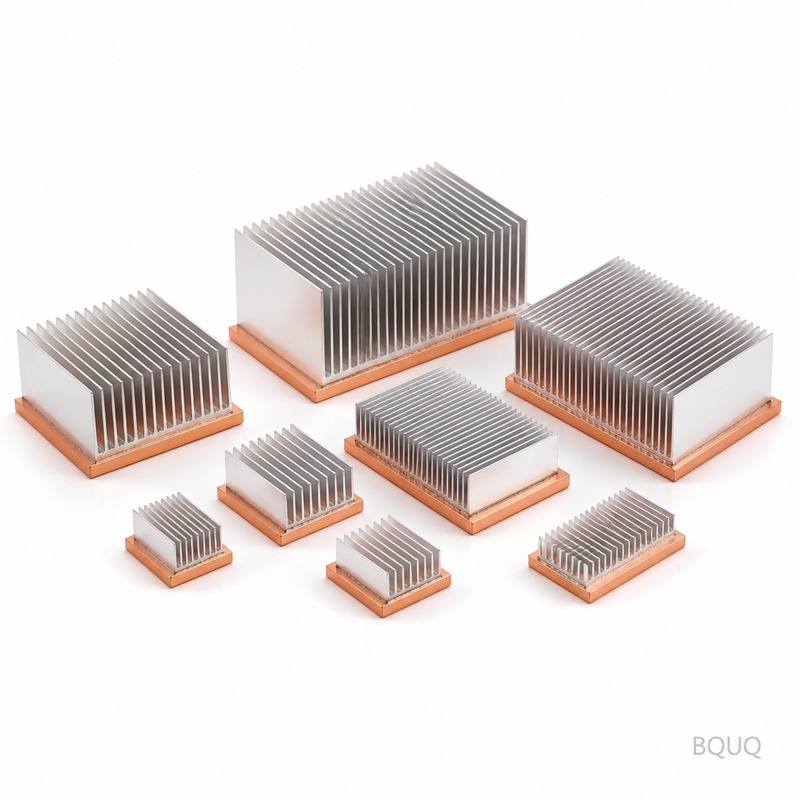
Fan heat sink integration reduces the total thermal resistance from junction to ambient (Rth j-a) by combining the heat sink's conductive resistance with the forced convective resistance. For a typical aluminum extrusion heat sink with a 60 mm x 60 mm base, the natural convection resistance is approximately 2.8 °C/W, while the same heat sink with a 12 VDC axial fan operating at 3000 RPM yields a resistance of 0.55 °C/W. This reduction is not linear; doubling the fan speed from 3000 to 6000 RPM reduces resistance by only 25%, while increasing acoustic noise from 25 dBA to 40 dBA, a significant penalty.
The junction temperature calculation is straightforward: Tj = Ta + (P x Rth j-a). For a 50 W processor in a 45 °C ambient, a passive solution with Rth of 2.8 °C/W yields Tj = 185 °C, which exceeds the absolute maximum rating of most silicon (150 °C). The active solution with Rth of 0.55 °C/W yields Tj = 72.5 °C, well within the recommended operating range of 85 °C. This is why fan heat sink integration is not optional for high-power CPUs, GPUs, and IGBT modules; it is the only method to maintain reliability margins below 80 °C for long-term operation.
Which Applications Require Active Cooling Despite Fan Reliability Concerns?
Applications with power densities above 10 W/cm², such as high-performance computing, automotive engine control units (ECUs), and LED lighting arrays above 100 W, require active cooling. For example, a typical server CPU dissipates 150 W from a 45 mm x 45 mm die, which is a power density of 7.4 W/cm²; passive cooling would require a heat sink weighing over 2 kg and standing 150 mm tall. In contrast, a 1U server heatsink with a dual-ball-bearing fan achieves the same cooling in a 28 mm profile, weighing 450 g, a critical constraint for rack-mounted equipment.
Another mandatory active cooling case is in sealed enclosures with no external airflow, such as in-vehicle infotainment systems. These enclosures have internal temperatures that can rise to 60 °C, and passive heat sinks simply cannot reject heat to a stagnant internal air pocket. We recommend active cooling for any application where the internal enclosure temperature rise exceeds 10 °C above ambient, regardless of the total wattage, because the delta-T available for natural convection becomes negligible.
How Much Does Active vs Passive Cooling Cost in Terms of Material and Assembly?
The cost difference between passive and active cooling is significant at the component level but can be offset by reduced heat sink size. A passive aluminum extrusion heat sink for 30 W costs between USD 1.50 and USD 3.00 per unit in quantities of 10,000, depending on fin density and surface treatment (anodizing adds 5% to 10% cost). An active solution for the same 30 W consists of a smaller heat sink (USD 0.80) plus a 40 mm fan (USD 1.20 to USD 2.50), totaling USD 2.00 to USD 3.30, which is comparable or slightly higher.
However, the assembly cost is higher for active cooling due to fan mounting hardware, electrical connectors, and thermal interface material (TIM) application. Fan attachment requires either screw bosses, push pins, or wire clips, adding 30 to 60 seconds of assembly time per unit. Labor cost in our Dongguan facility is approximately USD 0.08 per minute, so this adds USD 0.04 to USD 0.08 per unit. The total system cost for active cooling is 10% to 20% higher, but the performance gain allows for a smaller PCB and enclosure, often reducing the overall system cost by 5% to 10%.
| Cooling Method | Thermal Resistance (°C/W) | Max Dissipation (W) | Acoustic Noise (dBA) | Heat Sink Volume (cm³) | Relative Cost (USD) | MTBF (Hours) |
| Active (40mm fan + extruded HS) | 0.30 - 0.60 | 75 - 150 | 25 - 40 | 40 - 80 | 3.00 - 5.50 | 30,000 |
| Passive (extruded HS, natural conv.) | 1.50 - 3.00 | 10 - 30 | 0 | 150 - 300 | 1.50 - 3.00 | 100,000+ |
| Active (60mm fan + finned HS) | 0.15 - 0.35 | 150 - 300 | 35 - 50 | 100 - 200 | 5.00 - 9.00 | 25,000 |
| Passive (heat pipe + fin stack) | 0.80 - 1.20 | 20 - 50 | 0 | 80 - 150 | 4.00 - 8.00 | 100,000+ |
| Active (blower + vapor chamber) | 0.08 - 0.15 | 300 - 500 | 45 - 55 | 150 - 250 | 12.00 - 20.00 | 20,000 |
Why Is Fan Heat Sink Integration a Reliability Risk and How Can It Be Mitigated?
The primary reliability risk of fan heat sink integration is mechanical bearing failure, which accounts for 90% of fan failures in electronic systems. A standard sleeve bearing fan has a mean time between failures (MTBF) of 30,000 hours at 40 °C, which is only 3.4 years of continuous operation. Dual-ball-bearing fans extend this to 60,000 hours, but they cost 30% more and generate slightly higher acoustic noise due to the metal ball contact. For applications requiring 10-year lifespans, such as industrial controls or base station radios, a fan with ball bearings is mandatory, or the design must include a redundant fan with a failover circuit.
Mitigation strategies include using fans with PWM speed control that only spin at full speed when the heat sink temperature exceeds 65 °C, which extends bearing life by 40% because the fan runs at 50% speed most of the time. Additionally, we recommend using a fan with an alarm output (tachometer signal) that the system microcontroller can monitor. If the fan speed drops below 80% of nominal, the system can reduce power consumption or trigger a service alert, preventing a thermal runaway that would otherwise damage the CPU or power semiconductor.
How Do You Select the Right Fan Heat Sink Integration for Your Electronic Enclosure?
Selection starts with defining the maximum ambient temperature (Ta max), the maximum allowable junction temperature (Tj max), and the total power dissipation (P). The required thermal resistance is then Rth = (Tj max - Ta max) / P. For example, if Tj max is 100 °C, Ta max is 50 °C, and P is 80 W, then Rth must be 0.625 °C/W or lower. A passive heat sink in a 50 °C ambient would require a massive volume of 500 cm³, which is usually impractical, so you select an active solution with a 60 mm fan and a heat sink that provides 0.4 °C/W, giving a 20% margin.
Next, calculate the system acoustic budget. For office environments, the limit is typically 35 dBA at 1 meter. A 60 mm fan at 3000 RPM produces about 32 dBA, which is acceptable, but at 4500 RPM it jumps to 45 dBA, which is not. You must also consider the pressure drop of the heat sink fins; a high fin density (e.g., 20 fins per inch) increases surface area but raises static pressure, requiring a fan with higher static pressure (measured in mmH2O) rather than a high airflow fan. Our engineering team typically uses a 4.5 mm fin pitch with a 40 mm fan for optimal balance between airflow and pressure drop in 1U and 2U chassis designs.
What Are the Common Mistakes in Fan Heat Sink Integration Design?
The most common mistake is placing the fan directly against a solid wall or PCB, which restricts inlet airflow and causes a condition called "fan starvation" that reduces airflow by up to 50%. You must maintain a clearance of at least 7 mm between the fan inlet and any obstruction. Another frequent error is using a heat sink with fins oriented perpendicular to the natural airflow path; for horizontal PCBs, the fins should be oriented vertically to allow natural convection assist when the fan is not running, providing a failsafe cooling mode.
A third mistake is ignoring the thermal interface material (TIM) between the heat sink base and the component. Using a 0.5 mm thick silicone pad with a thermal conductivity of 1 W/mK can add 0.5 °C/W to the total resistance, negating the benefit of the fan. We recommend using a phase-change TIM with a thermal conductivity of 5 W/mK and a bond-line thickness of 0.05 mm, which adds only 0.05 °C/W. Finally, engineers often forget to account for the fan's own heat generation; a 40 mm fan consumes 1.5 W, and this heat is added to the enclosure, so the total thermal load must include this parasitic power.
FAQ
What Is the Maximum Power a Passive Heat Sink Can Dissipate in a Sealed Enclosure?
In a sealed enclosure with no external airflow, a passive heat sink can dissipate only 5 to 10 W while maintaining a 40 °C temperature rise above ambient. Beyond this, the internal air temperature rises to the point where the heat sink reaches thermal equilibrium with the air, and no heat transfer occurs. For any sealed enclosure exceeding 10 W, you must use an active solution or a heat pipe that conducts heat to the external enclosure wall.
Can a Fan Heat Sink Integration Work in a Dusty or Humid Environment?
Yes, but only with protection such as a washable filter or an IP5X-rated fan housing. Dust accumulation on fins reduces airflow by 30% after six months in an industrial environment, increasing thermal resistance by 20%. For humid environments, fans with sealed ball bearings and conformal-coated PCB windings prevent moisture ingress and corrosion.
How Do You Calculate the Airflow Required for a Fan Heat Sink?
The required airflow in cubic feet per minute (CFM) is calculated as CFM = (1.76 x P) / (Delta-T), where P is power in watts and Delta-T is the allowable air temperature rise across the heat sink in °C. For a 100 W load with a 10 °C rise, you need 17.6 CFM. A 40 mm fan at 5000 RPM provides about 10 CFM, so you would need a 60 mm fan or dual 40 mm fans.
When Should You Use a Heat Pipe Instead of a Solid Aluminum Heat Sink with a Fan?
Use a heat pipe when the heat source is concentrated in a small area but the heat sink must be located remotely, such as in a laptop where the CPU is at the center and the fan is at the edge. Heat pipes have an effective thermal conductivity of 10,000 W/mK, allowing heat to be spread over 100 mm with virtually no temperature drop. For power levels above 150 W, we recommend using multiple heat pipes (3 to 5 pipes of 6 mm diameter) combined with a fan-cooled fin stack.
Which Is More Energy Efficient: Active or Passive Cooling?
Passive cooling is 100% energy efficient because it consumes zero electrical power. Active cooling consumes 1 to 5 W for the fan, which represents 2% to 5% of the total heat dissipated. However, active cooling allows the system to operate at a lower junction temperature, which reduces leakage current in semiconductors, potentially saving more energy than the fan consumes in high-power applications.
Can a Fan Heat Sink Be Used Outdoors in Direct Sunlight?
Yes, but the fan must be rated for high ambient temperatures (up to 70 °C) and the heat sink must be anodized with a dark coating to maximize radiation heat loss. Direct sunlight adds 10 to 15 °C to the heat sink surface temperature, so the thermal design must include this solar load. We recommend using a fan with a temperature sensor that increases speed automatically as ambient temperature rises.
What Is the Typical Lead Time for Custom Fan Heat Sink Integration?
For a custom aluminum extrusion heat sink with a standard 40 mm or 60 mm fan, the tooling lead time is 3 to 4 weeks, and production lead time is 2 to 3 weeks for quantities under 5,000 units. If you require a stamped fin and copper base assembly with a custom shroud, tooling takes 5 to 6 weeks. We recommend ordering pre-production samples for thermal validation before mass production.
The decision between active and passive cooling is a balance of thermal performance, acoustic limits, and lifecycle cost. For power levels above 75 W or ambient temperatures above 50 °C, fan heat sink integration is the only practical solution, with dual-ball-bearing fans and PWM control providing the best reliability. For lower power levels, passive cooling offers zero maintenance and infinite lifespan, provided the enclosure allows adequate natural convection. At BQUQ, we manufacture precision CNC-machined and stamped heat sinks with tolerances of ±0.05 mm, and we can integrate any standard fan into your thermal assembly. Our engineering team provides free thermal simulation and a 12-hour quoting service for your custom heat sink requirements. Contact us at sc@bquq.com or WhatsApp +86 13713157787, and visit www.bquq.com to download our thermal design guide.
Related Articles
- Heat Sink Fin Spacing: Calculate Optimal Fin Pitch for Natural and Forced Air Cooling in 2025
- Regional Market Competition: Differences and Opportunities in Asia Pacific, North America, and Europe's Heat Sink Ecology
- AI simulation and intelligent manufacturing: the heat sink industry has gone from "trial and proof" to "one time right"