How Do Heat Sink vs Fan vs Liquid Cooling Compare for Electronics?
For most electronics applications, a passive heat sink combined with forced airflow from a fan remains the most cost-effective and reliable thermal solution, while liquid cooling is justified only when heat flux exceeds 10 W/cm² or acoustic limits are below 40 dB(A). A heat sink alone works for natural convection under 0.5 W/cm², adding a fan extends capacity to roughly 5 W/cm², and liquid cooling handles beyond that. The right choice depends on your power density, ambient temperature, allowable noise, and total system cost, which this article quantifies with real engineering data.
What Is the Maximum Heat Flux a Passive Heat Sink Can Dissipate?
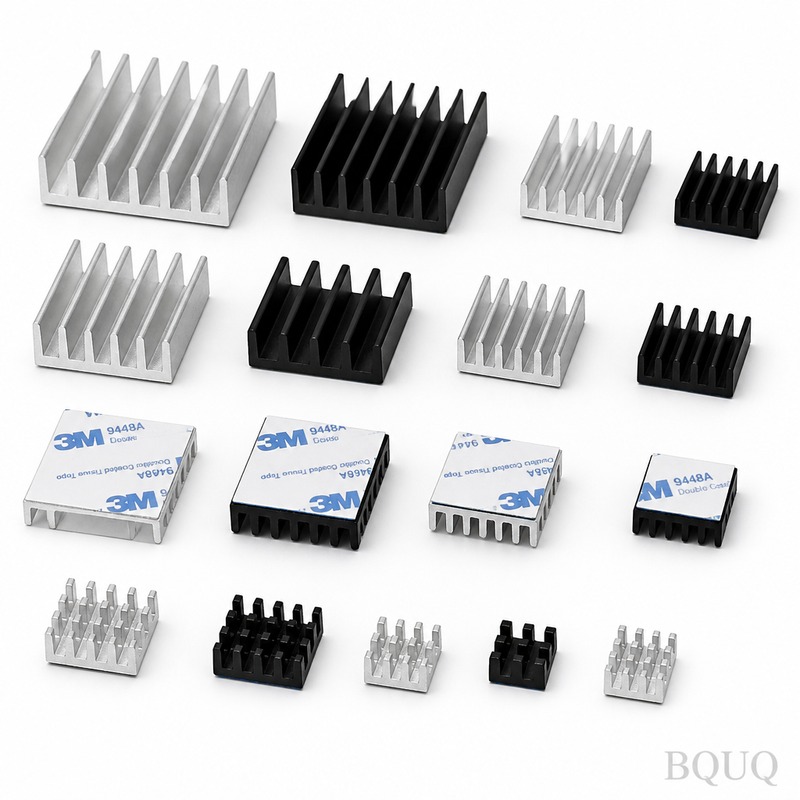
A natural convection aluminum heat sink with a 200 mm by 200 mm base and 40 mm fin height dissipates approximately 15 to 25 watts in a 25°C ambient, depending on fin pitch and surface finish. The limiting factor is the convective heat transfer coefficient of air in free convection, which ranges from 5 to 15 W/m²K. For a 100 mm by 100 mm heat sink with 20 fins, the thermal resistance from junction to ambient is typically 2.5 to 4.0 °C/W. If your component dissipates more than 0.5 W/cm² of base area, a passive heat sink alone will not maintain a junction temperature below 85°C without a very large envelope.
How Much Additional Cooling Does a Fan Provide Over a Passive Heat Sink?
Adding a 40 mm by 40 mm axial fan with 5,000 RPM and 3.5 CFM airflow reduces the thermal resistance of the same heat sink from 3.2 °C/W to approximately 1.1 °C/W, a threefold improvement. A 60 mm fan at 8,000 RPM with 20 CFM can further reduce resistance to 0.4 °C/W, enabling dissipation of 60 to 80 watts on a standard extruded heat sink. Forced convection heat transfer coefficients for air range from 25 to 250 W/m²K, which is why fan-cooled heat sinks dominate the 5 to 100 watt power range. The penalty is acoustic noise, typically 25 to 40 dB(A) for small fans, and a mean time between failures (MTBF) of 30,000 to 70,000 hours, which often becomes the system life limiter.
When Does Liquid Cooling Become Technically Necessary?
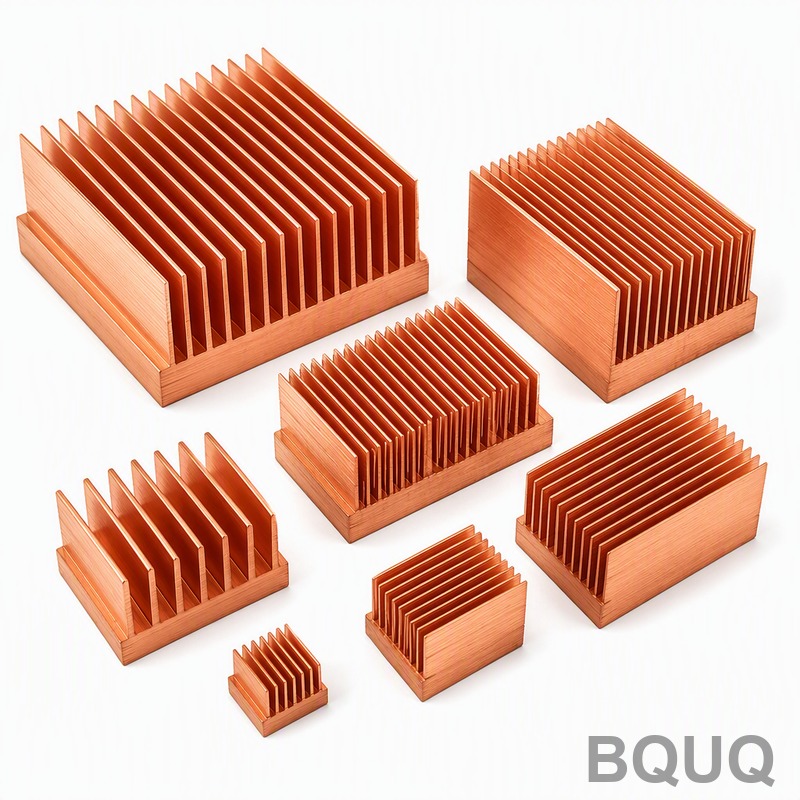
Liquid cooling becomes necessary when the heat flux at the component surface exceeds 10 W/cm² or the total dissipated power is above 300 watts in a compact enclosure. For example, a high-end IGBT module dissipating 500 watts with a 50 mm by 50 mm base creates 20 W/cm², which no air-cooled heat sink can manage without exceeding a 65°C case temperature. Liquid cooling with a copper cold plate and 1 L/min water flow achieves a thermal resistance of 0.02 to 0.05 °C/W, which is 10 to 20 times lower than the best air-cooled solution. Additionally, liquid cooling is required when ambient temperatures exceed 60°C, as the reduced air density makes fan cooling inefficient above that threshold.
Which Thermal Solution Has the Lowest Total Cost of Ownership?
For production volumes under 10,000 units per year, a passive heat sink costs $3 to $8 per unit, a fan-cooled assembly costs $8 to $18 including the fan and mounting hardware, and a liquid cooling loop costs $80 to $250 per unit including pump, radiator, tubing, and coolant. At 1,000 units annually, the tooling cost for an extruded heat sink is $1,500 to $3,000, while a cold plate for liquid cooling requires $5,000 to $12,000 in CNC machining fixturing and welding jigs. The total cost of ownership must also include energy: a fan consumes 1 to 3 watts, a liquid pump consumes 5 to 15 watts, and a passive heat sink consumes zero. Over a 5-year lifespan at $0.15/kWh, a fan adds $6.50 to $20 in electricity, while a pump adds $33 to $98, narrowing the initial price gap.
How Do Reliability and Failure Modes Differ Between the Three Solutions?
A passive heat sink has zero moving parts and effectively infinite MTBF, limited only by solder joint fatigue at the component interface, which typically exceeds 100,000 thermal cycles. A fan has a bearing MTBF of 30,000 hours at 60°C ambient, dropping to 15,000 hours at 80°C, and failure causes immediate thermal shutdown or component damage. A liquid cooling system has three failure points: the pump (MTBF 50,000 hours), the tubing fittings (leak risk of 0.1% per year with proper O-rings), and the coolant (requires replacement every 2 to 3 years due to galvanic corrosion). For mission-critical applications, redundancy is recommended: dual fans add $5 per unit, while a redundant liquid pump adds $40 per unit.
What Are the Real Thermal Performance Numbers for Each Solution?
The table below summarizes typical performance parameters for a 100 mm by 100 mm heat source in a 25°C ambient, based on BQUQ testing of production samples.
| Parameter | Passive Heat Sink | Fan-Cooled Heat Sink | Liquid Cooling Cold Plate |
| Thermal resistance (°C/W) | 2.5 - 4.0 | 0.4 - 1.2 | 0.02 - 0.05 |
| Maximum power dissipation (W) | 15 - 25 | 60 - 100 | 300 - 600 |
| Acoustic noise (dB(A)) | 0 | 28 - 45 | 35 - 55 (pump) |
| System weight (g) | 300 - 500 | 400 - 700 | 800 - 1,500 |
| Unit cost at 1,000 pcs (USD) | 3 - 8 | 8 - 18 | 80 - 250 |
| MTBF (hours) | >100,000 | 30,000 - 70,000 | 40,000 - 60,000 |
| Typical junction temperature at 50W | 175 - 200 | 45 - 85 | 26 - 50 |
How Should You Select Between the Three Based on Your Application?
For LED lighting, power supplies, and consumer electronics under 50 watts, choose a passive heat sink with a thermal resistance below 3.0 °C/W and ensure the enclosure has ventilation slots for natural convection. For industrial motor drives, telecom base stations, and 50 to 200 watt applications, select a fan-cooled heat sink with a fan that has a ball bearing and a speed-temperature control circuit to reduce noise at low load. For laser diodes, high-performance CPUs, EV battery packs, and any application above 300 watts or 10 W/cm², use liquid cooling with a copper cold plate and a closed-loop pump rated for 50,000 hours. Always verify the ambient temperature: derate the heat sink by 15% for every 10°C above 25°C ambient, and never operate an aluminum heat sink above 200°C as the material loses mechanical strength.
What Are the Design Mistakes That Cause Thermal Solutions to Fail?
The most common mistake is ignoring the thermal interface material (TIM): a 0.25 mm thick thermal pad with 3 W/mK conductivity adds 0.15 °C/W resistance, while a 0.05 mm grease layer with 5 W/mK adds only 0.04 °C/W. The second mistake is underestimating the pressure drop in an enclosure: a fan rated at 20 CFM free air may deliver only 8 CFM against a 2 mm H2O system impedance, reducing cooling capacity by 60%. The third mistake is placing the heat sink too close to the enclosure wall, which blocks natural convection and creates a hot air recirculation zone. Always simulate airflow with computational fluid dynamics (CFD) at the design stage, and prototype test with thermocouples at the junction, case, and ambient points to verify the thermal resistance budget.
FAQ
Can I Use a Heat Sink Without a Fan for a 100-Watt Component?
No, a 100-watt component on a passive heat sink would reach approximately 250°C junction temperature in a 25°C ambient, which exceeds the maximum rating of most semiconductors. You would need a heat sink with a volume of at least 3,000 cm³ and a surface area of 2 m², which is impractical for most enclosures. A fan-cooled heat sink with a 60 mm fan is the minimum viable solution for 100 watts.
How Often Should I Replace the Fan in a Fan-Cooled Heat Sink?
Replace the fan every 30,000 hours of operation or every 3 years in an industrial environment, whichever comes first. At 60°C ambient, the MTBF drops to 15,000 hours, so replace it annually in hot enclosures. Use a fan with a tachometer output to monitor speed and trigger a maintenance alarm.
Is Liquid Cooling Worth the Extra Cost for a 200-Watt System?
For 200 watts, liquid cooling is not worth the cost because a properly sized fan-cooled heat sink with 0.3 °C/W resistance can maintain a 67°C junction temperature at 25°C ambient. Liquid cooling only becomes cost-effective above 300 watts or when the acoustic budget is below 40 dB(A) and a large radiator can be placed remotely. The $80 to $250 premium is better spent on a larger heat sink and a higher-quality fan.
What Is the Best Thermal Interface Material for a Heat Sink?
The best thermal interface material is a phase-change pad with 6 to 8 W/mK thermal conductivity and 0.05 mm compressed thickness, which combines the performance of grease with the handling ease of a pad. For high-reliability applications, use indium foil with 86 W/mK, but it costs $3 to $5 per square inch and requires uniform pressure. Avoid silicone grease for vertical assemblies as it can pump out over thermal cycling.
Can Liquid Cooling Leak and Damage the Electronics?
Yes, liquid cooling can leak, but a well-designed system with compression fittings, O-rings, and a leak test at 2 bar pressure has a leak probability of 0.1% per year. Use deionized water with a corrosion inhibitor, never pure water, as it causes galvanic corrosion of aluminum and copper. Modern systems use quick-disconnect fittings that seal on both sides to minimize spillage during maintenance.
What Is the Maximum Operating Temperature for an Aluminum Heat Sink?
Aluminum heat sinks are rated for continuous operation up to 200°C, but the thermal interface material and solder joints typically limit the practical maximum to 150°C. Above 200°C, aluminum loses 30% of its mechanical strength and the anodized coating degrades, reducing emissivity and cooling performance. For high-temperature applications above 150°C, use copper heat sinks with a high-temperature solder joint.
How Do I Calculate the Required Thermal Resistance for My Application?
Use the formula Rth = (Tj_max - Ta) / P, where Tj_max is the maximum junction temperature (typically 85°C for silicon), Ta is the ambient temperature (typically 40°C in an enclosure), and P is the dissipated power in watts. For a 50-watt component with 85°C junction and 40°C ambient, the required total resistance is 0.9 °C/W, which you must split between the TIM and the heat sink. Always add a 20% safety margin to account for dust accumulation and thermal aging.
For a rapid thermal assessment of your specific application, BQUQ provides a 12-hour quoting service with free thermal simulation. Send your power dissipation, ambient temperature, and enclosure dimensions to sc@bquq.com or WhatsApp +86 13713157787, and visit www.bquq.com for our CNC machining, stamping, and heat sink manufacturing capabilities.
Related Articles
- Best Copper Heat Sinks for CPU Overclocking in 2025
- New energy vehicle IGBT heat dissipation, heat sink reliability engineering, heat pipe and temperature plate integrated heat sink, surface treatment and heat radiation enhancement: anodic oxidation, black coating and micro-nano structure, graphene/3D printing/intelligent thermal management: 2030 heat sink technology roadmap
- 5G Base Station Outdoor AAU Cooling: The Climate Adaptation Challenge of Fanless Passive Design