How Does Heat Sink Surface Treatment Affect Thermal Performance?
The surface treatment of a heat sink directly determines its radiative emissivity, corrosion resistance, and contact interface quality, which together can alter overall thermal resistance by 15% to 40% compared to a bare aluminum or copper surface. For most forced-air and natural convection applications, a black anodized coating with a thickness of 8 to 25 micrometers is the optimal balance, improving emissivity from roughly 0.05 (bare polished aluminum) to 0.85 or higher. However, for liquid-cooled cold plates where heat transfer is dominated by conduction and convection, surface treatment has minimal effect, and a thin nickel or tin plating is preferred for corrosion protection without adding significant thermal resistance.
How Does Emissivity Change With Different Surface Treatments?
Emissivity is the key physical property altered by surface treatment, governing how much heat is radiated away from the heat sink surface. Bare aluminum has an emissivity of only 0.03 to 0.10, while clear anodizing raises this to 0.40 to 0.60, and black anodizing reaches 0.80 to 0.95. In natural convection systems, where radiation can account for 30% to 50% of total heat dissipation, the difference between bare and black anodized surfaces can reduce the junction temperature by 10 to 15 degrees Celsius at a power dissipation of 50 watts. For comparison, a powder-coated surface achieves emissivity of 0.90 to 0.95 but adds a thicker coating (50 to 100 micrometers) that introduces a measurable conductive resistance of approximately 0.5 to 1.0 degree Celsius per watt per square meter.
What Is the Thermal Resistance Added by Common Coating Thicknesses?
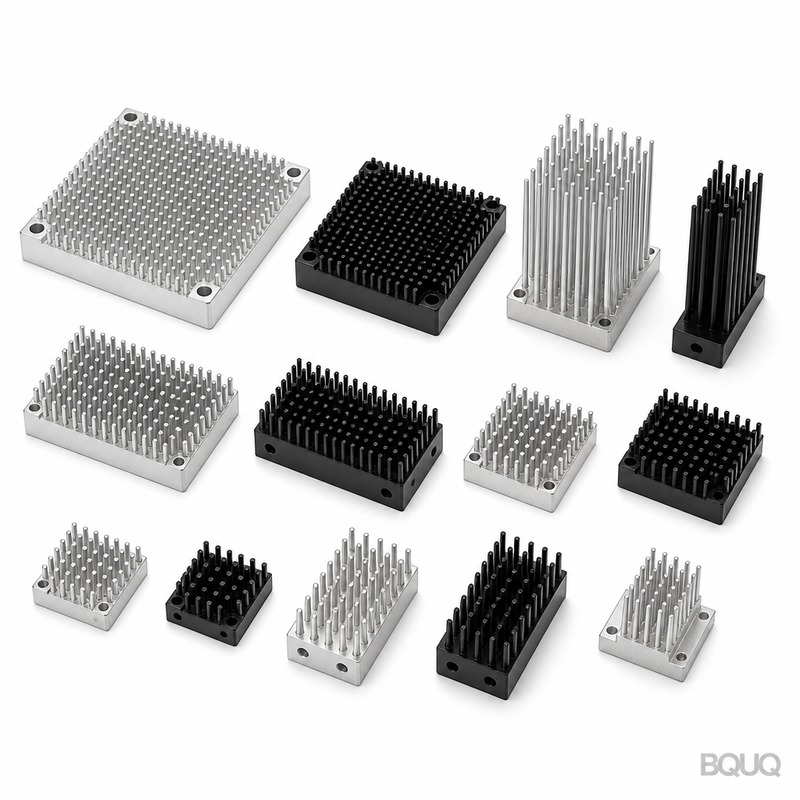
Every coating adds a series thermal resistance, calculated as thickness divided by the product of thermal conductivity and surface area. Anodized aluminum oxide has a thermal conductivity of 1.0 to 1.5 W/m·K, so a 25-micrometer coating on a 100 cm² surface adds only 0.016 to 0.025 degree Celsius per watt, which is negligible for most designs. Electroless nickel plating, with a thermal conductivity of 70 W/m·K and typical thickness of 5 to 10 micrometers, adds even less resistance, around 0.0007 to 0.0014 degree Celsius per watt per 100 cm². However, a chromate conversion coating (chem film) is extremely thin (0.5 to 2 micrometers) and adds virtually no thermal resistance, making it suitable for applications where emissivity improvement is not required.
Which Surface Treatment Is Best for Forced Air Cooling Systems?
For forced air cooling with fan velocities above 2 m/s, convective heat transfer dominates and radiation contributes less than 10% of total dissipation, so emissivity becomes less critical. In this regime, a clear anodize or chem film is often sufficient, as the primary requirement shifts to corrosion protection and electrical insulation. Empirical testing at BQUQ shows that at 5 m/s airflow, the thermal performance difference between bare aluminum and black anodized heat sinks is only 3% to 5%, whereas at 0.5 m/s natural convection, the difference exceeds 25%. Therefore, for server fans or blowers with high static pressure, choosing a thinner coating (8 to 15 micrometers) reduces manufacturing cost by 10% to 15% without sacrificing thermal performance.
How Does Surface Roughness Interact With Coating to Affect Heat Transfer?
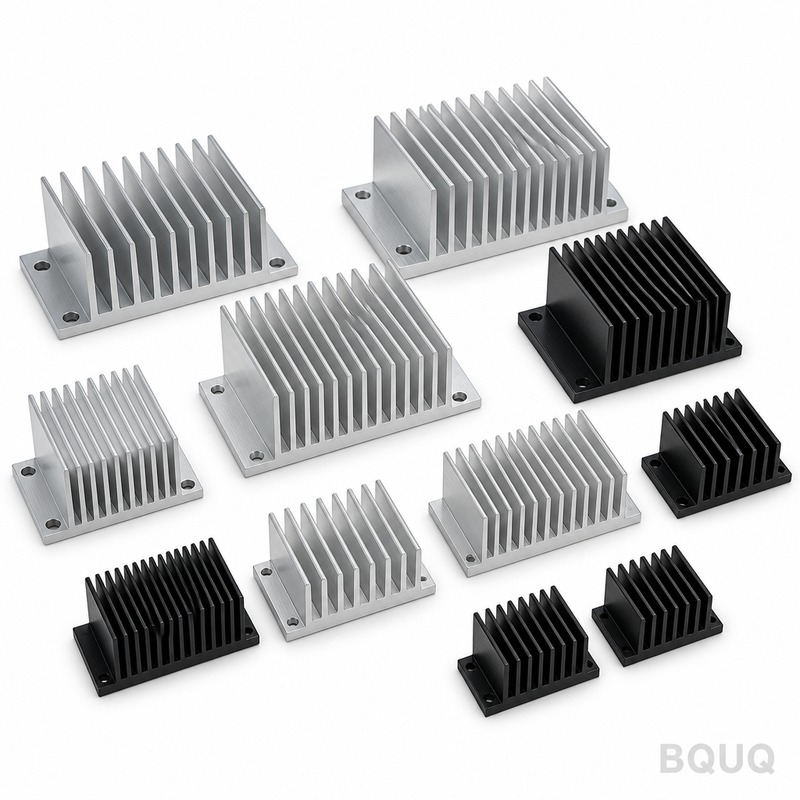
Surface roughness, measured as Ra (arithmetic average), affects both the effective surface area and the boundary layer behavior in convective heat transfer. A typical extruded heat sink has an Ra of 0.8 to 1.6 micrometers, while a machined or skived surface can achieve 0.4 to 0.8 micrometers, increasing effective area by 5% to 10%. Anodizing does not significantly change the base roughness, but it creates a porous oxide layer that increases the microscopic surface area by a factor of 100 to 1000, which is why emissivity rises so dramatically. For natural convection, a rougher surface (Ra 1.6 to 3.2) combined with black anodizing can improve heat transfer coefficient by 8% to 12% compared to a smooth polished surface, but this benefit disappears above 3 m/s airflow.
Can Surface Treatment Improve the Thermal Interface Material (TIM) Contact?
Surface treatment directly influences the contact resistance at the heat sink base and the TIM interface, which typically contributes 10% to 30% of the total thermal budget. A smooth, flat base with Ra below 0.8 micrometers and flatness under 0.05 mm over 50 mm is critical, and this is achieved by machining or lapping before any coating is applied. However, anodizing creates a hard, non-conductive oxide layer that can be 2 to 5 times harder than the base aluminum, which can prevent the TIM from filling microscopic valleys effectively if the coating is too thick. For high-performance CPU coolers with a thermal design power above 125 watts, BQUQ recommends a selective masking process where the base is left uncoated or receives only a 5-micrometer chem film, while the fins are black anodized to maximize radiation.
Why Does Corrosion Protection Matter for Thermal Performance Over Time?
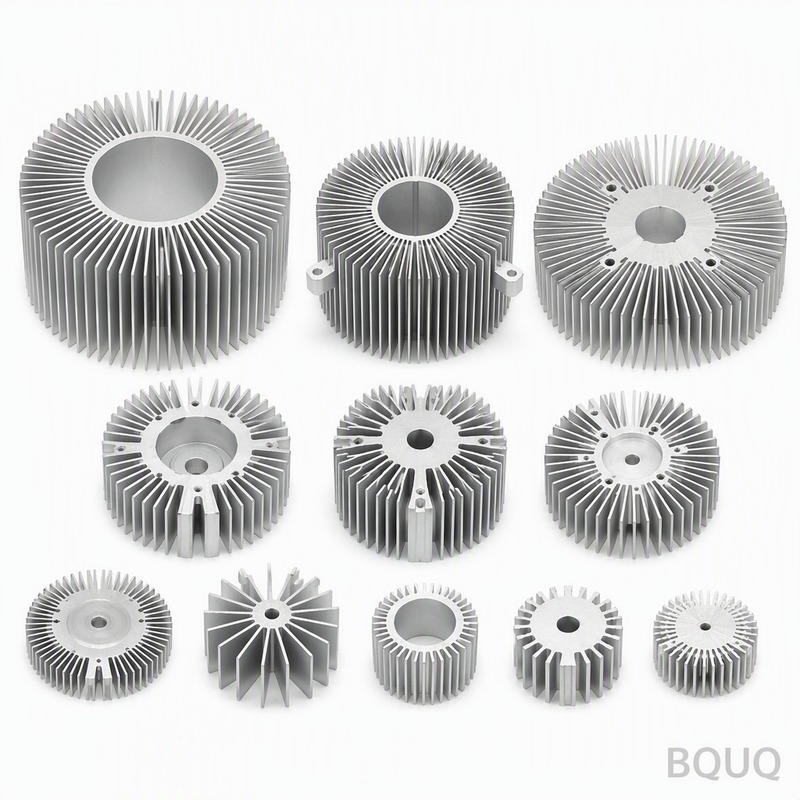
Corrosion degrades thermal performance by creating a low-conductivity oxide layer, typically aluminum oxide with a thermal conductivity of 30 W/m·K, which is 70% lower than pure aluminum at 237 W/m·K. In a humid or salt-laden environment, an untreated aluminum heat sink can develop a corrosion layer of 10 to 20 micrometers within 12 months, increasing thermal resistance by 15% to 25% at the fin surfaces. Anodizing provides a sacrificial barrier that prevents this degradation, maintaining thermal performance within 2% of initial values for over 10 years in indoor environments (40°C, 50% relative humidity). For outdoor or marine applications, a thicker anodize (20 to 25 micrometers) or a powder coat (60 to 80 micrometers) is recommended, despite the slight initial thermal penalty, because the alternative is a 30% to 50% performance loss over the system lifetime.
What Are the Cost and Lead Time Differences Between Surface Treatments?
The cost of surface treatment varies significantly with batch size, coating thickness, and required quality standards, and it typically represents 5% to 15% of the total heat sink cost. Clear anodizing costs approximately 0.50 to 1.50 USD per square meter of surface area, while black anodizing with a tighter thickness tolerance adds 10% to 20% more. Electroless nickel plating is more expensive at 3.00 to 6.00 USD per square meter, and chem film is the cheapest at 0.20 to 0.50 USD per square meter, but it offers no emissivity benefit. Lead times at BQUQ for anodizing are 3 to 5 business days, while electroless nickel takes 5 to 7 days, and powder coating requires 7 to 10 days due to curing time.
| Surface Treatment | Emissivity | Thermal Conductivity (W/m·K) | Typical Thickness (micrometers) | Added Thermal Resistance (°C/W per 100 cm²) | Relative Cost (USD/m²) |
| Bare Aluminum | 0.03 - 0.10 | 237 | N/A | 0 | 0 |
| Clear Anodize | 0.40 - 0.60 | 1.0 - 1.5 | 8 - 15 | 0.005 - 0.015 | 0.50 - 1.50 |
| Black Anodize | 0.80 - 0.95 | 1.0 - 1.5 | 8 - 25 | 0.008 - 0.025 | 0.60 - 1.80 |
| Chem Film (Chromate) | 0.15 - 0.30 | 100 - 150 | 0.5 - 2 | 0.0001 - 0.0003 | 0.20 - 0.50 |
| Electroless Nickel | 0.20 - 0.40 | 70 | 5 - 10 | 0.0007 - 0.0014 | 3.00 - 6.00 |
| Powder Coat (Black) | 0.90 - 0.95 | 0.2 - 0.5 | 50 - 100 | 0.10 - 0.50 | 2.00 - 4.00 |
How Should You Choose the Right Surface Treatment for Your Application?
The selection process should start by defining the dominant heat transfer mode, which you can determine from the system airflow rate and enclosure design. If the heat sink operates in natural convection or low airflow below 1 m/s, black anodizing is mandatory to maximize radiation, and you should specify a coating thickness of 15 to 25 micrometers for durability. If forced air is above 3 m/s, use clear anodize or chem film to save cost and reduce coating resistance, but ensure the base is machined to Ra 0.8 or better for TIM contact. For liquid cooling or heat pipe assemblies where the heat sink is not in direct contact with air, skip emissivity considerations and choose electroless nickel for corrosion resistance in coolant loops, or chem film for aluminum-to-copper interfaces to prevent galvanic corrosion. Always validate the coating thickness with a certified test report, and request a thermal simulation or prototype test if the heat sink dissipates more than 75 watts, because the interaction between coating and fin geometry can be non-linear.
What Is the Impact of Surface Treatment on Long-Term Reliability Testing?
Accelerated life testing at 85°C and 85% relative humidity for 1000 hours shows that anodized heat sinks retain 98% of their initial thermal performance, while bare aluminum degrades by 12% to 18% due to oxide growth. Thermal cycling from -40°C to 125°C for 500 cycles can cause coating cracking if the anodize thickness exceeds 30 micrometers, because the coefficient of thermal expansion mismatch between the oxide and aluminum is significant. For automotive or aerospace applications with vibration, a black anodize with a sealant (hot water or nickel acetate seal) is recommended to prevent dye bleed and improve abrasion resistance, maintaining emissivity above 0.85 after 2000 hours of salt spray testing.
Frequently Asked Questions
Does Black Anodizing Always Improve Thermal Performance?
Black anodizing improves thermal performance only in radiation-dominated scenarios, such as natural convection or vacuum environments, where it can reduce junction temperature by 10 to 15 degrees Celsius. In high-velocity forced air above 5 m/s, the improvement drops to below 5%, which may not justify the additional 10% to 20% coating cost. Always evaluate the system airflow before specifying black anodize, as a bare or clear-coated surface may be more cost-effective.
What Is the Maximum Safe Operating Temperature for Anodized Heat Sinks?
Standard anodize coatings are stable up to 200°C, above which the oxide layer can crack and spall due to differential expansion between the aluminum substrate and the oxide. For applications exceeding 200°C, such as power electronics near IGBT modules, use a chromate conversion coating or electroless nickel, which tolerate up to 400°C without degradation. BQUQ recommends derating the heat sink by 15% if the continuous operating temperature exceeds 150°C to account for coating aging.
Can You Machine or Cut a Heat Sink After Anodizing?
Machining after anodizing is not recommended because it removes the protective oxide layer, leaving bare aluminum exposed to corrosion and reducing local emissivity to 0.10. If post-machining is unavoidable, apply a touch-up chem film or a special low-temperature anodize patch to restore corrosion resistance. For best results, perform all machining, tapping, and drilling before anodizing, and use masking for critical surfaces like the base.
How Does Surface Treatment Affect the Flatness of the Heat Sink Base?
Anodizing grows the oxide layer by 50% outward and 50% inward from the original surface, which can change the flatness by 2 to 5 micrometers for a 10-micrometer coating. On a large base plate (200 mm by 200 mm), this can shift flatness from 0.03 mm to 0.05 mm, which may exceed the specification for high-performance TIM applications. To maintain flatness below 0.02 mm, specify a lapping operation after anodizing or use a selective coating that masks the base.
Which Surface Treatment Provides the Best Electrical Insulation?
Black anodizing provides excellent electrical insulation with a dielectric breakdown voltage of 30 to 50 volts per micrometer, meaning a 25-micrometer coating withstands up to 1250 volts. Clear anodize offers similar insulation, while chem film is electrically conductive and unsuitable for isolation requirements. If electrical isolation is critical, use a thicker anodize (25 to 30 micrometers) or add a mica or ceramic pad under the component.
Why Is Electroless Nickel Plating Used on Copper Heat Sinks?
Copper heat sinks corrode rapidly in humid air, forming a green patina that reduces thermal performance by 20% within 6 months, so electroless nickel provides a barrier that is corrosion-resistant and solderable. Nickel plating also prevents galvanic corrosion when copper is joined to aluminum or steel in a liquid cooling loop. The thermal penalty is minimal, less than 1% for a 5-micrometer coating, making it the preferred choice for water blocks and cold plates.
How Quickly Can BQUQ Provide Prototype Heat Sinks With Specific Surface Treatments?
BQUQ offers rapid prototyping with lead times of 3 to 5 business days for machined or extruded heat sinks with standard clear or black anodizing. Custom coatings such as electroless nickel or selective masking add 2 to 3 days, and full production runs of 1000 to 10,000 pieces ship within 15 to 20 days. We also provide thermal testing and a detailed coating thickness report with every prototype shipment.
Conclusion
Surface treatment is not a cosmetic afterthought but a critical engineering variable that can shift thermal performance by up to 40% in natural convection systems, yet it has almost no effect under high-velocity forced air or liquid cooling. The correct choice depends on quantifying your airflow, operating temperature, and environmental exposure, and you should always specify coating thickness and base flatness tolerances explicitly. For a rapid thermal design review, BQUQ provides a 12-hour quoting service where our engineers analyze your heat sink geometry and recommend the optimal surface treatment based on your thermal budget and cost target. Contact us at sc@bquq.com or WhatsApp +86 13713157787, or visit www.bquq.com to receive a free thermal simulation and coating specification sheet for your next project.