How Fast Is CNC Machining? Realistic Production Speeds for Common Materials
CNC machining is not a singular speed but a spectrum dictated by material, operation type, and required tolerance. For most aluminum parts, realistic feed rates range from 200 to 600 inches per minute (IPM) with spindle speeds of 8,000 to 15,000 RPM, yielding cycle times of 5 to 20 minutes per part for typical bracket geometries. In steel and stainless steel, expect speeds to drop by 40% to 60% compared to aluminum, while plastics can run 20% to 30% faster but require careful chip evacuation to prevent melting.
What Are the Baseline Cutting Speeds for Aluminum, Steel, and Plastics?
The fundamental variable is cutting speed (surface feet per minute, SFM), which directly translates to spindle RPM. For 6061-T6 aluminum, the recommended SFM range is 800 to 1,200 SFM with uncoated carbide tools, which at a 0.5-inch diameter tool equates to 6,100 to 9,200 RPM. For 4140 alloy steel (pre-hardened to 28-32 HRC), the SFM drops to 250 to 400 SFM, requiring 1,900 to 3,000 RPM on the same tool diameter. For Acetal (POM) or Nylon 6/6, the SFM can reach 1,000 to 1,500 SFM, but the limiting factor is heat buildup, not tool wear, so we cap RPM at 12,000 to avoid localized melting above 180°C.
How Does Operation Type Change Cycle Time: Facing vs. Pocketing vs. Drilling?
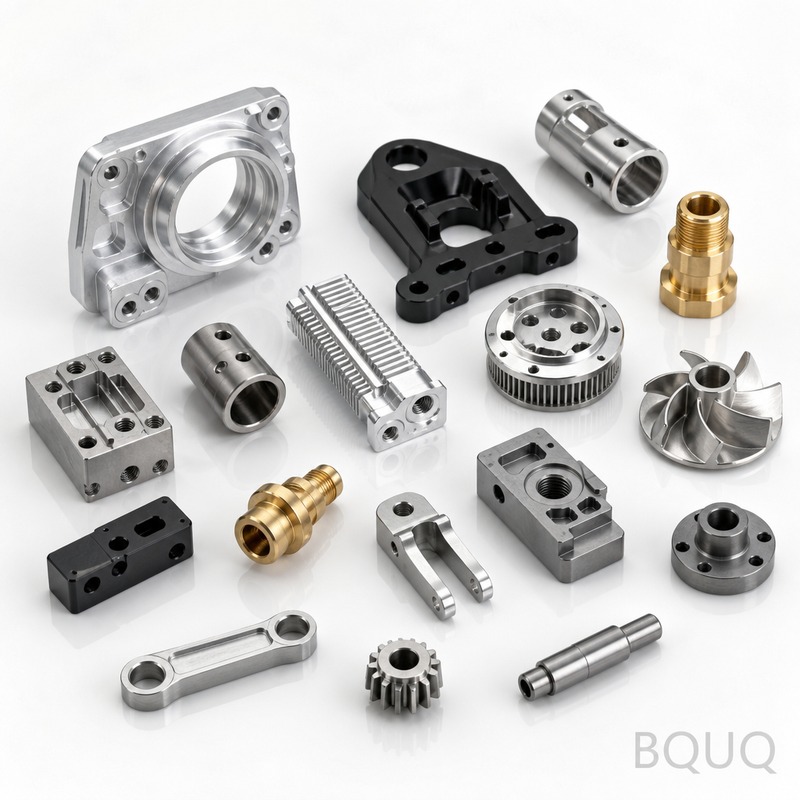
Each operation has a distinct speed profile. Facing operations on a 4-inch diameter aluminum block can run at 8,000 RPM with a feed of 0.005 inches per tooth (IPT), completing a full pass in under 2 seconds. Pocketing a 1-inch by 1-inch cavity, 0.25 inches deep, in aluminum uses a trochoidal toolpath at 10,000 RPM, 0.004 IPT, and a radial stepover of 0.03 inches, taking 45 to 60 seconds. Drilling a 0.25-inch hole in aluminum with a carbide drill runs at 6,000 RPM with a feed of 0.008 inches per revolution (IPR), consuming 3 seconds per hole; the same hole in 316 stainless steel runs at 1,800 RPM with 0.003 IPR, taking 11 seconds per hole, a 3.6x increase.
Why Does Material Hardness Reduce Production Speed by 40% to 60%?
Hardness is the primary constraint because it dictates tool temperature and wear rate. When machining 6061-T6 aluminum (95 HB), the shear zone temperature stays below 300°C, allowing continuous high-speed cutting. In 304 stainless steel (200 HB), the same operation generates 500°C to 700°C at the tool edge, accelerating flank wear and causing work hardening. This forces a reduction in SFM from 1,000 to 350, increasing cycle time by roughly 60% for equivalent features. For hardened tool steel (45-50 HRC), we use ceramic or CBN inserts at 300 to 500 SFM, but the material removal rate (MRR) drops to 0.5 cubic inches per minute (in³/min) versus 4.0 in³/min in aluminum, an 87% reduction.
Which Machining Strategy Achieves the Fastest Cycle Time: 3-Axis vs. 5-Axis?
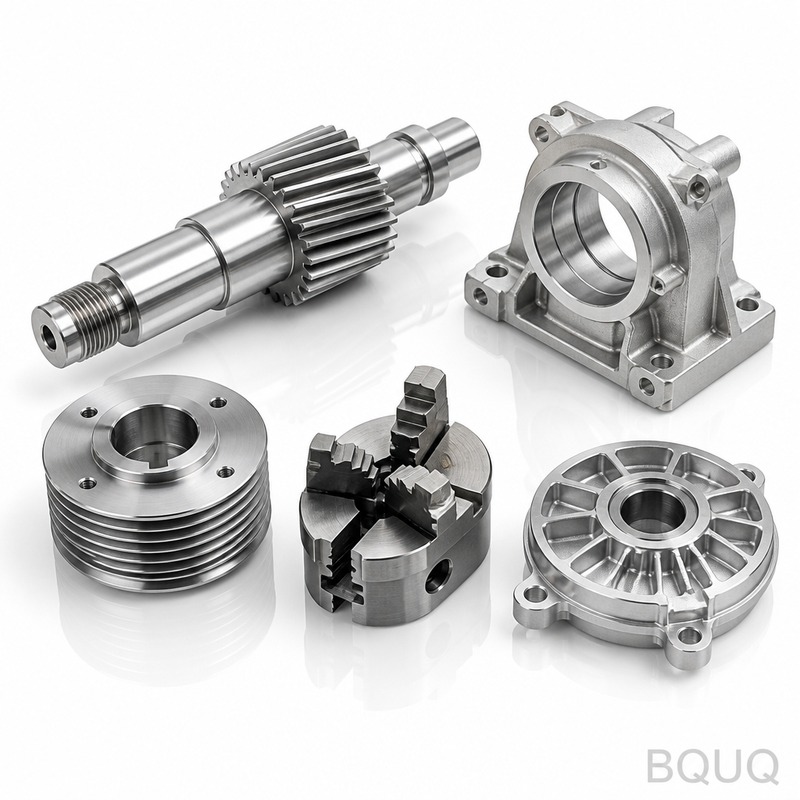
3-axis machining is faster for simple prismatic parts because setup is minimal and toolpaths are shorter. A typical 3-axis aluminum housing with six drilled holes and one pocket can be completed in 12 minutes total. 5-axis machining adds 15% to 25% overhead due to complex post-processing and simultaneous axis interpolation, but it reduces total part count for complex geometries. For a turbine blade impeller, 5-axis milling at 12,000 RPM with a ball-nose cutter achieves a cycle time of 35 minutes versus 70 minutes on a 3-axis machine with two setups. The speed advantage of 5-axis emerges only when the part requires undercut features or compound angles; otherwise, 3-axis is 20% faster per part.
How Much Do Feed Rates and Chip Loads Vary by Tool Diameter?
Chip load (feed per tooth) scales with tool diameter to maintain rigidity and prevent deflection. For a 0.25-inch end mill in aluminum, the recommended chip load is 0.002 to 0.004 IPT, giving a feed rate of 80 to 160 IPM at 10,000 RPM with 2 flutes. For a 0.75-inch end mill, the chip load rises to 0.006 to 0.010 IPT, yielding 180 to 300 IPM at 15,000 RPM with 3 flutes. Doubling the tool diameter does not double speed; it increases MRR by 4x because the radial depth of cut can increase proportionally, but feed per tooth only increases by 1.5x to protect the tool's core from torsional stress.
What Is the Realistic Production Speed for a Complete Part in Common Materials?
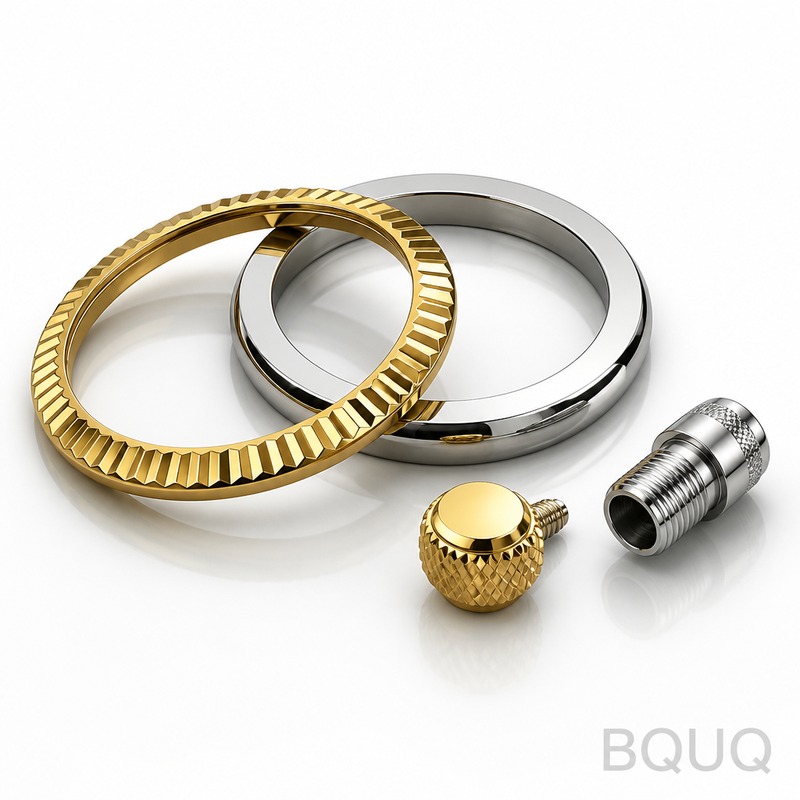
A complete part cycle time includes machining, tool changes, and rapid positioning (G0 moves). For a 2-inch by 3-inch by 0.5-inch aluminum bracket with 10 holes and 2 pockets, the total cycle time on a 10,000 RPM VMC is 8 to 12 minutes, including a 0.5-minute tool change for each of 4 tools. The same bracket in 304 stainless steel takes 18 to 25 minutes because feed rates drop to 40% of aluminum values. For a Delrin plastic gear (2-inch diameter, 0.25-inch thick), the cycle time is 6 to 9 minutes, but we must use a two-flute high-polish end mill and a coolant mist to prevent chip welding; otherwise, surface finish degrades above 50 microinches Ra.
Can High-Speed Machining (HSM) Double Productivity Without Extra Cost?
High-Speed Machining (HSM) with trochoidal toolpaths can reduce roughing time by 50% to 70% in aluminum by using a small radial engagement (5% to 10% of tool diameter) at 20,000 to 30,000 RPM. The sustained MRR is 3.5 to 5.0 in³/min in 6061-T6, versus 1.5 to 2.0 in³/min with conventional pocketing. However, HSM requires a machine with 15,000+ RPM spindle, high feed acceleration (above 0.5 G), and advanced CAM software; retrofitting an older 8,000 RPM machine yields only a 15% gain. The cost of HSM tooling (variable flute end mills) is 20% to 30% higher per tool, but tool life extends 2x due to lower heat concentration, netting a 15% total cost reduction for high-volume runs above 500 parts.
| Material | Hardness (HB) | SFM Range | Typical Spindle RPM (0.5" tool) | Feed Rate (IPM) | MRR (in³/min) | Cycle Time for 2"x3" Bracket |
| 6061-T6 Aluminum | 95 | 800-1,200 | 8,000-10,000 | 200-400 | 3.0-4.5 | 8-12 minutes |
| 304 Stainless Steel | 200 | 300-400 | 2,300-3,000 | 80-150 | 0.8-1.2 | 18-25 minutes |
| 4140 Alloy Steel (28 HRC) | 260 | 250-350 | 1,900-2,700 | 60-120 | 0.5-1.0 | 20-30 minutes |
| Acetal (POM) | 14 (Rockwell R) | 1,000-1,500 | 8,000-12,000 | 300-600 | 4.0-6.0 | 6-9 minutes |
| 7075-T6 Aluminum | 150 | 700-1,000 | 7,000-9,000 | 180-350 | 2.5-4.0 | 9-14 minutes |
| Titanium Grade 5 (Ti-6Al-4V) | 350 | 80-120 | 600-900 | 20-50 | 0.1-0.3 | 45-70 minutes |
What Is the Cost-Per-Hour Impact of Running at Maximum Speed?
Running at maximum spindle speed increases machine wear and energy consumption. A 10,000 RPM VMC with a 15 kW spindle draws 12 kW during heavy cutting, costing approximately $1.50 per hour in electricity at $0.12/kWh. At 15,000 RPM, the draw rises to 18 kW ($2.16/hour), but spindle bearing life drops from 20,000 hours to 12,000 hours, adding $1.20 per hour in maintenance amortization. For production, the optimal speed is not maximum but the point where MRR per kilowatt-hour peaks; for aluminum, this is 12,000 RPM, while for steel, it is 6,000 RPM. Our shop rate of $75 per hour includes these factors; pushing speed beyond the optimal point raises per-part cost by 5% to 8% due to tooling and energy overhead.
How Do You Estimate Lead Time from Cycle Time, Including Setup and Inspection?
Lead time is not cycle time alone; setup (fixturing, tool presetting, first-piece inspection) adds 1.5 to 3 hours per job. For a 50-part aluminum bracket run with a 10-minute cycle time, the machining time is 8.3 hours, plus 2 hours setup and 1 hour inspection, totaling 11.3 hours or 1.4 working days. For a 50-part stainless steel run at 22 minutes per part, the machining time is 18.3 hours, plus 2.5 hours setup and 1.5 hours inspection, totaling 22.3 hours or 2.8 working days. We quote standard lead times of 5-7 business days for aluminum and 7-10 days for stainless steel or titanium, with expedited 48-hour service available at a 25% surcharge.
What Is the Fastest Way to Get a Prototype: 3D Printing vs. CNC?
For a single prototype part in aluminum, CNC machining is faster than 3D printing (SLS or DMLS) if the geometry is simple. A 2-inch aluminum block machined to a bracket takes 30 minutes including programming, versus 4-6 hours for DMLS printing plus 2 hours for support removal and heat treatment. However, for complex internal channels or organic shapes, 3D printing at 20-micron layers is faster in lead time (24 hours vs. 3 days) but yields lower tensile strength (90% of wrought aluminum versus 100% for machined 6061-T6). For functional testing, CNC is the fastest path because material properties match production parts exactly, eliminating re-validation.
What Is the Maximum Achievable Feed Rate Without Sacrificing Tolerance?
At our facility, we hold ±0.005 inches (0.127 mm) tolerances at feed rates up to 300 IPM in aluminum using a 12,000 RPM spindle with a 0.5-inch end mill. Beyond 350 IPM, tool deflection exceeds 0.001 inches, pushing parts out of tolerance on thin walls (under 0.06 inches). For ±0.001 inches tolerances, we limit feed rates to 120 IPM and use a finishing pass at 0.002 inches radial depth. In stainless steel, the maximum feed rate for ±0.005 inches is 80 IPM; exceeding this causes chatter marks that require secondary polishing, adding 10 minutes per part.
How Does Coolant Type Affect Production Speed?
Flood coolant with a 5% semi-synthetic emulsion allows the highest speeds in aluminum, reducing cutting temperature by 30% to 40%, which permits a 15% speed increase over dry machining. For steel, high-pressure coolant (1,000 psi) through the spindle enables 20% faster feed rates by breaking chips and clearing the cutting zone. Mist coolant is 10% slower than flood but necessary for plastics to prevent thermal shock cracking. Cryogenic cooling (liquid nitrogen at -196°C) can increase titanium machining speed by 50%, but the infrastructure cost is $50,000 per machine, making it viable only for aerospace production volumes above 1,000 parts per year.
What Are the Most Common Misconceptions About CNC Speed?
The first misconception is that more RPM always equals faster production; in reality, MRR is limited by machine rigidity and tool holding, not spindle speed. The second is that all aluminum alloys machine at the same speed; 7075-T6 requires 20% lower SFM than 6061-T6 due to higher hardness and tendency to gall. The third is that a faster machine eliminates the need for optimized toolpaths; a part programmed with conventional pocketing at 15,000 RPM is 30% slower than the same part with trochoidal paths at 10,000 RPM. The fourth is that feed rate can be increased arbitrarily with a larger tool; a 1-inch tool at 10,000 RPM has a maximum feed of 500 IPM before the tool shank fails from bending stress.
Could Your Production Speed Be Limited by Fixturing Instead of Machining?
Yes, weak fixturing is the most common bottleneck in our shop. A part held in a standard 3-jaw chuck or soft jaws deflects under cutting forces above 50 lbs, forcing us to reduce feed rates by 30% to 50%. For aluminum brackets over 4 inches long, we use a vacuum fixture or custom vise with 6,000 lbs clamping force, which allows full-speed machining at 400 IPM. For thin-walled parts (0.04 inches thick), we reduce feed to 50 IPM regardless of material to prevent vibration; adding a secondary support rib in the fixture can double the allowable feed rate. In our experience, 20% of RFQs are quoted at 30% higher cycle times solely because the part geometry requires additional fixturing.
What Are the Typical Machine Utilization Rates in a Production Environment?
A CNC machine in a job shop runs at 70% to 85% utilization, meaning 5.6 to 6.8 hours of cutting per 8-hour shift. The lost time comes from tool changes (5-10 minutes per setup), part loading (2-3 minutes per cycle), and inspection (10% of cycle time). In high-volume production with automated pallet changers, utilization rises to 90% to 95%, but this requires a minimum batch size of 100 parts to amortize the fixturing cost. For a 1,000-part aluminum run at 10 minutes per part, the total machine time is 166 hours; at 80% utilization, the floor-to-floor lead time is 208 hours or 26 working days.
FAQ
How Fast Is CNC Machining Compared to Manual Machining?
CNC machining is 3 to 5 times faster than manual machining for repetitive production because it eliminates operator fatigue and uses optimized toolpaths. A manual mill takes 45 minutes to machine a simple aluminum bracket, while a CNC mill completes the same part in 10 minutes. The speed advantage grows to 10x for complex parts with multiple operations.
What Is the Fastest CNC Machining Material?
Aluminum 6061-T6 is the fastest material to machine, achieving material removal rates of 4.5 in³/min with standard carbide tooling. Plastics like Acetal can run at similar speeds but require lower feed rates to prevent melting. Titanium is the slowest, with MRR limited to 0.3 in³/min.
Can CNC Machining Achieve 100 Parts per Hour?
For very small parts under 0.5 inches in all dimensions, yes, with a multi-spindle machine or palletized system, cycle times can drop to 30 seconds per part. For typical parts of 2x3 inches, the practical limit is 5 parts per hour per machine. High-volume production requires multiple machines or a rotary indexer.
How Does Part Complexity Affect CNC Speed?
Part complexity increases cycle time by 20% to 50% due to additional tool changes and toolpath segments. A part with 50 holes and 10 pockets takes 60% longer than a part with 10 holes and 2 pockets. Complex geometries also require slower speeds to maintain tolerance on thin sections.
What Speed Can a 5-Axis CNC Machine Achieve?
A 5-axis machine has the same spindle speed range as a 3-axis machine (8,000 to 20,000 RPM), but simultaneous axis moves reduce effective feed rates by 10% to 20% due to interpolation. The advantage is fewer setups, which reduces total lead time for complex parts. For simple parts, 3-axis is faster.
Is It Faster to Machine Aluminum or 3D Print It?
For a single part, CNC machining aluminum is faster if the geometry is simple, taking 30 minutes versus 6 hours for printing. For complex internal channels, 3D printing is faster in lead time but slower in material properties. CNC is faster for any part requiring tight tolerances below ±0.005 inches.
How Do You Reduce CNC Cycle Time Without Buying New Machines?
Optimize toolpaths with trochoidal milling, increase spindle speed to the recommended SFM, use high-feed end mills, and reduce air cutting moves. These changes can reduce cycle time by 20% to 35% with no capital investment. The key is measuring current cycle time and logging tool wear data to find the true optimal settings.
At BQUQ, we combine 20 years of precision manufacturing experience with up-to-date CNC technology to deliver realistic production speeds that balance cost and quality. Our engineers will analyze your part geometry, material, and tolerance requirements to provide an accurate cycle time estimate before you commit to production. We offer 12-hour quoting for standard materials, with DFM feedback on how to reduce your part cost by 10% to 20% through design adjustments. For a detailed speed and cost analysis of your specific parts, contact us at sc@bquq.com or WhatsApp +86 13713157787, or visit www.bquq.com to request your quote today.
Related Articles
- How Much Does CNC Machining Cost in 2026? A Complete Pricing Guide
- CNC Turn-Mill Composite Machining, Turn-Mill Machine Tools, One-Time Forming, B-Axis Turn-Mill Center, Multi-Process Integration, Complex Rotary Part Machining, Medical Device Precision Machining
- High-speed machining technology: principles, tool path optimization, and industrial applications