How Much Does a Custom Heat Sink Cost? Price Factors for 2026
A custom heat sink typically costs between $8 and $45 per unit for prototype quantities (1-10 pieces), dropping to $2.50 to $12 per unit for production volumes of 1,000 or more, with tooling and NRE (Non-Recurring Engineering) fees ranging from $500 to $15,000 depending on complexity. The final price is driven by four primary factors: manufacturing process (CNC machining, extrusion, stamping, or skiving), material selection (aluminum 6061-T6 vs. copper C1100), thermal performance requirements (power density in W/cm²), and annual volume. For 2026, expect a 6-9% cost increase over 2024 baseline pricing due to aluminum alloy surcharges and energy costs in Chinese smelting facilities, though BQUQ’s vertical integration in Dongguan mitigates this to under 5% for committed annual contracts.
What Is the Base Price Range for Different Heat Sink Manufacturing Processes?
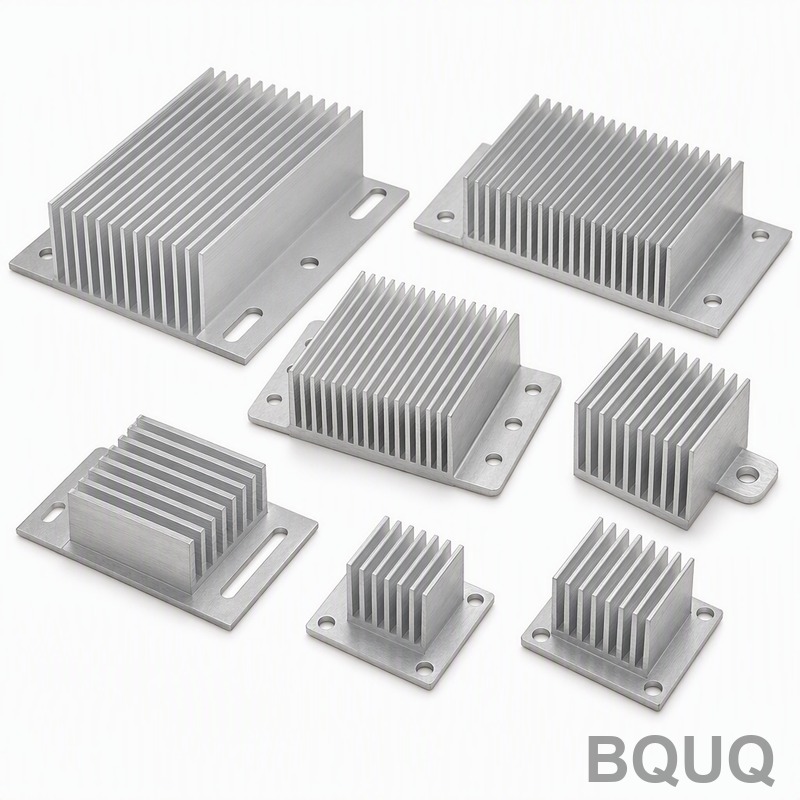
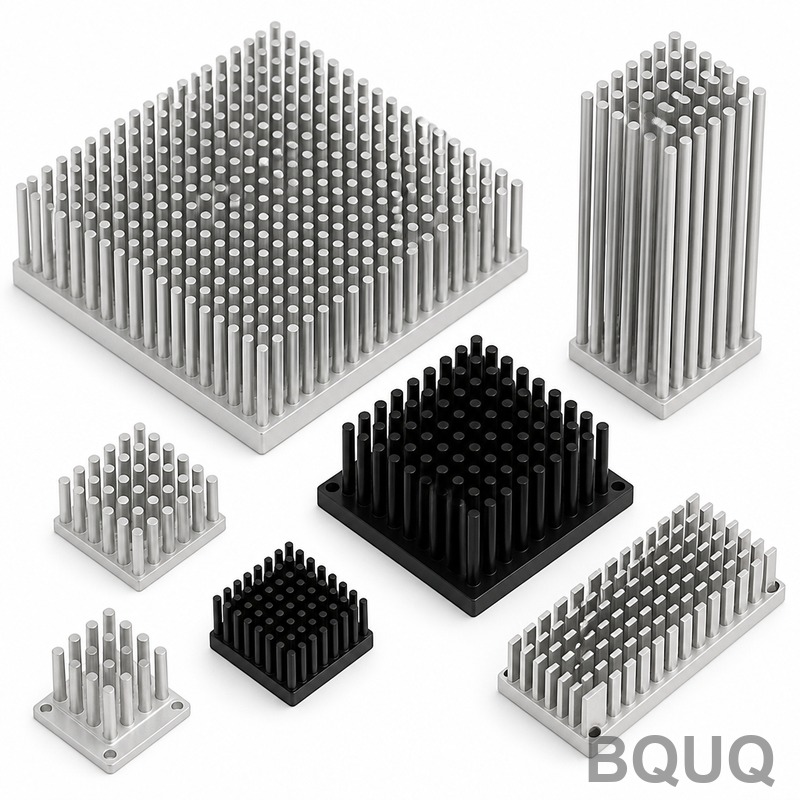
The process choice dominates cost per unit. CNC machined heat sinks from solid aluminum 6061-T6 cost $0.85 to $2.10 per cubic inch of removed material, with typical small fin geometries (fin thickness 1.0-1.5 mm, fin height 15-40 mm) landing at $12-$35 for a 100x100x40 mm block in quantities of 50. Extruded aluminum profiles (6005-T5 or 6063-T5) have a lower recurring cost of $0.30-$0.80 per linear inch but require a die investment of $1,200-$4,500. Skived fin heat sinks, which offer fin densities up to 20 fins per inch with fin thickness down to 0.3 mm, cost $18-$60 per unit for low volumes due to the specialized machinery and slower cycle times. Stamped copper or aluminum fin assemblies (folded fin) are the lowest recurring cost at $1.80-$6.50 per unit for volumes above 5,000, but tooling for the stamping die runs $6,000-$15,000.
How Does Material Choice Affect the Final Price per Unit?
Aluminum 6061-T6 remains the default due to its balance of thermal conductivity (167 W/m·K) and machinability, priced at $3.20-$4.10 per kg in 2026. Copper C1100 offers 385 W/m·K (2.3x better) but costs $12.50-$15.80 per kg and requires slower machining speeds (reducing throughput by 40%), pushing per-unit cost up by 180-250% for identical geometries. An intermediate option is copper-aluminum composite (Al 6061 base with copper insert), which raises cost by only 60-90% while improving thermal performance by 35-45% in localized hotspot areas. For 2026, consider that aluminum alloy surcharges (due to China’s carbon-reduction production caps) add $0.12-$0.18 per kg, while copper’s LME price volatility adds a 4-7% hedging premium on quoted lead times beyond 4 weeks.
Which Heat Sink Features Drive the Highest Cost Increases?
Three features disproportionately inflate cost: fin aspect ratio, surface treatment, and assembly complexity. Fins with a height-to-thickness ratio exceeding 30:1 (e.g., 2 mm thick, 60 mm tall) require specialized long-reach tooling and increase CNC cycle time by 55-70%, adding $6-$12 per unit. Surface treatments—black anodizing (per MIL-A-8625 Type II) adds $3.50-$7.00 per unit for parts under 300 cm² surface area, while nickel plating for corrosion resistance adds $5-$9. Press-fit or soldered heat pipes (copper, 6 mm diameter) embedded into the base add $4-$8 per pipe plus labor. The most expensive optional feature is a vapor chamber, which adds $25-$60 per unit and requires vacuum brazing with a 3-5% reject rate.
Why Do Tooling and NRE Costs Vary So Widely Between Suppliers?
Tooling costs vary because they reflect not just the die or fixture, but the engineering validation included. A simple extruded heat sink die with a 5-7 day design cycle costs $1,200-$2,800; a complex 12-cavity die with back-end machining fixtures runs $4,500-$9,000. CNC machining heat sinks typically require only soft tooling (fixtures and jigs) at $500-$1,500, but if the design demands 5-axis machining for undercut fins, the programming and prove-out adds $800-$2,500 in NRE. For stamped fin assemblies, the progressive die cost is $8,000-$15,000 and includes a 2-3 week tryout period. In 2026, leading suppliers like BQUQ bundle DFM (Design for Manufacturing) analysis into the NRE, reducing overall project cost by 12-18% by eliminating rework cycles.
How Does Order Quantity Change the Unit Price Curve?
The price-per-unit curve flattens significantly above 2,000 pieces. At quantities of 100, a CNC machined aluminum heat sink (80x80x25 mm, 12 fins) costs $16.50 each; at 500 pieces, $9.80; at 2,000 pieces, $6.20; and at 10,000 pieces, $4.40. Extruded versions with post-machining drop from $11.20 at 500 pieces to $3.10 at 10,000 pieces. The break-even point between CNC and extrusion is typically 800-1,200 units per year—below this, CNC is cheaper due to zero die cost; above, extrusion wins. For stamped assemblies, the break-even is higher at 3,000-5,000 units annually due to the tooling investment. BQUQ recommends annual blanket orders with scheduled releases to lock in material pricing and avoid 2026’s quarterly surcharge adjustments.
What Is the Realistic Lead Time and How Does Expediting Affect Price?
Standard lead time for custom heat sinks in 2026 is 3-4 weeks for CNC machining (including 3-5 days for engineering review and quoting) and 5-7 weeks for extrusion or stamping (including die fabrication). Expediting to 7-10 days for CNC parts adds a 25-35% premium due to dedicated machine time and overtime labor. For production orders, a 2-week expedite (versus 4-week standard) typically adds 10-15%. BQUQ maintains a 12-hour quoting response and can hold raw aluminum 6061 stock in 150 mm, 200 mm, and 250 mm diameters to shave 5-7 days off the schedule without premium charges. Air freight versus sea freight for a 50 kg heat sink shipment from Dongguan to Los Angeles costs $4.20/kg versus $0.85/kg, but for urgent prototypes this is often acceptable.
Heat Sink Cost Comparison by Process and Volume (2026 Baseline)
| Process | Unit Cost (100 pcs) | Unit Cost (1,000 pcs) | Unit Cost (5,000 pcs) | Tooling/NRE | Typical Lead Time |
| CNC machined (Al 6061, 80x80x25mm) | $16.50 | $9.80 | $6.20 | $500-$1,500 | 3-4 weeks |
| Extruded (Al 6063, custom die) | $11.20 | $5.40 | $3.10 | $1,200-$4,500 | 5-7 weeks |
| Skived fin (Al 6061, 20 fpi) | $24.00 | $14.50 | $9.80 | $800-$2,000 | 4-5 weeks |
| Stamped folded fin (Al 1100 or Cu) | $8.50 | $4.20 | $2.20 | $6,000-$15,000 | 6-8 weeks |
| Copper insert base (CNC + brazed) | $32.00 | $19.50 | $12.80 | $1,500-$3,000 | 4-6 weeks |
How Should You Specify Your Heat Sink to Minimize 2026 Costs?
Engineers should specify only the thermal requirements that are truly critical. Avoid tight tolerances on fin thickness—specify ±0.10 mm for fins and ±0.05 mm for base flatness, not tighter, as this doubles machining time. Use a base thickness of 6-10 mm; going thicker than 12 mm adds material cost without thermal benefit in most forced convection applications. Choose 6061-T6 over 7075-T6 unless structural loads demand otherwise; 7075 costs 40% more and machines 30% slower. Also, specify standard anodizing (black, 10-15 micron) instead of hard anodizing (50 micron) unless abrasion resistance is required—hard anodizing costs 3x more and reduces thermal conductivity by 8-12%. Finally, consolidate multiple heat sinks into one extruded profile that you cut to length for different SKUs, reducing die costs by 40-60%.
What Hidden Costs Appear in a Heat Sink RFQ?
Three hidden costs commonly appear: surface area penalty for large parts, packaging for delicate fins, and quality inspection reports. Heat sink pricing scales with external surface area, not just volume—a part with 25 fins has roughly 4x the surface area of a block, increasing anodizing and packaging costs. Fin deformation during shipping requires corrugated inserts or foam, adding $0.20-$0.80 per unit for fragile geometries (fin thickness under 1.0 mm). A full dimensional inspection report with CMM (Coordinate Measuring Machine) data adds $150-$300 per batch. For 2026, also budget for REACH/RoHS documentation if shipping to Europe—this is free from BQUQ but costs $200-$500 from third-party labs if required separately.
FAQ
What is the minimum order quantity for a custom heat sink?
There is no minimum order quantity for CNC machined heat sinks; BQUQ can produce a single prototype for $25-$60 depending on size. For extruded or stamped designs, the minimum is effectively tied to tooling amortization—typically 500 pieces for extrusion and 2,000 for stamping to justify the die cost. We recommend starting with 10-20 CNC prototypes for thermal validation before committing to production tooling.
How much does heat sink thermal testing cost?
A basic thermal resistance test (using a heated die simulator and airflow chamber) costs $400-$800 per setup, covering 3-5 samples and a detailed report. This includes junction-to-ambient thermal resistance in °C/W at specified airflow rates (typically 1.0-3.0 m/s). BQUQ offers this as a bundled service at $350 per design for orders above 500 units.
Can I use a custom heat sink for both natural and forced convection?
Yes, but you must specify the intended airflow regime. A heat sink optimized for forced convection (fins spaced 4-6 mm apart) will perform poorly in natural convection (needs 8-12 mm spacing). Designing for dual-mode operation increases fin pitch and surface area by 30-40%, raising cost by 15-25%. We recommend separate designs if both modes are equally important.
Are copper heat sinks worth the 2x price premium?
Copper is worth the premium when your heat flux exceeds 15 W/cm² or when space constraints limit heat sink volume. For typical LED or MOSFET cooling below 10 W/cm², aluminum 6061 with a heat pipe or vapor chamber is more cost-effective. Copper’s higher density (8.96 g/cm³ vs. 2.70 g/cm³) also increases shipping costs and requires stronger mounting hardware.
How fast can I get a quotation for a custom heat sink?
BQUQ provides a 12-hour turnaround on quotes when you send a 3D model (STEP or IGES) and thermal requirements (power dissipation in watts, maximum allowable temperature, available airflow, and maximum envelope dimensions). For designs requiring DFM feedback, the initial engineering review takes 1-2 business days. All quotes are valid for 30 days and include 2026 material surcharge projections.
Which surface finish gives the best thermal performance for the lowest cost?
A bare machined aluminum surface (no coating) has the best thermal performance but oxidizes over time, increasing emissivity slightly. Black anodizing (Type II, 10-15 micron) costs only $3.50-$7.00 per unit and improves radiative heat transfer by 15-20% in natural convection, making it the best cost-performance choice. Electroless nickel plating is only recommended for salt-spray corrosion environments above 500 hours.
What tolerances can I expect on a CNC machined heat sink?
Standard CNC machining tolerances are ±0.05 mm for base dimensions and ±0.10 mm for fin thickness and spacing. Base flatness can be held to 0.05 mm over 100 mm length, which is critical for proper thermal interface material (TIM) contact. Tighter tolerances (±0.02 mm) are possible but increase cost by 20-40% due to additional inspection and slower machining passes.
Conclusion
For 2026, a custom heat sink cost is best understood as a function of process, material, and volume—with CNC machined aluminum starting at $16 per unit for low volumes and dropping to $6 or less at production scale. The most effective cost reduction strategy is to optimize fin geometry for your exact airflow and heat load, avoid over-specifying tolerances, and consolidate volume into annual contracts. BQUQ’s 20 years of manufacturing experience in Dongguan ensures you receive a design-for-manufacturing review before any tooling commitment, eliminating costly redesign loops. For a precise quotation within 12 hours, send your CAD files and thermal specifications to sc@bquq.com or contact us on WhatsApp at +86 13713157787. Visit www.bquq.com for detailed case studies and material datasheets.