How to Mount a Heat Sink with Screws, Clips, Tape, and Adhesives?
The best method to mount a heat sink depends on your thermal budget, mechanical constraints, and production volume, but for permanent, high-performance applications, screw mounting with thermal paste is the gold standard. For low-cost, low-profile assemblies, thermally conductive adhesive tapes offer a clean solution, while clips provide the best balance of serviceability and pressure for CPU/GPU sockets. This guide details the engineering trade-offs, torque specifications, and thermal resistances for each method to help you select the correct attachment for your PCB or component.
What Are the Thermal Performance Differences Between Mounting Methods?
Thermal performance is quantified by the interface thermal resistance (Rth), measured in °C/W. Screw mounting with a quality thermal paste (e.g., 5 W/mK) achieves an Rth of 0.05 to 0.15 °C/W for a 25 mm x 25 mm die, which is the lowest of all methods. Clips with pre-applied phase-change material (PCM) yield 0.15 to 0.30 °C/W, while thermally conductive adhesive tapes (1.5 W/mK) typically show 0.50 to 1.00 °C/W depending on thickness (0.1 to 0.25 mm). Adhesives (epoxy or silicone) perform similarly to tape at 0.40 to 0.80 °C/W, but they cure to a rigid bond that can induce mechanical stress on the package over temperature cycling.
How Much Pressure Should Screws and Clips Apply?
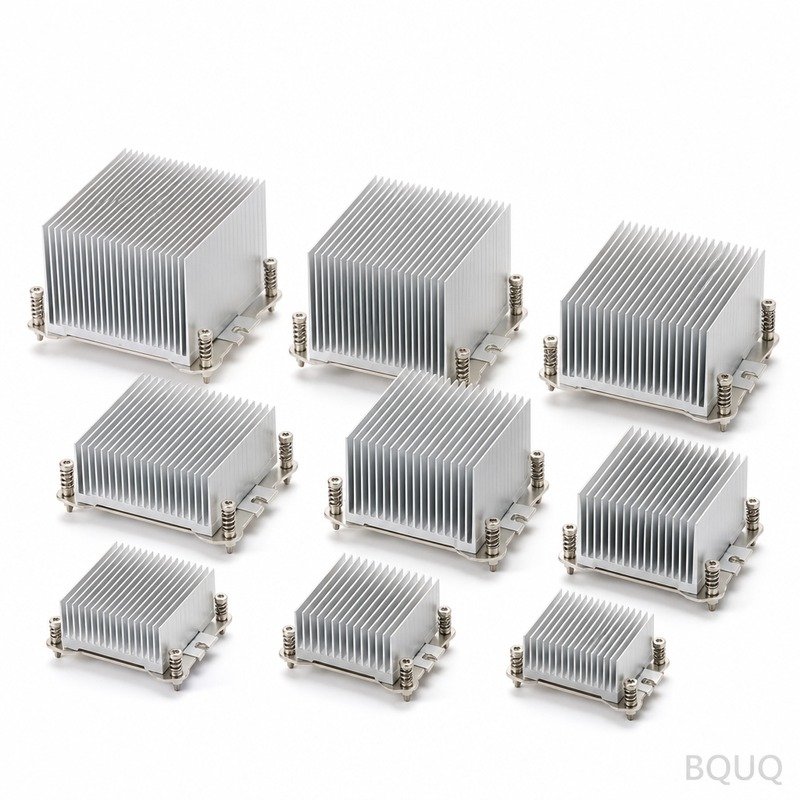
Uniform contact pressure is critical to minimize air gaps at the interface. For screw mounting, the recommended torque for M3 screws is 0.4 to 0.6 N·m (3.5 to 5.3 in-lb), which translates to a linear force of 50 to 80 N per screw. Clips (e.g., push-pin or leaf spring designs) should exert a total force of 30 to 60 N, distributed evenly across the package. Exceeding 100 N on a bare die can crack the silicon, while under 20 N leaves a 10 to 20 µm air gap that reduces thermal transfer by up to 40%. Always use a spring washer or Belleville washer under the screw head to maintain constant pressure despite thermal expansion.
Which Materials Are Suitable for Thermally Conductive Tape?
Choose tape with a silicone or acrylic carrier loaded with ceramic or aluminum oxide fillers. For consumer electronics, acrylic tapes (e.g., 3M 8805) offer 1.6 W/mK and a dielectric breakdown voltage of 6 kV, suitable for isolating components. For high-temperature environments (above 125 °C), use silicone-based tapes like 3M 9890FR, which withstands 200 °C continuous duty. Tape thickness ranges from 0.05 mm (for flat surfaces with < 5 µm roughness) to 0.25 mm (for warped PCBs). The adhesion strength is typically 0.5 to 1.0 N/mm², which is sufficient for heat sinks under 10 grams in vertical orientation, but not for heavy copper heatsinks over 50 grams without additional mechanical support.
When Should You Use Adhesives Instead of Mechanical Fasteners?
Use thermally conductive adhesives when there is no access to the backside of the PCB for screws, and when the heat sink must also serve as a structural brace. Two-part epoxies (e.g., Arctic Alumina) cure in 24 hours at 25 °C, or 90 minutes at 80 °C, and provide 7 MPa shear strength. However, adhesives are permanent; removing the heat sink risks delaminating PCB traces. For reworkable designs, use silicone adhesives (e.g., Dow Corning 3-6751), which offer lower bond strength (1.5 MPa) but can be peeled off with a razor at 100 °C. Adhesives are not recommended for components dissipating above 10 W/cm² because the rigid bond cannot accommodate differential thermal expansion between aluminum (23 µm/m·K) and silicon (2.6 µm/m·K).
How Does the Heat Sink Weight Affect Mounting Method Selection?
For heat sinks under 20 grams, thermal tape or adhesive is reliable in any orientation. For 20 to 100 grams, clips or screws are mandatory to prevent shear failure during vibration or drop testing (IEC 60068-2-6). Above 100 grams (typical for server CPU coolers), use a backplate with screws to distribute the load across the PCB, because a point load of 150 N can bow a standard 1.6 mm FR4 board by 0.3 mm, cracking solder joints. As a rule of thumb, calculate the required retention force as 5 times the heat sink weight to survive a 5g vibration profile.
What Are the Cost and Lead Time Implications of Each Mounting Method?
| Mounting Method | Material Cost (per 100 units) | Tooling Cost | Assembly Time (per unit) | Thermal Resistance (°C/W) | Reworkability |
| Screws + Thermal Paste | $15 - $25 (screws, springs, paste) | None | 45 seconds (manual) | 0.05 - 0.15 | Excellent |
| Clips + PCM Pad | $20 - $35 (clip, pad) | $800 - $1,500 (stamping die) | 15 seconds (snap-on) | 0.15 - 0.30 | Good |
| Thermal Tape | $8 - $12 (tape die-cut) | $300 - $600 (die-cut tool) | 10 seconds (peel & stick) | 0.50 - 1.00 | Poor (one-time) |
| Adhesive (Epoxy) | $10 - $18 (2-part syringe) | $200 - $400 (dispensing fixture) | 90 seconds + 24h cure | 0.40 - 0.80 | Not reworkable |
Screws are the lowest recurring cost but require the most labor unless automated. Clips have a moderate tooling investment but pay off in high-volume consumer electronics (above 10,000 units/year) due to rapid assembly. Thermal tape is the cheapest turnkey solution for prototyping or low-power LED modules, but it cannot be re-applied after removal. Adhesives incur hidden costs from dispensing equipment calibration and scrap from misaligned placement.
How Do You Achieve a Flat Contact Surface for Any Mounting Method?
Surface flatness of the heat sink base must be within 0.05 mm across the contact area, and the PCB or component surface should have a roughness of Ra 1.6 µm or better. If using screws, apply a 0.05 mm thick layer of thermal paste, then torque in a crisscross pattern (e.g., screw 1 to 50%, screw 2 to 50%, then both to 100%) to avoid tilting the heat sink. For clips, ensure the spring force center is aligned with the die center within 2 mm; off-center pressure creates a wedge gap that increases Rth by 0.2 °C/W. For tape, clean both surfaces with isopropyl alcohol (99% purity) and apply the tape from one edge to the other to avoid air bubbles. For adhesives, use a double-sided spacer (e.g., 0.1 mm shims) to control bond line thickness; a thicker bond line increases thermal resistance linearly at about 10 °C/W per 0.1 mm for a 1.5 W/mK adhesive.
Which Mounting Method Is Best for High Vibration or Thermal Cycling Applications?
For automotive or industrial environments with temperature swings from -40 °C to 125 °C, screws with a compliant thermal pad (e.g., 6 W/mK graphite or 5 W/mK silicone pad) are the only reliable choice. The screw maintains constant pressure, while the pad compresses to absorb differential expansion of up to 0.2 mm. Clips can fatigue after 1,000 thermal cycles if the spring steel is not heat-treated; specify 17-7 PH stainless steel clips for high-cycle durability. Thermal tape loses 20% of its adhesion strength after 500 hours at 85 °C/85% RH humidity testing, so it is not suitable for sealed enclosures without conformal coating. Adhesives become brittle below -20 °C, risking fracture of the bond line; if unavoidable, use a silicone adhesive with 500% elongation at break.
How Do You Validate the Mounting After Assembly?
Measure the thermal performance using a thermocouple on the heat sink base and a second on the component case. The temperature difference should not exceed 15 °C at 5 W dissipation for a properly mounted screw assembly. Also perform a pull test: a 25 mm x 25 mm heat sink mounted with tape should withstand a 10 N pull perpendicular to the PCB without detachment. For screws, verify torque with a calibrated driver; for clips, check that the clip moves freely and does not bottom out on the PCB. X-ray inspection is recommended for adhesives to detect voids larger than 1 mm³, which act as localized hot spots.
FAQ
Can I Reuse a Heat Sink Mounted with Thermal Tape?
No, thermal tape is a one-time adhesive. Once removed, the tape's acrylic layer tears and loses its conformability, so you must clean both surfaces and apply fresh tape. Reusing tape often introduces air pockets that raise thermal resistance by 30% or more.
What Is the Maximum Operating Temperature for Adhesive Mounting?
Standard acrylic tapes are rated to 125 °C continuous, while silicone adhesives can handle 200 °C. Always check the glass transition temperature (Tg) of the adhesive; above Tg, the bond strength drops by 50% and creep increases significantly.
How Do I Choose Between Thermal Paste and a Phase-Change Material (PCM) for Screws?
Thermal paste is best for static assemblies that will not be disassembled, as it pumps out after 1,000 thermal cycles. PCM (e.g., Honeywell PTM7950) is solid at room temperature and melts at 45 °C, filling gaps like paste but without dry-out; use PCM for laptop or server applications where rework is common.
Are Spring Washers Necessary for Screw Mounting?
Yes, if the assembly experiences vibration or thermal cycling. A flat washer will loosen over time because aluminum and copper expand at different rates, reducing contact pressure by up to 50% after 500 cycles. Belleville washers maintain a constant load over a 0.2 mm deflection range.
What Is the Minimum Heat Sink Size for Clip Mounting?
Clips require a minimum package area of 20 mm x 20 mm to distribute the spring force without cracking the die. For smaller packages, use screws or tape; clips on a 10 mm x 10 mm QFN package can cause corner stress fractures.
Can I Use Thermal Tape on a Vertical Heat Sink Over 50 Grams?
No, the shear strength of most tapes (0.5 N/mm²) is insufficient to hold a 50 g heat sink vertically without sliding. The tape would need a contact area of at least 1,000 mm², which is impractical for most PCB layouts; use screws or clips instead.
How Long Does Thermal Adhesive Take to Cure for Production?
Two-part epoxy cures in 24 hours at room temperature, but you can accelerate to 90 minutes at 80 °C in a convection oven. For high-volume lines, consider UV-curable thermal adhesives that cure in 10 seconds with a 365 nm lamp, though they are more expensive at $0.30 per gram.
Conclusion
Selecting the right heat sink mount is a trade-off between thermal resistance, assembly cost, and mechanical reliability. For engineering prototypes and high-heat components above 10 W, use M3 screws with thermal paste and a torque of 0.5 N·m. For mass production of low-power devices, thermal tape offers the fastest cycle time, while clips are ideal for modular designs requiring field replacement. Adhesives should be reserved for permanent assemblies with no rework requirement. Regardless of method, always validate with a thermal test and a pull test before approving the design for production.
For a detailed mounting design review or to request samples for your specific heat sink and PCB, our engineering team at BQUQ can provide torque specifications and thermal simulation within 12 hours. Contact us at sc@bquq.com or WhatsApp +86 13713157787, or visit www.bquq.com for our full range of CNC-machined heat sinks and custom stamping services.