Passive vs Active Heat Sinks: Which Cooling Solution Do You Need?
Selecting between a passive and active heat sink depends on your system's power density, allowable acoustic noise, and reliability requirements. For dissipating less than 25 W in a naturally ventilated enclosure, a passive heat sink is often sufficient and offers zero failure modes; for loads above 50 W or confined spaces, an active solution with a fan is typically mandatory to keep junction temperatures below 85°C. The decision is not merely about cost—it involves a trade-off between thermal resistance, MTBF (Mean Time Between Failures), and space constraints.
Thermal Performance Fundamentals
The core metric for any heat sink is thermal resistance, expressed in °C/W. This value quantifies the temperature rise per watt of heat dissipated. A typical extruded aluminum passive heat sink with a 100 mm x 100 mm base and 40 mm fin height offers a thermal resistance of approximately 0.8 °C/W in natural convection. In contrast, a similar-sized active heat sink with a 60 mm axial fan can achieve 0.2 °C/W at the same footprint.
For a 30 W load, the passive sink would rise 24°C above ambient. If ambient is 40°C, the base temperature reaches 64°C, which is acceptable for most silicon junctions rated at 85°C. However, at 60 W, the passive sink base reaches 88°C—exceeding typical limits. The active sink at 60 W would rise only 12°C, keeping the base at 52°C, well within safe margins. This 4x improvement in thermal resistance is the primary reason active cooling dominates high-power applications.
Cost Breakdown and Economic Comparison
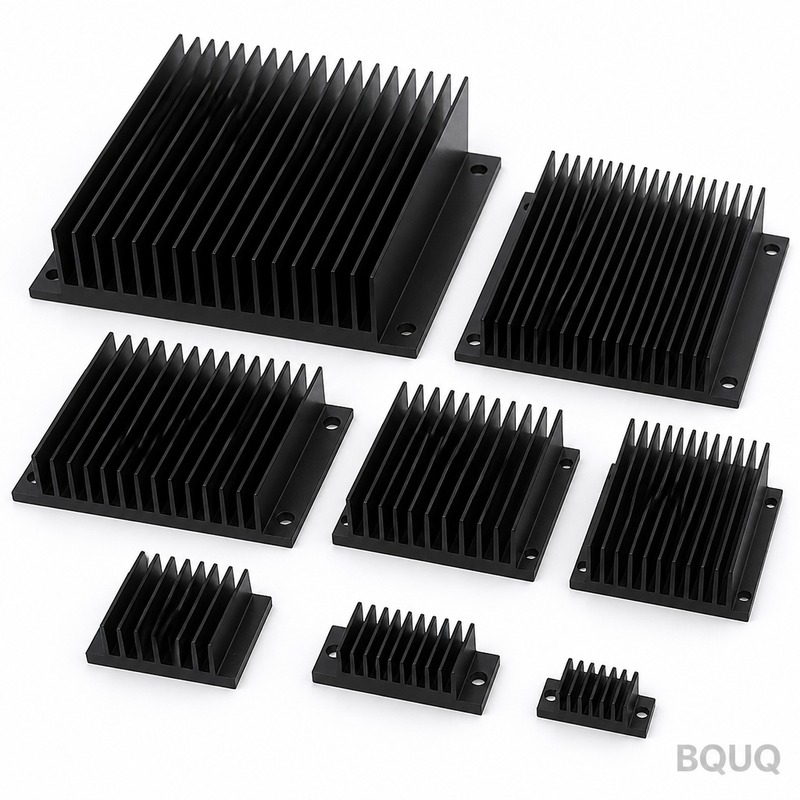
The manufacturing cost difference between passive and active heat sinks is significant, but the total system cost includes the fan, controller, and assembly labor. A passive heat sink for 30 W (aluminum extrusion, black anodized) costs between $2.50 and $4.00 per unit at 1000-piece volumes. An active heat sink with a sleeve-bearing 40 mm fan costs $5.50 to $8.50 per unit, including the fan and pre-applied thermal interface material (TIM).
The table below summarizes typical pricing and specifications for BQUQ-manufactured heat sinks at 1000-piece order quantities:
| Parameter | Passive Extruded Heat Sink | Active Heat Sink with Axial Fan |
| Thermal Resistance (°C/W) | 0.8 - 1.2 | 0.2 - 0.5 |
| Maximum Dissipation (W) | 25 - 40 | 60 - 120 |
| Noise Level (dBA) | 0 | 18 - 32 |
| Unit Cost (USD) | 2.50 - 4.00 | 5.50 - 8.50 |
| Mean Time Between Failures (hours) | 100,000+ (no moving parts) | 30,000 - 50,000 (fan dependent) |
| Height Profile (mm) | 40 - 60 | 25 - 40 |
| Operating Temperature Range (°C) | -40 to +150 | -10 to +70 (fan limited) |
The price per watt of dissipation is instructive. At $3.25 average cost for a passive sink handling 30 W, the cost is $0.11/W. An active sink at $7.00 handling 90 W costs $0.08/W. For high-density applications, active cooling is actually more cost-effective per watt, despite the higher absolute price.
Reliability and Maintenance Considerations
The most critical engineering distinction is reliability. A passive heat sink has zero moving parts, yielding an effective MTBF exceeding 100,000 hours—essentially the life of the electronics. Active heat sinks depend on fan longevity. A standard sleeve-bearing fan at 40°C ambient has an MTBF of 30,000 hours (3.4 years of continuous operation). A dual ball-bearing fan extends this to 50,000 hours (5.7 years), but adds $1.50 to $2.00 to the unit cost.
For industrial equipment intended for 10-year service life, this means the fan must be replaced at least once. If the application is in a dusty environment, the fan's performance degrades by 20-30% within 6 months without filters. Filter maintenance adds recurring labor costs. BQUQ recommends passive cooling for outdoor telecom enclosures and medical devices where maintenance access is restricted. Active cooling is preferred for indoor consumer electronics with a 2-3 year design life, where fan replacement aligns with product obsolescence.
Space and Enclosure Design Constraints
Enclosure volume drives the passive vs active decision more than raw wattage. A passive heat sink requires substantial surface area for natural convection—typically 100 cm² per 10 W dissipated. For a 50 W load, you need 500 cm² of exposed fin surface. This often requires a taller enclosure or external fins. An active heat sink with a 40 mm fan can achieve the same dissipation with only 150 cm² of fin area, allowing for a 40% reduction in heat sink volume.
For a 1U rack-mount server chassis (44.45 mm height), a passive sink is geometrically impossible for loads above 20 W due to height restrictions. The fin height is limited to 25 mm, which severely limits natural convection. In such constrained profiles, active cooling with a blower-style fan is the only viable option. Conversely, in a wall-mounted industrial controller with 200 mm of clearance, a passive sink with 80 mm fin height can handle 60 W without any acoustic penalty.
Noise and Environmental Compliance
Acoustic noise is a hard specification in many applications. Passive heat sinks emit 0 dBA. Active heat sinks with a 40 mm fan typically generate 25-32 dBA, which is noticeable in quiet office environments. For medical diagnostic equipment where the sound limit is 25 dBA, a larger passive sink or a low-speed 60 mm fan at 18 dBA is required. The trade-off is that a low-speed fan provides only 50% of the airflow of a standard-speed fan, requiring a 30% larger fin surface to compensate.
Regarding environmental compliance, passive aluminum heat sinks easily meet RoHS and REACH requirements with simple black anodizing. Active heat sinks introduce the fan motor, which contains copper windings and rare-earth magnets. These components complicate end-of-life recycling and may trigger additional WEEE (Waste Electrical and Electronic Equipment) documentation. For export to EU markets, the fan supplier must provide full material declarations, adding procurement overhead.
Practical Selection Recommendations
For loads under 25 W in free air, always select a passive heat sink. The cost savings and reliability benefits outweigh any size advantages. For loads between 25 W and 50 W, evaluate enclosure airflow. If the enclosure has ventilation slots and the ambient is below 50°C, a high-efficiency passive sink with a 50 mm fin height can suffice. For loads above 50 W or any enclosure with restricted airflow, select an active heat sink with a dual ball-bearing fan rated for at least 50,000 hours.
When choosing an active heat sink, specify the fan voltage precisely. A 12 V fan at 0.15 A draws 1.8 W, which is 3-6% of the total heat load for a 50 W system. This fan power must be included in the thermal budget. Also, specify the fan's PWM (Pulse Width Modulation) control input if variable speed is required. BQUQ's active heat sinks use standard 4-pin PWM connectors, enabling dynamic speed control that reduces noise by 40% at low loads.
For extreme environments above 70°C ambient, fan bearings fail rapidly. In this case, use a passive heat sink with a 2x safety margin or specify a high-temperature fan with an operating range to 85°C, which adds 30% cost. Always derate the thermal resistance by 15% for altitudes above 2000 meters due to reduced air density.
Conclusion
The passive vs active heat sink decision is a quantitative engineering trade-off, not a preference. Passive cooling offers absolute reliability and zero noise but is limited to approximately 40 W in practical footprints. Active cooling handles 60-120 W in compact spaces but introduces a wear-out mechanism and noise. BQUQ manufactures both types in-house with CNC-machined aluminum bases and stamped fin assemblies, ensuring tolerances of ±0.1 mm on base flatness and ±0.05 mm on fin pitch. For a custom cooling solution, send your thermal load, ambient temperature, and size constraints to our engineering team. We provide 12-hour quoting on all heat sink designs. Contact us at Email: sc@bquq.com, WhatsApp: +86 13713157787, or visit www.bquq.com for immediate assistance.
Related Articles
- Stamped Metal vs Die Cast Heat Sinks: Cost & Quality Comparison
- New energy vehicle IGBT heat dissipation, heat sink reliability engineering, heat pipe and temperature plate integrated heat sink, surface treatment and heat radiation enhancement: anodic oxidation, black coating and micro-nano structure, graphene/3D printing/intelligent thermal management: 2030 heat sink technology roadmap
- 5G Base Station Outdoor AAU Cooling: The Climate Adaptation Challenge of Fanless Passive Design