Precision Machined Parts Material Selection Guide for Engineers and Buyers
Selecting the correct material for precision machined parts determines 80% of your final part cost, functional lifespan, and manufacturing lead time. For CNC machining, the best material is 6061-T6 aluminum for general prototyping, 303 stainless steel for corrosion resistance, and 7075-T6 aluminum for high-stress aerospace components. This guide provides a decision framework based on quantitative data from a 20-year-old Dongguan factory floor, covering machinability, thermal properties, and real cost per kilogram.
Material Selection Criteria and Mechanical Thresholds
The material choice must satisfy three simultaneous constraints: yield strength for the application, machinability rating for cost control, and thermal stability for tolerance retention. For parts with tolerances below ±0.01 mm, choose materials with a Rockwell hardness below HRC 35 to minimize tool wear and thermal distortion.
Aluminum 6061-T6 offers a yield strength of 276 MPa with a machinability rating of 100% (baseline). Stainless steel 304 has a yield strength of 215 MPa but a machinability rating of only 45%, increasing cycle time by 2.2 times. For high-temperature environments above 150°C, aluminum loses 30% of its yield strength, making steel or titanium necessary.
Aluminum Alloys for CNC Machining and Heat Sinks
Aluminum is the default for precision machined parts due to its excellent thermal conductivity (167 W/m·K for 6061) and low density (2.70 g/cm³). For heat sink applications, 6063-T5 aluminum provides a thermal conductivity of 201 W/m·K, making it the preferred choice for LED and power electronics cooling, though its yield strength is lower at 145 MPa.
For structural precision parts, 7075-T6 aluminum offers a yield strength of 503 MPa, comparable to mild steel, while maintaining a weight reduction of 65%. The trade-off is a machinability rating of 70% and a price premium of 1.8 times over 6061. In our factory, we recommend 7075-T6 only when the design requires a strength-to-weight ratio above 180 kN·m/kg; otherwise, 6061-T6 provides the best economic balance.
Stainless Steel Grades for Corrosion and Wear Resistance
Stainless steel is required for medical devices, marine components, and food processing equipment. The two most common grades we machine are 303 and 316L. Grade 303 contains sulfur for improved machinability, achieving a rating of 78%, but its corrosion resistance is inferior to 316L, which contains molybdenum (2-3%) for pitting resistance in chloride environments.
For precision parts with sliding contact, we recommend 440C stainless steel hardened to HRC 58-60. This grade provides a wear resistance of 0.5 mg weight loss per 1000 cycles in a pin-on-disc test, compared to 8 mg for 303. The machining cost for 440C is 3.5 times higher than 303 because it requires grinding operations after heat treatment to maintain tolerances below ±0.005 mm.
Engineering Plastics and Brass for Cost-Sensitive Applications
When electrical insulation or weight reduction is critical, engineering plastics such as PEEK and PTFE are viable. PEEK maintains a tensile strength of 90 MPa at 250°C, making it suitable for high-temperature insulators. However, PEEK costs USD 45 per kilogram and requires specialized tooling with a 4-times longer cycle time than aluminum.
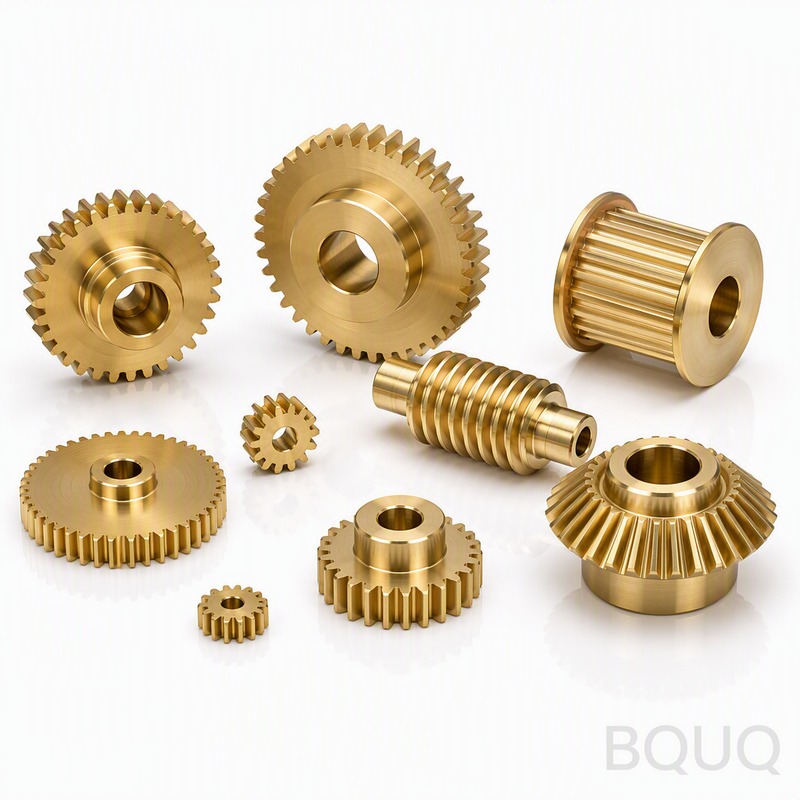
Brass C36000 (free-cutting brass) offers the fastest machining cycle of all materials, with a machinability rating of 150%. For threaded fittings and electrical terminals, brass provides a yield strength of 310 MPa and a coefficient of friction of 0.35 against steel. The price per part is often lower than steel despite a higher material cost (USD 8/kg) because cycle time is reduced by 40%.
Cost Comparison Table for Common Machined Materials
| Material | Yield Strength (MPa) | Machinability Rating (%) | Material Cost (USD/kg) | Relative Cycle Time | Typical Tolerance (mm) |
| 6061-T6 Aluminum | 276 | 100 | 4.50 | 1.0 | ±0.005 |
| 7075-T6 Aluminum | 503 | 70 | 8.10 | 1.4 | ±0.005 |
| 303 Stainless Steel | 241 | 78 | 6.20 | 1.8 | ±0.010 |
| 316L Stainless Steel | 290 | 55 | 7.80 | 2.2 | ±0.010 |
| 440C Stainless Steel (HRC 58) | 1900 | 30 | 9.50 | 3.5 | ±0.005 (ground) |
| C36000 Brass | 310 | 150 | 8.00 | 0.6 | ±0.010 |
| PEEK (unfilled) | 90 | 40 | 45.00 | 4.0 | ±0.020 |
Surface Finish and Thermal Treatment Interactions
The chosen material dictates the achievable surface finish. Aluminum 6061-T6 can achieve Ra 0.4 µm with a single-pass diamond cut, while stainless steel 304 requires a secondary polishing operation to reach Ra 0.8 µm, adding USD 0.50 per square centimeter. For parts requiring anodizing, only aluminum alloys are suitable; hard anodizing (Type III) adds a 50 µm coating with a hardness of HRC 55, but reduces fatigue strength by 10%.
Heat treatment must be specified before final machining for steel parts. For 4140 alloy steel, we quench and temper to HRC 28-32, then machine to final dimensions. This sequence ensures a dimensional stability of ±0.01 mm over a 100 mm length after thermal cycling. If hardening is performed after machining, expect a distortion of 0.02-0.05 mm per 100 mm length, requiring a wire EDM operation to correct.
FAQ-Style Material Selection Tips for Design Engineers
What is the cheapest material for a prototype with 500 parts? Use 6061-T6 aluminum if the service temperature is below 100°C. For a 50 mm x 50 mm x 10 mm block, the material cost is USD 0.30 and machining time is 8 minutes, totaling approximately USD 12 per part including setup.
When should I choose titanium over aluminum? Titanium (Grade 5, Ti-6Al-4V) is necessary for continuous service above 200°C or where the part must match the thermal expansion of carbon fiber composites (8.6 µm/m·°C). Otherwise, aluminum is superior due to a 5-times lower machining cost.
How do I avoid stress corrosion cracking in stainless steel? Specify 316L instead of 304 for any part exposed to seawater or chloride solutions above 50°C. Also, request a solution annealing treatment after forming to restore the austenitic microstructure.
Can I use the same cutting tools for all aluminum grades? Yes, but use carbide tools with a 10-degree rake angle for 7075 to prevent edge build-up. For 6061, high-speed steel tools work fine at speeds below 150 m/min.
Conclusion and Practical Recommendation
For 90% of precision machined parts, the optimal material is 6061-T6 aluminum when strength and cost are balanced, 303 stainless steel for corrosive environments, and C36000 brass for high-volume threaded components. Always verify the maximum operating temperature and required yield strength against the data table above before finalizing your drawing. Specify surface finish in Ra values, not vague terms like "smooth," and include heat treatment requirements in the notes field.
For a definitive material recommendation, send your 3D model and application parameters to our engineering team. We will provide a DFM analysis with a firm cost quote within 12 hours.
| Email: sc@bquq.com | WhatsApp: +86 13713157787 | www.bquq.com |
Related Articles
- Custom CNC Machining Services: A Complete Guide for Engineers
- How Much Does CNC Machining Cost in 2026? A Complete Pricing Guide
- When CNC 'Speaks' — Intelligent Process Planning Driven by Large Models and Knowledge Graphs
Frequently Asked Questions
What is the best aluminum alloy for general CNC machining prototypes?
6061-T6 aluminum is the best choice for general prototyping. It offers a yield strength of 276 MPa, a machinability rating of 100% (baseline), and provides the best economic balance for most parts. Its thermal conductivity is 167 W/m·K, and it has a low density of 2.70 g/cm³.
When should I choose 7075-T6 aluminum over 6061-T6?
Choose 7075-T6 only when the design requires a strength-to-weight ratio above 180 kN·m/kg. It offers a yield strength of 503 MPa, comparable to mild steel, with a 65% weight reduction. However, it has a machinability rating of 70% and costs 1.8 times more than 6061-T6.
Which stainless steel grade is best for corrosion resistance in chloride environments?
316L stainless steel is recommended for chloride environments because it contains molybdenum (2-3%) for pitting resistance. While 303 has better machinability (78% rating), its corrosion resistance is inferior. 316L is suitable for medical devices, marine components, and food processing equipment.
What material is recommended for high-wear precision parts with tight tolerances?
440C stainless steel hardened to HRC 58-60 is recommended for sliding contact parts. It achieves a wear resistance of 0.5 mg weight loss per 1000 cycles, compared to 8 mg for 303. However, machining costs are 3.5 times higher than 303 due to required grinding operations to maintain tolerances below ±0.005 mm.