Standard Heat Sink Sizes for TO-220, TO-247 and Common Power Packages
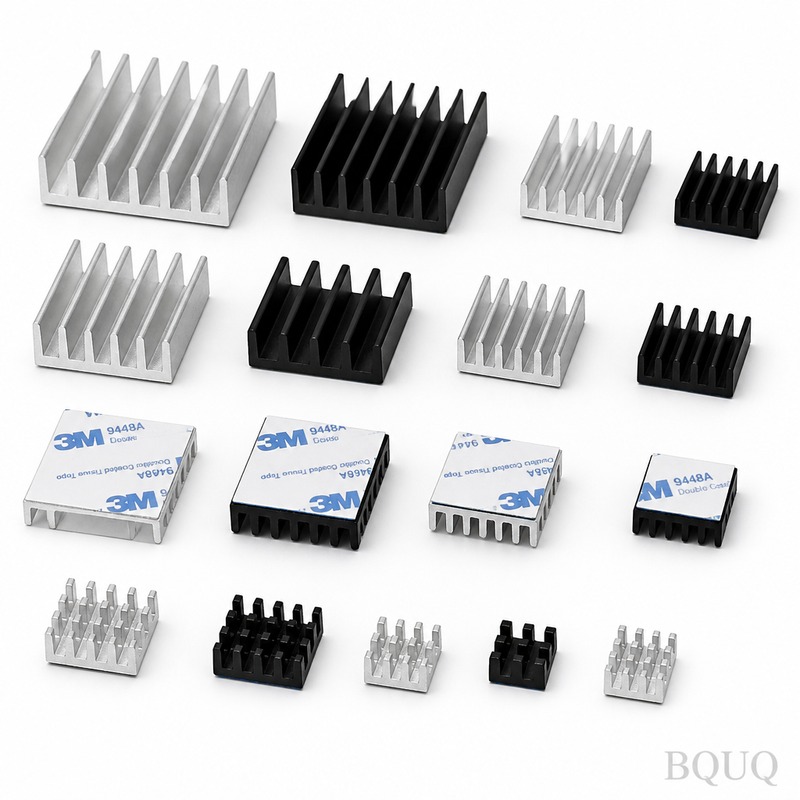
The standard heat sink size for TO-220 packages is typically 19.0 mm wide by 12.7 mm deep with a height of 10.0 mm to 25.4 mm, offering a thermal resistance of 10 to 25 °C/W in natural convection. For TO-247 packages, the standard footprint is 20.0 mm wide by 15.0 mm deep, with heights from 20.0 mm to 40.0 mm, achieving 5 to 12 °C/W. These dimensions are not fixed industry standards but rather derived from the package lead spacing, mounting hole patterns, and the power dissipation requirements of typical applications, which BQUQ has refined over 20 years of CNC machining and stamping production.
Package Geometry and Mounting Constraints
The physical dimensions of TO-220 and TO-247 packages dictate the minimum heat sink interface area. TO-220 packages have a lead pitch of 2.54 mm and a mounting hole diameter of 3.2 mm (for M3 screws), with the tab center located 3.7 mm from the package edge. Consequently, the heat sink mounting surface must provide a flat zone of at least 15.0 mm by 10.0 mm to accommodate the tab without interfering with leads. TO-247 packages are larger, with a lead pitch of 5.08 mm and a mounting hole of 3.5 mm (M3.5), requiring a minimum flat surface of 20.0 mm by 15.0 mm. Standard heat sinks from BQUQ are extruded aluminum 6063-T5, with a flatness tolerance of 0.05 mm across the mounting surface, ensuring proper thermal interface material (TIM) compression of 0.05 to 0.10 mm.
Thermal Resistance and Power Dissipation Correlation
The required heat sink size is a direct function of the junction-to-ambient thermal budget. For a TO-220 device with a maximum junction temperature of 150 °C operating at 50 °C ambient, the total allowable temperature rise is 100 °C. If the device dissipates 10 W, the total thermal resistance (junction-to-case plus case-to-sink plus sink-to-ambient) must be below 10 °C/W. Given that junction-to-case is typically 1.5 °C/W and case-to-sink with grease is 0.5 °C/W, the heat sink must provide 8.0 °C/W or better. A standard extruded heat sink measuring 19.0 mm wide, 12.7 mm deep, and 25.4 mm tall with a single 6.0 mm fin pitch achieves approximately 12 °C/W in natural convection at 10 W. To reach 8 °C/W, the height must increase to 38.0 mm or the width to 25.0 mm, which is why BQUQ stocks 12 standard profiles in this range.
Standard Heat Sink Size Table for Common Packages
The following table provides reference dimensions and thermal performance for standard heat sinks used with common through-hole power packages. These values are based on BQUQ production data and typical forced convection at 2.0 m/s airflow unless noted.
| Package Type | Mounting Hole | Min Flat Surface (mm) | Standard Width (mm) | Standard Depth (mm) | Standard Height (mm) | Thermal Resistance Natural Convection (°C/W) | Thermal Resistance Forced Air 2 m/s (°C/W) | Typical Power Dissipation (W) |
| TO-220 | M3, 3.2 mm | 15.0 x 10.0 | 19.0 | 12.7 | 10.0 - 25.4 | 10.0 - 25.0 | 3.0 - 8.0 | 5 - 15 |
| TO-247 | M3.5, 3.5 mm | 20.0 x 15.0 | 20.0 | 15.0 | 20.0 - 40.0 | 5.0 - 12.0 | 1.5 - 4.0 | 15 - 40 |
| TO-126 | M2.5, 2.7 mm | 10.0 x 8.0 | 12.0 | 8.0 | 8.0 - 15.0 | 20.0 - 35.0 | 6.0 - 12.0 | 2 - 6 |
| TO-3 (metal can) | Two M3, 22.0 mm spacing | 30.0 x 25.0 | 40.0 | 30.0 | 30.0 - 60.0 | 3.0 - 8.0 | 0.8 - 2.5 | 30 - 80 |
| TO-218/TO-3P | M3, 3.2 mm | 20.0 x 15.0 | 25.0 | 18.0 | 25.0 - 45.0 | 4.0 - 10.0 | 1.2 - 3.5 | 20 - 50 |
Fin Geometry Optimization and Standard Profiles
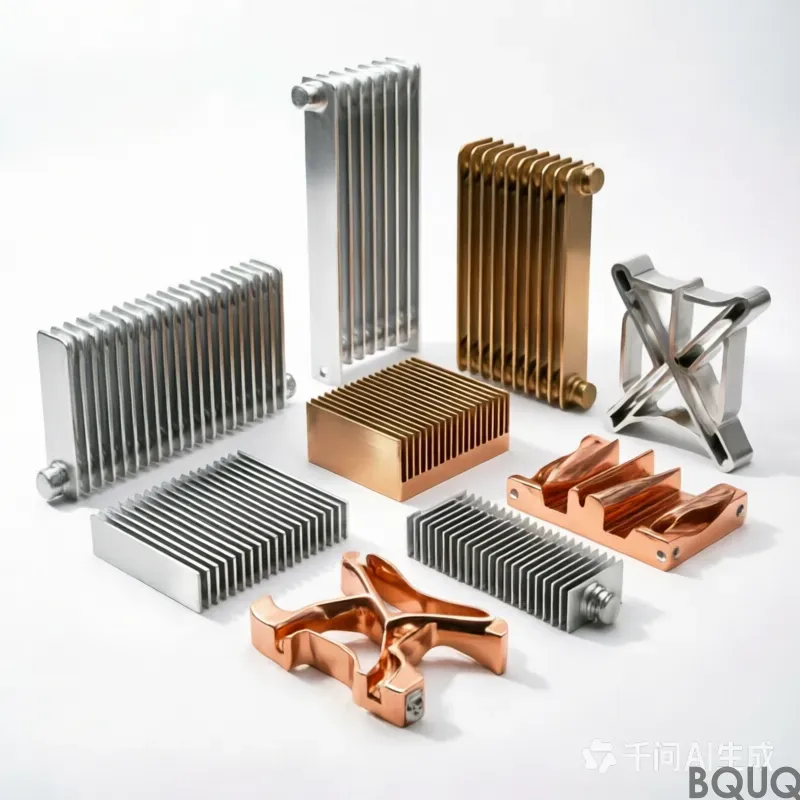
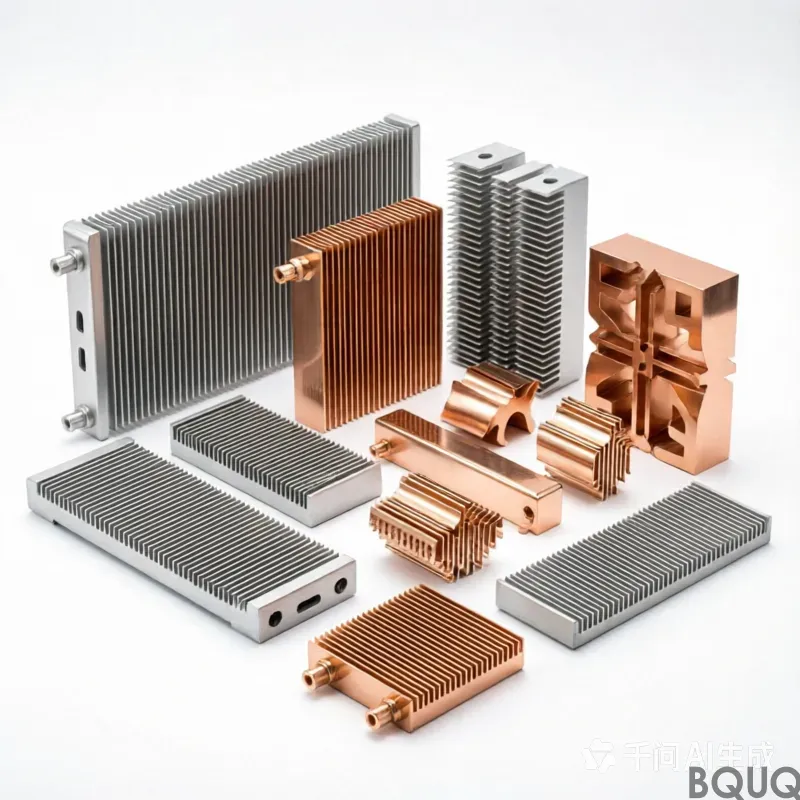
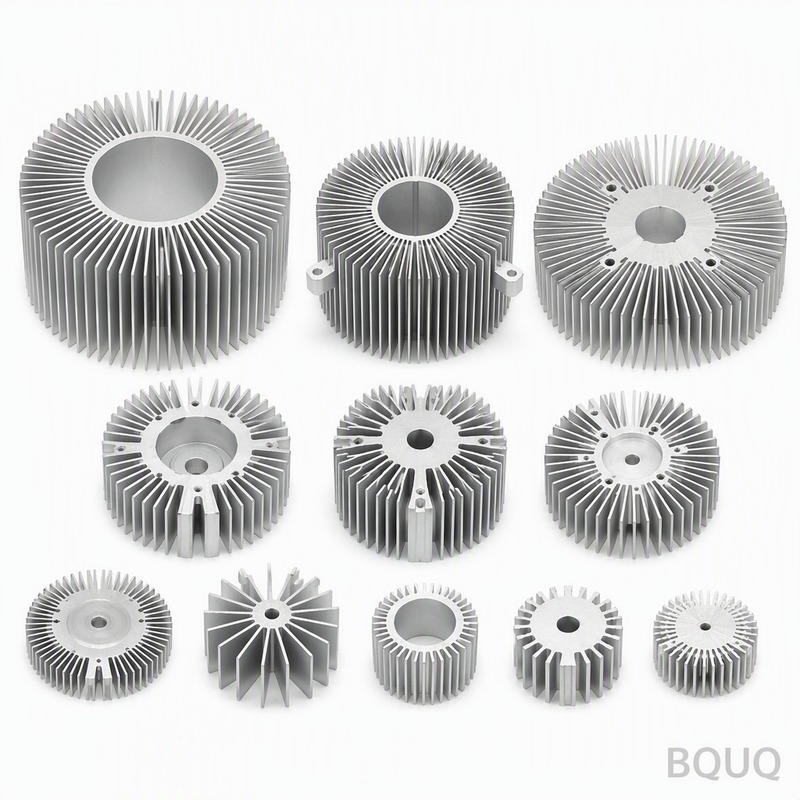
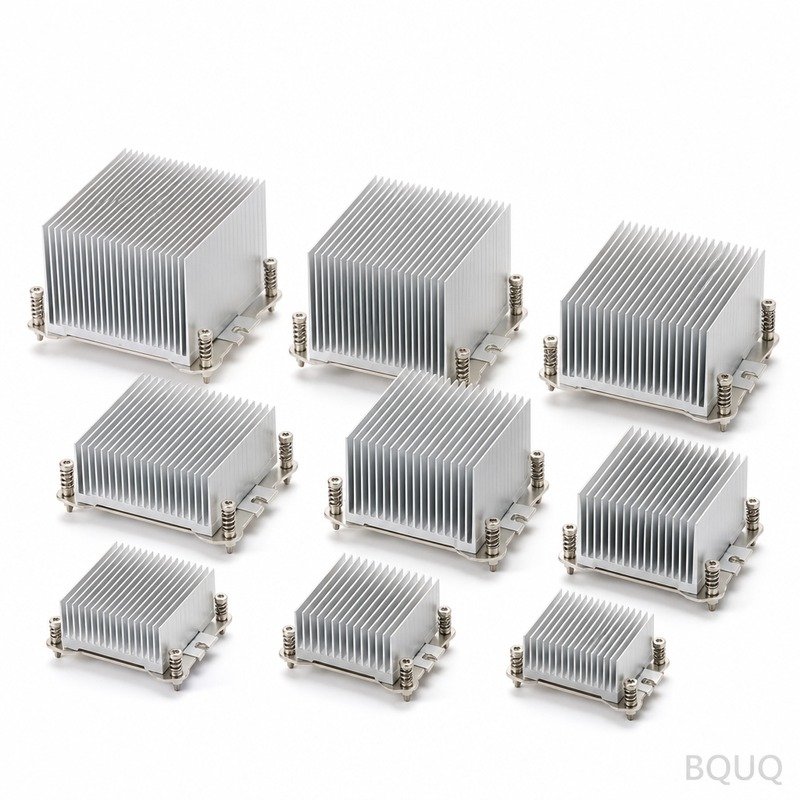
Fin spacing and thickness are as critical as overall footprint. For natural convection, BQUQ recommends a fin pitch of 6.0 to 8.0 mm with a fin thickness of 1.5 to 2.0 mm, as this balances radiation surface area against airflow resistance. For forced convection above 2.0 m/s, a tighter pitch of 3.0 to 4.0 mm increases surface area by 40% without significant pressure drop in the typical 60 mm fan shroud. Standard BQUQ profiles include the 19.0 mm wide series with 6, 8, or 10 fins, and the 25.0 mm wide series with 8, 10, or 12 fins. The extrusion tolerance for fin height is ±0.10 mm, and the straightness is 0.5 mm per meter, which is critical for automated assembly with spring clips or screws. For TO-247, the standard depth of 15.0 mm allows for a 12.0 mm fin length, providing a surface area of 85 cm² per 25.0 mm length section, yielding the 5.0 °C/W figure at 20.0 mm height.
Material Selection and Surface Finish Impact
Aluminum 6063-T5 is the default material for standard heat sinks due to its thermal conductivity of 201 W/m·K and excellent extrudability. For high-volume stamped heat sinks used with TO-220, BQUQ uses 1100 aluminum or 5052 alloy with a thickness of 1.5 mm to 2.0 mm, which reduces cost by 30% compared to extrusion but increases thermal resistance by 15% due to lower conductivity (180 W/m·K for 1100) and reduced fin area. Surface finish plays a measurable role: a clear anodized finish (8-12 µm) increases emissivity from 0.05 to 0.85, improving radiation heat transfer by up to 25% in natural convection. For a 10 W TO-220 application, this can reduce the required heat sink height from 25.4 mm to 20.0 mm. BQUQ applies a standard clear anodize to all extruded profiles at no additional cost for orders above 500 pieces, with a thickness tolerance of 10 µm ± 2 µm. Bare aluminum is only recommended for forced-air systems above 3.0 m/s where convection dominates.
Cost and Lead Time Considerations by Volume
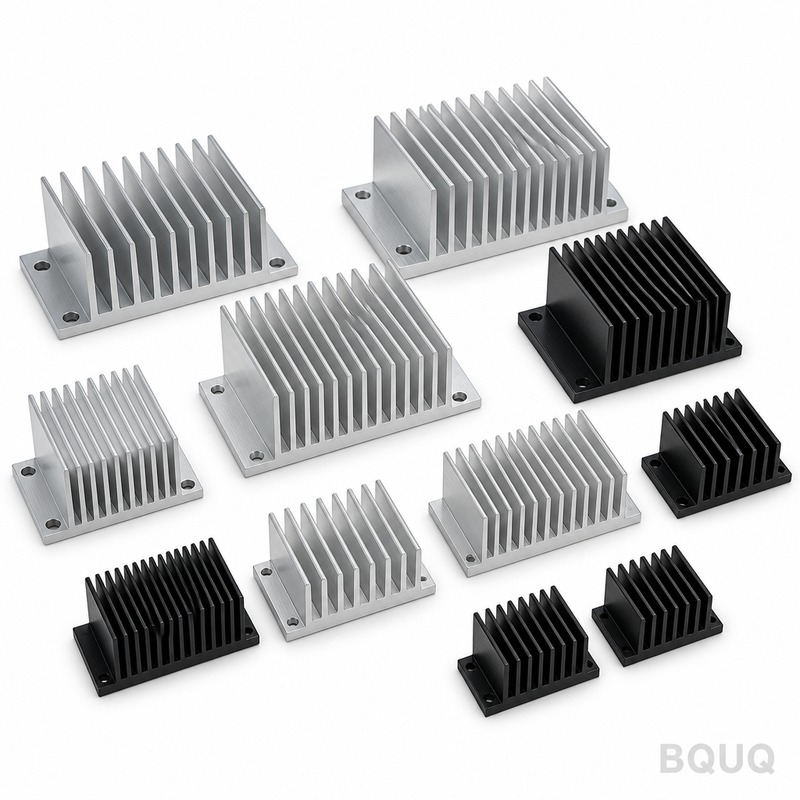
The standard heat sink size affects unit cost through material utilization and secondary operations. For a 19.0 mm x 12.7 mm x 25.4 mm extruded heat sink for TO-220, the raw material cost is approximately 0.12 USD at current aluminum prices (2,300 USD/ton). With cutting, deburring, and anodizing, the unit cost at 1,000 pieces is 0.45 USD. At 50,000 pieces, this drops to 0.28 USD due to automated cutting and batch anodizing. For TO-247 standard size (20.0 mm x 15.0 mm x 30.0 mm), unit cost is 0.65 USD at 1,000 pieces and 0.40 USD at 50,000 pieces. Stamped alternatives for TO-220 can be produced at 0.18 USD at 100,000 pieces, but require a tooling investment of 1,500 to 3,000 USD. BQUQ lead time for standard extruded profiles is 3 to 5 days for samples, 10 to 12 days for 1,000 to 5,000 pieces, and 18 to 20 days for 50,000 pieces. Custom extrusion dies cost 800 to 1,200 USD and add 15 to 20 days to the lead time.
Practical Recommendations for Selecting Standard Heat Sink Size
For TO-220 applications dissipating under 10 W, select a heat sink with a width of 19.0 mm and a height of 20.0 mm, which provides 15 °C/W in natural convection. For 10 to 20 W, increase the height to 38.0 mm or switch to the 25.0 mm width profile, which yields 8 °C/W. For TO-247 devices dissipating 20 to 40 W, begin with the 20.0 mm width by 15.0 mm depth profile at 30.0 mm height, which provides 6 °C/W. Always verify that the mounting hole is centered within the flat surface with a margin of at least 2.0 mm on each side to prevent edge cracking during screw tightening. Use a TIM with 1.0 W/m·K thermal conductivity and a thickness of 0.1 mm; this adds 0.5 °C/W, which must be included in your budget. For high-vibration environments, specify a heat sink with a mounting hole depth of at least 6.0 mm for TO-220 and 8.0 mm for TO-247 to ensure full thread engagement of the M3 and M3.5 screws.
Frequently Asked Questions on Heat Sink Sizing
Q: Can I use a TO-220 heat sink for a TO-247 package? A: No, the TO-247 tab is 20.0 mm wide versus 15.0 mm for TO-220, and the mounting hole spacing is different. Using a smaller heat sink will leave the edges of the tab unsupported, causing uneven TIM compression and a 20-30% increase in thermal resistance.
Q: What is the minimum height for a standard TO-220 heat sink? A: The practical minimum is 10.0 mm, which provides 25 °C/W and handles up to 4 W at a 100 °C rise. Below this height, the fin surface area is too small to be effective, and the base thickness of 3.0 mm consumes most of the profile.
Q: How does mounting orientation affect the standard size? A: With fins vertical and the package mounted horizontally, natural convection performance improves by 10-15% compared to horizontal fins. If the heat sink must be mounted with fins horizontal, increase the height by 20% or the width by 15% to compensate.
Q: What is the standard hole depth for M3 mounting screws? A: For extruded heat sinks, the standard hole depth is 6.0 mm for M3 and 8.0 mm for M3.5, which accommodates a screw length of 5.0 mm and 6.0 mm respectively. Deeper holes (10.0 mm) are available at no cost but require a minimum base thickness of 12.0 mm.
Q: Does a black anodized finish change the required size? A: No, the finish does not change the thermal conductivity but improves the radiation coefficient. For the same power dissipation, a black anodized heat sink can be 15% shorter in height compared to a clear anodized version in natural convection, as radiation accounts for 30% of total heat transfer.
Conclusion
The standard heat sink size for TO-220 and TO-247 packages is defined by the package mechanical envelope, the thermal resistance required for the application, and the manufacturing process chosen. For TO-220, a 19.0 mm wide by 12.7 mm deep profile with a height between 10.0 mm and 25.4 mm covers the majority of applications up to 15 W. For TO-247, the standard is a 20.0 mm wide by 15.0 mm deep profile with heights from 20.0 mm to 40.0 mm, handling up to 40 W. Selecting the correct size requires balancing the thermal budget with the available board space and airflow, and production volume determines whether extrusion or stamping is the cost-optimal solution. BQUQ has produced these standard profiles for over 20 years, with dimensional tolerances of ±0.10 mm and surface flatness of 0.05 mm, ensuring reliable thermal performance in your power electronics assembly.
For a precise heat sink size calculation based on your exact power dissipation and airflow, BQUQ provides free engineering support with a 12-hour quoting service. Send your design files or requirements to sc@bquq.com or contact us on WhatsApp at +86 13713157787. Visit www.bquq.com to download standard profile drawings and thermal data sheets.
Related Articles
- How to Attach a Heat Sink Without Screws: Thermal Adhesive Guide
- Stamped Metal vs Die Cast Heat Sinks: Cost & Quality Comparison
- New energy vehicle IGBT heat dissipation, heat sink reliability engineering, heat pipe and temperature plate integrated heat sink, surface treatment and heat radiation enhancement: anodic oxidation, black coating and micro-nano structure, graphene/3D printing/intelligent thermal management: 2030 heat sink technology roadmap