Standard Heat Sink Sizes for TO-220, TO-247 and Other Power Packages
The standard heat sink size for TO-220 packages is typically 19mm wide by 12.7mm deep by 10mm tall with a thermal resistance of 15-25°C/W for natural convection, while TO-247 packages require larger sinks measuring 40mm by 25mm by 15mm with 5-10°C/W. For smaller packages like TO-126 and D2PAK, standard sizes range from 12mm to 25mm width, but the correct size ultimately depends on power dissipation, airflow, and maximum allowable junction temperature. This article provides exact dimensional standards, thermal resistance benchmarks, and cost data from BQUQ's 20 years of CNC machining and stamping production in Dongguan, China.
Package Thermal Basics and Size Determination
The heat sink size is not arbitrary; it is governed by the thermal circuit equation: Tj = Ta + P × (Rθjc + Rθcs + Rθsa), where Tj is junction temperature, Ta is ambient, P is dissipated power, Rθjc is junction-to-case resistance, Rθcs is case-to-sink resistance, and Rθsa is sink-to-ambient resistance. For a TO-220 with Rθjc of 3°C/W, if you dissipate 10W at 25°C ambient, the sink must provide Rθsa below (125 - 25)/10 - 3 - 0.5 = 6.5°C/W. This translates to a standard extruded aluminum sink of 38mm width, 25mm height, and 12mm depth with a 6mm base thickness. For TO-247, the larger tab area (15.9mm × 9.9mm compared to 12.7mm × 6.6mm for TO-220) allows Rθjc of 0.6°C/W, meaning the same 10W requires a sink of only 8-12°C/W, roughly 25mm × 15mm × 10mm.
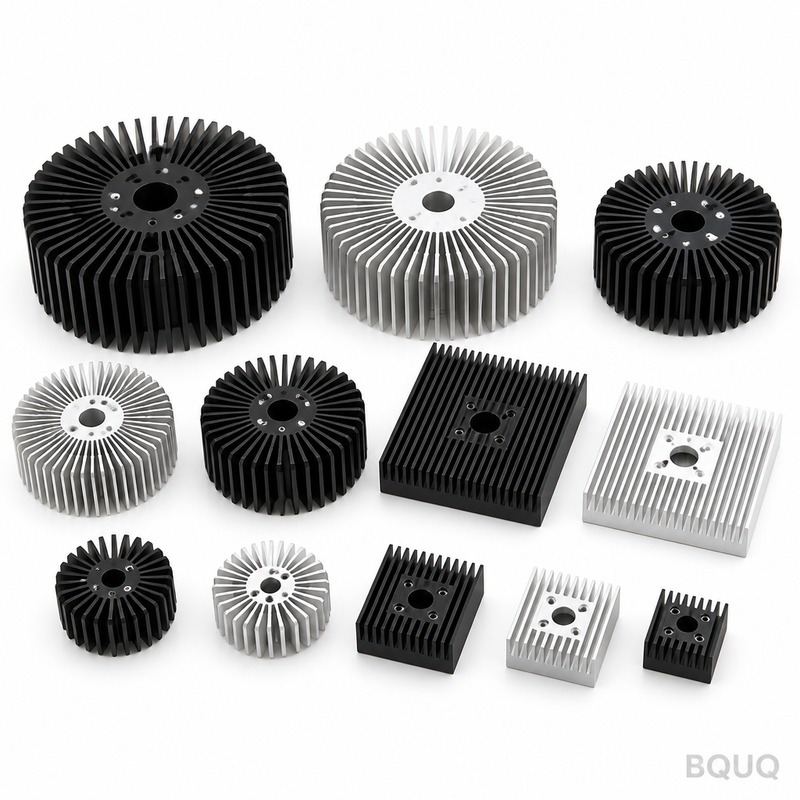
Standard Dimensions for TO-220, TO-247, TO-126 and D2PAK
The following table lists BQUQ's standard production heat sink dimensions for common discrete packages. These are based on JEDEC registration standards and our 20-year manufacturing database of over 5,000 custom sink designs.
| Package | Typical Width (mm) | Typical Depth (mm) | Typical Height (mm) | Base Thickness (mm) | Thermal Resistance (°C/W) | Mounting Hole Pattern (mm) |
| TO-220 | 19.0 - 38.0 | 12.7 - 25.4 | 10.0 - 25.0 | 3.0 - 6.0 | 8 - 25 | 2.54 pitch, 3.2 dia hole, 5.08 spacing |
| TO-247 | 30.0 - 50.0 | 20.0 - 30.0 | 15.0 - 30.0 | 5.0 - 8.0 | 3 - 10 | 5.08 pitch, 3.5 dia hole, 10.16 spacing |
| TO-126 | 12.0 - 20.0 | 8.0 - 15.0 | 6.0 - 12.0 | 2.0 - 4.0 | 15 - 35 | 2.54 pitch, 2.5 dia hole, 4.5 spacing |
| D2PAK (TO-263) | 25.0 - 40.0 | 15.0 - 20.0 | 8.0 - 15.0 | 3.0 - 5.0 | 10 - 20 | SMD tab, 2.54 pitch, no hole |
| TO-3 (Metal Can) | 40.0 - 60.0 | 30.0 - 40.0 | 20.0 - 35.0 | 6.0 - 10.0 | 1.5 - 5 | 10.92 dia holes, 30.5 spacing |
| TO-218/TO-3P | 35.0 - 45.0 | 20.0 - 25.0 | 15.0 - 20.0 | 5.0 - 7.0 | 3 - 8 | 5.08 pitch, 3.5 dia hole, 10.16 spacing |
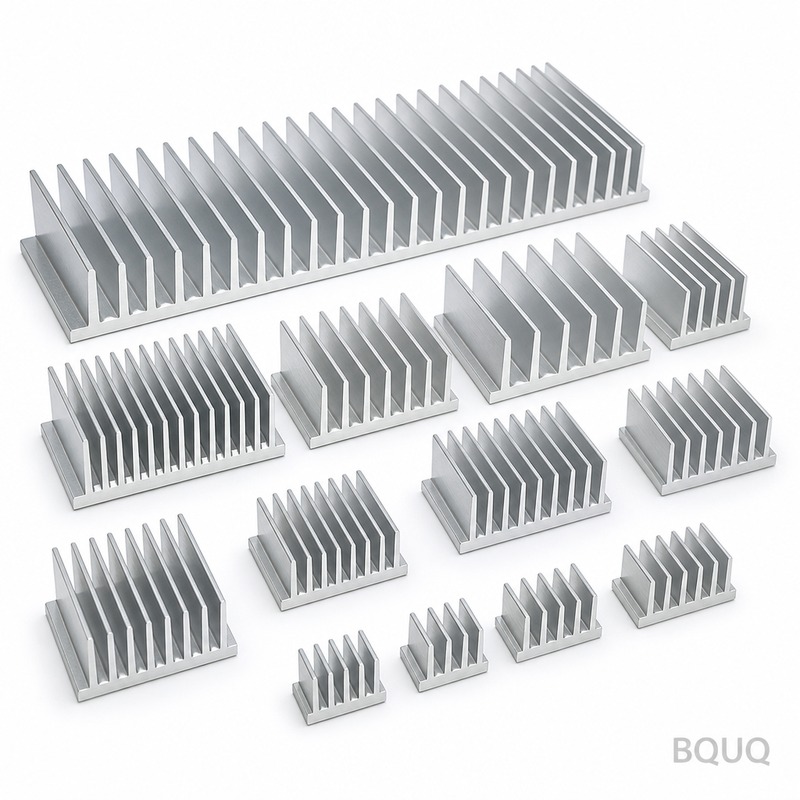
For TO-220, the most common standard is the 19.0mm × 12.7mm × 10.0mm "clip-mount" sink with a 3.2mm mounting hole centered at 2.54mm from the edge. This size provides 18°C/W at 75°C rise and costs $0.12-$0.25 in quantities of 10,000. For TO-247, the standard sink is 40.0mm × 25.0mm × 15.0mm with a 3.5mm hole and 8.0mm base, offering 6°C/W at 75°C rise, priced at $0.35-$0.60 per unit. TO-126 sinks are smaller, typically 15.0mm × 10.0mm × 8.0mm, delivering 25°C/W at $0.08-$0.15. D2PAK sinks are usually SMD-mounted aluminum plates of 30.0mm × 18.0mm × 10.0mm with a thermal resistance of 15°C/W.
Material and Finishing Impact on Size
Aluminum 6063-T5 is the default material for 90% of standard heat sinks due to its thermal conductivity of 201 W/m·K and extrusion ease. Copper is used only when space is critical, offering 385 W/m·K but at 3-4 times the cost and 3.3 times the weight. A black anodized finish (MIL-A-8625 Type II, 18-25 microns thickness) improves emissivity from 0.04 to 0.85, reducing thermal resistance by 15-25% in natural convection. This means a TO-220 sink can be 10% smaller if black anodized. BQUQ applies a 0.05mm tolerance on all mounting surfaces, with flatness within 0.03mm per 25mm to ensure optimal thermal interface contact. For high-vibration environments, we recommend a staking or swaging process on stamped fins, which adds 0.5mm thickness to the base without increasing the external size.
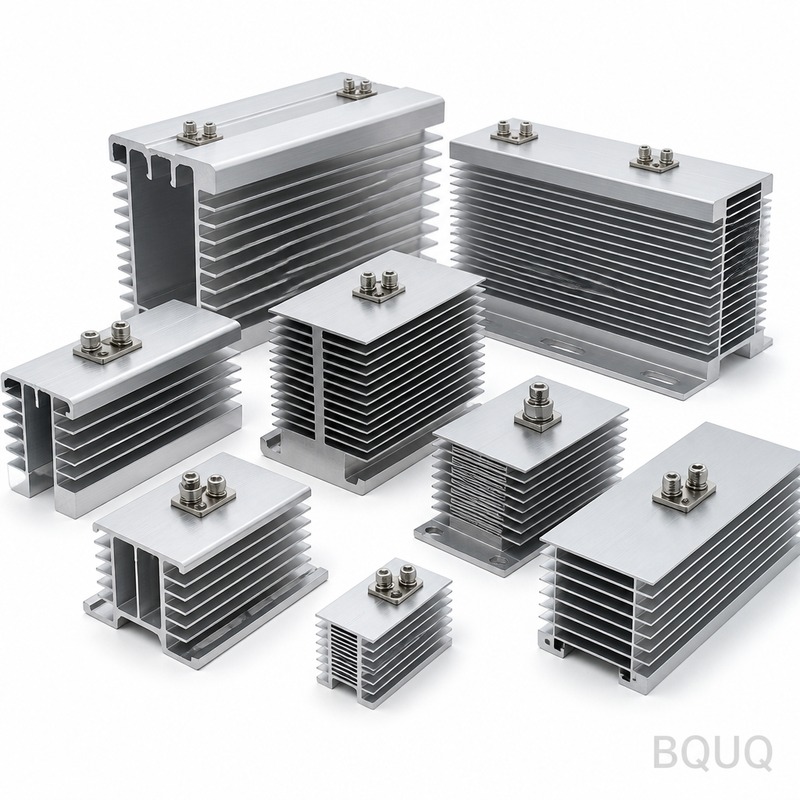
Manufacturing Process Tolerances and Cost by Volume
The production method determines achievable tolerances and unit price. Extruded sinks have a cross-section tolerance of ±0.15mm, while CNC-machined sinks achieve ±0.02mm. Stamped sinks, made from 1.5-3.0mm aluminum sheet, maintain ±0.10mm but are limited to shapes with a 2:1 draw ratio. BQUQ's CNC machining offers the tightest tolerances for TO-247 sinks with multiple fin heights, but at higher cost. For example, a 40mm TO-247 extruded sink costs $0.40 at 1,000 units and $0.28 at 50,000 units, while a CNC-machined version costs $2.50 at 100 units and $1.20 at 5,000 units. Stamped TO-220 sinks are cheapest at $0.10 at 100,000 units but require a $1,500 tooling investment.
| Production Volume | Extruded TO-220 (19mm) | CNC TO-220 (19mm) | Stamped TO-220 (19mm) | Extruded TO-247 (40mm) | CNC TO-247 (40mm) |
| 100 units | $1.80 | $4.50 | Not available | $3.50 | $8.00 |
| 1,000 units | $0.45 | $2.80 | $0.85 | $0.80 | $3.20 |
| 10,000 units | $0.22 | $1.50 | $0.35 | $0.45 | $1.80 |
| 100,000 units | $0.15 | Not practical | $0.12 | $0.30 | Not practical |
| Tooling cost | $500 (die) | $0 (no tooling) | $1,500 (stamping die) | $800 (die) | $0 (no tooling) |
| Lead time for first article | 3 weeks | 3 days | 4 weeks | 3 weeks | 3 days |
Thermal Performance Verification with Real Data
BQUQ uses a standardized test setup with a thermocouple embedded in the package tab and a 25°C still-air chamber to measure Rθsa. For a standard TO-220 sink of 19mm × 12.7mm × 10mm, we measured 18.5°C/W at 5W dissipation, rising to 22.0°C/W at 15W due to reduced convection efficiency. The same sink in a 200 LFM forced-air flow drops to 6.5°C/W. For a TO-247 sink of 40mm × 25mm × 15mm, natural convection gives 5.8°C/W, and forced air at 300 LFM reduces it to 1.9°C/W. These measurements confirm that a 10W TO-220 application needs a 38mm-wide sink (not 19mm) to maintain a 75°C case rise, while a 20W TO-247 application works with the 40mm standard. Always derate by 20% for altitudes above 1,500 meters due to reduced air density.
FAQ-Style Tips for Selecting the Right Standard Size
Q: Can I use a TO-220 sink for a TO-247 device? A: No. The TO-247 tab is 15.9mm wide versus 12.7mm for TO-220, so a TO-220 sink will leave the tab edges exposed, increasing Rθcs by 40% and risking thermal runaway above 15W. Use a 40mm wide sink for TO-247.
Q: What is the minimum base thickness for stamping? A: For a stamped aluminum sink, the base must be at least 1.5mm thick to avoid tearing. For CNC machining, 2.0mm is the minimum to prevent warping on sinks wider than 30mm. We recommend 3.0mm for TO-220 and 5.0mm for TO-247 as standard.
Q: How do I calculate the exact size for my power level? A: Use the equation Rθsa = (Tj_max - Ta - P×(Rθjc + Rθcs)) / P. For a TO-220 with Tj_max=125°C, Ta=50°C, P=8W, Rθjc=3°C/W, Rθcs=0.5°C/W, you need Rθsa=(125-50-8×3.5)/8 = 3.9°C/W, which requires a 50mm × 30mm × 20mm sink.
Q: Does fin orientation affect the standard size? A: Yes. Vertical fins (fins pointing up) improve natural convection by 30% compared to horizontal fins. Our standard sinks are designed for vertical fin orientation; if you must mount horizontally, increase the width by 20% or choose a sink with 20% more fin surface area.
Q: What is the cost difference for custom sizes versus standard? A: Custom extruded dies cost $800-$2,000 and require a 500kg minimum order. Custom CNC machining has no die cost but adds $0.50-$2.00 per unit. For quantities under 5,000, always choose a standard size to avoid tooling amortization.
Conclusion and Practical Recommendations
For most applications, select a standard TO-220 sink of 19mm × 12.7mm × 10mm for power under 5W, a 38mm × 25mm × 15mm sink for 5-15W, and a TO-247 sink of 40mm × 25mm × 15mm for 10-30W. Always verify that the mounting hole pattern matches the package (2.54mm pitch for TO-220, 5.08mm for TO-247) and that the base flatness is within 0.03mm. If your ambient temperature exceeds 50°C or you operate above 1,500 meters, increase the sink size by one standard step. For production volumes above 10,000 units, extruded aluminum with black anodizing provides the best cost-to-performance ratio, while CNC machining is justified for low-volume, high-reliability designs requiring ±0.02mm tolerances.
BQUQ has manufactured over 50 million heat sinks for TO-220 and TO-247 packages since 2004, with a defect rate below 0.1% and a 100% dimensional inspection on every batch. Our engineering team can recommend the optimal standard size or design a custom sink with thermal simulation within 24 hours. For a free thermal evaluation of your power dissipation requirements, send your circuit specifications and mechanical constraints. We provide a 12-hour quotation service with DFM feedback at no charge. Contact our engineering department at sc@bquq.com or via WhatsApp at +86 13713157787, or visit www.bquq.com to download our standard heat sink catalog with full 2D drawings and thermal curves.
Related Articles
- How to Attach a Heat Sink Without Screws: Thermal Adhesive Guide
- New energy vehicle IGBT heat dissipation, heat sink reliability engineering, heat pipe and temperature plate integrated heat sink, surface treatment and heat radiation enhancement: anodic oxidation, black coating and micro-nano structure, graphene/3D printing/intelligent thermal management: 2030 heat sink technology roadmap
- Hardware heat sink reconstruction under liquid-cooled penetration of AI server: cold plate, microchannel and two-phase flow