What Are the Best Heat Sink Solutions for 5G and Telecom Equipment?
The best heat sink solutions for 5G and telecom equipment are high-density aluminum die-cast and skived copper fin heat sinks, typically paired with heat pipes or vapor chambers, achieving thermal resistances below 0.5 °C/W. These designs manage heat fluxes exceeding 100 W/cm² at junction temperatures under 100 °C, essential for Massive MIMO antennas and base station power amplifiers. For most outdoor and indoor telecom applications, a combination of aluminum fins with embedded copper heat pipes offers the optimal balance of weight, cost, and thermal performance, with production lead times of 15 to 25 days from BQUQ.
What Thermal Challenges Are Unique to 5G and Telecom Equipment?
5G base stations generate 3 to 4 times more heat than 4G units, with typical power dissipation ranging from 500 W to 2,000 W per remote radio unit (RRU). The primary challenge is not just total heat, but heat flux density: GaN (gallium nitride) power amplifiers can produce localized heat fluxes of 150 to 300 W/cm². Additionally, telecom equipment must operate in ambient temperatures from -40 °C to +55 °C, with solar radiation adding up to 1,120 W/m² on outdoor enclosures. The reliability requirement is severe: a 5G base station must maintain a mean time between failures (MTBF) of over 200,000 hours, meaning the heat sink must keep the junction temperature below 105 °C at all times to prevent thermal runaway and signal degradation.
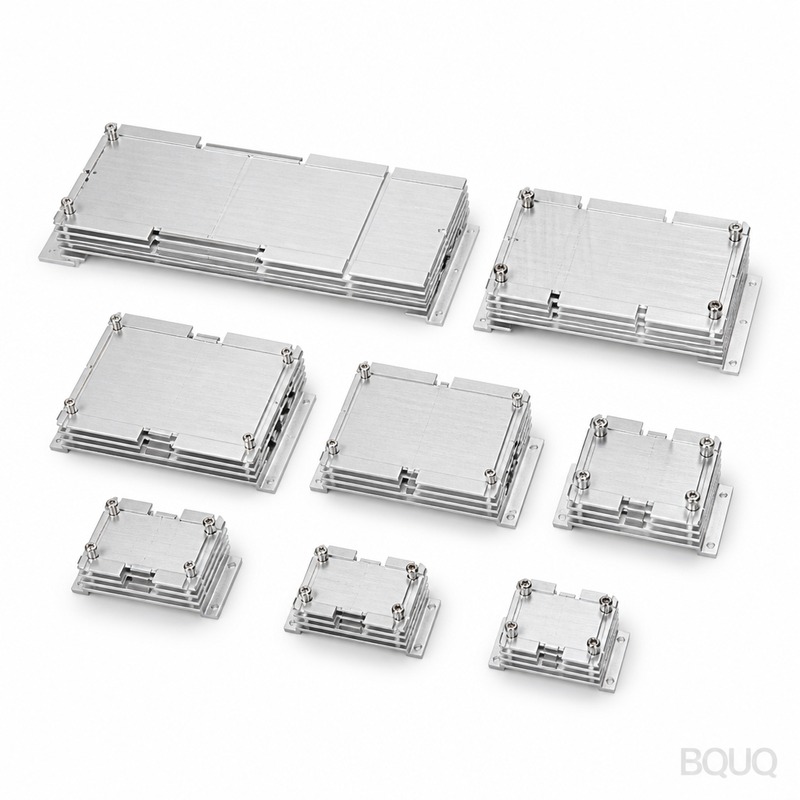
How Do Heat Pipes and Vapor Chambers Improve Heat Sink Performance?
Heat pipes and vapor chambers are two-phase heat transfer devices with effective thermal conductivities of 5,000 to 20,000 W/m·K, compared to 200 to 400 W/m·K for solid copper or aluminum. In a 5G heat sink, heat pipes spread localized heat from the GaN amplifier across the entire fin array, reducing the spreading resistance by 40 to 60%. Vapor chambers, being flat and thin (2.0 to 3.5 mm thick), are ideal for direct attachment to high-power ICs, spreading heat over a 100 mm x 100 mm area with a thermal resistance of only 0.1 to 0.2 °C/W. For a 1,000 W RRU, using four heat pipes of 8 mm diameter can lower the base plate temperature by 15 to 25 °C compared to a solid aluminum heat sink of the same volume.
Which Materials Offer the Best Thermal Conductivity for 5G Heat Sinks?
The material selection directly impacts thermal performance, weight, and cost. Copper (385 to 400 W/m·K) offers the highest conductivity but is heavy (8.96 g/cm³) and expensive, priced at approximately $12 to $15 per kilogram in mid-2025. Aluminum 6063-T5 (201 W/m·K) is lighter (2.70 g/cm³) and costs only $3.5 to $5 per kilogram, but requires larger fin surface area. For high-density solutions, a hybrid design is optimal: a copper base plate or embedded copper heat pipes with aluminum fins. This combination provides 80% of the thermal performance of all-copper heat sinks at 40% of the weight and 60% of the cost. For extreme cases, pyrolytic graphite sheets (1,500 W/m·K in-plane) can be used as a thin interface layer, but they are limited to low-pressure applications due to their fragility.
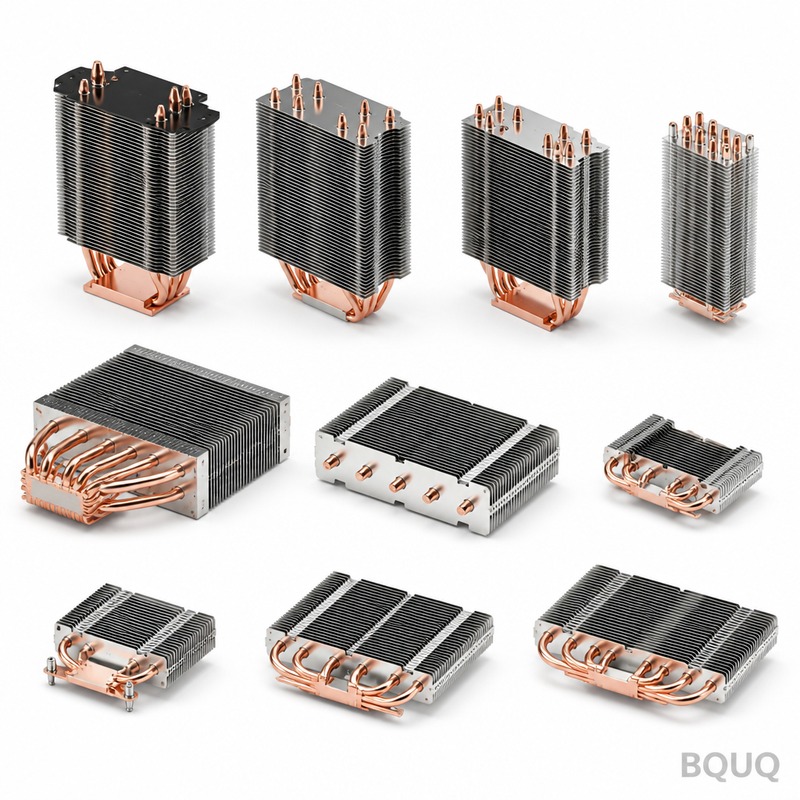
How Is Fin Density Optimized for Natural and Forced Convection?
Fin density is a critical parameter that differs based on the cooling method. For natural convection (passive cooling), the optimal fin spacing is 8 to 12 mm, with fin thickness of 1.5 to 2.5 mm and fin height of 30 to 50 mm. This configuration achieves a heat transfer coefficient of 5 to 10 W/m²·K. For forced convection (with fans), fin spacing can be reduced to 3 to 5 mm, fin thickness to 0.8 to 1.2 mm, and fin height increased to 60 to 80 mm, achieving heat transfer coefficients of 25 to 50 W/m²·K. The pressure drop across the heat sink must be kept below 50 to 100 Pa for standard axial fans. A typical 5G RRU heat sink with dimensions of 300 mm x 300 mm x 80 mm and a fin density of 6 fins per inch can dissipate 800 W with a 10 °C rise at a 5 m/s airflow, which is a common specification for telecom enclosures.
What Tolerances and Manufacturing Processes Are Required for High-Density Heat Sinks?
The manufacturing process determines the achievable fin density, aspect ratio, and dimensional accuracy. Skiving (planing) can produce fins as thin as 0.5 mm with heights up to 60 mm and fin pitch down to 1.5 mm, achieving an aspect ratio of 40:1. CNC machining offers tolerances of ±0.05 mm on critical mounting surfaces, which is essential for proper contact with GaN packages that have a flatness requirement of 0.02 mm. Die casting (aluminum A380) is cost-effective for volumes above 5,000 units, with tolerances of ±0.1 mm and minimum wall thickness of 1.5 mm, but it cannot achieve fin densities below 3 mm pitch. For 5G equipment, the mounting surface must be machined to a flatness of 0.05 mm or better to ensure thermal interface material (TIM) thickness of 50 to 100 µm, as an uneven surface can increase thermal resistance by 30 to 50%. BQUQ recommends a combined process: die-cast aluminum body with CNC-machined mounting faces and press-fit copper heat pipes, which balances cost and performance. The table below summarizes key specifications:
| Parameter | Natural Convection | Forced Convection (Fan) | Liquid Cooling (Cold Plate) |
| Fin Pitch (mm) | 8-12 | 3-5 | N/A |
| Fin Thickness (mm) | 1.5-2.5 | 0.8-1.2 | N/A |
| Max Heat Dissipation (W) | 150-300 | 500-1,500 | 1,000-3,000 |
| Thermal Resistance (°C/W) | 0.3-0.8 | 0.1-0.3 | 0.05-0.15 |
| Typical Airflow (m³/h) | 0 (passive) | 200-600 | 0 (liquid flow 2-6 L/min) |
| System Cost (USD/unit) | 10-25 | 25-60 | 80-200 |
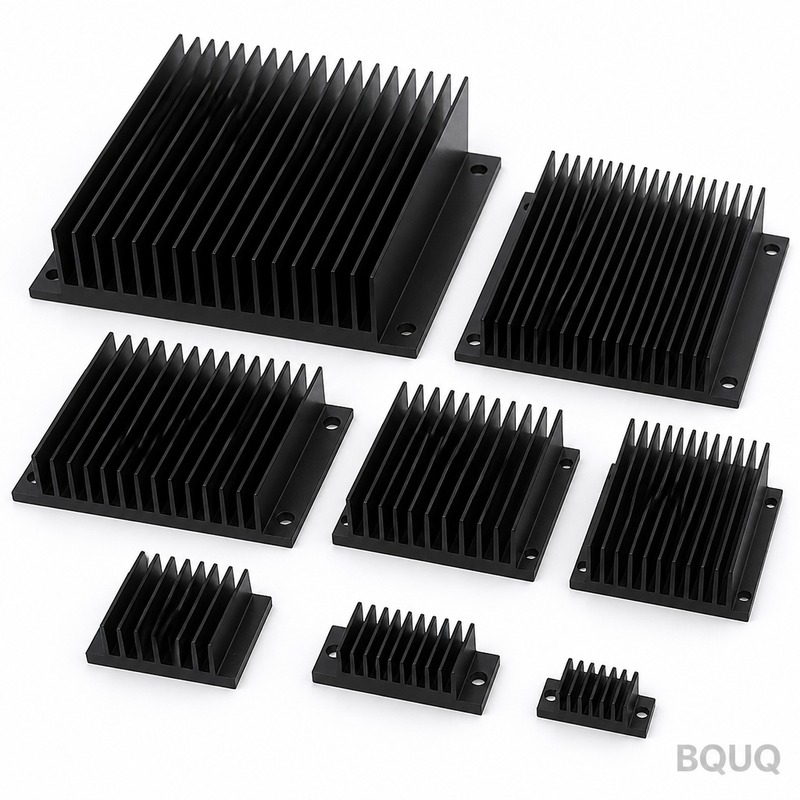
How Does Environmental Sealing Affect Heat Sink Design for Outdoor Telecom?
Outdoor 5G equipment requires IP65 or IP67 ingress protection, which means the heat sink often serves as the enclosure itself, creating a sealed, finned housing. This design requires a minimum wall thickness of 3 mm for structural integrity and pressure die-casting to ensure leak-proof seams. The heat sink must also withstand salt spray testing per IEC 60068-2-11 for 500 hours, necessitating a protective coating such as chromate conversion or powder coating, which adds 15 to 25 µm and slightly reduces thermal performance by 2 to 5%. Condensation management is critical: internal desiccant packs or breather valves with membranes (e.g., GORE-TEX) are specified to prevent moisture ingress while allowing pressure equalization. The weight of an outdoor sealed heat sink is typically 5 to 12 kg, and it must withstand wind loads of up to 150 km/h and seismic vibrations per GR-63-CORE, requiring mounting bosses with inserts for M6 or M8 screws that are designed for a pull-out force of over 2,000 N.
How Much Does a High-Density 5G Heat Sink Cost and What Is the Lead Time?
The cost of a 5G telecom heat sink varies significantly with volume, material, and complexity. For a typical aluminum die-cast heat sink with heat pipes (300 mm x 200 mm x 40 mm), the unit price is $15 to $30 for volumes of 10,000 pieces per year, including tooling amortization. Tooling costs for the die-cast mold are approximately $8,000 to $15,000, while CNC machining fixtures add $1,000 to $2,000. Skived fin heat sinks, which require no tooling but more machining time, cost $40 to $80 per unit for medium volumes. Vapor chamber assemblies for high-end massive MIMO units range from $50 to $120. At BQUQ, standard lead time for prototypes is 7 to 10 days, and for production quantities (5,000+ units), lead time is 20 to 30 days after approval of the first article. The total cost of ownership must include the thermal interface material (e.g., phase-change material at $0.50 to $2.00 per application) and the assembly labor, which adds $3 to $8 per unit.
Why Is Simulation and Prototyping Essential Before Mass Production?
Thermal simulation using computational fluid dynamics (CFD) software (e.g., Flotherm, Icepak) is mandatory to predict junction temperatures within ±5 °C accuracy before building hardware. This simulation is critical for optimizing fin spacing and heat pipe placement because a single design iteration on a die-cast mold costs $8,000 and takes 3 weeks. For instance, simulation can determine whether two 8 mm heat pipes or four 6 mm heat pipes better distribute heat from a 200 W GaN amplifier, a decision that affects cost by 15% and performance by 10%. BQUQ recommends a two-phase prototyping approach: first, a CNC-machined aluminum prototype that replicates the final thermal performance (delivered in 5 days), followed by thermal testing in an environmental chamber at 55 °C ambient with a 1,000 W heat load. This testing verifies that the case temperature stays below 85 °C, ensuring a 20 °C margin to the maximum junction temperature. Only after passing this test should the die-cast tooling be ordered.
What Are the Latest Trends in 5G Heat Sink Technology?
The shift to 5G-Advanced and 6G is driving two major trends: liquid cooling integration and additive manufacturing. Liquid-cooled cold plates, using microchannel copper or aluminum designs, are now specified for high-power base stations above 3,000 W, achieving thermal resistance of 0.02 °C/W and enabling heat densities of 500 W/cm². However, the cost of liquid cooling infrastructure (pumps, hoses, coolant) adds $150 to $300 per site. Additive manufacturing (3D printed aluminum or copper) is emerging for complex internal channel designs that are impossible to cast, but the cost is currently $150 to $400 per part, limiting it to niche high-performance applications. Another trend is the use of graphene-enhanced TIMs with a thermal conductivity of 50 to 80 W/m·K, which improves performance by 20% compared to standard silicone-based TIMs (5 to 10 W/m·K) but costs 5 to 10 times more.
How Can You Select the Right Heat Sink Manufacturer?
Selecting a manufacturer requires verifying three capabilities: thermal simulation expertise, precision machining (CNC and die-casting), and environmental testing. The manufacturer must demonstrate experience with telecom-grade enclosures, including IP67 sealing and salt-spray compliance. A critical question is whether they can perform in-house thermal testing using a wind tunnel and thermocouple validation, as this reduces iteration cycles by 40%. Lead time reliability is also key: for a 5G deployment, a delay in heat sink delivery can hold up an entire site installation. BQUQ, with 20 years of experience in CNC machining, metal stamping, springs, and heat sinks, offers a complete in-house process from simulation to anodizing, ensuring a single point of accountability for quality and schedule.
What Is the Conclusion and Recommended Next Step?
High-density thermal solutions for 5G and telecom equipment require a systems approach that balances thermal resistance, weight, environmental sealing, and manufacturing cost. The optimal solution for most applications is an aluminum body with press-fit copper heat pipes, achieving 0.1 to 0.3 °C/W resistance at a cost of $25 to $60 per unit. For extreme heat fluxes, vapor chambers or liquid cooling are justified only when power exceeds 1,500 W per unit. The key to success is early collaboration with a manufacturer that can simulate, prototype, and test within a 10-day cycle. If you have a specific 5G heat sink requirement, our engineering team can provide a thermal simulation report and a quotation within 12 hours.
How Quickly Can I Get a Quote for a Custom 5G Heat Sink?
BQUQ provides a detailed quotation, including thermal simulation and DFM (Design for Manufacturing) feedback, within 12 hours of receiving your 2D drawings or 3D models. We offer prototype lead times of 7 to 10 days and production lead times of 20 to 30 days, with free thermal analysis for the first design iteration. Please send your requirements to sc@bquq.com or contact us on WhatsApp at +86 13713157787.
What Is the Maximum Heat Flux That a Vapor Chamber Can Handle?
A standard copper vapor chamber with sintered wick can handle heat fluxes of 200 to 400 W/cm², while advanced vapor chambers with hybrid wicks can manage up to 700 W/cm². For 5G GaN amplifiers operating at 150 to 300 W/cm², a vapor chamber is a robust solution. The limiting factor is the dry-out limit, which depends on the heat pipe length and wick structure, so simulation is required for your specific power map.
Can Aluminum Heat Sinks Be Used for 5G Base Stations Without Copper?
Yes, aluminum heat sinks can be used for lower-power 5G components, such as small-cell radios dissipating 50 to 150 W. For a 1,000 W macro base station, an all-aluminum heat sink would need to be 50 to 70% larger and heavier than a hybrid design, which is often unacceptable for pole-mounted installations. The decision should be based on the allowable weight and volume constraints of your enclosure.
What Is the Typical Lifespan of a Heat Sink in a Telecom Environment?
A properly designed heat sink with no moving parts has a lifespan exceeding the 15-year service life of a 5G base station, provided the environment does not cause corrosion. The main failure mode is degradation of the thermal interface material, which should be replaced every 5 to 7 years. Heat pipes and vapor chambers have a reliability of 0.5% failure per 100,000 hours when charged with high-purity water and properly sealed.
How Does Altitude Affect Heat Sink Performance for Telecom Sites?
At high altitudes (e.g., 3,000 meters), air density decreases by approximately 30%, which reduces the heat transfer coefficient of natural and forced convection by 20 to 30%. This requires increasing the fin surface area by 15 to 25% or selecting a more powerful fan to maintain the same cooling performance. If your installation site is above 2,000 meters, inform the manufacturer so that thermal simulation accounts for the reduced air density.
Which Thermal Interface Material Is Best for GaN Power Amplifiers?
The best TIM for GaN packages is a phase-change material (PCM) with a thermal conductivity of 5 to 8 W/m·K, which becomes liquid at operating temperature to fill microscopic surface gaps. This provides a bond line thickness of 25 to 50 µm and a thermal resistance of 0.05 to 0.1 °C·cm²/W. Indium foil or liquid metal (e.g., Gallium-based) is used for extreme heat fluxes but requires a nickel-plated surface to prevent corrosion and gallium embrittlement of aluminum.
Do You Offer Standard Off-the-Shelf Heat Sinks for 5G Testing?
Yes, BQUQ maintains a stock of standard extruded aluminum heat sinks and modular heat pipe assemblies for rapid evaluation, with dimensions from 150 mm x 100 mm to 400 mm x 300 mm. These standard parts are available for shipment within 48 hours and are ideal for proof-of-concept testing. For production, we will recommend a custom design to optimize performance and cost for your exact thermal load.
For immediate technical support and a 12-hour quotation on your 5G heat sink project, email sc@bquq.com or WhatsApp +86 13713157787. Visit our website at www.bquq.com for more case studies and specifications.
Related Articles
- New energy vehicle IGBT heat dissipation, heat sink reliability engineering, heat pipe and temperature plate integrated heat sink, surface treatment and heat radiation enhancement: anodic oxidation, black coating and micro-nano structure, graphene/3D printing/intelligent thermal management: 2030 heat sink technology roadmap
- 5G Base Station Outdoor AAU Cooling: The Climate Adaptation Challenge of Fanless Passive Design
- Hardware heat sink reconstruction under liquid-cooled penetration of AI server: cold plate, microchannel and two-phase flow