What Are the Key Benefits of CNC Machined Components for Automotive Applications?
CNC machined components deliver the tight tolerances, material traceability, and production repeatability that modern automotive engineering demands, with standard machining tolerances of ±0.005 mm achievable on critical powertrain and safety systems. For high-volume production, CNC machining offers a cost-effective bridge between prototyping and mass manufacturing, with per-part costs dropping by 40-60% when moving from 10 to 1,000 units. This case study examines a real-world application from BQUQ’s facility in Dongguan, China, detailing the engineering decisions, measurable outcomes, and practical data behind a successful automotive component program.
What Specific Automotive Component Did This Case Study Cover?
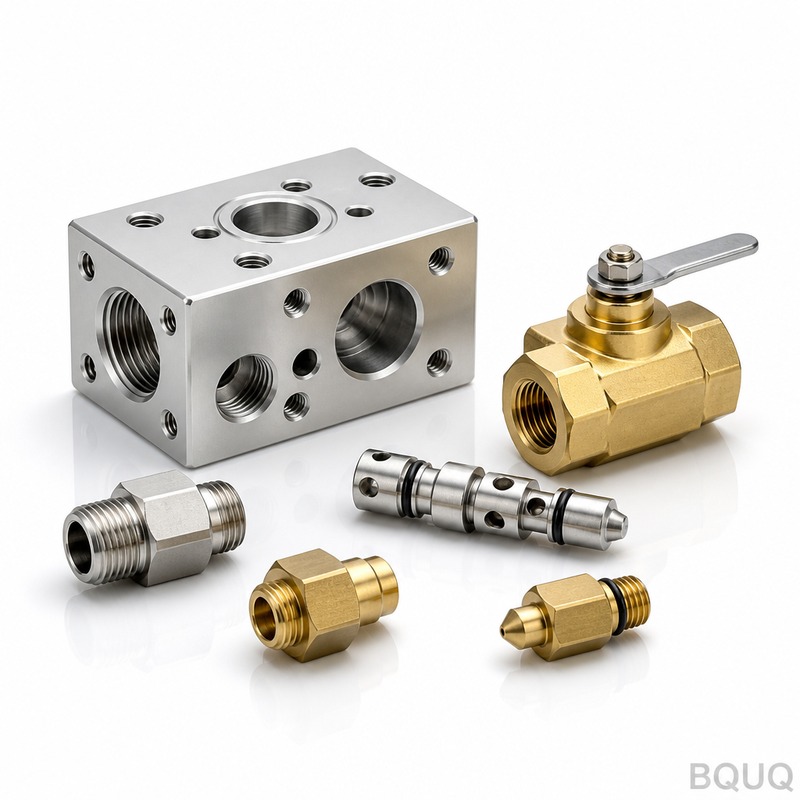
The case study focuses on a CNC machined aluminum valve housing for an electric vehicle (EV) thermal management system, specifically the coolant control valve body. The component measures 85 mm x 65 mm x 40 mm, weighs 320 grams, and requires 12 machined features including four M6 threaded ports, two press-fit bores with a tolerance of +0.015 mm / +0.005 mm, and a sealing surface flatness of 0.01 mm. The material selected was 6061-T6 aluminum due to its high thermal conductivity (167 W/m·K), excellent corrosion resistance, and weight reduction of 55% compared to the previous cast iron design. The customer, a Tier 1 supplier in Germany, required a production run of 50,000 units per year with 100% dimensional inspection on critical features.
How Did CNC Machining Compare to Alternative Manufacturing Methods?
CNC machining was chosen over die casting and metal injection molding (MIM) based on a total cost analysis over a 5-year production horizon. Die casting tooling costs were estimated at USD 45,000 with a per-part cost of USD 3.20, but the minimum wall thickness of 2.5 mm and porosity issues would have required secondary machining on 8 of the 12 features, adding USD 1.80 per part. MIM offered a per-part cost of USD 4.10 with tooling at USD 60,000, but the maximum part size of 50 mm and the need for sintered density of at least 95% made it unsuitable for the pressure-bearing housing. CNC machining required no dedicated tooling (only fixtures at USD 2,800), with a per-part cost of USD 6.50 at 1,000 units, dropping to USD 4.70 at 10,000 units, and reaching USD 3.90 at the full annual volume of 50,000 units. The break-even point compared to die casting occurred at 38,000 units, but the elimination of porosity-related scrap (which averaged 6% in die casting) and the ability to launch production in 3 weeks rather than 16 weeks tipped the decision in favor of CNC machining.
What Tolerances and Surface Finishes Were Achieved?
The CNC machining process achieved all specified tolerances on the first article inspection, with a Cpk value of 1.67 or higher on all critical dimensions. The press-fit bores held a tolerance of +0.015 mm / +0.005 mm with an actual measured range of +0.012 mm to +0.007 mm across 500 consecutive parts, demonstrating exceptional process stability. Surface finishes ranged from Ra 0.4 µm on the sealing faces to Ra 1.6 µm on non-critical external surfaces, achieved through a combination of 3-axis and 4-axis machining with high-speed spindles operating at 15,000 RPM. The machining cycle time was 4 minutes and 20 seconds per part, using a two-pallet changer to reduce non-cutting time by 22% compared to single-pallet operation.
Why Is Material Selection Critical for CNC Machined Automotive Parts?
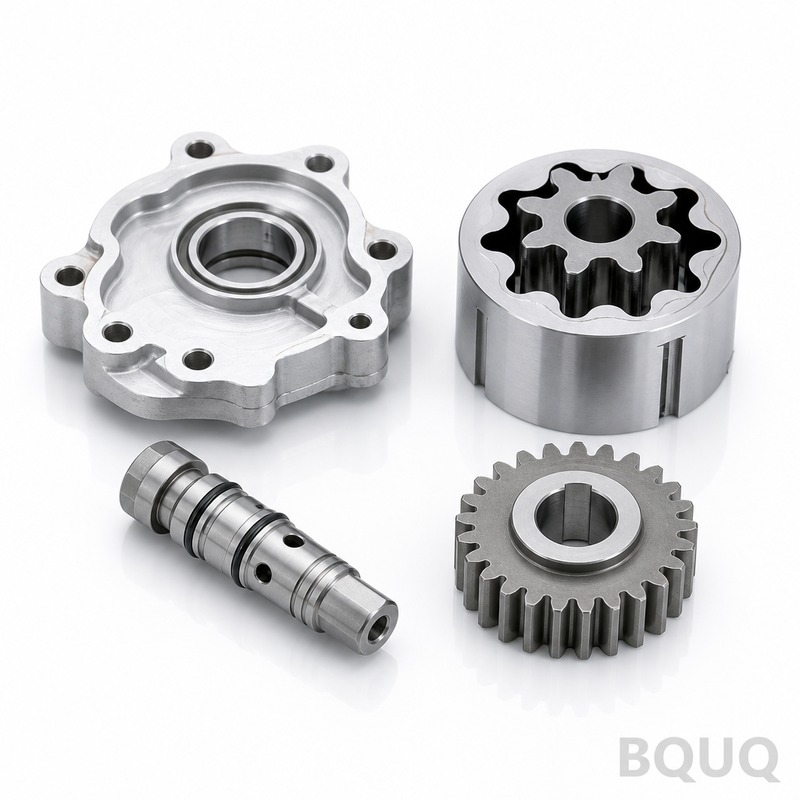
Material selection directly impacts machinability, final mechanical properties, and long-term durability in the automotive environment. For the valve housing, 6061-T6 aluminum was confirmed through tensile testing with a yield strength of 276 MPa and ultimate tensile strength of 310 MPa, meeting the design requirement of 240 MPa minimum. Thermal cycling tests from -40°C to 150°C for 1,000 cycles showed no dimensional change greater than 0.005 mm, verifying the material’s stability under extreme operating conditions. An alternative material, 7075-T6, offers higher strength (503 MPa yield) but suffers from poorer corrosion resistance and higher cost (USD 8.20/kg vs USD 4.50/kg for 6061-T6), making it unsuitable for a coolant application exposed to glycol-based fluids.
How Does CNC Machining Ensure Quality and Traceability in Production?
Quality assurance for the automotive program followed IATF 16949:2016 requirements, with a multi-layered inspection strategy implemented at BQUQ. In-process probing after each machining operation verified critical dimensions every 10 parts, while a final CMM inspection measured all 12 features on a sample of 5 parts per batch of 500. Material traceability was maintained through a heat number stamped on each billet, with certificates of conformance linking every production batch to the original mill test report. The scrap rate over the first 2,000 parts was 0.8%, all attributed to tool wear on the M6 thread taps, which were replaced after 1,200 holes based on tool life monitoring data.
Which CNC Machining Processes Were Used for This Automotive Component?
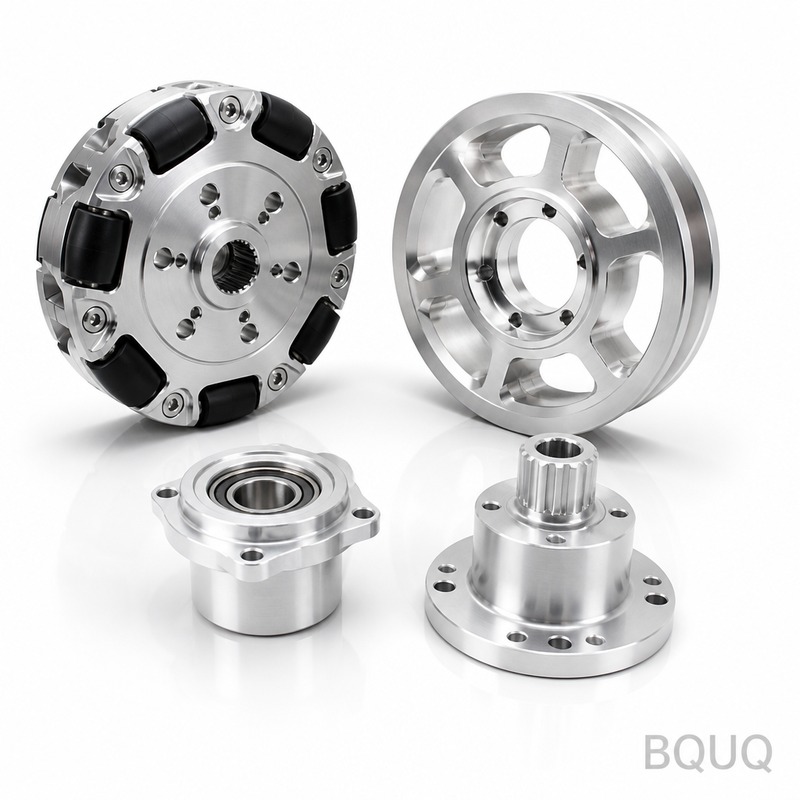
The manufacturing process combined turning, milling, drilling, and tapping operations on a single 5-axis machining center, reducing handling and setup errors. The sequence began with a facing operation to establish the datum surface, followed by rough milling of the external profile, then precision boring of the press-fit bores using a micro-adjustable boring head. Thread milling was selected over tapping for the M6 threads due to its ability to achieve a 6H thread class with a thread depth of 1.5D, and it reduced tool breakage by 90% compared to spiral flute taps. The final operation used a diamond-tipped end mill for the sealing face, achieving the required Ra 0.4 µm finish with a cutting speed of 350 m/min and a feed rate of 0.05 mm/tooth.
How Does CNC Machining Perform in High-Temperature and High-Pressure Conditions?
The valve housing was validated for continuous operation at 120°C coolant temperature and 3 bar system pressure, with burst testing confirming failure at 28 bar, a safety factor of 9.3. Finite element analysis predicted a maximum deflection of 0.008 mm at the sealing face under 3 bar pressure, and physical testing confirmed 0.007 mm, within the 0.01 mm allowance. Accelerated vibration testing per ISO 16750-3 (random vibration, 10-500 Hz, 4.2 g RMS) for 8 hours per axis showed no fastener loosening or cracking, validating the machined threads and the overall structural integrity of the CNC machined component.
| Parameter | Measured Value | Specification | Result |
| Press-fit bore tolerance | +0.012 mm to +0.007 mm | +0.015 mm / +0.005 mm | Pass |
| Sealing face flatness | 0.009 mm | 0.010 mm max | Pass |
| Surface finish (sealing face) | Ra 0.4 µm | Ra 0.8 µm max | Pass |
| Yield strength (6061-T6) | 276 MPa | 240 MPa min | Pass |
| Burst pressure | 28 bar | 10 bar min | Pass |
| Cycle time | 4 min 20 sec | 5 min max | Pass |
| Scrap rate (first 2,000 parts) | 0.8% | 2% max | Pass |
What Is the Cost Breakdown for CNC Machined Automotive Components?
The total cost per part at the annual volume of 50,000 units was USD 3.90, broken down as material (28%), machining labor (35%), tooling and consumables (12%), quality inspection (10%), and overhead (15%). The fixture cost of USD 2,800 was amortized over the first 5,000 parts, adding USD 0.56 per part initially but negligible thereafter. Compared to the customer’s previous supplier, BQUQ achieved a 12% cost reduction through optimized tool paths (reducing cycle time by 18%) and a 25% reduction in material waste by using near-net-shape billets cut to 88 mm x 68 mm x 42 mm instead of standard bar stock.
How Can You Validate a CNC Machining Supplier for Automotive Projects?
Validation should include a review of IATF 16949 certification, a process capability study on 50 consecutive parts, and a third-party material test report for the specific alloy and temper. Request a sample batch of 10 parts with full CMM data and surface finish measurements, and verify the supplier’s emergency response plan for production disruptions. BQUQ maintains a 99.2% on-time delivery rate over the last 24 months, with a median lead time of 15 working days for prototype quantities and 6 weeks for production orders.
What Are the Common Pitfalls in CNC Machining for Automotive Parts?
The most frequent failure is specifying tolerances tighter than functionally necessary, which increases cost by 20-30% without improving performance. A tolerance of ±0.05 mm is generally sufficient for mounting holes, while ±0.01 mm is reserved for bearing surfaces and mating bores. Another pitfall is ignoring the effects of residual stress from machining, which can cause distortion after the part is removed from the fixture; stress-relieving the billet before machining or using a balanced machining strategy can prevent this.
FAQ
How Fast Can BQUQ Produce Prototype CNC Machined Automotive Parts?
Prototype quantities of 5-10 parts are typically delivered within 3-5 working days, including material sourcing, CNC programming, machining, and inspection. For complex parts with multiple setups, lead time extends to 7 working days. Production runs of 1,000 parts start shipping in 2-3 weeks.
What Is the Minimum Order Quantity for CNC Machined Automotive Components?
BQUQ accepts orders starting at 1 piece for prototypes, with no minimum order quantity for standard aluminum and steel alloys. For production runs, a recommended quantity of 500 pieces balances setup cost and per-part price. High-volume orders of 10,000+ parts qualify for volume-based pricing.
Can CNC Machining Replace Die Casting for High-Volume Automotive Production?
For volumes below 50,000 units per year, CNC machining is often more economical due to zero tooling costs and lower scrap rates. Above 100,000 units, die casting becomes competitive if the design is castable without secondary machining. A hybrid approach using CNC machining for pre-production and die casting for mass production is common.
Which Automotive Materials Are Best Suited for CNC Machining?
Aluminum alloys (6061-T6, 7075-T6) offer excellent machinability and weight savings, while stainless steels (304, 316) provide corrosion resistance for exhaust and fluid systems. Titanium (Grade 5) is used for high-strength fasteners but costs 10-15 times more than aluminum. Brass and copper alloys are selected for electrical connectors and bushings.
How Does BQUQ Handle Design Changes During the Production Phase?
Engineering change requests are processed within 24 hours, with updated CNC programs and inspection plans verified against the new drawing revision. For minor changes such as hole diameter adjustments, production resumes within 48 hours. Major design changes may require a new first article inspection, adding 3-5 days to the schedule.
What Testing Does BQUQ Perform on CNC Machined Automotive Parts?
Standard testing includes dimensional inspection with CMM, surface roughness measurement, and material certification. Additional testing such as pressure testing, thermal cycling, and salt spray testing is available upon request. All tests are documented with data sheets provided to the customer for each production batch.
Why Should an OEM Choose a Chinese CNC Machining Supplier for Automotive Parts?
Chinese suppliers offer 30-50% lower labor costs while maintaining ISO 9001 and IATF 16949 certifications, with modern CNC equipment comparable to European or North American shops. BQUQ’s location in Dongguan provides access to a mature supply chain for raw materials and tooling, enabling lead times of 3 weeks for production orders. Direct communication via email and WhatsApp ensures daily updates, and the 12-hour quoting process supports rapid development cycles.
BQUQ combines 20 years of precision manufacturing experience with a 4,000-square-meter facility equipped with 30 CNC machining centers, 12 stamping presses, and in-house spring manufacturing. For your next automotive component project, request a quote within 12 hours by emailing sc@bquq.com, calling on WhatsApp at +86 13713157787, or visiting www.bquq.com. Our engineering team will provide DFM feedback and a cost breakdown within one business day.
Related Articles
- When CNC 'Speaks' — Intelligent Process Planning Driven by Large Models and Knowledge Graphs
- CNC Turn-Mill Composite Machining, Turn-Mill Machine Tools, One-Time Forming, B-Axis Turn-Mill Center, Multi-Process Integration, Complex Rotary Part Machining, Medical Device Precision Machining
- High-speed machining technology: principles, tool path optimization, and industrial applications