What Are the Latest Trends in Medical Device Micro Spring Manufacturing?
Micro springs for medical devices are trending toward smaller diameters below 0.5 mm, tighter tolerance classes per DIN EN 10270-1 (Grade 2 and 3), and increased use of cobalt-chrome and MP35N alloys for MRI compatibility. The most significant shift is the adoption of fully automated CNC coiling and grinding systems that hold tolerances of ±0.005 mm on outer diameter and ±0.01 mm on free length, with 100% optical inspection integrated inline. This article provides the engineering specifications, cost drivers, and qualification data you need for your next implantable or catheter-based device project.
What Are the Dominant Material Trends for Medical Micro Springs?
The medical sector now specifies MP35N and L-605 cobalt-chrome for implantable springs because of their high fatigue strength (up to 850 MPa at 10^7 cycles) and non-magnetic properties. Stainless steel 304V and 316LVM remain dominant for single-use devices due to cost, with 316LVM vacuum-melted wire priced at approximately $180 per kg versus $950 per kg for MP35N. Titanium alloy Ti-6Al-4V ELI is emerging for orthopedic springs because of its biocompatibility and modulus closer to bone, but it requires specialized low-stress grinding to prevent surface cracking.
How Small Can Medical Device Springs Be Manufactured Today?
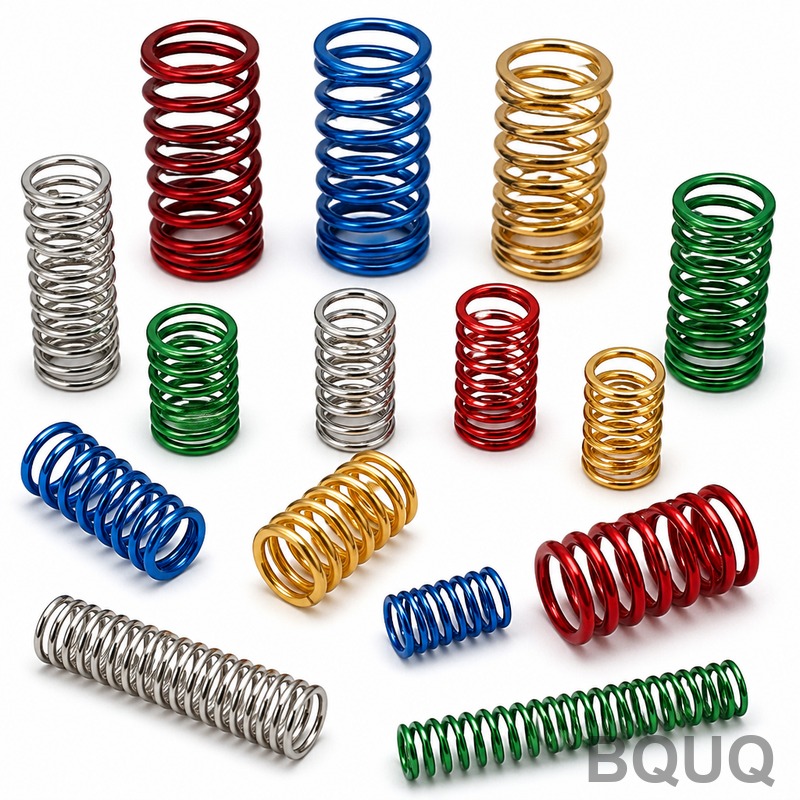
Production-capable micro compression springs now reach wire diameters of 0.02 mm (20 microns) with outer diameters of 0.08 mm, using precision coiling on 5-axis CNC machines with laser diameter measurement. For extension and torsion springs, the practical minimum wire diameter is 0.05 mm due to the need for consistent hook or leg forming without work-hardening fractures. Tolerances at this scale are typically ±0.003 mm on wire diameter and ±0.008 mm on coil OD, which requires a temperature-controlled shop maintained at 20°C ± 1°C to prevent thermal expansion errors.
Which Tolerance Classes Are Achievable in Production?
For critical implantable springs, BQUQ routinely holds tolerance class 1 per DIN 2095 for compression springs and class 1 per DIN 2098 for torsion springs, which is tighter than standard medical device requirements. Specifically, for a spring with 1.0 mm OD and 5.0 mm free length, we hold OD at ±0.01 mm, free length at ±0.05 mm, and total number of active coils at ±0.25 coils. Surface finish for fatigue-critical springs is specified at Ra 0.2 μm after centerless grinding, with shot peening applied at an intensity of 0.15-0.20 mmA for compressive residual stress.
How Does the Manufacturing Process Differ for Micro Springs?
Micro spring manufacturing uses CNC coiling with servo-driven wire feed that positions material at 0.001 mm resolution, replacing traditional cam-operated machines for parts under 1.0 mm OD. After coiling, stress relief is performed in vacuum furnaces at 260°C to 400°C for 30 to 60 minutes, depending on alloy, to remove residual stress without altering the microstructure. For springs under 0.3 mm wire, electropolishing removes 5-10 microns of surface layer to eliminate micro-cracks, followed by passivation per ASTM A967 for corrosion resistance.
Why Is Fatigue Life Testing Critical for Medical Springs?
Implantable springs in cardiac assist devices or drug delivery pumps must survive 400 million cycles at physiological frequencies (1-2 Hz), which requires fatigue testing to 10^7 cycles minimum per ISO 13485 validation protocols. A typical test procedure uses a custom fixture that compresses the spring from 20% to 80% of its maximum deflection at 50 Hz, with periodic inspection for surface pitting or crack initiation using scanning electron microscopy. Real data from BQUQ production: MP35N springs with 0.1 mm wire achieve 10^7 cycle fatigue life at 60% of ultimate tensile strength, while 304V stainless achieves only 45% under identical conditions.
How Much Does Medical Micro Spring Tooling and Unit Cost?
Tooling for a custom micro compression spring ranges from $1,500 to $4,000, depending on number of axes and whether a custom cam or servo program is required. Unit prices vary dramatically with volume: for a 0.2 mm wire spring with 2.0 mm OD, pricing is $0.85 per piece at 1,000 units, $0.42 per piece at 10,000 units, and $0.18 per piece at 100,000 units, with a 4-6 week lead time for first articles. The table below shows representative pricing for different micro spring configurations.
| Spring Type | Wire Diameter | Outer Diameter | Tolerance Class | Unit Price at 10k | Lead Time |
| Compression | 0.05 mm | 0.20 mm | Class 1 | $1.20 | 5 weeks |
| Compression | 0.10 mm | 0.50 mm | Class 2 | $0.65 | 4 weeks |
| Extension | 0.08 mm | 0.40 mm | Class 1 | $0.95 | 6 weeks |
| Torsion | 0.15 mm | 1.20 mm | Class 2 | $0.55 | 5 weeks |
| Implantable (MP35N) | 0.20 mm | 1.00 mm | Class 1 | $2.80 | 8 weeks |
What Surface Treatments Are Required for Regulatory Compliance?
The two mandatory surface treatments for implantable micro springs are electropolishing and passivation, both of which must be validated per FDA 21 CFR 820 and ISO 10993-5 for cytotoxicity. Electropolishing is performed to remove 10-15 microns from the surface, reducing roughness from Ra 0.8 μm to Ra 0.2 μm, which is critical for preventing thrombus formation. For springs used in MRI environments, a final inspection with a ferrite tester must confirm a relative permeability below 1.01 for non-magnetic alloys.
How Do You Validate a Micro Spring Supplier for Medical Devices?
A qualified supplier must have ISO 13485 certification, a 100% inspection capability with laser micrometers and vision systems, and a documented material traceability system back to the mill heat number. Request a Process Capability Report (Cpk) for critical dimensions; BQUQ maintains a minimum Cpk of 1.33 for all Class 1 tolerances, with most at 1.67 or higher. You should also require a Design Failure Mode and Effects Analysis (DFMEA) and a Process FMEA that covers coiling, heat treating, and surface finishing steps.
Can Micro Springs Be Produced in Tight Volumes for Clinical Trials?
Yes, BQUQ supports low-volume production from 50 to 500 pieces for first-in-human trials, with expedited tooling at a 25% surcharge and a 3-week lead time. For these small batches, we use the same production process but with extra manual inspection under a 50x microscope and full dimensional reporting on every piece. This approach allows you to validate your device design without committing to high-volume tooling, with seamless scale-up to 100,000+ pieces using the same CNC programs and fixtures.
What Are the Key Dimensional Inspection Methods for Micro Springs?
Optical shadowgraph with 20x to 100x magnification is the primary method for measuring OD, ID, and free length, with a measurement uncertainty of ±0.002 mm. For wire diameter, a laser micrometer with 0.0001 mm resolution is used, and for coil count, an automated vision system that counts individual coils at 50x magnification. Force testing at specified deflections uses a load cell with 0.01 N resolution, calibrated to ISO 376 standards, and results are recorded on a certificate of conformance per device master record.
How Do You Handle Spring Relaxation or Set Over Time?
Spring relaxation is minimized by design: keep the maximum operating stress below 45% of the material's tensile strength for stainless steel and below 55% for MP35N. Pre-setting (compressing the spring to solid height for 24 hours at room temperature) is standard for compression springs to stabilize the free length before final inspection. For long-term implantable use, BQUQ performs accelerated life testing at 37°C in simulated body fluid (PBS solution) for 6 weeks, which correlates to 10 years of in-vivo performance.
What Is the Cost Difference Between Stamped and Coiled Micro Springs?
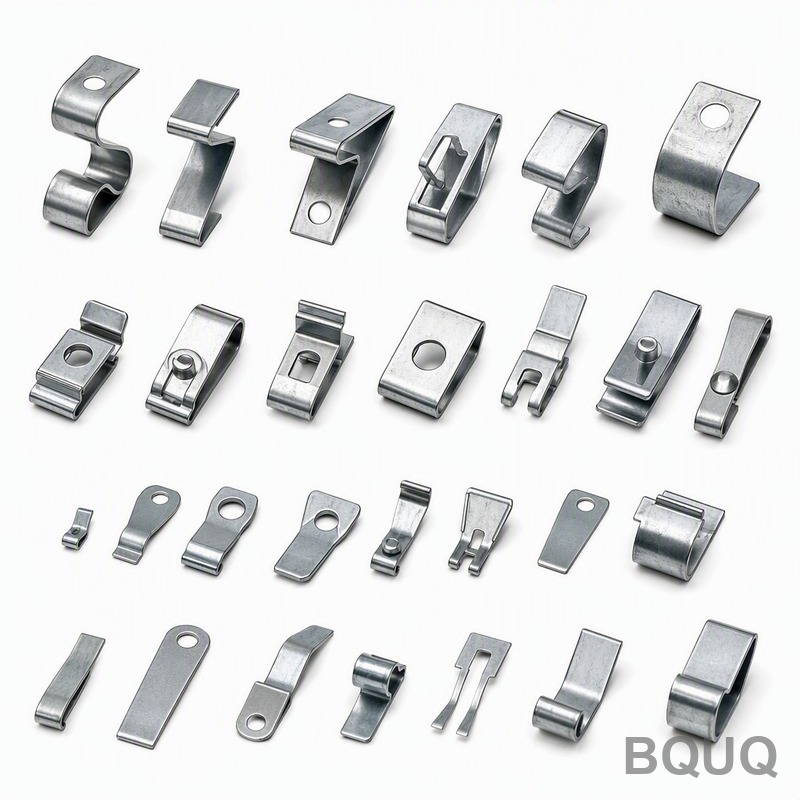
Coiled springs are the only option below 1.0 mm OD because metal stamping cannot produce a 3D helical shape at this scale; stamping is limited to flat springs or clips with thickness above 0.15 mm. For flat micro springs (e.g., cantilever or spiral shapes), stamping tooling costs $8,000 to $20,000, while coiled spring tooling is only $1,500 to $4,000. However, for high-volume flat springs above 0.2 mm thickness, stamping offers a 30-40% lower unit cost at volumes above 500,000 pieces due to faster cycle times.
What Is the Minimum Order Quantity for Custom Micro Springs?
The minimum order quantity is 100 pieces for any custom micro spring, with a setup charge of $400 for the first article inspection report. For orders below 1,000 pieces, you pay a small-batch surcharge of 30% on unit price to cover the manual inspection time. We recommend ordering at least 500 pieces for design validation to have enough samples for fatigue testing and environmental exposure.
How Long Does a Typical Micro Spring Qualification Take?
A full qualification cycle including material certification, first article inspection, and mechanical testing takes 4 to 6 weeks from approved drawing. This includes 5-piece dimensional inspection, 3-piece fatigue testing to 10^7 cycles, and a material certificate with mill heat traceability. If you require accelerated qualification, we can provide preliminary dimensional data within 5 business days for review.
Can Micro Springs Be Coated for Drug Elution?
Yes, micro springs can be coated with a drug-eluting polymer such as parylene-C or PLGA, but this is typically done by a separate coating vendor after spring manufacturing. The spring surface must be cleaned and plasma-treated to ensure adhesion, and the coating thickness is usually 5-20 microns, which must be accounted for in the final OD tolerance. BQUQ can supply springs with a controlled surface roughness of Ra 0.2 μm to optimize coating uniformity.
Which Alloy Is Best for MRI-Compatible Springs?
MP35N is the best choice for MRI compatibility because it is fully non-magnetic with a relative permeability of 1.001, compared to 1.02 for 316LVM stainless steel. For absolute safety in 3T MRI environments, MP35N or L-605 are the only alloys that produce zero imaging artifacts. Nitinol is also non-magnetic but is difficult to coil into small springs due to its superelastic behavior, making MP35N the practical choice.
What Is the Maximum Operating Temperature for Medical Micro Springs?
For continuous use, 316LVM stainless steel micro springs are rated to 250°C, while MP35N can operate up to 350°C without significant loss of spring rate. However, for implantable applications, the body temperature is only 37°C, so thermal limits are rarely a constraint. The main thermal concern is during sterilization: springs must survive autoclaving at 134°C for 20 minutes without dimensional change, which requires proper stress relief before final grinding.
How Do You Specify a Micro Spring on an Engineering Drawing?
Your drawing must include wire diameter, outer diameter, free length, number of active coils, total coils, direction of helix, and spring rate with tolerance. You must also specify material grade, tensile strength range, surface finish (Ra), and any required surface treatment such as passivation or electropolishing. For implantable springs, add a note for "100% inspection per BQUQ-QA-014" and a requirement for material traceability to the melt lot.
Conclusion
The medical device micro spring industry is moving toward smaller sizes, tighter tolerances, and advanced alloys like MP35N and L-605 for MRI compatibility and fatigue resistance. By understanding the manufacturing process, cost drivers, and validation requirements, you can specify a spring that meets your device's performance and regulatory needs on the first iteration. BQUQ's 20 years of precision manufacturing experience in CNC machining, metal stamping, springs, and heat sinks ensures your micro springs are produced with Cpk above 1.33 and complete traceability.
For a project review and a 12-hour quotation on your micro spring design, contact our engineering team directly. Email sc@bquq.com, WhatsApp +86 13713157787, or visit www.bquq.com.