What CNC Machining Precision Do Robotics Applications Require?
CNC machining for robotics requires tolerances of ±0.005 mm to ±0.025 mm for critical mating surfaces, with most structural components specified at ±0.05 mm. This precision level is non-negotiable because a robotic arm’s repeatability, often rated at ±0.02 mm, directly depends on the geometric accuracy of its machined joints, gearbox housings, and sensor mounts. Without these tolerances, positional errors compound across each axis, degrading the end-effector’s absolute accuracy.
What Are the Critical CNC Machined Components in a Robotic System?
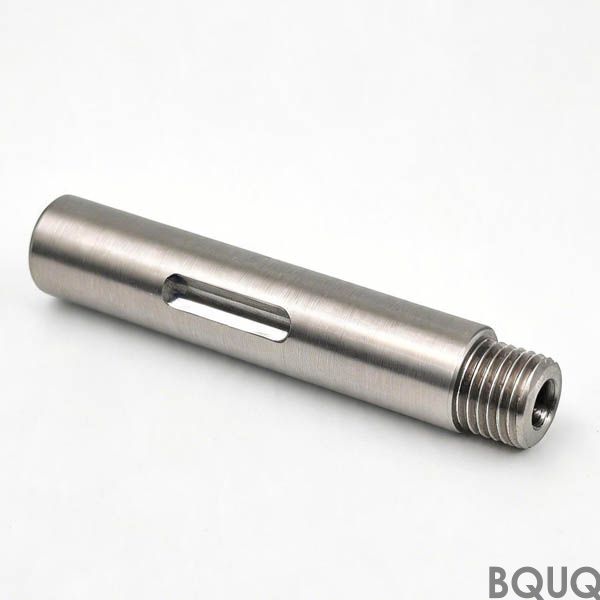
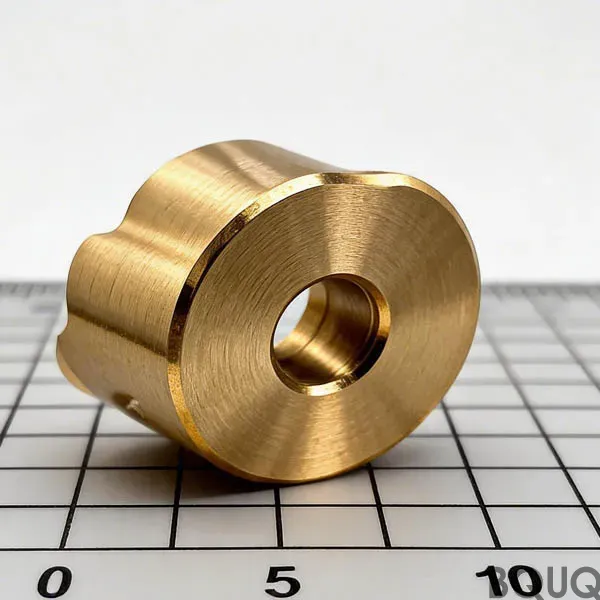
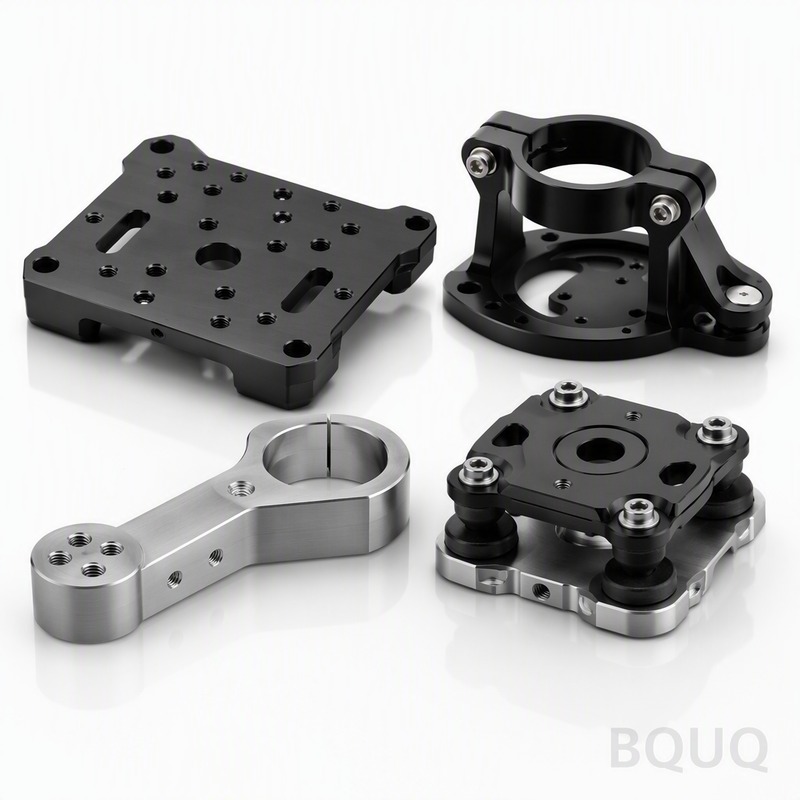
The most demanding CNC parts in robotics are the harmonic drive housings, joint housings, and the base frame. A typical six-axis robotic arm contains 12 to 18 CNC machined aluminum or steel components that directly affect kinematic performance. For example, the harmonic drive flexspline, often machined from 40CrMo steel, requires a wall thickness tolerance of ±0.01 mm to maintain elastic deformation consistency. Other critical parts include: encoder mounting plates (flatness ≤ 0.01 mm), actuator flanges (concentricity ≤ 0.02 mm), and the forearm structural link (parallelism ≤ 0.03 mm across 500 mm length). BQUQ manufactures these using 5-axis simultaneous machining centers to reduce setup errors and achieve the required datum consistency.
How Does Material Selection Impact Robot Performance and Cost?
Material choice determines the stiffness-to-weight ratio, which directly influences robot payload capacity and dynamic response. For high-speed pick-and-place robots, 7075-T6 aluminum is preferred due to its yield strength of 503 MPa and density of 2.81 g/cm³, offering a 40% weight reduction versus steel while maintaining adequate rigidity. For heavy-load industrial arms (payload >100 kg), cast iron or 4140 alloy steel is used for the base and pedestal to absorb vibration; these materials cost 30% less per kilogram than aluminum but require slower machining speeds. In collaborative robots (cobots), where mass is critical for safe impact, carbon-fiber-reinforced polymer plates are CNC routed with aluminum inserts for threaded connections. BQUQ recommends anodized 6061-T6 for prototype iterations (yield 276 MPa) and 7075-T6 for production runs when cyclic fatigue load exceeds 10⁶ cycles.
Which CNC Machining Tolerances Are Achievable for Robotic Joints?
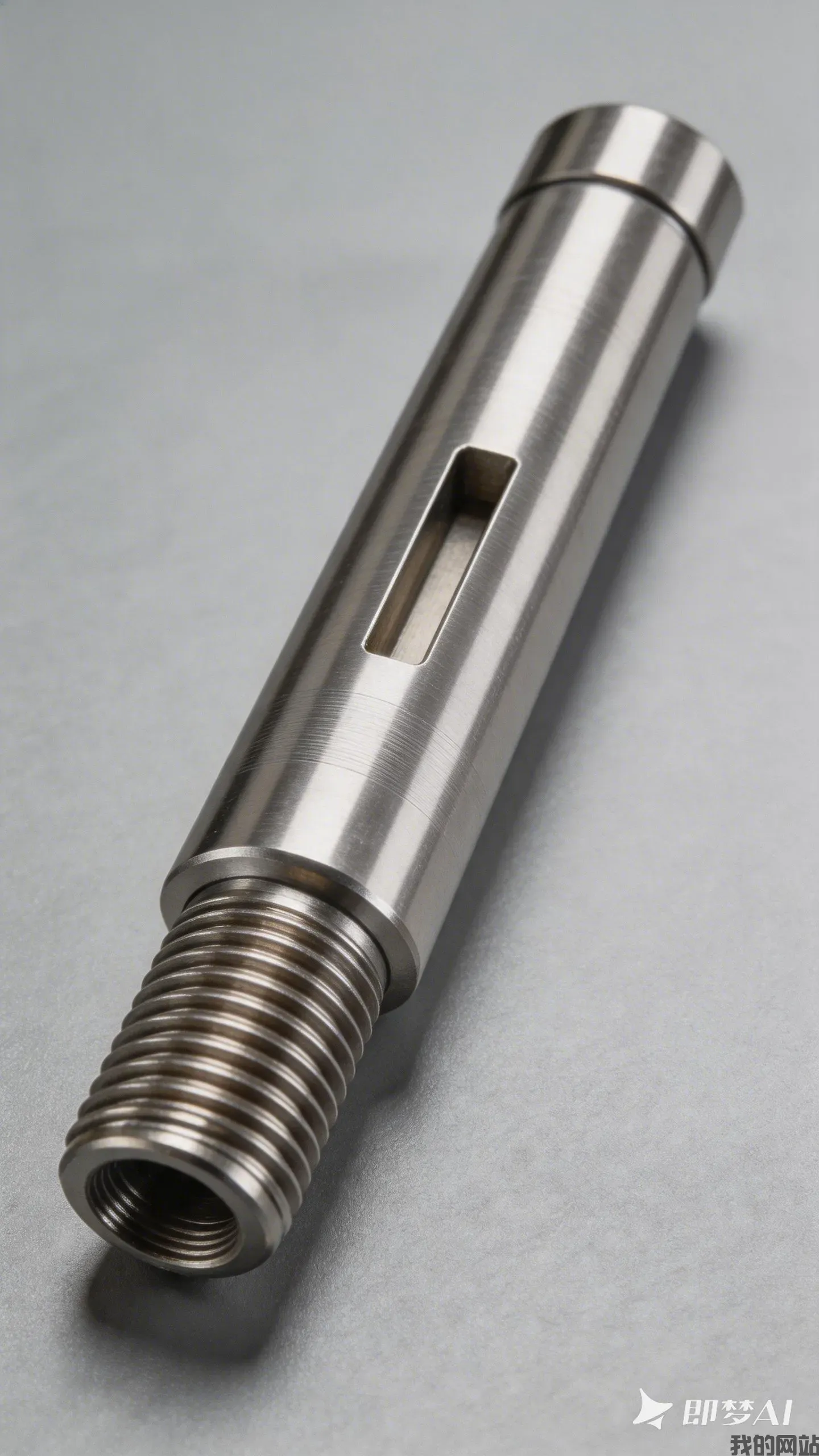
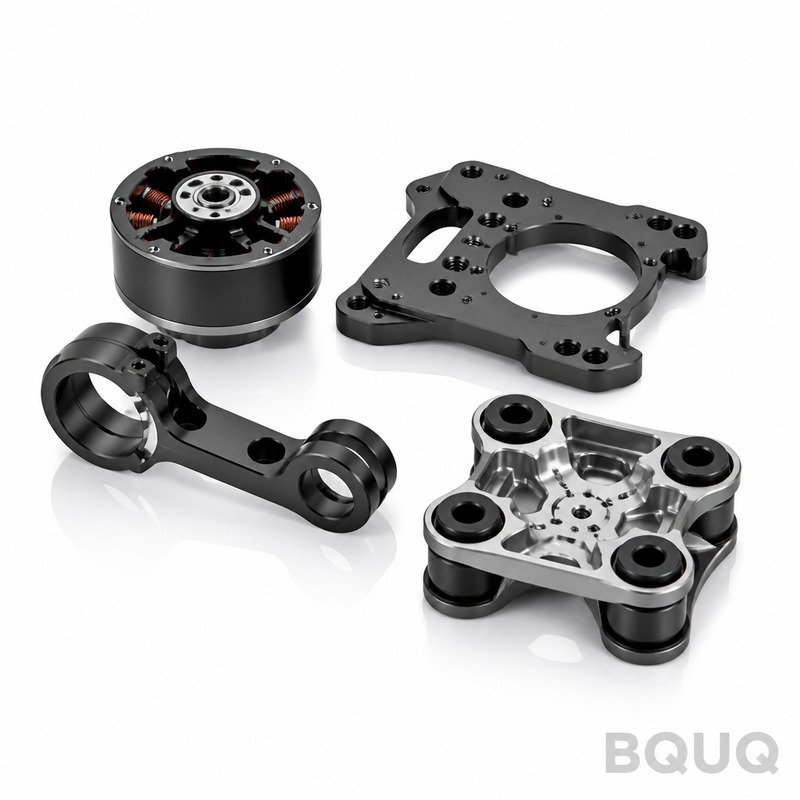
Robotic joints demand the tightest tolerances in precision machining. For a standard RV reducer output flange, we achieve a runout of 0.008 mm total indicated reading (TIR) relative to the bearing bore. The bearing seat diameter (typically Ø62 mm H7) is machined to +0.030 mm / 0.000 mm, with surface roughness Ra 0.4 μm to ensure proper bearing preload. Spline couplings for servo motors are cut with a profile tolerance of 0.015 mm using CNC hobbing or wire EDM. For the rotating shaft, we hold a cylindricity of 0.005 mm over a 120 mm length. These values are achievable on standard 3-axis machines with a precision chuck, but BQUQ uses CMM (coordinate measuring machine) inspection on 100% of critical dimensions to guarantee conformity.
Why Is Thermal Stability a Major Challenge in Robot Machining?
The coefficient of thermal expansion (CTE) of aluminum (23.6 x 10⁻⁶ /°C) means a 300 mm structural arm grows 0.007 mm for every 1°C temperature rise. During machining, cutting heat can induce thermal distortion that exceeds the required tolerance. For example, roughing a 6061-T6 housing generates cutting zone temperatures up to 400°C, causing localized expansion that results in a 0.02 mm error after cooling. To mitigate this, BQUQ employs a two-stage machining process: roughing with a 15% feed rate reduction, followed by a 24-hour stress-relief period, then finishing passes at low depth of cut (0.2 mm). The shop floor is climate-controlled to 23°C ± 1°C, and we use high-pressure coolant (70 bar) to maintain tool and workpiece temperature stability within 2°C of ambient.
How Much Does CNC Machining Tooling Cost for Robotic Parts?
Tooling costs for robot components range from 800 USD for a simple 2-axis fixture to 8,500 USD for a complex 5-axis tombstone setup. For a typical joint housing, the initial tooling investment includes: a custom soft jaw set (350 USD), a dedicated drilling jig (450 USD), and a vacuum fixture for thin-wall sections (1,200 USD). The amortized tooling cost per part drops significantly with volume. At 100 units, tooling adds 25 USD per part; at 5,000 units, it falls below 1 USD per part. In comparison, the machining cost per hour for a 5-axis DMG MORI machine is 95 USD, versus 55 USD for a 3-axis vertical mill. BQUQ advises customers that for low-volume prototyping (under 50 parts), using standard vises and probing cycles reduces tooling cost by 60% while maintaining ±0.03 mm tolerances.
What Are the Typical Lead Times for Robotic CNC Parts?
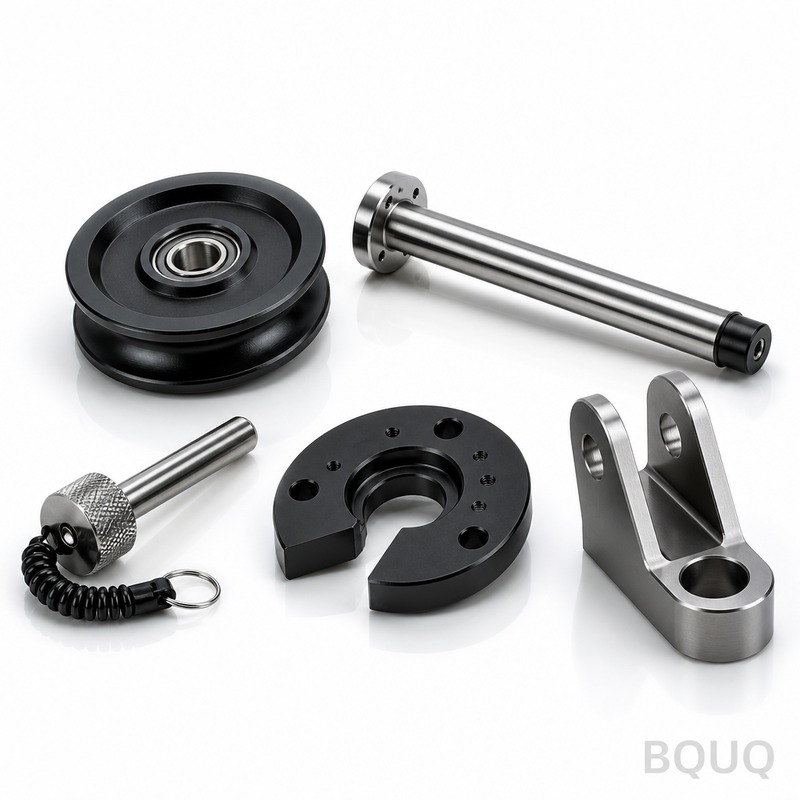
Standard lead time for machined robotic components is 10 to 15 business days, with expedited 5-day service available at a 30% surcharge. The timeline breaks down as: 1-2 days for CAD/CAM programming, 3-5 days for material procurement, 4-6 days for machining, and 2-3 days for surface finishing and inspection. Complex parts requiring EDM (electrical discharge machining) for internal splines add 3-4 days. For example, a harmonic drive housing with 12 drilled holes, 4 tapped holes, and a Ø80 mm bearing bore requires 2.5 hours of CNC time per part. BQUQ maintains a 15% capacity buffer for urgent robotics orders, ensuring a 72-hour response for quick-turn prototypes.
How Do Surface Finishes Affect Robot Durability and Friction?
Surface finish directly influences wear resistance and friction coefficients in moving joints. For sliding contact surfaces, such as linear guide rails and piston rods, we specify Ra 0.2 μm or better, achieved by grinding or hard turning. A smooth finish of Ra 0.4 μm on a bearing journal reduces friction torque by 15% compared to Ra 1.6 μm, lowering motor load and heat generation. For static mating faces, Ra 1.6 μm is sufficient for sealing with anaerobic gaskets. Anodizing to MIL-A-8625 Type III (hard coat, 50 μm thickness) increases surface hardness to 68 HRC and improves wear resistance by 10 times. BQUQ applies hard anodizing to aluminum robot arms, which also provides dielectric insulation for internal cabling.
| Component Type | Typical Material | Achievable Tolerance | Surface Roughness Ra | Machining Time per Part | Cost per Part (USD, qty 100) |
| Joint Housing | 7075-T6 Aluminum | ±0.015 mm | 0.8 μm | 2.5 hours | 85 |
| Harmonic Drive Flexspline | 40CrMo Steel | ±0.008 mm | 0.4 μm | 4.0 hours | 320 |
| Base Frame | 6061-T6 Aluminum | ±0.05 mm | 1.6 μm | 6.0 hours | 180 |
| Encoder Mount Plate | Stainless 304 | ±0.02 mm | 0.8 μm | 1.2 hours | 45 |
| Motor Shaft | 4140 Alloy Steel | ±0.005 mm | 0.2 μm | 1.8 hours | 65 |
What Quality Inspection Methods Ensure Robotic Part Accuracy?
Inspection is a multi-stage process to verify the tight tolerances required. First, in-process probing with a Renishaw touch probe checks critical bores immediately after machining, correcting offsets in real-time. Second, post-process CMM inspection uses a Zeiss Contura with a measurement uncertainty of ±1.5 μm to verify all datums, positions, and geometric tolerances. For surface finish, a Mitutoyo SJ-410 profilometer measures Ra, Rz, and Rmax. Finally, for parts requiring high concentricity, a Talyrond roundness machine measures circularity to 0.3 μm. BQUQ provides a full inspection report with every shipment, including a statistical process control (SPC) chart showing Cpk values above 1.33 for critical features. We recommend customers specify critical dimensions on their drawings using GD&T (geometric dimensioning and tolerancing) per ASME Y14.5 to avoid ambiguity.
Can CNC Machining Be Combined with Other Processes for Robot Frames?
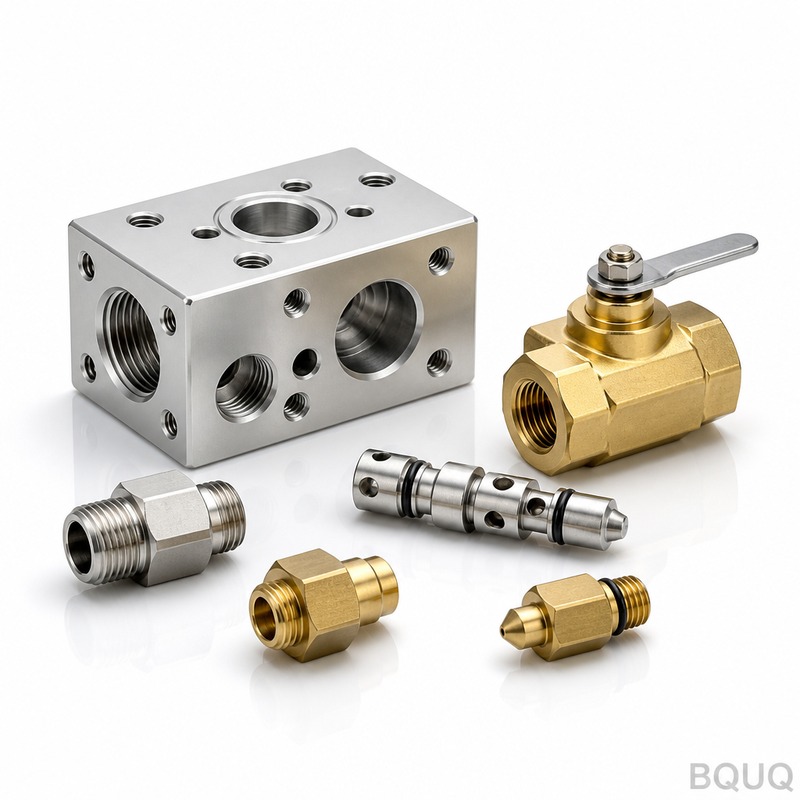
Yes, hybrid manufacturing is common for cost-effective robot structures. For example, a robot base can be a CNC machined aluminum plate welded to a laser-cut steel stiffener, reducing material waste by 40%. Alternatively, 3D-printed metal inserts (DMLS) with complex internal cooling channels are CNC machined on their sealing faces to achieve the required flatness. For high-volume production (over 10,000 units/year), casting combined with CNC finishing is optimal: a cast aluminum housing costs 40% less per blank than solid billet, but requires 0.5 mm machining stock on all critical surfaces. BQUQ’s 20 years of experience in metal stamping and springs also allows us to supply integrated robotic gripper components, such as stamped steel fingers with CNC-machined contact pads, reducing assembly costs by 25%.
FAQ
What Is the Best Material for a Robot Arm Structure?
For most industrial robots, 7075-T6 aluminum is the best balance of strength, weight, and machinability. It offers a yield strength of 503 MPa and can be hard-anodized for wear resistance, though it is 25% more expensive than 6061-T6. Use 6061-T6 for non-critical covers and brackets to reduce cost.
How Tight a Tolerance Can a Standard CNC Machine Hold?
A standard 3-axis CNC machine can reliably hold ±0.025 mm for general features. For critical features requiring ±0.005 mm, you need a temperature-controlled environment, high-quality tooling, and a machine with thermal compensation. BQUQ achieves ±0.005 mm on shaft diameters and bearing bores with careful process control.
Does Robot Part Machining Require 5-Axis CNC?
Not always, but 5-axis machining is recommended for complex joint housings with angled ports and undercuts. It reduces the number of setups from 4 to 1, improving datum consistency by up to 50%. For simple flat parts, a 3-axis machine is more economical.
What Is the Typical Cost for a CNC Machined Robot Joint?
A typical robot joint housing in 7075 aluminum costs between 85 and 120 USD per unit for quantities of 100. This excludes surface finishing and tooling amortization. For small batches of 10 units, the price may rise to 250 USD per unit due to setup overhead.
How Long Does a CNC Machined Aluminum Robot Part Last?
With proper hard anodizing (Type III), an aluminum robot part can last over 1 million cycles without significant wear in a clean environment. Fatigue life is typically 10⁷ cycles at stress levels below 50% of yield strength. Regular inspection of bearing surfaces is recommended every 5,000 operating hours.
Which Surface Finish Is Best for Reducing Friction in Robot Joints?
For bearing journals and sliding surfaces, specify Ra 0.2 μm or finer, achieved by grinding or polishing. This finish reduces the coefficient of friction by up to 30% compared to a standard machined finish of Ra 1.6 μm. For non-contact surfaces, Ra 3.2 μm is acceptable.
Can You Machine Parts from Titanium for Robot End-Effectors?
Yes, titanium (Ti-6Al-4V) is ideal for end-effectors requiring high strength-to-weight ratio and corrosion resistance, though machining time is 3 times longer than aluminum. The cost per part is typically 5-8 times higher due to slower speeds and specialized tooling. Use it only for highly stressed gripping fingers or surgical robot tools.
CNC machining remains the backbone of robotics manufacturing because it offers the exact combination of precision, material flexibility, and scalability required for both prototyping and mass production. When selecting a manufacturing partner for robotic components, always verify their inspection capabilities, request a detailed CMM report, and confirm their experience with harmonic drive and gearbox tolerances. For your next robotics project, BQUQ provides free DFM (Design for Manufacturing) feedback on your 3D files. Send your CAD models to sc@bquq.com or WhatsApp +86 13713157787, and receive a precise quote with full tolerance analysis within 12 hours. Visit www.bquq.com to explore our CNC machining, metal stamping, and spring manufacturing capabilities.