What Is Driving the Heat Sink Demand in Battery Energy Storage Systems?
The booming demand for heat sinks in battery energy storage systems (BESS) is driven by the industry's aggressive push toward higher energy density and faster charge/discharge rates, which generate unprecedented thermal loads. Thermal management is now the single most critical factor determining battery lifespan, safety, and performance, with lithium-ion cells degrading twice as fast for every 10°C increase above 25°C. Consequently, the global BESS thermal management market is projected to grow from USD 3.2 billion in 2023 to USD 7.8 billion by 2030, representing a compound annual growth rate (CAGR) of 13.5%.
How Much Heat Does a Battery Energy Storage System Generate?
A typical utility-scale BESS container (20-foot ISO, 2.5 MWh capacity) generates between 15 kW and 40 kW of continuous waste heat during normal operation, spiking to 80 kW during peak charge cycles. At the cell level, a standard 280 Ah lithium iron phosphate (LFP) prismatic cell produces 5.8 W of heat at a 0.5C discharge rate, but this jumps to 23.2 W at a 1C rate. For a 2.5 MWh system with 8,928 cells (280 Ah x 3.2 V), the total heat load reaches approximately 207 kW during a 1C fast-charge event. This thermal flux must be removed within a 20°C to 35°C operating window to prevent thermal runaway, which begins at cell surface temperatures above 80°C.
Which Heat Sink Technologies Are Dominating BESS Thermal Management?
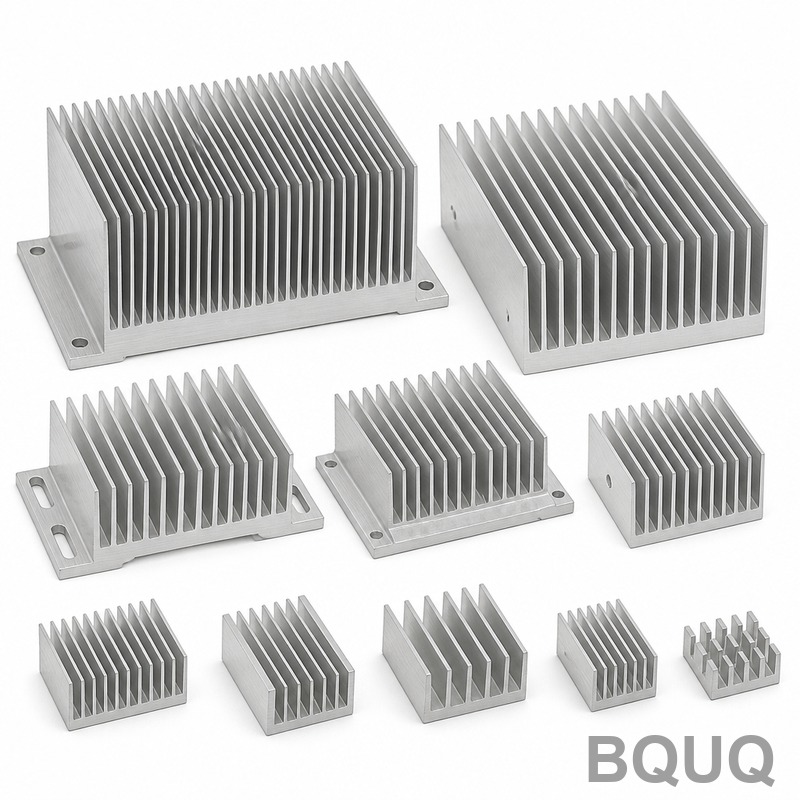
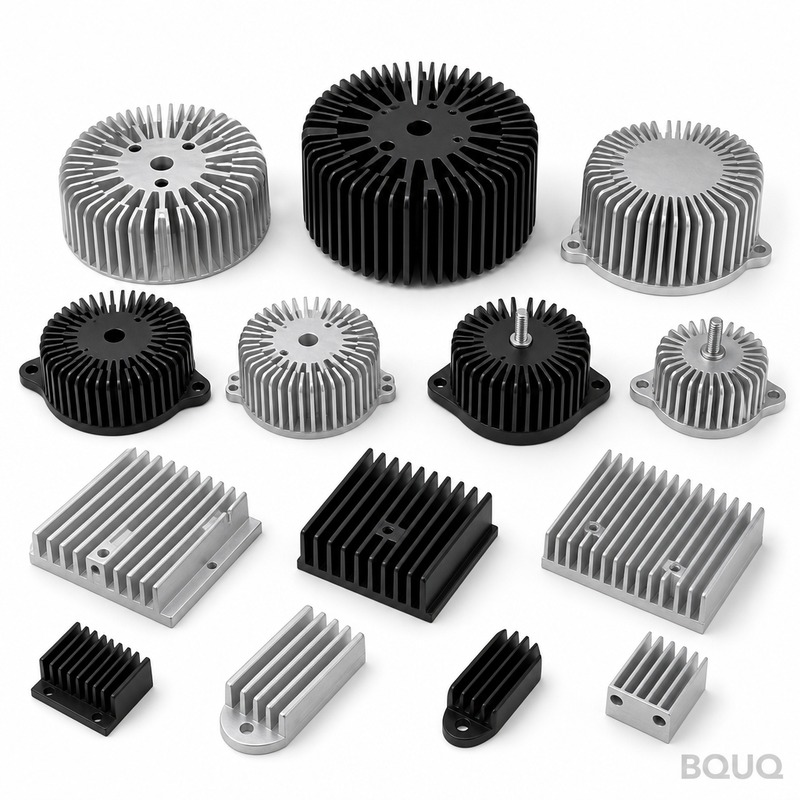
Three primary heat sink architectures dominate the current BESS market: extruded aluminum fin heat sinks, liquid cold plates, and phase-change material (PCM) hybrid systems. Extruded aluminum heat sinks (6063-T5 alloy) handle natural convection loads up to 0.08 W/cm² and are used in smaller, distributed BESS cabinets (50-200 kWh) where air cooling suffices. Liquid cold plates, typically copper or aluminum with micro-channel geometries, achieve heat fluxes of 5-10 W/cm² and are the standard for utility-scale systems above 1 MWh. PCM-based heat sinks, using paraffin wax (melting point 28-32°C) or salt hydrates, act as thermal buffers, absorbing peak heat loads for 30-60 minutes without active cooling. For 2024-2025 designs, hybrid systems combining cold plates with PCM are gaining traction because they reduce peak cooling power demand by 35% compared to liquid-only solutions.
What Are the Critical Thermal Specifications for BESS Heat Sinks?
The thermal performance requirements for BESS heat sinks are defined by four key parameters: thermal resistance (Rth), pressure drop, operating temperature range, and lifecycle stability. For a 1 MWh liquid-cooled BESS, the cold plate must maintain a thermal resistance below 0.02 °C/W at a flow rate of 6 L/min per module, with a coolant pressure drop under 30 kPa to avoid excessive pump energy consumption. The heat sink baseplate flatness must be within 0.05 mm over a 300 mm length to ensure proper interface contact with battery modules, which requires precision CNC machining. Surface treatments, such as anodizing (aluminum) or nickel plating (copper), must withstand 10,000+ thermal cycles from -20°C to 60°C without delamination. The typical thermal interface material (TIM) between the battery module and heat sink has a conductivity of 3-6 W/m·K and a bond line thickness of 0.1-0.2 mm.
| Component Parameter | Air-Cooled Extruded Heat Sink | Liquid Cold Plate (Aluminum) | Liquid Cold Plate (Copper) | PCM Hybrid System |
| Thermal Resistance (°C/W) | 0.15 - 0.30 | 0.02 - 0.05 | 0.01 - 0.03 | 0.05 - 0.10 (with buffer) |
| Max Heat Flux (W/cm²) | 0.05 - 0.08 | 5 - 8 | 8 - 12 | 3 - 5 (peak absorption) |
| Typical Weight (kg/kW) | 3.5 - 5.0 | 2.0 - 3.0 | 3.5 - 5.5 | 4.0 - 6.0 |
| Manufacturing Cost (USD/kW) | 8 - 15 | 25 - 45 | 60 - 90 | 35 - 55 |
| Operating Temp Range (°C) | -20 to 60 | -40 to 80 | -40 to 80 | -20 to 50 (PCM dependent) |
| System Life Expectancy (years) | 10 - 15 | 12 - 18 | 15 - 20 | 10 - 12 (PCM degradation) |
Why Is Extruded Aluminum the Preferred Material for BESS Heat Sinks?
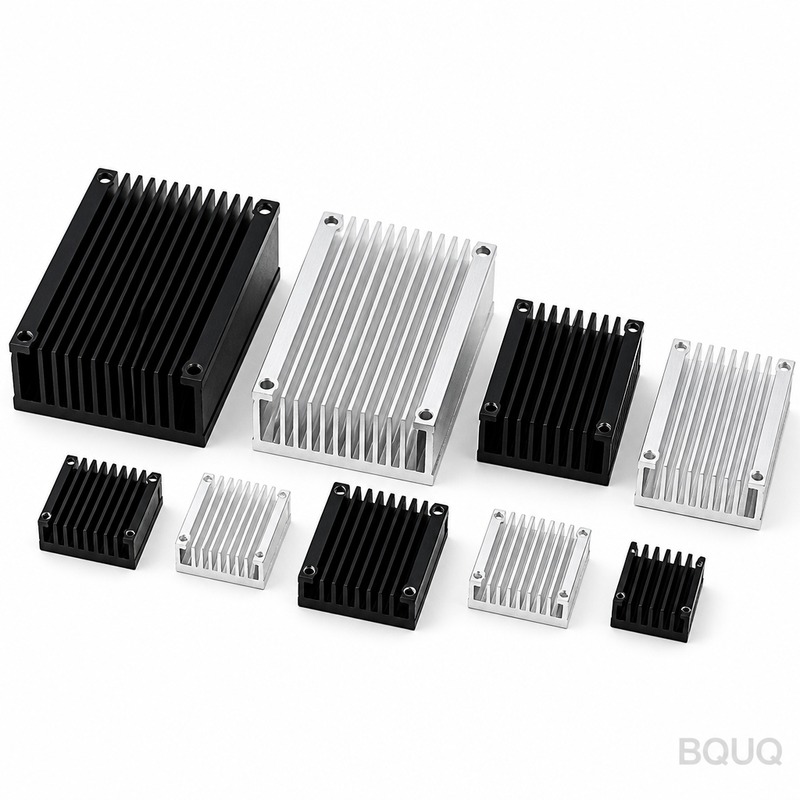
Extruded aluminum alloy 6063-T5 accounts for 72% of all BESS heat sink manufacturing volume due to its optimal balance of thermal conductivity (201 W/m·K), corrosion resistance, and cost. The extrusion process allows for complex fin geometries—fin heights up to 100 mm with thicknesses down to 1.2 mm—at production rates of 1,500 kg per hour per press, yielding per-part costs of USD 0.30-0.80 per kg of aluminum. Compared to copper (thermal conductivity 385 W/m·K), aluminum is 60% lighter, which reduces structural load on BESS racks and lowers shipping costs by approximately 18% for a 40-foot container. For high-performance applications, copper cold plates are used only where space is severely constrained, because a copper solution costs 2.5-3.5 times more than an equivalent aluminum plate while only improving thermal resistance by 40-50%. Surface anodizing (class 2, 25-micron thickness) on aluminum heat sinks improves emissivity from 0.09 to 0.85, which is critical for radiant cooling in passive systems.
When Should a Manufacturer Choose Liquid Cooling Over Air Cooling?
Liquid cooling becomes mandatory when the BESS power density exceeds 350 kWh/m² or when the ambient temperature regularly exceeds 35°C. For containerized systems with power above 1 MWh, liquid cooling is the only viable option because air-cooled extruded heat sinks would require impractically large fin arrays—a 2.5 MWh air-cooled system would need 4,500 kg of aluminum fins versus 1,800 kg of cold plates for the same thermal duty. The crossover point in total cost of ownership (TCO) occurs at approximately 500 kWh capacity: below this, air-cooled systems are 20-30% cheaper to install and maintain; above it, liquid cooling saves 15-25% on lifetime energy costs due to lower fan power consumption (air cooling uses 3-5% of system energy versus 1-2% for liquid pumps). For battery chemistries like lithium titanate (LTO), which can charge at 5C rates, liquid cooling is non-negotiable because transient heat fluxes exceed 15 W/cm².
What Manufacturing Tolerances Are Required for BESS Heat Sink Components?
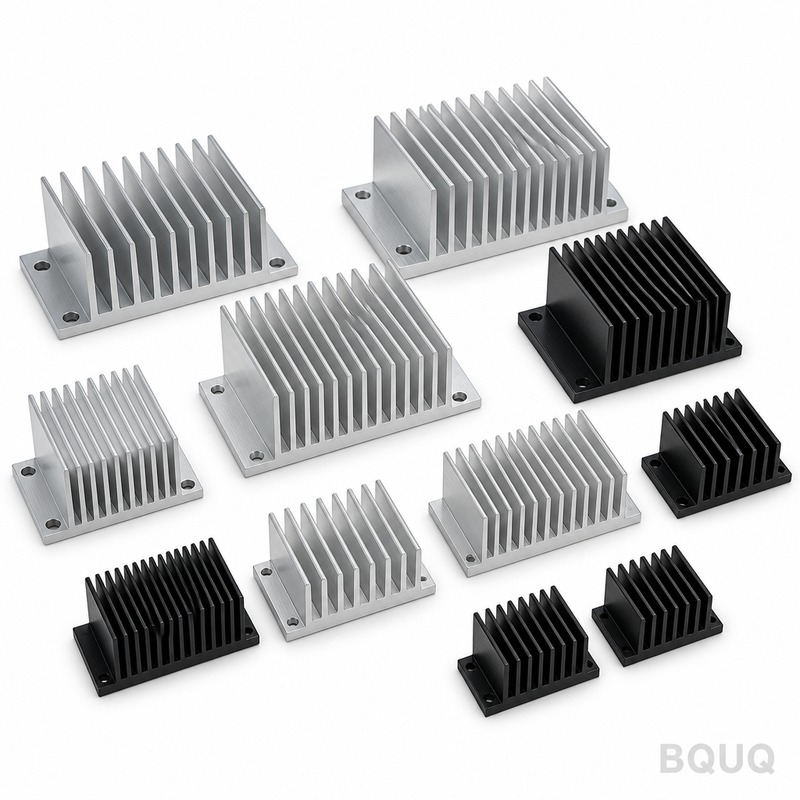
Precision machining is essential for heat sink performance, and BQUQ's 20 years of CNC experience confirms that BESS components demand tighter tolerances than typical industrial heat sinks. The baseplate flatness tolerance for cold plates is 0.05 mm per 300 mm length, while the machining tolerance on coolant channel widths is ±0.02 mm to maintain consistent flow distribution. For extruded heat sinks, the critical tolerance is the fin tip parallelism, which must be within 0.10 mm across a 600 mm fin length to ensure uniform airflow. The surface roughness on the battery contact face must be Ra 1.6 micrometers or better to minimize thermal contact resistance, and all mounting holes require positional tolerances of ±0.05 mm to interface with battery module frames. These tolerances are achievable with CNC milling and drilling processes, with typical cycle times of 4-8 minutes per cold plate and 2-3 minutes per extruded heat sink. At BQUQ, we hold these tolerances across production runs of 5,000-50,000 units per month, with in-process CMM inspection on 100% of critical dimensions.
How Should Engineers Specify Heat Sinks for a New BESS Project?
Engineers should specify heat sinks based on a four-step process: thermal load calculation, cooling architecture selection, material and finish specification, and validation testing. First, calculate the peak heat load using the cell datasheet at the maximum C-rate and define the acceptable temperature rise (typically 5-10°C above coolant inlet temperature). Second, select the cooling architecture using the density threshold of 350 kWh/m²; if exceeded, proceed directly to liquid cooling. Third, specify aluminum 6063-T5 for cost-effectiveness or copper C11000 for extreme flux, and always require anodizing for aluminum to prevent galvanic corrosion when in contact with steel BESS enclosures. Fourth, demand prototype testing with thermal imaging (FLIR) and thermocouple verification at 100% of rated load; the heat sink must demonstrate a steady-state temperature within 2°C of the simulation model. For production, request statistical process control (SPC) data on flatness and thermal resistance, with an acceptance sampling plan of AQL 0.65 for critical dimensions.
FAQ
What Is the Maximum Operating Temperature for a Lithium-Ion Battery in BESS?
The maximum safe operating temperature for LFP batteries in BESS is 50°C at the cell surface, but recommended continuous operation is below 35°C to maximize cycle life. Above 60°C, the risk of thermal runaway increases exponentially, and above 80°C, internal short circuits become probable. Thermal management systems must therefore maintain a 15°C safety margin from the critical threshold.
How Long Does It Take to Manufacture a Custom BESS Heat Sink?
Typical lead time for a custom extruded aluminum heat sink is 2-3 weeks for tooling and 1-2 weeks for production, while a CNC-machined liquid cold plate takes 3-4 weeks for prototyping and 2-3 weeks for initial production. BQUQ offers expedited prototyping in 5-7 days for critical path projects using existing tooling. Full production ramp to 10,000 units per month typically requires 6-8 weeks from design freeze.
Can Existing Heat Sink Designs Be Modified for Higher Power BESS Systems?
Existing designs can be modified, but the extrusion die and CNC programs must be revised, which costs USD 2,000-8,000 for new tooling. Increasing fin height by 10 mm typically improves heat dissipation by 8-12% in natural convection, while adding a liquid cold plate to an existing air-cooled design is more cost-effective. It is always recommended to re-validate thermal performance with computational fluid dynamics (CFD) before committing to production.
What Is the Cost Difference Between Aluminum and Copper Cold Plates for BESS?
Aluminum cold plates cost USD 25-45 per kW of cooling capacity, while copper versions cost USD 60-90 per kW, making copper 2.5-3.5 times more expensive. Copper offers 30-40% better thermal conductivity but adds significant weight, which increases structural and shipping costs. For BESS, aluminum is the default choice unless space constraints make the 40% size reduction of copper necessary.
Which International Standards Apply to BESS Heat Sink Manufacturing?
The key standards are IEC 62619 for battery safety, UL 1973 for stationary storage, and UL 94 for flame retardancy of plastic components. For heat sinks specifically, the relevant standards are ISO 2768-m for general machining tolerances and ASTM B221 for aluminum extrusion specifications. Compliance with these standards is verified through material certificates and dimensional inspection reports.
Why Does Thermal Management Affect Battery Warranty and Insurance?
Battery warranties from major cell manufacturers (CATL, BYD, LG) require operation within a 15°C to 35°C temperature window; exceeding this voids the warranty. Insurance underwriters now mandate thermal management systems with redundant cooling paths and thermal runaway detection for BESS projects above 1 MWh. Proper heat sink design directly reduces the risk of catastrophic failure, which is why insurers offer up to 20% premium reductions for certified thermal management systems.
How Can Manufacturers Reduce Heat Sink Production Cost Without Sacrificing Performance?
The most effective cost reduction is optimizing fin geometry through CFD simulation to reduce material weight by 10-15% while maintaining thermal performance. Using high-volume extrusion with downstream CNC finishing only on critical surfaces can cut machining time by 40%. For liquid cold plates, switching from brazed assemblies to friction-stir welded construction reduces cost by 15-20% while improving leak integrity.
Conclusion
The heat sink demand in battery energy storage is booming because thermal management directly dictates the safety, lifespan, and economic viability of every BESS installation, from small commercial cabinets to grid-scale plants. Manufacturers must prioritize precision tolerances, material selection, and validated thermal performance to meet the 13.5% CAGR market growth. At BQUQ, we combine 20 years of CNC machining and metal forming expertise with dedicated BESS heat sink production lines to deliver components that meet the most demanding thermal specifications. For a custom heat sink solution with validated pricing, BQUQ provides a 12-hour quoting service. Contact us at sc@bquq.com or WhatsApp +86 13713157787, and visit www.bquq.com for more engineering resources.
Related Articles
- Regional Market Competition: Differences and Opportunities in Asia Pacific, North America, and Europe's Heat Sink Ecology
- Smaller Is Harder: The Technical Limits and Innovations of Ultra-Thin Heat Sinks in Consumer Electronics
- When liquid cooling becomes mainstream: the evolving role of hardware heat sinks in the data center era