What Is the Forging Process for Heat Sinks and How Does It Perform?
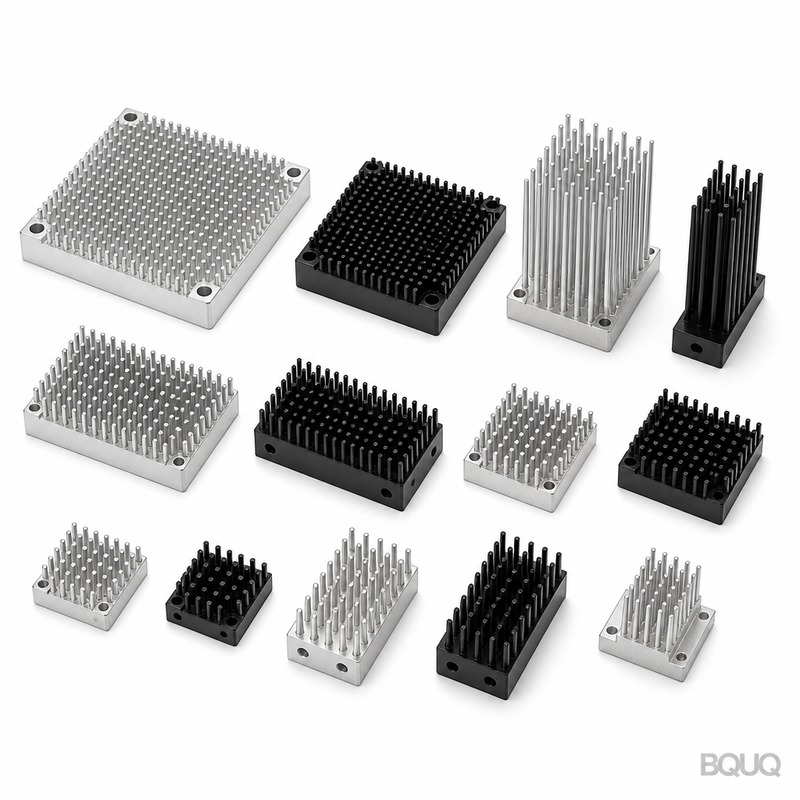
Forged heat sinks are manufactured by applying high pressure to a malleable metal billet, typically aluminum alloy 6063 or 6061, forcing it into a precision-machined steel die cavity to produce a near-net-shape finned structure with a continuous, unbroken grain flow. This process yields heat sinks with superior mechanical strength and thermal conductivity compared to die-cast or skived alternatives, achieving fin thicknesses down to 0.8 mm and aspect ratios up to 15:1. For high-volume production runs exceeding 5,000 units, forging offers the best balance of thermal performance, structural integrity, and unit cost, typically delivering thermal resistance values 10-20% lower than equivalent extruded designs.
What Is the Forging Process for Heat Sinks and What Are Its Key Steps?
The forging process for heat sinks involves four critical stages: billet preparation, die heating, forging, and trimming. First, an aluminum billet (typically 6063-T5 or 6061-T6) is cut to a calculated volume and preheated to 400-480°C (752-896°F) in a furnace. The heated billet is then placed into a die set mounted in a mechanical or hydraulic press, with the die preheated to 200-300°C to reduce thermal shock. The press applies 500 to 2,500 tons of force, depending on the projected area of the heat sink, causing the aluminum to flow into the die cavities at speeds of 50-150 mm/s. After a dwell time of 3-10 seconds to allow for complete die filling, the part is ejected, quenched in water or forced air to achieve the T5 or T6 temper, and then trimmed to remove flash. Final operations include straightening, surface finishing (bead blasting or anodizing), and 100% dimensional inspection with CMM (coordinate measuring machine) verification.
How Does Forging Compare to Extrusion and Die Casting for Heat Sink Production?
Forging outperforms extrusion and die casting in structural integrity and thermal performance, but it has a higher tooling cost. Extruded heat sinks, limited to 2D profiles, have a maximum fin aspect ratio of about 8:1 and require secondary machining for any 3D features, which can double the unit cost. Die-cast heat sinks, while offering complex 3D shapes, suffer from porosity (1-3% by volume) that reduces effective thermal conductivity by up to 20% and limits fin thickness to a minimum of 1.5 mm. Forged heat sinks achieve zero porosity, a continuous grain structure aligned with the fin direction, and fin thicknesses of 0.8-2.0 mm. The table below shows the quantitative comparison for a typical 100 mm x 100 mm x 40 mm heat sink base plate with 10 fins:
| Parameter | Forging (6063-T5) | Extrusion (6063-T5) | Die Casting (A380) |
| Fin thickness (mm) | 0.8 - 2.0 | 1.0 - 3.0 | 1.5 - 4.0 |
| Max aspect ratio (height/thickness) | 15:1 | 8:1 | 6:1 |
| Porosity (%) | 0 | 0 | 1 - 3 |
| Ultimate tensile strength (MPa) | 205 | 165 | 160 |
| Thermal conductivity (W/m·K) | 209 | 201 | 96 |
| Tooling cost (USD) | 15,000 - 40,000 | 3,000 - 8,000 | 8,000 - 20,000 |
| Unit cost at 10,000 pcs (USD) | 4.50 - 7.00 | 3.00 - 5.00 (plus machining) | 2.50 - 4.00 |
| Lead time for first articles (weeks) | 6 - 8 | 2 - 4 | 4 - 6 |
Why Does Forging Improve Thermal Performance Compared to Other Methods?
Forging improves thermal performance primarily by eliminating porosity and creating a continuous, unbroken grain flow that follows the heat sink's geometry. In die casting, entrapped air forms voids that act as thermal insulators, reducing effective conductivity from 96 W/m·K to as low as 77 W/m·K in practice. Forged aluminum 6063-T5 maintains a consistent 209 W/m·K throughout the part. Additionally, the forging process work-hardens the material, increasing its density at the surface and improving heat transfer at the fin-to-air interface. The ability to forge thinner fins (0.8 mm versus 1.5 mm minimum for die casting) increases the surface area by up to 30% for the same overall envelope, directly enhancing convective heat dissipation. For a typical power electronics application dissipating 150 W, a forged heat sink can maintain a junction-to-ambient thermal resistance of 0.45°C/W, compared to 0.58°C/W for a die-cast equivalent, a 22% improvement.
What Tolerances Can Be Achieved with Forged Heat Sinks?
Forged heat sinks achieve tighter tolerances than die casting but require secondary machining for the highest precision. As-forged dimensions can hold tolerances of ±0.3 mm on fin thickness and ±0.5 mm on overall length and width, with a draft angle of 0.5-1.0 degrees required for die release. The base plate flatness after forging is typically 0.1 mm over 100 mm, which is suitable for most mounting applications. However, critical mounting surfaces, such as the base plate underside that contacts the heat source, require a secondary milling or grinding operation to achieve a flatness of 0.05 mm and a surface roughness of Ra 0.8 µm. The table below summarizes achievable tolerances for standard forged features:
| Feature | As-Forged Tolerance (mm) | After Secondary Machining (mm) |
| Fin thickness | ±0.3 | ±0.1 |
| Base plate thickness | ±0.4 | ±0.05 |
| Overall length/width | ±0.5 | ±0.1 |
| Base plate flatness | 0.1 over 100 mm | 0.05 over 100 mm |
| Surface roughness (Ra) | 3.2 µm | 0.8 µm |
| Hole position (for mounting) | Not applicable | ±0.05 |
Which Aluminum Alloys Are Best Suited for Forged Heat Sinks?
The best alloys for forged heat sinks are 6063-T5 and 6061-T6, each serving different performance priorities. Alloy 6063 offers the highest thermal conductivity (209 W/m·K) and excellent corrosion resistance, making it the default choice for most commercial and consumer electronics applications where thermal efficiency is paramount. Alloy 6061 provides higher mechanical strength (ultimate tensile strength of 310 MPa versus 205 MPa for 6063) and better machinability, making it suitable for applications subject to vibration or mechanical shock, such as automotive power modules and aerospace avionics. For extreme high-temperature environments above 200°C, alloy 6061 with a T6 temper maintains its strength better than 6063-T5, which begins to soften above 150°C. For specialized applications requiring maximum weight reduction, a copper-tungsten forging or a hybrid aluminum-copper forging can be specified, but at a material cost increase of 300-500%.
When Should an Engineer Specify Forged Heat Sinks Over Alternatives?
Engineers should specify forged heat sinks when production volume exceeds 5,000 units per year and the design requires either high fin density or a 3D geometry that cannot be extruded. The break-even point versus extrusion is typically at 8,000-10,000 units when factoring in the secondary machining costs required for extruded profiles with 3D features. Forging is also the preferred choice when the application demands zero porosity for vacuum-brazed assemblies or when the heat sink must withstand high mechanical loads, such as in railway traction converters where vibration levels reach 5 g RMS. Conversely, for low-volume prototypes (under 500 units) or simple flat-fin geometries, extrusion or skiving is more cost-effective, with tooling costs of only $3,000-8,000 versus $15,000-40,000 for forging dies.
How Long Does Tooling Production and First Article Approval Take for Forged Heat Sinks?
The tooling for forged heat sinks takes 4-6 weeks to design and manufacture, with an additional 2-3 weeks for first article approval (FAI). The die set, typically made of H13 hot-work tool steel, is CNC-machined, heat-treated to 45-52 HRC, and then polished to a surface finish of Ra 0.4 µm to ensure smooth metal flow and easy part ejection. The FAI process includes 100% dimensional inspection, metallurgical analysis to verify grain flow, and thermal performance testing using a wind tunnel or thermal test vehicle. Total lead time from purchase order to production-ready parts is 7-9 weeks for the first batch, with subsequent production runs of 5,000-10,000 pieces typically completed in 3-4 weeks. For urgent requirements, BQUQ offers expedited tooling at a 20% surcharge, reducing the tooling lead time to 3 weeks.
Can Forged Heat Sinks Be Anodized or Otherwise Surface Treated?
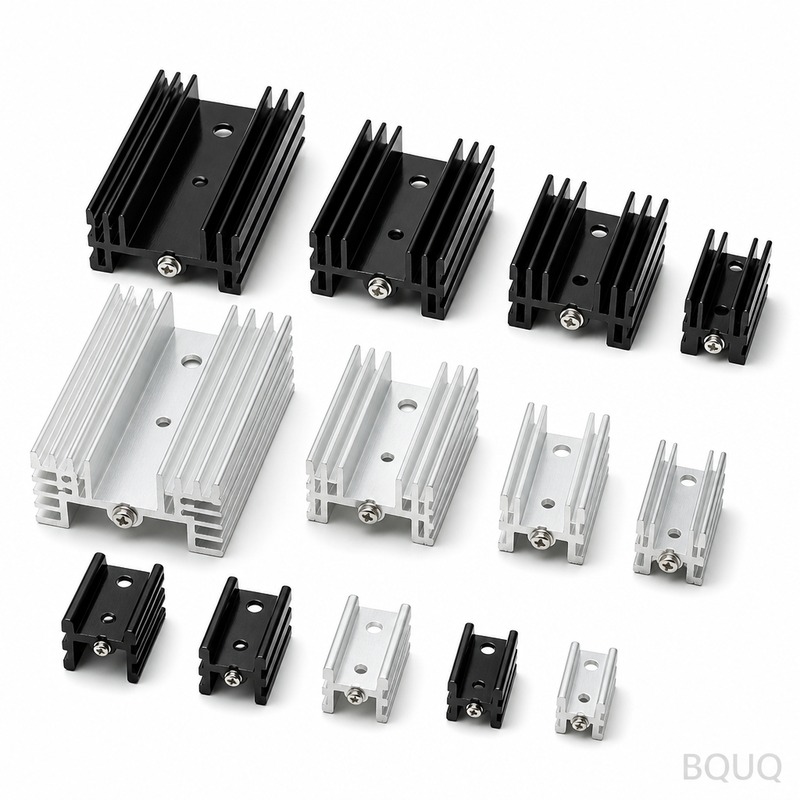
Yes, forged heat sinks can be anodized to Type II (sulfuric acid) or Type III (hard coat), with excellent results due to the dense, porosity-free surface. Type II anodizing to a thickness of 8-12 µm increases surface emissivity from 0.1 to 0.8, improving radiative heat transfer by up to 15% in natural convection applications. Black anodizing is the most common finish, providing both improved thermal performance and aesthetic uniformity. Type III hard anodizing to 25-50 µm thickness is specified for applications requiring wear resistance, but it reduces thermal conductivity by approximately 5% due to the insulating ceramic layer. Other viable surface treatments include chromate conversion coating (for electrical grounding) and powder coating (for harsh environments), though powder coating should be applied only to non-fin surfaces to avoid reducing fin thermal efficiency.
FAQ
What Is the Typical Cost per Unit for a Forged Heat Sink at 10,000 Pieces?
At 10,000 pieces, a standard forged aluminum heat sink (100 mm x 100 mm x 40 mm) costs between $4.50 and $7.00 per unit, including material, forging, trimming, and basic inspection. This price assumes a tooling amortization of $15,000-40,000 over the order quantity. The unit cost drops to $3.50-5.50 at 50,000 pieces as tooling costs are fully amortized.
How Does Forging Affect the Fin Aspect Ratio Capability?
Forging can achieve fin aspect ratios up to 15:1, meaning a fin of 12 mm height can be as thin as 0.8 mm. This is significantly better than extrusion (8:1) and die casting (6:1). The higher aspect ratio directly increases the surface area for heat dissipation without increasing the overall heat sink footprint.
What Is the Maximum Size Limit for a Forged Heat Sink?
The maximum practical size for a forged heat sink is limited by press capacity, typically 400 mm x 400 mm in plan area and 150 mm in height for a 2,500-ton press. Larger parts can be forged on specialized presses up to 5,000 tons, but tooling costs escalate exponentially. For sizes above 500 mm in length, multiple-piece assemblies or alternate processes are recommended.
Are Forged Heat Sinks Suitable for High-Volume Consumer Electronics?
Yes, forged heat sinks are ideal for high-volume consumer electronics when the design requires thin fins or complex 3D geometry. At volumes of 100,000 pieces per year, the unit cost can drop below $2.00, making forging competitive with die casting while offering superior thermal performance. The zero-porosity characteristic also ensures consistent quality across millions of cycles.
What Is the Thermal Conductivity of a Forged 6063-T5 Heat Sink?
A forged 6063-T5 heat sink has a bulk thermal conductivity of 209 W/m·K, which is effectively maintained throughout the part due to zero porosity. This is 118% higher than die-cast A380 aluminum (96 W/m·K). In practical terms, this means a forged heat sink can dissipate the same heat load with a 15-20% smaller surface area compared to a die-cast equivalent.
How Does the Press Tonnage Affect the Forged Heat Sink Quality?
Press tonnage must be matched to the projected area of the heat sink; a rule of thumb is 500-800 tons per square meter of projected area. Insufficient tonnage results in incomplete die filling, thin fins, and cold shuts. Excessive tonnage causes die deflection and premature wear. For a 100 mm x 100 mm heat sink, a 1,000-ton press provides an optimal balance.
Can Forged Heat Sinks Include Mounting Holes and Other Features?
Yes, forged heat sinks can include bosses, standoffs, and mounting lugs as part of the forged shape, reducing secondary machining. However, through-holes and tapped holes with tight tolerances must be drilled and tapped in a secondary operation. This hybrid approach minimizes machining time while leveraging the near-net-shape capability of forging.
Conclusion
Forged heat sinks deliver the best combination of thermal performance, mechanical strength, and cost-effectiveness for medium-to-high volume production runs above 5,000 units. The process eliminates porosity, enables fin aspect ratios up to 15:1, and achieves thermal conductivity of 209 W/m·K in 6063-T5 aluminum, outperforming die casting and extrusion in demanding applications. BQUQ's 20 years of precision manufacturing experience in CNC machining, metal stamping, springs, and heat sinks ensures that your forged heat sink project benefits from rigorous process control and fast turnaround. For a detailed engineering review and quotation, contact us at sc@bquq.com or WhatsApp +86 13713157787, and receive a response within 12 hours. Visit www.bquq.com for more information on our manufacturing capabilities.