What Materials Keep Spring Strength at 300°C and Above?
The direct answer is that only precipitation-hardened nickel-based superalloys, certain cobalt-based alloys, and specialized austenitic stainless steels can reliably maintain spring force at 300°C and above. Specifically, Inconel X-750, Inconel 718, Elgiloy, and Nimonic 90 are the industry standards, with Inconel X-750 retaining approximately 85% of its room-temperature yield strength at 540°C. For continuous operation above 400°C, standard chrome-silicon steel and 302 stainless steel will experience stress relaxation and permanent set, making them unsuitable for precision applications.
What Is the Maximum Continuous Operating Temperature for Common Spring Materials?
The maximum continuous operating temperature is defined as the temperature at which a spring retains at least 90% of its initial load after 100 hours of exposure. For oil-tempered chrome-silicon steel (ASTM A401), this limit is approximately 232°C. Chrome-vanadium steel (ASTM A231) reaches 260°C. Standard 302/304 stainless steel (ASTM A313) is rated to 288°C. Above these thresholds, you must move to high-temperature alloys. Inconel X-750 (ASTM A637) operates continuously at 650°C, while Nimonic 90 can reach 700°C in low-stress applications. For short-term exposure, Inconel 718 can withstand peaks up to 815°C, but only for minutes, not hours.
Which Alloys Are Best for Springs Operating at 300°C to 650°C?
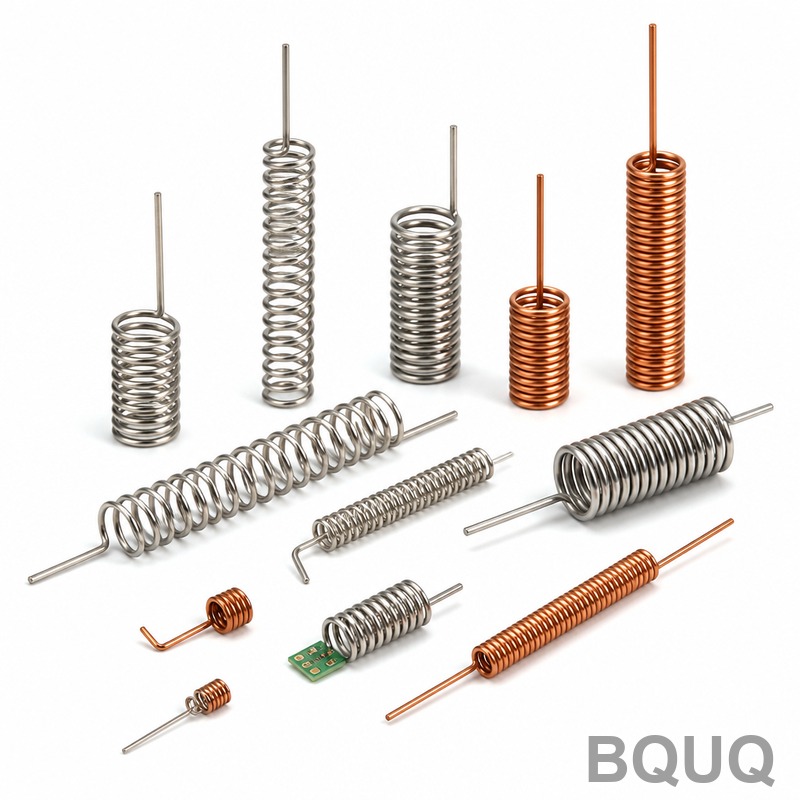
For the 300°C to 650°C range, the four primary choices are Inconel X-750, Inconel 718, Elgiloy, and Nimonic 90. Inconel X-750 is the most common because it offers a good balance of cost, availability, and stress relaxation resistance. Inconel 718 provides higher tensile strength (up to 1379 MPa at room temperature) but is more difficult to coil due to its work-hardening rate. Elgiloy, a cobalt-chromium-nickel alloy, offers excellent corrosion resistance and maintains its modulus of elasticity up to 400°C. Nimonic 90 is preferred for the highest temperatures (above 600°C) but requires specialized heat treatment and is significantly more expensive. For less demanding applications at 300°C to 350°C, 17-7 PH stainless steel (ASTM A313) can be a cost-effective alternative, though its stress relaxation is higher than Inconel X-750.
How Does Stress Relaxation Affect Spring Performance at High Temperatures?
Stress relaxation is the gradual loss of load when a spring is held at a constant deflection under elevated temperature. At 300°C, a chrome-silicon spring will lose approximately 40% of its initial load within 100 hours. At the same temperature, Inconel X-750 will lose only 5-8%. This difference is critical for applications such as valve springs, seal preloads, and electrical contacts where consistent force is mandatory. The mechanism is dislocation climb and grain boundary sliding, which accelerates exponentially with temperature. For every 50°C increase above 300°C, the relaxation rate roughly triples. To mitigate this, engineers specify higher initial stress (up to 30% more) or use materials with high recrystallization temperatures. Shot peening, when performed after heat treatment, can improve relaxation resistance by 15-20% by introducing compressive residual stresses.
What Tolerances and Surface Finish Can Be Achieved with High-Temperature Springs?
High-temperature springs can be manufactured to the same dimensional tolerances as standard springs, but the tolerance range widens due to the heat treatment required for nickel alloys. For wire diameters from 0.5 mm to 6.0 mm, the typical tolerance on free length is ±1.0% or ±0.25 mm, whichever is greater. The outside diameter tolerance is ±0.5% for coils up to 10 active coils, and ±1.0% for larger coils. The spring rate tolerance is typically ±5% for compression springs and ±10% for torsion springs. Surface finish is critical because nickel alloys are susceptible to surface cracking under fatigue. The recommended surface finish is Ra 0.8 µm or better for wire below 3 mm, achieved through centerless grinding or polishing. For wire above 3 mm, shot blasting with glass beads is acceptable, achieving Ra 1.6 µm. All high-temperature springs should be stress-relieved after coiling at a temperature 50°C below the final aging temperature to prevent distortion.
How Much Does a Custom High-Temperature Spring Cost?
The cost of a custom high-temperature spring is driven primarily by material cost and heat treatment complexity. Inconel X-750 wire costs approximately $45 to $65 per kilogram, while Inconel 718 costs $60 to $80 per kilogram. Elgiloy is significantly more expensive at $120 to $150 per kilogram, and Nimonic 90 ranges from $150 to $200 per kilogram. For comparison, chrome-silicon steel costs only $5 to $8 per kilogram. Tooling or setup costs for a custom spring range from $150 to $500, depending on whether you need a new coiling arbor or can use an existing one. Per-piece pricing for a typical 2 mm wire diameter, 20 mm free length compression spring in Inconel X-750 is $3.50 to $7.00 for quantities of 1,000 pieces, and drops to $1.80 to $3.00 for quantities of 10,000 pieces. Lead time for custom high-temperature springs is 2 to 3 weeks for prototypes and 4 to 6 weeks for production runs.
| Material | Max Continuous Temp (°C) | Typical Tensile Strength (MPa) | Relative Cost per kg (USD) | Stress Relaxation at 400°C (100h) |
| Inconel X-750 | 650 | 1172 | $45-$65 | 5-8% |
| Inconel 718 | 650 | 1379 | $60-$80 | 4-6% |
| Elgiloy | 400 | 1517 | $120-$150 | 3-5% |
| Nimonic 90 | 700 | 1240 | $150-$200 | 3-6% |
| 17-7 PH Stainless | 350 | 1379 | $20-$30 | 12-15% |
| Chrome-Silicon Steel | 232 | 1930 | $5-$8 | >40% (not suitable) |
When Should You Choose Inconel 718 Over Inconel X-750?
Choose Inconel 718 when your application demands higher strength at elevated temperatures or requires better resistance to stress corrosion cracking. Inconel 718 has a higher yield strength (1034 MPa at 650°C) compared to Inconel X-750 (827 MPa at 650°C), making it the better choice for high-load springs with limited space. However, Inconel 718 is harder to cold wind because it work-hardens rapidly; it often requires hot coiling at 850°C to 950°C for wire above 4 mm diameter. Inconel X-750 is easier to coil, has better ductility after heat treatment, and is more forgiving in manufacturing. For most industrial applications below 600°C with moderate loads, Inconel X-750 is the cost-effective default. Use Inconel 718 only when the calculated shear stress at operating temperature exceeds 600 MPa or when the environment contains chloride or sulfur compounds.
Why Is Heat Treatment Critical for Nickel-Based High-Temperature Springs?
Nickel-based alloys achieve their high-temperature strength through precipitation hardening, which requires a precise solution treatment and aging cycle. For Inconel X-750, the standard process is solution annealing at 980°C for 1 hour, followed by air cooling, then aging at 730°C for 16 hours. This produces the gamma-prime phase that blocks dislocation movement. If the aging temperature is too low or the time too short, the spring will have lower strength and higher relaxation. If the temperature is too high, the grains coarsen and ductility drops. The heat treatment must be performed in a vacuum or inert atmosphere to prevent oxidation. After aging, springs should be quenched rapidly to lock in the precipitates. A common manufacturing error is skipping the solution anneal and going directly to aging, which results in inconsistent properties. Always request a material certificate and hardness test (typically 32-40 HRC for Inconel X-750) with your springs.
Can High-Temperature Springs Be Used for Cyclic Fatigue Applications?
Yes, but fatigue life at 300°C and above is significantly lower than at room temperature. An Inconel X-750 spring that survives 10 million cycles at room temperature will typically survive only 1 to 3 million cycles at 400°C under the same load. This reduction is due to oxidation-assisted crack initiation at the surface. To maximize fatigue life, specify a polished surface (Ra 0.4 µm) and shot peening with high-intensity peening (Almen intensity of 0.25-0.35 mm A). For cyclic applications above 500°C, consider using Inconel 718 with a double aging treatment (720°C for 8 hours plus 620°C for 8 hours) to improve notch sensitivity. Also, design the spring with a lower stress ratio (R < 0.5) to reduce mean stress effects. In our experience, springs operating above 350°C should be replaced preventively at 50% of the predicted fatigue life, as inspection intervals are unreliable at these temperatures.
What Is the Best Way to Specify a High-Temperature Spring for Manufacturing?
When specifying a high-temperature spring, provide the operating temperature range, the required load at a specific deflection, the maximum allowable outside diameter, and the expected cycle count. Do not specify a material without confirming its availability in the required wire diameter. For wire sizes above 6 mm, Inconel X-750 and Elgiloy may have long lead times (8-10 weeks) due to mill production schedules. Also specify the environment (oxidizing, reducing, or corrosive) as this affects the choice between Inconel and Elgiloy. Always ask for a stress relaxation test report at your operating temperature, not just tensile data. For critical applications, request a 100% dimensional inspection and a load test at elevated temperature. Finally, consider the end conditions: closed and ground ends are standard for compression springs, but grinding after heat treatment requires a secondary operation that adds 2-3 days to the lead time.
FAQ
What Is the Cheapest Material for a Spring That Must Work at 300°C?
17-7 PH stainless steel is the cheapest option that can operate at 300°C, at approximately $20-$30 per kilogram. However, it has higher stress relaxation (12-15% at 350°C) and should only be used for non-critical applications. If load retention is critical, pay the premium for Inconel X-750.
How Do I Calculate the Spring Rate Change at 400°C?
The spring rate is proportional to the shear modulus, which decreases with temperature. For Inconel X-750, the shear modulus drops from 77.2 GPa at 20°C to approximately 67.5 GPa at 400°C, a reduction of about 12.5%. Multiply the room-temperature spring rate by 0.875 to estimate the hot spring rate.
Can I Use a Standard Stainless Steel Spring at 350°C?
No, 302 stainless steel will lose over 50% of its load within 24 hours at 350°C. You must use a precipitation-hardened alloy like 17-7 PH or Inconel X-750. For a temporary fix, a 302 spring can be pre-set by compressing it solid at temperature, but this only delays relaxation.
What Is the Difference Between Inconel X-750 and Inconel 625 for Springs?
Inconel X-750 is precipitation-hardenable and intended for spring applications. Inconel 625 is solid-solution strengthened, has lower yield strength (about 550 MPa), and is not recommended for springs above 300°C. Inconel 625 is better for fasteners and sheet metal, not for high-force springs.
How Long Does a High-Temperature Spring Last in Service?
At 400°C and below 50% of the material's yield strength, an Inconel X-750 spring can last over 10,000 hours with less than 10% load loss. At 650°C, the same spring will last only 500 to 1,000 hours before 15% relaxation occurs. Replace springs when load loss exceeds 10% of the design value.
Do High-Temperature Springs Need Special Lubrication?
Yes, never use petroleum-based lubricants above 200°C. Use dry film lubricants like molybdenum disulfide (MoS2) or graphite, which are stable up to 400°C and 500°C respectively. For operating temperatures above 500°C, use no lubricant and rely on the material's inherent wear resistance.
What Is the Minimum Bend Radius for Coiling Inconel X-750 Wire?
The minimum bend radius for Inconel X-750 wire is 2.0 times the wire diameter for diameters below 3 mm, and 2.5 times for larger diameters. A tighter radius causes cracking at the inner surface during coiling. Always specify a spring index (D/d) of at least 4 to avoid excessive forming stress.
At BQUQ, we manufacture high-temperature springs from Inconel X-750, Inconel 718, Elgiloy, and Nimonic 90 with full material traceability and stress relaxation testing. Our engineers can help you select the right alloy and heat treatment for your operating temperature, load, and fatigue requirements. We provide a 12-hour quotation service for custom springs, so send your drawings and specifications to sc@bquq.com or contact us on WhatsApp at +86 13713157787. Visit our website at www.bquq.com to download our high-temperature spring design guide.