When Does Metal Stamping Make Sense for Cooling Applications?
For high-volume production runs exceeding 50,000 parts annually, metal stamping is the most cost-effective manufacturing method for heat sinks, delivering per-unit costs 60-80% lower than CNC machining while maintaining thermal performance within 5-10% of machined equivalents. Metal stamping makes sense when your design has a flat or semi-formed geometry, requires thin fins (0.3-1.5 mm), and demands production speeds of 15-60 strokes per minute. It does not make sense for low-volume prototyping, complex three-dimensional geometries, or applications requiring tolerances tighter than ±0.05 mm.
What Thermal Performance Can Stamped Heat Sinks Achieve?
Stamped aluminum heat sinks (typically AA 1050, 1100, or 6061-T6) achieve thermal conductivity values of 180-230 W/m·K, compared to 150-180 W/m·K for die-cast alternatives and 200-240 W/m·K for extruded profiles. In natural convection applications, a stamped heat sink with 0.5 mm fins at 10 mm height can dissipate 3-8 W per 25 mm² of base area at a 40°C temperature rise. For forced convection with 2-3 m/s airflow, the same geometry handles 15-30 W. The stamping process work-hardens the aluminum, which slightly reduces thermal conductivity by 3-7% compared to annealed stock, but the thin fins created by stamping actually improve surface-to-volume ratio, often resulting in better overall thermal resistance than thicker machined fins of the same footprint.
How Does Stamping Cost Compare to CNC Machining and Extrusion?
| Process | Tooling Cost (USD) | Per-Unit Cost at 10k pcs | Per-Unit Cost at 100k pcs | Lead Time for First Article | Typical Fin Thickness (mm) | Achievable Tolerance (mm) |
| Metal Stamping | $3,000-$15,000 | $1.80-$4.50 | $0.40-$1.20 | 3-5 weeks | 0.3-2.0 | ±0.05 to ±0.15 |
| CNC Machining | $0-$500 (fixturing) | $8.00-$25.00 | $6.50-$18.00 | 1-2 weeks | 0.8-5.0 | ±0.02 to ±0.05 |
| Extrusion | $5,000-$20,000 (die) | $2.50-$6.00 | $1.50-$3.50 | 4-8 weeks | 1.0-6.0 | ±0.10 to ±0.30 |
| Die Casting | $15,000-$50,000 | $3.50-$8.00 | $1.00-$2.50 | 6-10 weeks | 1.5-4.0 | ±0.10 to ±0.25 |
At 100,000 units per year, stamping saves $410,000-$1,680,000 compared to CNC machining. The breakeven point between stamping and machining typically occurs at 3,000-8,000 parts, depending on geometry complexity and material thickness. Extrusion becomes competitive only for simple, constant cross-section profiles longer than 150 mm, while stamping wins for fin arrays shorter than 80 mm.
Which Heat Sink Designs Are Best Suited for Stamping?
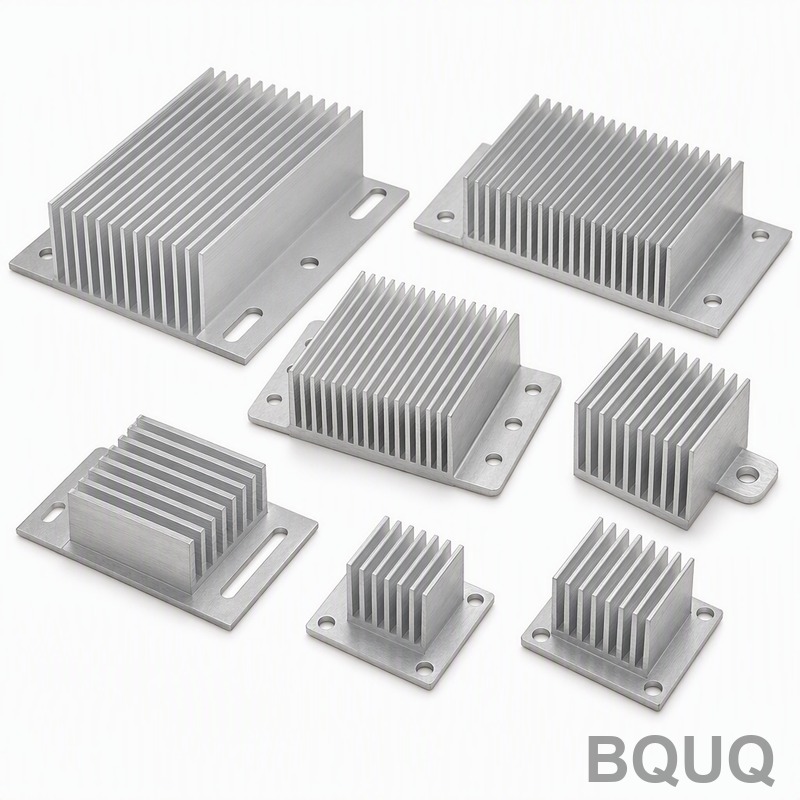
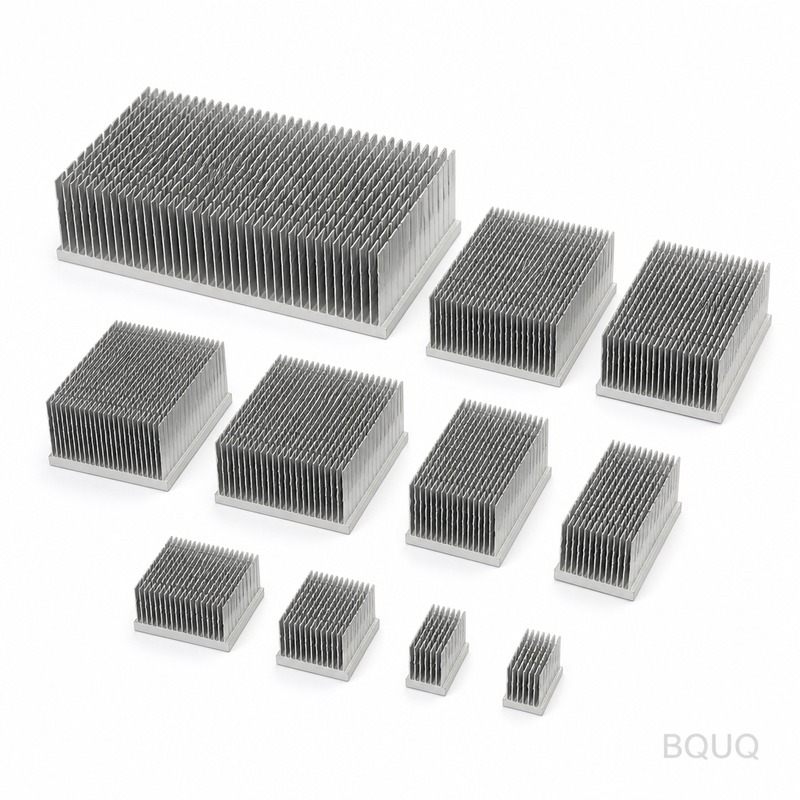
Stamping excels for heat sinks with two-dimensional or shallow-drawn geometries: straight fin arrays, pin fins with aspect ratios up to 4:1, corrugated folded fins, and base plates with embossed patterns. The ideal design has fins perpendicular to the base, uniform thickness, and draft angles of 0.5-2 degrees for easy release. Practical limits include maximum fin height of 25 mm (for 0.5 mm thick stock), minimum fin spacing of 2.5 mm, and maximum part size of 300 mm x 300 mm for progressive dies. Stamping cannot produce deep channels, undercuts, or closed-back geometries—these require secondary operations like skiving or brazing. For LED lighting, power supplies, and automotive electronics, stamped heat sinks with 0.4-0.8 mm fins provide 20-40% more surface area per unit volume than equivalent machined designs.
Why Is Stamping Faster and More Repeatable Than Machining?
A stamping press operates at 15-60 strokes per minute, producing one complete heat sink every 1-4 seconds, whereas CNC machining takes 3-15 minutes per part for similar geometry. This 50-900x speed advantage comes from the progressive die performing multiple operations—blanking, piercing, bending, and coining—in a single stroke. Dimensional repeatability is excellent: stamped parts hold ±0.05 mm across a production run of 500,000 pieces, with a Cpk of 1.33 or better. The process is deterministic—once the die is validated, every part is identical, eliminating the operator-dependent variation of machining. Additionally, stamping produces zero material waste in the form of chips; a well-designed nesting layout achieves 75-85% material utilization, compared to 40-60% for machining from solid stock.
How Does Stamping Affect Material Selection and Surface Finish?
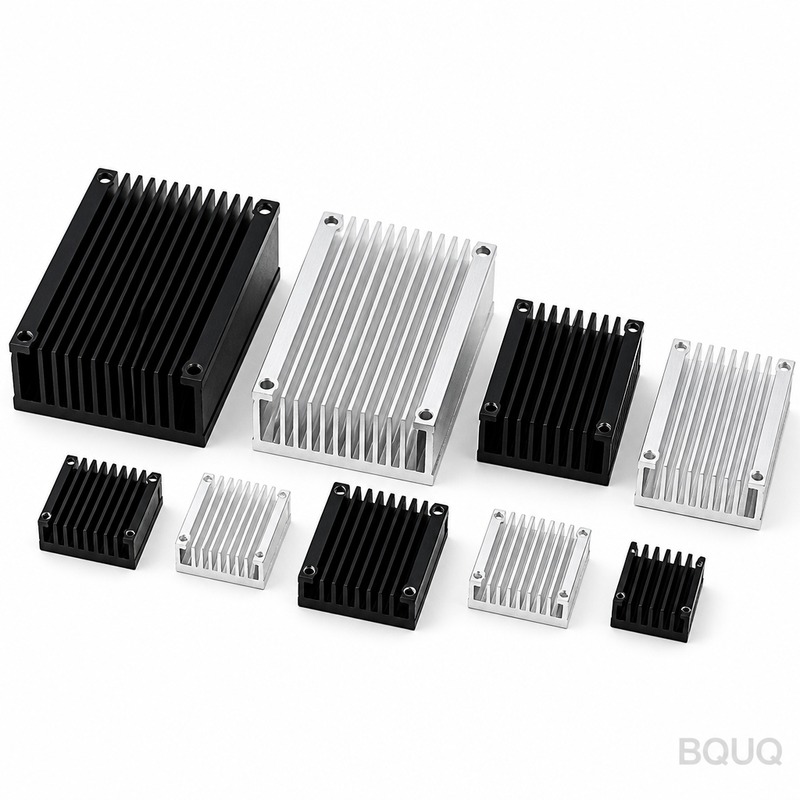
Stamping requires materials with sufficient ductility for cold forming: aluminum alloys 1050, 1100, 3003, and 5052 are preferred, with 6061-T6 only suitable for simple bends after annealing. Copper (C11000) and brass (C26000) are stampable for high-performance applications, providing 380-400 W/m·K thermal conductivity but at 3-4x the material cost of aluminum. Surface finish after stamping ranges from 0.8 to 3.2 μm Ra on the die-side and 0.4-1.6 μm Ra on the punch-side, which is adequate for thermal interface applications without additional machining. However, stamping leaves burrs of 0.05-0.15 mm on cut edges; these must be removed via tumbling or deburring for applications where sharp edges contact insulation films or wiring. Optional post-stamping treatments include black anodizing (increases emissivity from 0.08 to 0.85, improving radiative heat transfer by 15-25%), nickel plating, or chromate conversion coating.
When Should You Avoid Stamping for Heat Sinks Despite High Volume?
Avoid stamping when your thermal requirement demands fin heights above 25 mm, fin thickness below 0.3 mm (causes tearing), or base thickness greater than 3 mm (requires excessive tonnage). Stamping is also unsuitable for heat sinks needing integrated features like threaded inserts, press-fit pins, or hermetic sealing—these add secondary costs that erode the cost advantage. If your application runs at temperatures above 200°C, stamped aluminum loses strength (yield drops below 50% of room-temperature value), making extruded or machined alternatives safer. For prototypes or low-volume production under 2,000 units, the $3,000-$15,000 tooling investment is rarely justified; CNC machining or 3D-printed aluminum (selective laser melting) provides faster iteration and no tooling commitment. Finally, if your design requires tight flatness on the mounting surface (below 0.05 mm over 50 mm), stamping's inherent spring-back of 0.1-0.3 degrees per bend may require an additional coining or flattening operation, which adds cost and lead time.
How Do You Validate a Stamped Heat Sink Design Before Tooling?
Use finite element analysis (FEA) to simulate both the stamping process (spring-back prediction, thinning analysis) and the thermal performance (computational fluid dynamics for airflow). For the mechanical side, run a forming simulation with software like AutoForm or LS-DYNA to verify that the material's elongation limit (typically 15-25% for aluminum) is not exceeded. Thermally, model the heat sink in steady-state with a power input of 5-20 W and ambient temperature of 25-50°C, targeting a junction-to-ambient thermal resistance of 5-15°C/W for natural convection. Before committing to the production die, request a soft-tooled prototype using wire EDM or CNC machining of the die cavity—this costs $500-$2,000 and takes 5-7 days, allowing you to verify fin geometry, burr formation, and assembly fit. BQUQ recommends a design-for-manufacturing review at the concept stage; our engineers typically suggest 5-10 modifications (corner radii, bend allowances, material grade changes) that reduce tooling cost by 20-30% without compromising thermal performance.
FAQ
What Is the Minimum Order Quantity for Stamped Heat Sinks?
The practical minimum is 5,000-10,000 parts per year to amortize tooling costs over a reasonable period. At 5,000 parts, per-unit cost is $1.80-$4.50 depending on size; below this volume, CNC machining or extrusion is more economical. BQUQ accepts orders as low as 2,000 parts but will advise you on the cost trade-off.
Can Stamped Heat Sinks Be Used in Outdoor or Corrosive Environments?
Yes, with proper surface treatment. Stamped aluminum is susceptible to galvanic corrosion when in contact with copper or steel; apply a chromate conversion coating or powder coating (50-100 μm thickness) for outdoor use. Anodizing to a thickness of 10-25 μm provides excellent corrosion resistance and improves emissivity, but it is non-conductive, so ensure ground connections are made before coating.
How Long Does Stamping Tooling Last?
Production dies made of D2 tool steel or carbide last for 500,000 to 2,000,000 strokes before requiring reconditioning. Maintenance costs run 5-10% of initial tooling cost per year, and routine sharpening of cutting edges is needed every 100,000-200,000 strokes. With proper lubrication and die maintenance, a stamping tool can serve a product lifetime of 5-10 years.
What Is the Maximum Size for a Stamped Heat Sink?
The practical maximum is 300 mm x 300 mm for a single progressive die, limited by press bed size (typically 400-800 tons for large parts) and material coil width. Parts larger than this can be made by forming multiple sections and brazing or mechanically fastening them together, but this adds cost. For most electronics applications (LED drivers, IGBT modules, power supplies), heat sinks under 150 mm x 150 mm are standard.
Does Stamping Work for Copper Heat Sinks?
Yes, copper stamping is common for high-end thermal solutions requiring 380-400 W/m·K conductivity. Tooling costs are 20-30% higher due to copper's work-hardening and galling tendencies, and the material cost is 3-4x aluminum. Use copper only when space is constrained and thermal resistance targets cannot be met with aluminum; otherwise, stamped aluminum with optimized fin density provides 80-90% of copper's performance at 30% of the cost.
How Fast Can BQUQ Deliver Prototypes and Production Quantities?
Soft prototypes (machined or 3D-printed) ship in 3-5 days. Production tooling takes 3-5 weeks, and the first article (FAI report included) is ready within 1 week after tooling completion. Production quantities of 10,000-50,000 parts ship in 2-4 weeks after approval; we carry common aluminum alloys (1050, 1100, 5052) in stock to reduce material lead time.
What Testing Is Available for Stamped Heat Sinks?
BQUQ offers thermal resistance testing per JEDEC JESD51 standards, dimensional inspection with CMM (accuracy ±0.002 mm), and salt spray testing per ASTM B117 for corrosion resistance. We also perform pull-testing on integral mounting tabs and micro-section analysis to verify grain structure after forming. All test reports are provided with the shipment documentation.
For a stamped heat sink design review, quotation, or thermal simulation, contact BQUQ for a response within 12 hours. Email us at sc@bquq.com, reach our engineers on WhatsApp at +86 13713157787, or visit www.bquq.com to upload your CAD files and specifications.