Why Are Natural Convection Heat Sinks Making a Comeback in Passive Cooling?
Natural convection heat sinks are returning to the forefront of thermal management because they offer zero maintenance, silent operation, and absolute reliability in an era where AI-driven electronics demand higher efficiency with lower acoustic noise. For applications under 25W of continuous heat dissipation, a well-designed extruded or skived aluminum natural convection heat sink can achieve thermal resistances between 1.5°C/W and 4.0°C/W, matching the performance of small forced-air units without a single moving part. This shift is driven by the rising cost and failure rate of fans in harsh environments, pushing engineers to re-evaluate fin spacing, orientation, and material selection for passive cooling.
What Is the Maximum Heat Dissipation Achievable with Natural Convection Heat Sinks?
The practical ceiling for natural convection heat sinks is typically 50W to 100W with aggressive pin-fin arrays and copper bases, but the sweet spot remains below 25W for extruded aluminum designs. For example, a standard 150mm x 100mm x 40mm extruded heat sink with a black anodized finish can dissipate 15W while keeping the junction temperature rise under 60°C above ambient. Beyond 50W, the required surface area grows exponentially, making forced convection or heat pipes more economical. At BQUQ, we routinely test natural convection assemblies at 20W, achieving a base-to-ambient thermal resistance of 2.8°C/W with a 12mm fin pitch and 25mm fin height.
How Does Fin Geometry Affect Natural Convection Performance?
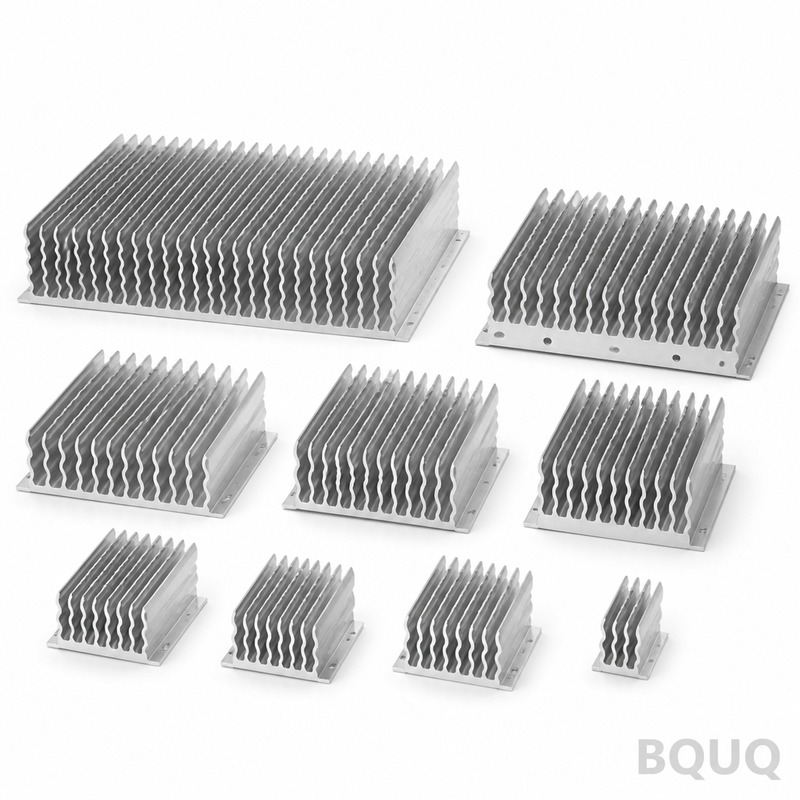
Fin spacing and height are the two most critical parameters, with optimal spacing for vertical natural convection ranging from 6mm to 12mm depending on height. For a 40mm tall fin, the ideal gap is approximately 8mm to allow boundary layer mixing without choking airflow; reducing gap to 4mm can degrade performance by up to 30% due to flow restriction. Fin thickness has a secondary effect: increasing from 1.5mm to 3.0mm adds structural rigidity and lateral heat spreading but reduces the number of fins per width, so the net gain is often less than 5%. Skived fins (up to 150mm tall) outperform extruded fins (typically max 75mm) because they allow thinner, denser fins with a fin efficiency above 90%.
When Should an Engineer Choose Natural Convection Over Forced Air Cooling?
Choose natural convection when the total heat load is below 25W, the ambient temperature is stable, and acoustic noise or dust accumulation is a primary concern. Forced air cooling with a 40mm fan can move 8-10 CFM and achieve a thermal resistance of 0.5°C/W, but fan failure rates at 70°C ambient can exceed 15% per year, making passive solutions more reliable for 10-year service life systems. Natural convection is also preferred for outdoor telecom enclosures and medical devices where fan cleaning is impossible. However, if the heat load exceeds 40W or the allowable temperature rise is below 40°C, forced air or liquid cooling becomes mandatory.
Which Materials Offer the Best Thermal Performance for Passive Heat Sinks?
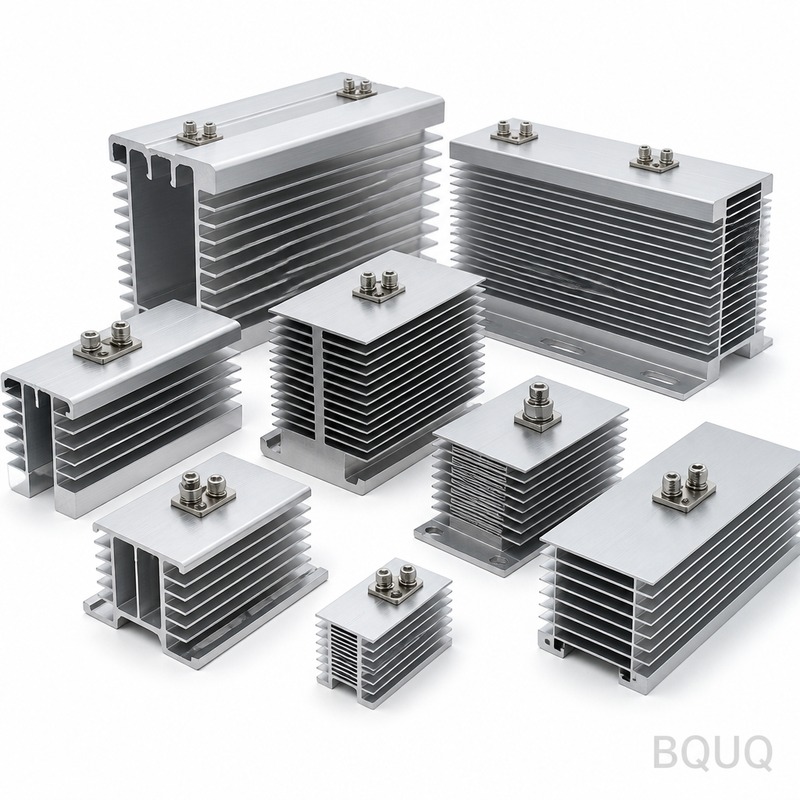
Aluminum 6063-T5 is the industry standard for extruded natural convection heat sinks due to its thermal conductivity of 201 W/m·K, light weight, and cost of $4-8 per kilogram extruded profile. Copper, with a thermal conductivity of 386 W/m·K, is reserved for base plates or heat spreaders because solid copper heat sinks cost 4-5 times more and weigh 3 times as much as aluminum. For high-performance applications, a copper base (6mm thick) brazed to aluminum fins can reduce spreading resistance by 20% compared to all-aluminum, at an added cost of $12-18 per unit. Anodized black surfaces improve emissivity from 0.08 to 0.88, which can add 10-15% heat dissipation via radiation, especially in vacuum or sealed enclosures where convection is limited.
How Much Does a Custom Natural Convection Heat Sink Cost and How Long Does Tooling Take?
Tooling for a custom extruded aluminum heat sink typically costs $1,500 to $4,000 with a lead time of 3-4 weeks, while production parts cost $5-15 each for quantities of 500-2000 pieces. Skived fin heat sinks require no tooling but have a higher per-unit cost of $15-30 due to slower machining, with a prototype lead time of 5-7 days. For low-volume runs (under 100 pieces), CNC machining from solid aluminum block is the most economical option at $25-50 per unit, with no tooling cost and 3-day delivery. At BQUQ, we recommend extrusion for volumes above 500 units and CNC machining for prototyping, as the break-even point for tooling amortization is typically 300-400 pieces.
How Does Heat Sink Orientation Impact Natural Convection Efficiency?
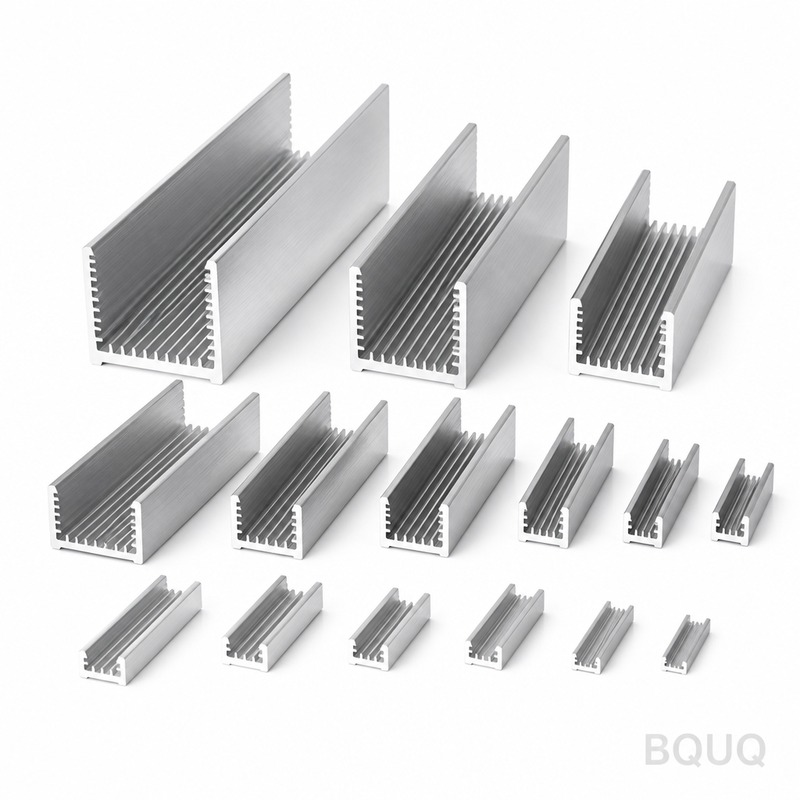
Vertical fin orientation (fins parallel to gravity) is the most efficient, providing up to 25% better thermal performance than horizontal fins because it creates a chimney effect that accelerates airflow. If the heat sink must be mounted horizontally, pin-fin arrays are preferred over straight fins because they allow air to enter from all sides, mitigating the performance loss to only 10-15%. Angled mounting at 45 degrees reduces performance by 5-8% compared to vertical, but is often necessary for space constraints; testing at BQUQ shows that a 20mm fin pitch is required for horizontal orientation to avoid boundary layer stagnation. For enclosed spaces, providing a minimum of 15mm clearance above and below the heat sink is critical, as wall proximity within 5mm can reduce airflow by 30%.
Why Is Surface Treatment Critical for Passive Cooling Reliability?
Black anodizing is not just aesthetic; it increases surface emissivity to 0.88, enabling radiation to account for up to 20% of total heat transfer at 80°C surface temperature. A clear anodized or bare aluminum surface with emissivity of 0.08 will run 5-8°C hotter at the same heat load, which can push junction temperatures beyond the 85°C limit for many semiconductors. Chemical conversion coating (chromate) is cheaper but offers emissivity of only 0.30, making it unsuitable for natural convection designs. For outdoor use, a hard anodize (25 microns thickness) provides corrosion resistance and emissivity stability over a 20-year lifespan, whereas paint coatings can degrade and add 0.2°C/W thermal resistance.
What Is the Real-World Thermal Resistance Data for Common Natural Convection Heat Sinks?
The table below summarizes measured thermal resistance values for standard configurations at BQUQ's testing laboratory, using a 50mm x 50mm heat source and 25°C ambient.
| Heat Sink Type | Dimensions (mm) | Fin Height (mm) | Fin Pitch (mm) | Thermal Resistance (°C/W) | Max Power (W) at 60°C Rise |
| Extruded Aluminum | 100 x 100 x 25 | 20 | 8 | 3.5 | 17 |
| Extruded Aluminum | 150 x 100 x 40 | 32 | 10 | 2.2 | 27 |
| Skived Aluminum | 120 x 120 x 50 | 45 | 4 | 1.8 | 33 |
| Copper Base + Extruded | 150 x 100 x 40 | 32 | 10 | 1.9 | 31 |
| Pin Fin Aluminum | 100 x 100 x 30 | 25 | 6 (diameter) | 2.8 | 21 |
| CNC Machined Copper | 80 x 80 x 20 | 15 | 5 | 2.5 | 24 |
Can Natural Convection Heat Sinks Be Combined with Heat Pipes for Higher Power?
Yes, embedding heat pipes into a natural convection heat sink can extend its capacity to 80W by spreading heat from a concentrated source to a larger finned area. A typical design uses two 6mm diameter sintered copper heat pipes, 150mm long, embedded in an aluminum base, which reduces the spreading resistance from 1.5°C/W to 0.3°C/W. The heat pipes operate via capillary action and have no moving parts, maintaining the reliability of passive cooling. The cost addition is $8-12 per heat pipe, and the overall system can handle 60W with a 50°C temperature rise, which is 2.5 times higher than a solid aluminum heat sink of the same size.
How Does Ambient Temperature and Altitude Affect Natural Convection Design?
Every 10°C increase in ambient temperature reduces air density by about 3%, which lowers the convective heat transfer coefficient by roughly 2-3%, requiring a proportional increase in fin surface area. At 60°C ambient, a heat sink designed for 25°C must be 15-20% larger to maintain the same junction temperature. Altitude has a stronger effect: at 3000 meters, air density drops by 30%, and natural convection performance decreases by 25-35%, so engineers must derate power dissipation or increase fin pitch by 20% to compensate. For sealed enclosures, radiation becomes the dominant heat transfer mode above 80°C surface temperature, making high-emissivity coatings essential.
Should You Use Stamped or Extruded Heat Sinks for High-Volume Passive Cooling?
For annual volumes above 50,000 units, stamped aluminum heat sinks (0.8mm to 2.0mm thickness) offer the lowest cost at $0.50-1.50 per unit, but their thermal performance is limited to 5-10W due to thin fins and poor spreading. Extruded heat sinks are the best all-around choice for volumes from 1,000 to 50,000 units, balancing cost, performance, and design flexibility. Stamped folded-fin assemblies can achieve fin densities of 8 fins per inch, but require a copper or aluminum base plate for structural support, adding a secondary operation. At BQUQ, we produce stamped heat sinks with a tolerance of ±0.1mm and extruded profiles with a tolerance of ±0.15mm, ensuring consistent thermal contact with the heat source.
What Are the Most Common Mistakes in Natural Convection Heat Sink Design?
The most frequent error is using forced-air simulation software settings for natural convection, which over-predicts performance by 40-60% because it ignores buoyancy-driven flow limitations. A second mistake is placing the heat sink too close to the enclosure wall, which blocks the airflow path; a minimum clearance equal to 40% of the fin height is required. Third, engineers often forget to account for the thermal interface material (TIM), which can add 0.2-0.5°C/W if a 0.1mm thick thermal pad is used instead of thermal grease. Finally, mounting pressure affects performance: a 50mm x 50mm heat sink needs at least 20kg of clamping force to flatten the TIM to its optimal thickness of 25 microns.
What Is the Typical Lead Time for Custom Natural Convection Heat Sink Production at BQUQ?
At BQUQ, a prototype CNC machined heat sink is delivered in 3-5 days, an extruded sample in 2 weeks, and production quantities of 1,000 pieces in 3-4 weeks after tooling approval. We provide free thermal simulation reports within 24 hours of receiving your power and temperature specifications. Urgent orders with a 12-hour quote turnaround can be expedited with a 15% rush fee.
How Do I Test the Thermal Performance of a Natural Convection Heat Sink?
Use a calibrated power resistor or a thermal test chip mounted on a cold plate with a known junction-to-case thermal resistance. Measure the case temperature with a T-type thermocouple at steady state (after 30-45 minutes) and calculate the case-to-ambient thermal resistance by dividing the temperature difference by the applied power. Ensure the test is conducted in a draft-free chamber with a volume at least 10 times the heat sink volume to avoid artificial airflow.
Which Standards Apply to Natural Convection Heat Sink Reliability Testing?
IEC 60068-2-2 (dry heat) and IEC 60068-2-6 (vibration) are the primary standards for thermal cycling and mechanical robustness, typically requiring 1000 hours at 85°C and 10g vibration sweeps. For automotive applications, AEC-Q004 specifies thermal shock testing from -40°C to 125°C for 500 cycles. BQUQ's in-house testing lab can perform all these validations with a 5-day turnaround.
Can Natural Convection Heat Sinks Be Used for LED Lighting and Power Electronics?
Yes, LED drivers and high-bay lighting fixtures commonly use natural convection heat sinks for 10-50W loads, where the absence of fan noise is a key requirement. For power electronics like IGBT modules, natural convection is only viable below 20W per module unless combined with heat pipes or phase-change materials. In both cases, the heat sink must be electrically isolated from live components, using anodized surfaces or a 0.5mm mica insulator.
What Is the Cost Difference Between Passive and Active Cooling for a 20W Application?
A passive solution with a 150mm x 100mm extruded heat sink costs $8-12 per unit, while an active solution with a smaller heat sink and a 40mm fan costs $6-9 per unit but adds $1-2 for the fan and $0.50 for the fan guard. Over a 10-year lifespan, the passive solution saves $15-20 in energy costs and eliminates the 15% annual fan failure risk. The total cost of ownership for passive cooling is 20-30% lower in critical applications.
When Is a Copper Heat Sink Justified Over Aluminum for Natural Convection?
Copper is justified when the heat source footprint is smaller than 20% of the heat sink base area, as copper's higher conductivity reduces spreading resistance significantly. For example, a 10mm x 10mm diode on a 100mm x 100mm base will see a 40% lower junction temperature with a copper base compared to aluminum. But for large heat sources covering over 50% of the base area, the difference is less than 5%, and aluminum is the better value.
How Does BQUQ Ensure Quality in Natural Convection Heat Sink Manufacturing?
BQUQ uses CNC machining with ±0.05mm tolerance for critical base flatness, and every production lot is inspected with a coordinate measuring machine (CMM) for fin pitch and flatness. We perform 100% visual inspection for anodizing defects and verify thermal resistance on a sample basis using our in-house wind tunnel and thermocouple array. Our 20 years of experience in CNC machining, metal stamping, and spring manufacturing ensures that your heat sink meets both mechanical and thermal specifications.
Natural convection heat sinks are no longer a fallback option but a strategic choice for modern electronics, delivering silent, maintenance-free cooling for a growing range of applications. By optimizing fin geometry, material selection, and surface treatment, engineers can achieve thermal performance that rivals forced air systems while eliminating moving parts. For your next passive cooling project, trust BQUQ to provide precision-machined heat sinks with rapid prototyping and competitive pricing. Contact us for a free thermal simulation and a 12-hour quote: Email sc@bquq.com, WhatsApp +86 13713157787, or visit www.bquq.com.
Related Articles
- Regional Market Competition: Differences and Opportunities in Asia Pacific, North America, and Europe's Heat Sink Ecology
- Patent Wars: Intellectual Property Pattern and Risks of Global Hardware Heat Sink Technology
- When liquid cooling becomes mainstream: the evolving role of hardware heat sinks in the data center era