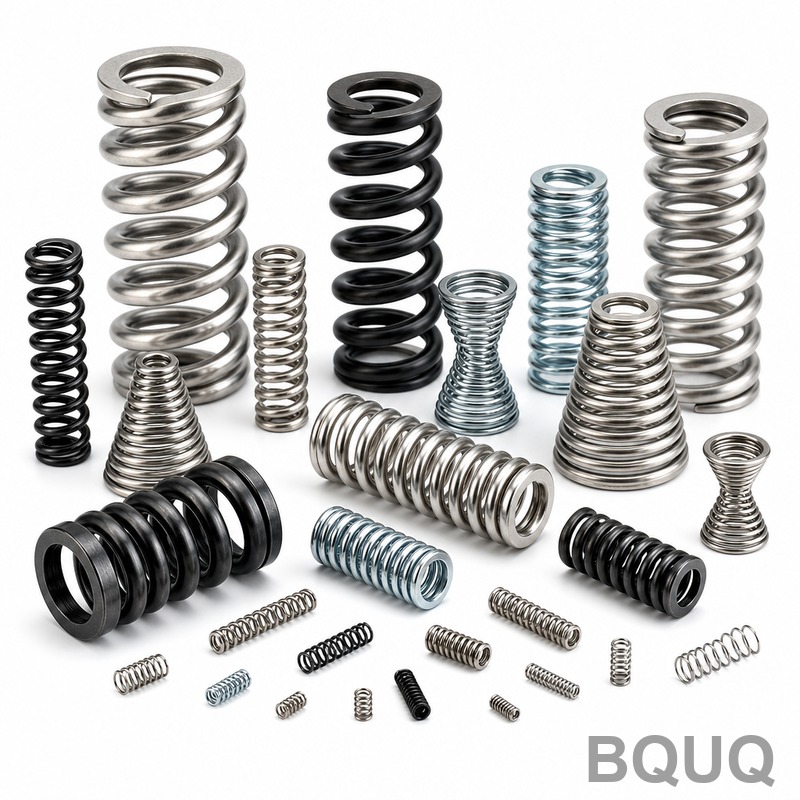
Pump Valve Compression Spring: Music Wire, 1.2mm, ±3% Force, 2M Cycles
In an industrial pump or valve, the return spring is the component nobody notices until it fails. It sits in the medium, cycles with every actuation, and its job is deceptively simple: push the spool or poppet back onto its seat, every single time, for years. When a spring relaxes, the valve no longer closes fully - and the resulting fault appears far away from its cause, which is exactly what makes it expensive.
Project Background & Challenge
The customer is a German manufacturer of industrial pumps and valves serving process and machinery-building markets. Their valve design uses a compression spring to return the poppet against the seat at every closure. After field service analysis, a proportion of incomplete-closure complaints was traced back to load loss in the return springs: the springs had relaxed after extended cycling, so the seating force fell below the design minimum long before the valve's stated service interval.
The specification that came out of that analysis was strict. The spring is coiled from 1.2mm music wire, with a force tolerance of ±3% on the load at working length. It must survive 2 million compression cycles with no relaxation beyond the stated limit, in an environment that sees elevated temperature and exposure to lubricating media. Surface treatment had to be black oxide - no plating, because the customer wanted no hydrogen-embrittlement risk and a finish that would not build up inside the valve bore.
Volume added a commercial dimension: 50,000 to 300,000 pieces per month depending on the pump program cycle, with full traceability documentation expected as a matter of course for the German market. The customer had quotes from several suppliers; what they were really looking for was proof of fatigue behavior, not just a datasheet.
The geometry itself demanded respect as well. At 1.2mm wire with closed ends, end-grinding squareness directly affects how the load reaches the poppet seat - a spring that stands slightly out of square pushes sideways, wears the seat asymmetrically and mimics the very fault the program was trying to eliminate. So the specification carried explicit squareness limits alongside the load requirements, and any qualified supplier had to show both numbers under control simultaneously.
BQUQ Process Solution
BQUQ proposed a straightforward but disciplined approach: control the raw material and the stress state, get the load curve right on every setup, and prove the fatigue life with a longer test than the specification requires.
Music Wire Selection & Stress Relief
The springs are coiled from 1.2mm music wire (high-carbon spring steel to ASTM A228), a material within BQUQ's spring wire range of 302/304 stainless steel, 65Mn, music wire and phosphor bronze. Music wire offers the high tensile strength this application needs, but its relaxation behavior depends heavily on post-coiling heat treatment, so the stress-relief parameters were developed and locked jointly with the customer's material engineer. Incoming wire is checked for diameter and surface condition, and mill certificates are retained for traceability on every lot.
Coiling, End Grinding & Squareness
Coiling is scheduled on CNC spring coiling equipment, with closed ends specified so the load is introduced evenly at both seats. After coiling and stress relief, the ends are ground flat and perpendicular, because squareness error translates directly into sideways load on the poppet and uneven seating. Load-deflection curves are measured on a spring tester at two verification points - one near installation height and one at working height - and the setup is adjusted until both fall inside the ±3% band before the run is released.
Fatigue Validation to 5M Cycles
The customer's specification calls for 2 million cycles without relaxation beyond the limit. BQUQ validated the design at 5 million cycles - a level inside its standard 5M-10M cycle validation capability - running springs through compression fatigue on a test rig and measuring load loss at intervals. The springs passed the 2M-cycle requirement with margin: relaxation remained within limit well beyond the specified life, which turned the fatigue report into the deciding document of the whole project.
Before coiling, music wire lots are verified for tensile strength and surface condition, because a valve spring that relaxes in service shows up as drifting cracking pressure. Coils are stress-relieved in controlled ovens right after forming, then the ends are ground square so the spring stands vertical under load. Every batch is cycled on a fatigue rig as part of life verification, and force at installed height and at full compression is recorded against a ±3% acceptance window on the force-travel curve.
Key Specifications
| Item | Specification |
|---|---|
| Material | Music wire (high-carbon spring steel, ASTM A228) |
| Wire diameter | 1.2mm |
| Force tolerance | ±3% on load at working length |
| Fatigue life | 2M-cycle specification, validated at 5M cycles, no relaxation beyond limit |
| Surface finish | Black oxide |
| Volume | 50K-300K pcs/month |
| Inspection | Load-deflection curve, squareness, CPK≥1.33, ISO9001:2015 system |
| Delivery | Samples 3-7 days; first batch 12-20 days |
Quality Control & Delivery
Production starts only after first-article approval: dimensional layout, load testing at both verification points, end-grinding squareness, and oxide coating check. In running production, load and free length are the SPC characteristics, with CPK≥1.33 required on the working-length load; every shipment includes an inspection report with capability data, mill certificates on request, all under the ISO9001:2015 quality system. For the German market, documentation was aligned with the customer's PP-style layout from the start, so incoming inspection on their side needs no extra translation step.
The black oxide step is controlled as a process, not a dip: cleaning, oxide bath concentration, temperature and sealing are checked on a fixed schedule, and coating appearance is verified against an agreed reference sample. Since oxide adds no measurable thickness to the 1.2mm wire, it does not disturb the validated coil geometry - one of the reasons it was the right finish for this application in the first place.
Result: sample springs were approved on the first submission, and the part moved into serial supply at 50,000-300,000 pieces per month on a program-synced schedule. The customer has since extended the same design into two additional valve sizes, using the 5M-cycle validation report as the qualification basis for both. Annual re-validation on retained samples keeps the qualification current without repeating the full development cycle.
Related Products & Resources
For other spring formats, see the Custom Coil Springs range and the Steel Torsion Spring Collection.
To understand how spring production is organized and validated at volume, visit Factory Strength.
FAQ
How do you guarantee no relaxation over 2 million cycles?
You do not guarantee it on paper - you test it. We validated this spring at 5 million cycles, twice the specification, measuring load at set intervals on a fatigue rig. Validation across 5M-10M cycles is standard capability, and the report shipped with the qualification package.
Why music wire instead of stainless steel?
Music wire gives higher tensile strength and better fatigue performance per millimeter of wire, which matters in a 1.2mm return spring. Stainless 302/304 is chosen when corrosion drives the design. For this valve, the medium and temperature allowed music wire with black oxide, and the fatigue margin was the deciding factor.
What force tolerance can you hold in serial production?
±3-5% is the standard force and torque tolerance range; this project runs at ±3%. Control comes from locking the coiling setup around a force window, verifying at two load points, and requiring CPK≥1.33 on the working-length load before shipment.
What wire sizes and spring types does BQUQ support?
Wire diameters from 0.2mm to 3mm in 302/304 stainless steel, 65Mn, music wire and phosphor bronze, across compression, extension, torsion and wire forms. Samples take 3-7 days and a first batch 12-20 days after drawing approval.