Relay Reed Contact Stamping: C5191 Phosphor Bronze 0.3mm, ±5% Force Tolerance, 2M pcs/month
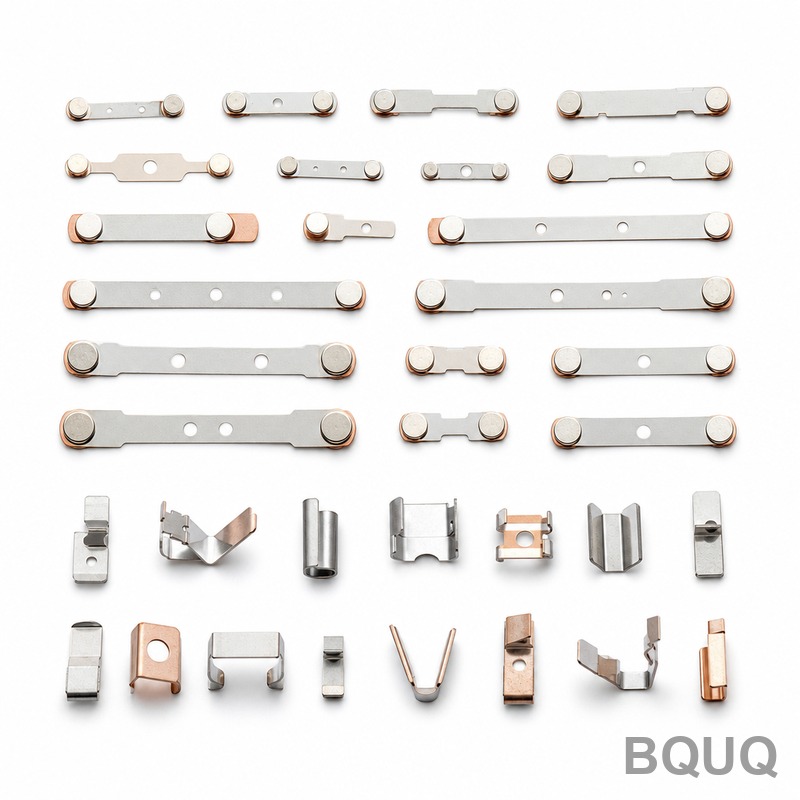
A relay's moving contact spring is the part that turns electrical switching into mechanical fatigue engineering. It flexes millions of times, carries the contact force budget, and must return to exactly the same position after every cycle. Stamp it from 0.3mm phosphor bronze and the difficulty is doubled: at that thickness, spring force is decided by tolerances measured in hundredths of a millimeter.
Project Background & Challenge
The customer is a European industrial automation relay manufacturer whose product line covers interface relays, safety relays and timer modules sold into machine-building and process-control markets. Their relays are specified for long electrical life, and the moving contact assembly - a stamped reed spring carrying the contact point - is central to that claim. When their previous supply arrangement could no longer keep pace with a product redesign, they opened the part for a new source.
The challenges on the drawing were specific. The spring is stamped from C5191 phosphor bronze at 0.3mm thickness with a tolerance of ±0.01mm, which directly controls the force-deflection curve. The required spring force tolerance is ±5% - not a wide window when you consider that material thickness, grain orientation, cut-edge quality and form radius all feed into the same number. The burr height must stay at or below 0.03mm, because on a 0.3mm strip even a small burr becomes a stress riser that initiates fatigue cracking during cycling. And the part is nickel-plated, so the plating must not alter the spring surface condition or add thickness where the geometry is already at its limit.
The commercial challenge was equally real: volumes of 800,000 to 2,000,000 pieces per month with a European customer that expects audit-ready process documentation, stable deliveries, and no drop in quality as volume scales. A supplier who could stamp the part was easy to find. A supplier who could hold ±5% on force at two million pieces a month was not.
BQUQ Process Solution
We approached the part as a spring before treating it as a stamping - controlling the material, the cut edge and the forming sequence so the force curve is an output of the process rather than a matter of luck.
Material Discipline and Grain Orientation
C5191 phosphor bronze strip is specified with a fixed temper and a controlled rolling direction relative to the strip progression. Bending the spring across the grain rather than along it changes formability and the work-hardening profile, and both change the force output. Incoming strip is checked against mill certificates for thickness and temper on every coil, because at 0.3mm a thickness drift within the mill's standard tolerance is already a measurable force shift.
Progressive Die Strategy for Thin-Strip Forming
The part runs on a multi-station progressive die with pilot location throughout the strip, pierce and blank stations built for burr control, and a forming sequence that splits the deflection-critical bends into two controlled steps. The dies are maintained on a sharpening interval defined by measured burr height under a profile projector rather than by shot count alone - if burrs approach 0.03mm, the cutting stations come out for maintenance before the parts drift. Carrier design keeps the fragile spring section fully supported until the final blanking hit, so nothing is stressed out of position during transport through the die. Form radii were set through trial tooling runs before mass production, because on a 0.3mm strip the difference between a radius that springs back and one that sets is a few hundredths of a millimeter - and that difference is exactly what the force tolerance cannot absorb.
Force Verification and Nickel Plating Control
Spring force is sampled from production on a defined AQL and measured on a force-deflection tester against the customer's specified deflection point, with ±5% as the acceptance band. Nickel plating is applied after stamping with a tightly controlled deposit thickness, and the plating parameters were qualified specifically for this part so the deposit does not shift the spring rate or leave hydrogen-induced brittleness. Samples from each plated lot are re-checked for force after plating, closing the loop between chemistry and mechanics.
Key Specifications
| Item | Specification |
|---|---|
| Material | C5191 phosphor bronze, mill-certified strip, controlled temper and grain direction |
| Strip thickness | 0.3mm ±0.01mm |
| Process | Progressive die stamping: pierce, form in two steps, final blank |
| Spring force tolerance | ±5% at customer-defined deflection, verified per lot |
| Burr height | ≤0.03mm, monitored under profile projector |
| Surface finish | Electroplated nickel, deposit thickness qualified on part |
| Volume | 800,000 - 2,000,000 pcs/month |
| Inspection | First-article layout, force-deflection sampling per lot, CPK≥1.33 on critical dimensions |
| Delivery | Samples in 5-7 days, first batch in 15 days, rolling monthly schedules |
Quality Control & Delivery
Each batch begins with a full first-article layout against the drawing. During production, thickness, burr height and form positions are checked at fixed intervals - burrs are read under a profile projector so the ≤0.03mm limit is measured, not assumed. Spring force is sampled per lot on the force-deflection tester, and statistical control on critical dimensions runs at CPK≥1.33 as the release condition, all within an ISO9001:2015 system. Every shipment carries a dimensional report, force data and plating documentation suitable for the customer's audit trail.
The customer also sent an engineer for an on-site process audit before the first production release. The audit covered incoming strip verification, die maintenance records, force-test data and the plating qualification file, and passed without corrective actions - which mattered to them because the same documentation package feeds their own customer audits downstream. Packaging for the European shipment uses anti-tarnish interleaving and humidity-controlled bags, since a spring contact that arrives oxidized is a spring contact the customer has to sort.
Delivery moved to rolling monthly releases aligned with the customer's relay build plan. As their redesigned relay platform ramped up, volumes grew from 800K toward 2M pieces per month without a force-tolerance escape, and the qualification data package - force curves, plating thickness, CPK records - supported the customer's own PP-style file for their automotive-facing customers.
Related Products & Resources
To see more parts in this category, browse the Stamped Electrical Terminals & Contacts collection and the Stamped Hydrogen Fuel Cell Bipolar Plates collection, or these resources:
For quality system details and the multi-process one-factory setup behind these programs, About BQUQ covers capabilities, capacity and certifications.
FAQ
How do you hold spring force within ±5% on a 0.3mm strip?
Three controls: fixed-temper C5191 strip with grain direction set in the die design, a two-step forming sequence with die maintenance triggered by measured burr height, and force-deflection testing sampled from every lot. Critical dimensions run at CPK≥1.33, so the force distribution stays inside the ±5% band batch after batch.
What keeps burr height at or below 0.03mm?
Burr is managed by cutting-tool condition, not inspection luck. The die's cutting stations are sharpened on intervals defined by profile-projector measurements, and burr height is recorded at each check. Since parts are 0.3mm thick, a 0.03mm burr limit means the cutting edges are refreshed well before drift can reach fatigue-critical levels.
Does nickel plating affect the spring force after plating?
The plating process was qualified on this exact part with a controlled deposit thickness, and samples from every plated lot are force-tested after plating. In qualification, post-plate force readings stayed within the same ±5% acceptance band, and that re-check remains a standing requirement in the lot documentation.
Can you handle our monthly volume and delivery cadence?
Yes. Our stamping lines support 100K to 5M pieces per month; this program runs at 800K-2M pcs/month on rolling releases. Standard lead time is samples in 3-7 days and first batch in 12-20 days, with monthly schedules locked against the customer's relay build plan.