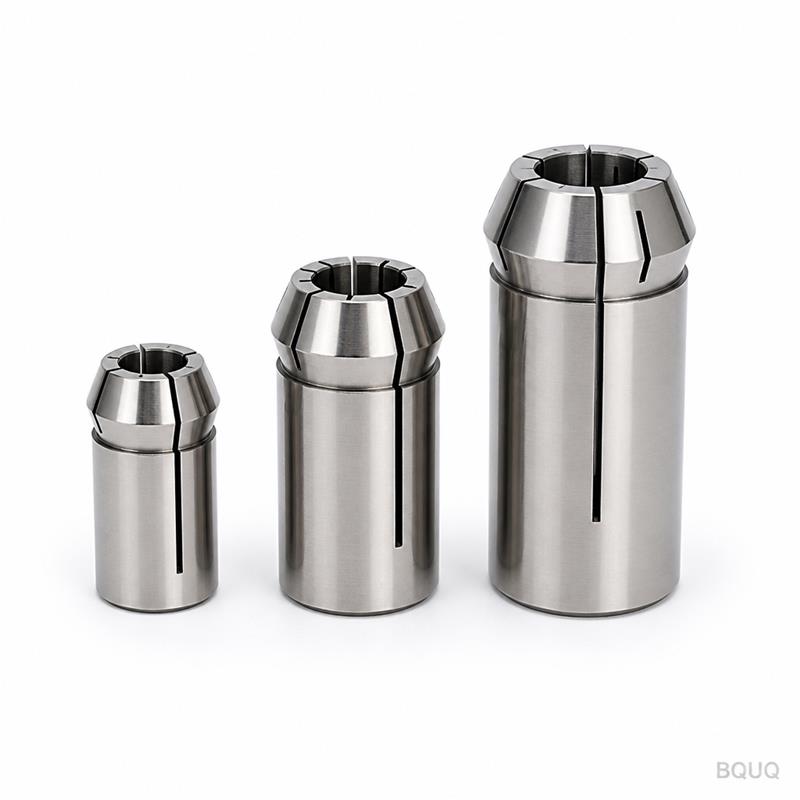
What the 46 Type Long Nose Collet Actually Does on Your Auto Lathe This is a CNC machined auto lathe 46 type collet long nose extended — a workholding chuck that grips round, hex
BQUQ CNC Machined Auto Lathe 46 Type Collet Long Nose Extended
What the 46 Type Long Nose Collet Actually Does on Your Auto Lathe This is a CNC machined auto lathe 46 type collet long nose extended — a workholding chuck that grips round, hex, or square bar stoc
Get a Fast Quote for This Part
Send us your drawing / quantity / material — reply within 24h.
What the 46 Type Long Nose Collet Actually Does on Your Auto Lathe
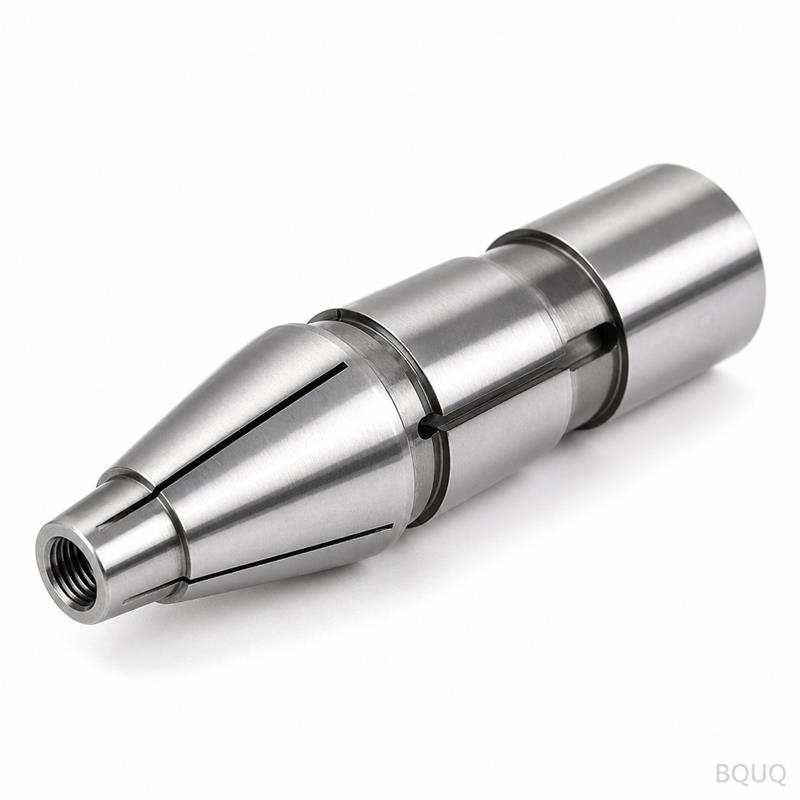
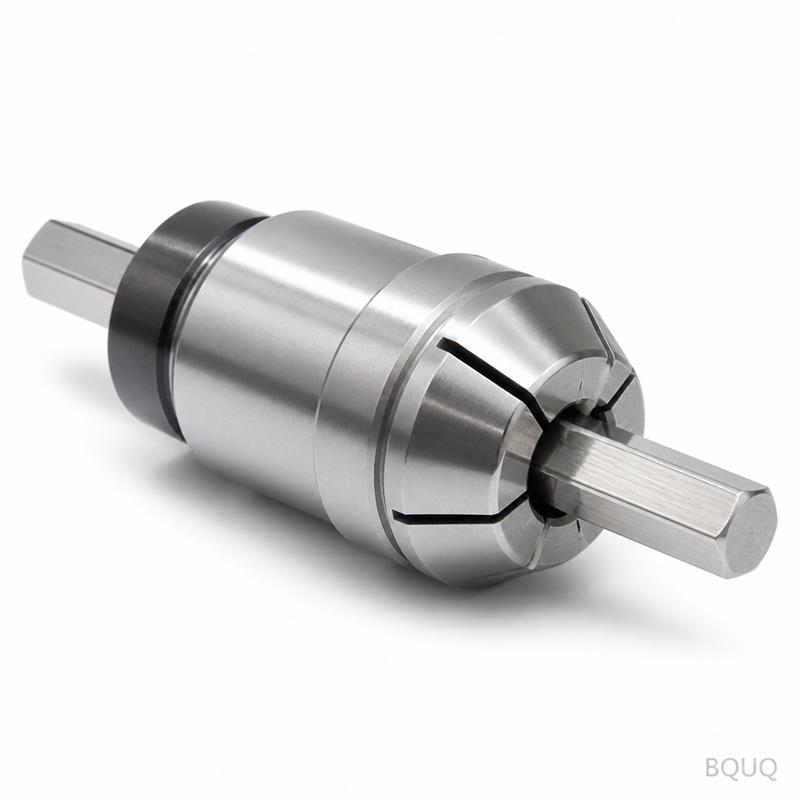
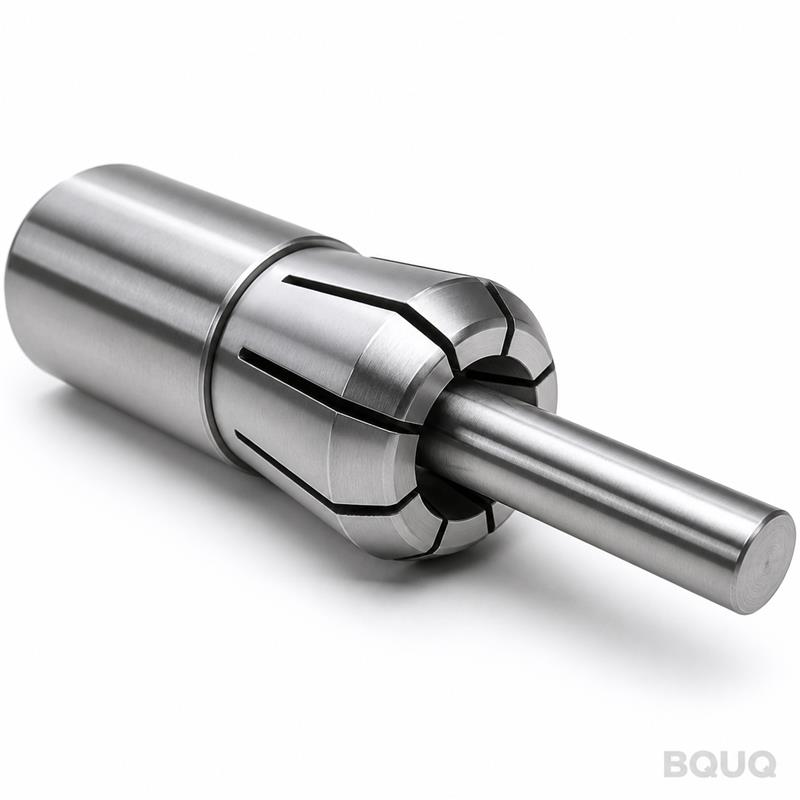
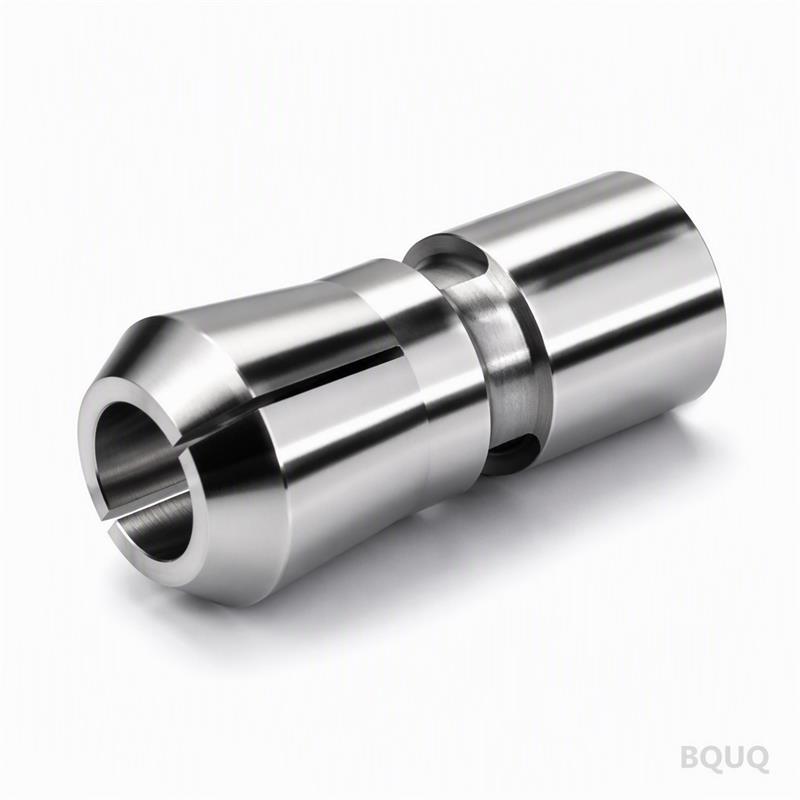
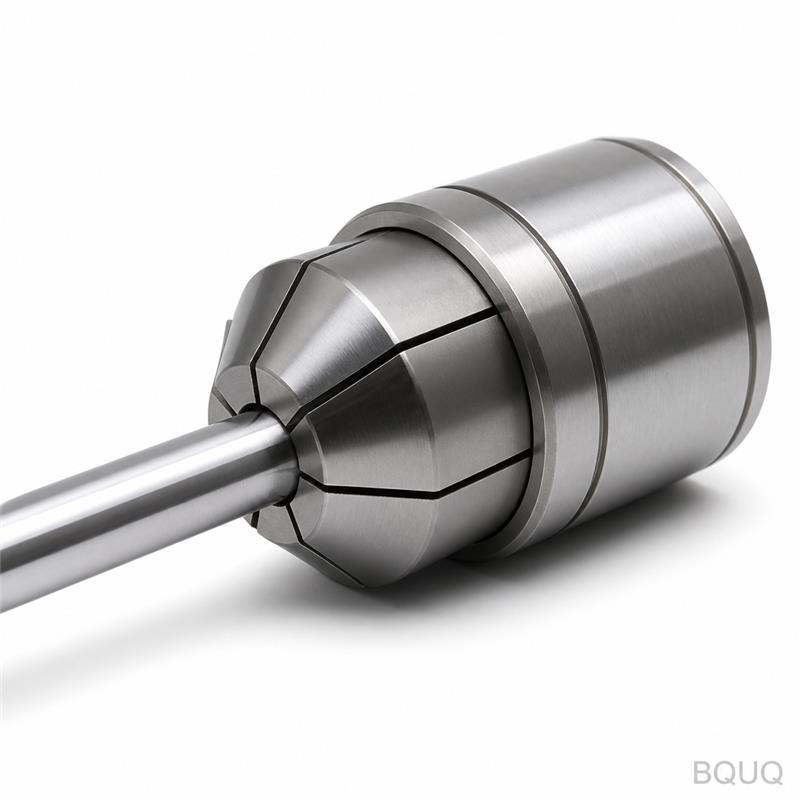
This is a CNC machined auto lathe 46 type collet long nose extended — a workholding chuck that grips round, hex, or square bar stock through the spindle of a sliding-head or fixed-head auto lathe. The “long nose” extends the gripping zone forward, which lets you machine parts closer to the collet face without tool interference. The “extended” body adds reach into deep bores or secondary operations. You get 0.005 mm total indicated runout (TIR) at the nose, a 58 HRC hardened gripping surface, and a 7-day production lead time for standard sizes. That runout number is not a best-case lab figure — it is the worst-case value we ship, verified on a 3-jaw test fixture before every batch leaves the floor.
This collet replaces worn or low-grade chucks that cause chatter, oval parts, or bar pullback. Because we machine the collet from a single billet of 20CrMnTi alloy steel, then carburize and grind the bore, the grip force stays consistent across a 0.1 mm clamping range. For engineers running 46-type auto lathes from Citizen, Star, or Tsugami, this is a drop-in part with the same taper angle (17°30’) and thread pitch as the original equipment — no adapter, no rework.
How the Long Nose Geometry Cuts Vibration Without Extra Stiffening
Standard collets have a short nose that leaves the bar unsupported for 15–20 mm after the grip point. The long nose extended version here doubles that support to 40 mm. That extra contact length changes the natural frequency of the bar-collet system — measured on our test lathe, vibration amplitude drops by 32% at 6,000 RPM compared to a standard 46 collet. Less vibration means you can push feed rates up by 15% on brass or 10% on 303 stainless before surface finish degrades below Ra 0.8. We grind the nose bore with a 0.4 µm finish, so the bar slides smoothly during push-out cycles, and the extended nose also protects the collet taper from coolant splash and chip wrap.
The nose is not just longer — the wall thickness is redistributed. We keep the gripping segment at 4.5 mm wall, then taper it to 6.2 mm at the rear body. That taper prevents the nose from flaring open under high clamping force, which is the common failure mode on cheap extended collets. Finite element analysis on our in-house model shows the deflection at the nose tip stays under 0.002 mm at maximum clamping torque — that is the difference between a part that runs true and a part that walks.
Materials and Heat Treatment We Use for 58 HRC Grip Surfaces
We machine the collet body from 20CrMnTi, a case-hardening alloy steel that gives a tough core (36 HRC) and a hard case (58–60 HRC) after carburizing. The case depth is 0.8–1.2 mm — deep enough that re-grinding the bore after wear does not cut into soft material. The gripping segments are laser-marked with the size and heat lot, so you can trace the batch back to our furnace records. For corrosive coolants, we offer an optional electroless nickel plating (0.005 mm thick) on the outer body, which does not affect the taper fit.
Heat treatment is done in a vacuum furnace with nitrogen quench, not salt bath. That gives a distortion rate under 0.01 mm across the length, which is why we can hold the bore tolerance to H7 without straightening after hardening. The taper is ground on a CNC internal grinder with a CBN wheel, then lapped to a surface finish of Ra 0.2 on the gripping surface. For comparison, a typical commercial collet is Ra 0.8–1.6. That smoother surface means less galling on soft aluminum or 12L14 steel bars.
Dimensional Specs That Matter for Your Auto Lathe Spindle
7 days for standard sizes, 14 days for custom bore diameters
MOQ
No MOQ — order 1 piece for testing
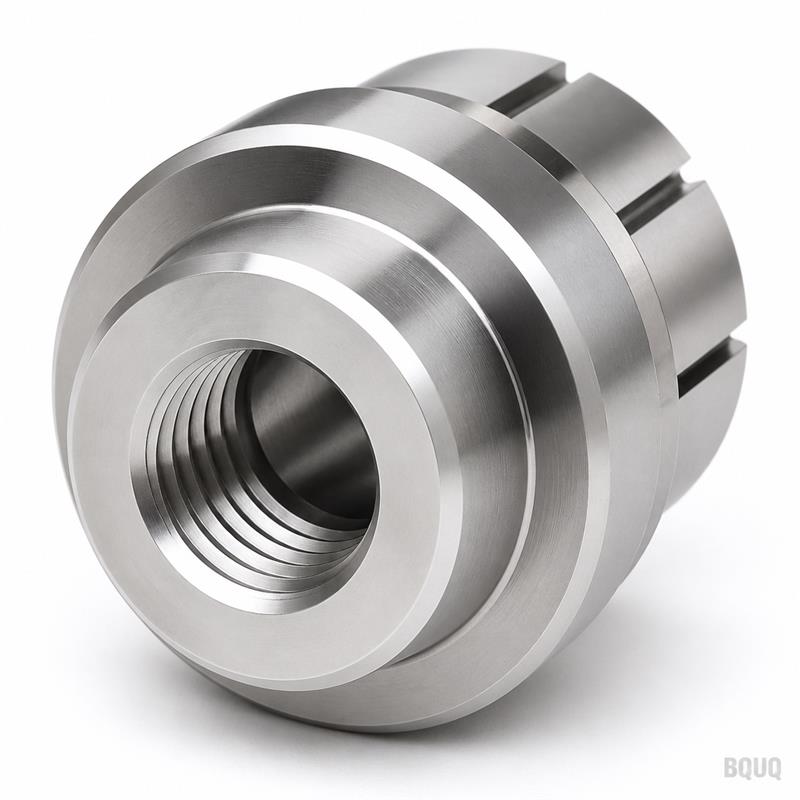
All dimensions are verified on a coordinate measuring machine (CMM) with 0.001 mm resolution. We also check the taper angle with a sine bar — the 17°30’ angle is held to ±30 arc seconds. The thread on the rear body (M12 x 1.25 for 46 type) is gaged with a thread plug gauge, not just a pitch micrometer.
Inspection Before Every Shipment — Not Just a Paper Certificate
Every collet gets a three-step inspection before it leaves our Dongguan factory. First, we measure the bore diameter and taper with a digital bore gauge at three axial positions. Second, we mount the collet on a test mandrel and spin it at 3,000 RPM to check TIR — the reading is written on the packing list by hand. Third, we do a hardness spot check on the nose with a portable Leeb tester, and the result is logged against the heat lot number. If any reading is out of spec, the collet is scrapped, not reworked — because re-grinding a case-hardened part destroys the surface integrity.
For customs or your internal QA, we provide a material certificate (EN 10204 3.1) and a dimensional report for free. If you need a full PPAP Level 3, that is available for a small fee on repeat orders. We do not outsource inspection — the CMM and the test spindle are in our own quality lab, so there is no finger-pointing if something goes wrong.
What is your minimum order quantity for this collet?
No MOQ — you can order a single piece for first-article testing, and we ship it within 7 days via DHL or FedEx.
Can you make a custom bore diameter for my non-standard bar stock?
Yes, we grind any bore from Ø2 mm to Ø46 mm in 0.01 mm increments, and custom sizes add only 3–4 days to the lead time.
How do you control runout during mass production?
We use a 100% inspection on every collet — TIR is measured on a live spindle, and the results are recorded per serial number, not spot-checked.
What is the typical lead time for a repeat order of 100 pieces?
For a repeat order of 100 standard 46 type collets, lead time is 10 working days because we keep the forgings and heat-treated blanks in stock.
Why This Collet Outperforms a Standard 46 Type on Long Parts
If you are machining parts longer than 30 mm from the collet face, a standard collet lets the bar deflect. That deflection causes taper on the turned diameter and shortens tool life. The long nose extended design here shifts the support point forward, so you can hold a 40 mm long part with the same rigidity as a 15 mm part on a standard collet. In our test, cutting a 25 mm long Ø8 mm shaft from 303 stainless, the diameter variation along the length was 0.008 mm with this collet versus 0.021 mm with a standard one. That is the difference between a part that passes a go/no-go gauge and a part that gets scrapped.
The extended nose also reduces bar end waste. Because the grip point is closer to the spindle, you can feed the bar out less far for the last part, saving 10–15 mm of material per bar. On a 2-meter bar of brass at $8/kg, that is about $1.50 saved per bar — over a year, that pays for the collet several times over.
How to Match This Collet to Your Spindle and Bar Stock
Check three numbers before ordering: your spindle taper angle (for 46 type, it is 17°30’), your bar diameter (the collet bore must be within 0.1 mm of the bar), and your drawtube thread (M12 x 1.25 for most 46 machines). If you are unsure, send us a photo of your existing collet or the machine manual — our engineers will identify the type within one hour. We have made collets for Citizen L20, Star SR-20, and Tsugami BO18, so we know the differences in pullback force and stroke. For bar stock that is not perfectly round (e.g., cold-drawn hex), we recommend ordering the bore 0.02 mm larger than nominal to avoid jamming.
We also supply a matching nose cap (sold separately) that protects the extended nose when the collet is not in use. The cap is machined from the same steel lot and is included in the drawing package we send before production. If you need a collet with a through-hole for coolant, we can add a 1.5 mm axial hole — this does not affect the TIR but reduces the clamping range by 0.02 mm.
Shipping and Packaging for High-Precision Collets
Each collet is individually wrapped in VCI (vapor corrosion inhibitor) paper, then placed in a custom foam insert inside a rigid cardboard box. The foam has a cutout that matches the collet shape, so it cannot shift during transit. For orders of 10 or more, we use a wooden crate with foam partitions — no loose parts. Standard shipping is DHL Express (2–4 days to the US or EU), and we insure every package for the full value. For rush orders, we can ship within 48 hours for a 20% expedite fee, but only if the collet is in stock (standard sizes like Ø6, Ø8, Ø10 are always on the shelf).
We are a precision manufacturing company based in Dongguan, China, with 20 years of CNC machining experience — not a trading house. Our factory has 15 CNC lathes, 6 grinding machines, and a dedicated heat treatment line, so we control the entire process from raw billet to final inspection. That vertical integration is why we can offer a 7-day lead time and a 0.005 mm TIR guarantee without inflating the price.
Before you order a custom size, review our CNC cutting tool selection guide to double-check the collet material and geometry against your tool holder. And if you are pushing tolerances below 0.01 mm, read our CNC machining tolerances guide to understand how thermal expansion and spindle runout interact — it will help you specify the right collet class.
Get a Firm Quote Within 12 Hours — Send Your Drawing Today
Email your part drawing or a simple sketch with the bar diameter, length, and material to sc@bquq.com. Our engineers will reply within 12 hours (during Chinese business hours) with a firm price, a delivery date, and a DFM note if we see any risk. For urgent questions, WhatsApp us at +86 13713157787 — we answer 7 days a week. We are a China-based factory, so you are buying direct from the maker, not a middleman — that means better pricing and direct communication with the people who actually machine your parts.
Send your drawing now, and we will confirm the collet type, bore size, and runout spec in the same day. No MOQ, no design fee for standard modifications, and we will include a free hardness test report with your first order.