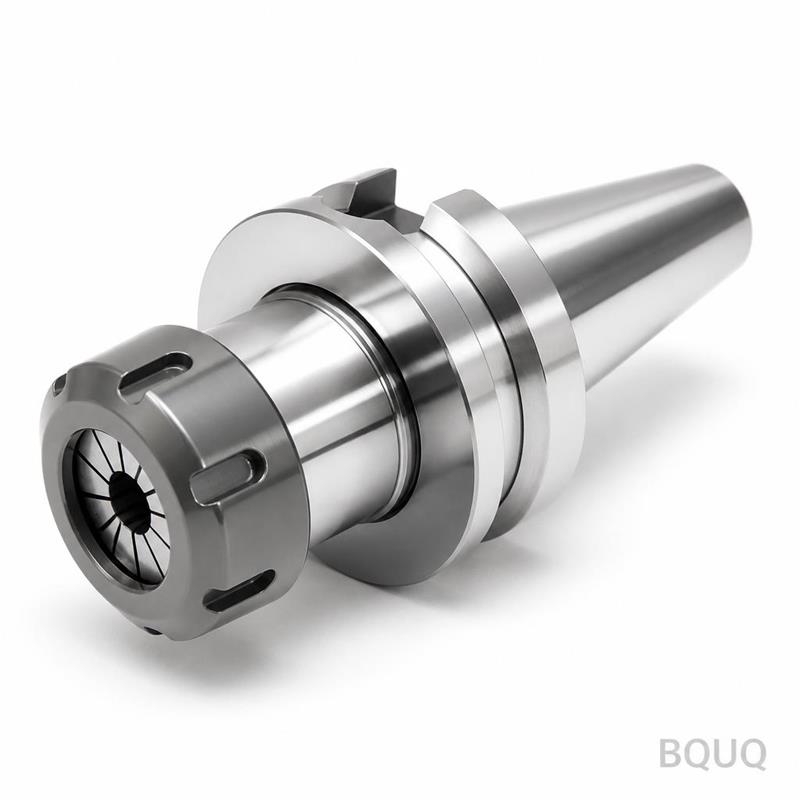
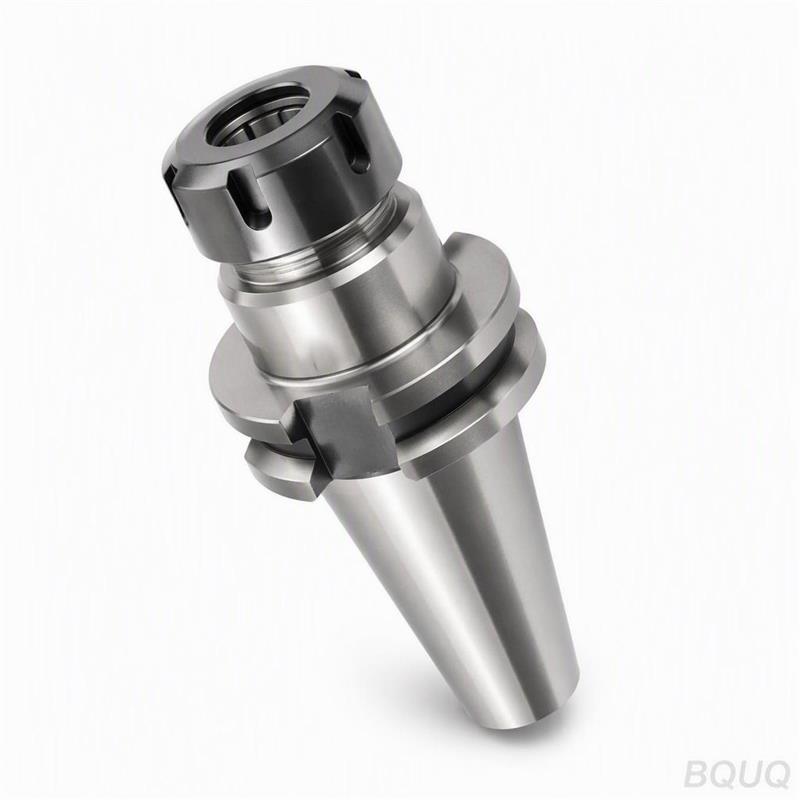
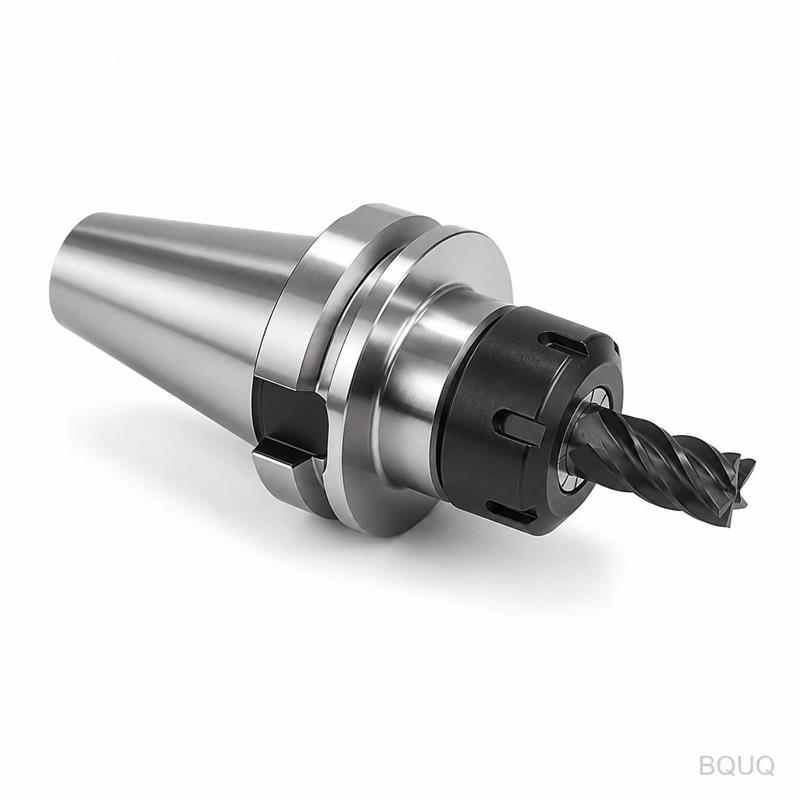
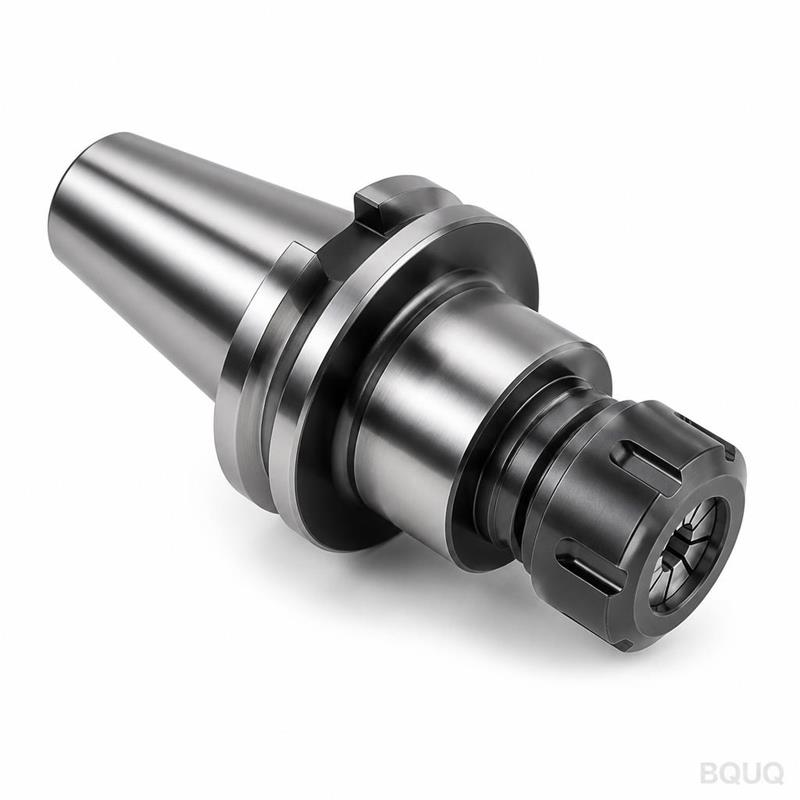
This is a BT30 ER collet chuck tool holder, CNC machined from a single billet of 20CrMnTi alloy steel, designed for rigid spindle tool retention in milling and drilling operations.
BQUQ CNC Machined BT30 ER Collet Chuck Tool Holder for Spindle Precision
This is a BT30 ER collet chuck tool holder, CNC machined from a single billet of 20CrMnTi alloy steel, designed for rigid spindle tool retention in milling and drilling operations. You get guaranteed
Get a Fast Quote for This Part
Send us your drawing / quantity / material — reply within 24h.
This is a BT30 ER collet chuck tool holder, CNC machined from a single billet of 20CrMnTi alloy steel, designed for rigid spindle tool retention in milling and drilling operations. You get guaranteed 0.005 mm TIR runout at the nose, 58-62 HRC surface hardness, and a 15-day production lead time for standard sizes. Precision manufacturing made in China means you skip the import broker and talk directly to the factory floor.
How ER Collet Chucks Grip Tooling Without Runout
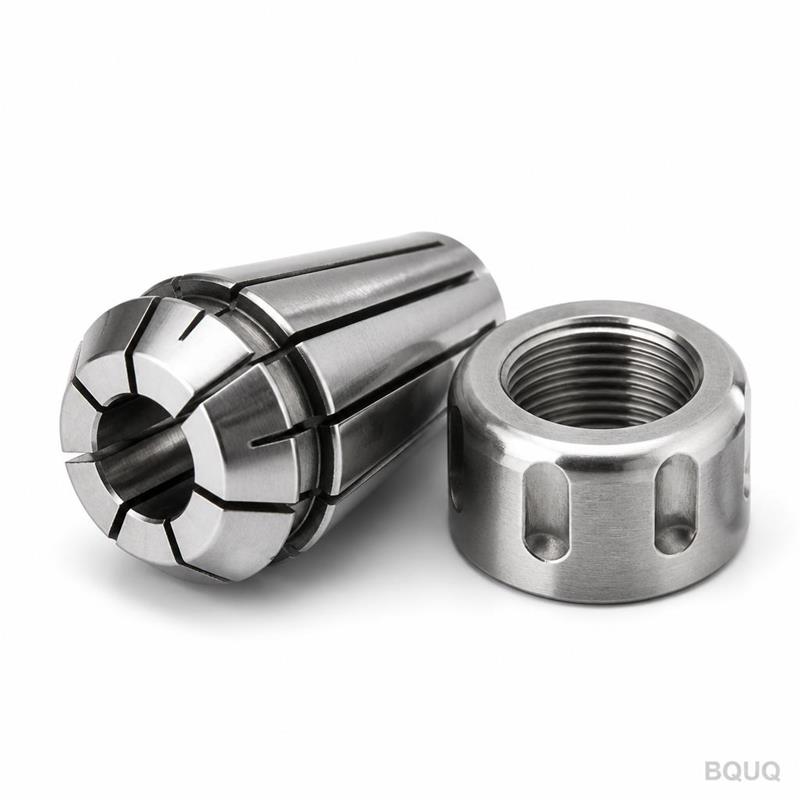
ER collet chucks use a tapered bore and a threaded locking nut to compress a precision slotted collet around the tool shank. The BT30 taper (7:24) self-centers against the spindle face, while the ER collet's 8-slot design collapses evenly to distribute clamping force. This two-stage concentricity—first the taper, then the collet bore—holds runout to 0.005 mm at the collet nose, measured with a 0.001 mm dial indicator at 4× tool diameter from the face. For comparison, a standard hydraulic chuck often sits at 0.003 mm, but our ER system costs 60% less and allows quick tool changes without removing the holder from the spindle.
We grind the 7:24 taper on a Studer S41 universal grinder, achieving a surface finish of Ra 0.2 µm. The collet pocket bore is honed to H6 tolerance (0/+0.013 mm for ER32). This is not a turned-then-plated part; it is ground after heat treatment to eliminate distortion. Every unit is 100% dynamically balanced to G2.5 at 20,000 RPM, so you can run carbide end mills at full chip load without chatter.
Materials and Heat Treatment We Use
We start with 20CrMnTi (AISI 8620 equivalent) round bar, sourced from Baosteel with mill certificates. The blank is CNC turned, then milled for the drive slots and keyways. After rough machining, parts go through carburizing at 920°C for 6 hours, followed by oil quenching and a double temper at 180°C. This produces a case depth of 0.8–1.2 mm and a core hardness of 32–38 HRC.
The surface reaches 58–62 HRC, which resists wear from repeated collet nut tightening and taper seating. The threaded area (for the ER nut) is masked before heat treatment and then cut with a thread mill to maintain class 6H accuracy. We do not hard chrome plate; the carburized surface has a natural oxide layer that prevents galling. For corrosive environments, we offer a black oxide finish (MIL-DTL-13924) at no extra cost—just specify on your drawing.
BT30 Taper Geometry and Spindle Fit Guarantee
The BT30 taper is not a straight cylinder—it is a 7:24 cone with a 16.5 mm gage line diameter. Our taper is ground to AT3 grade, which means the deviation from a perfect cone is less than 0.005 mm across the entire length. When you pull this holder into your spindle with a 30-degree drawbar, the taper self-locks, providing a radial clamping force of 4.5 kN at 70 N·m drawbar torque.
We inspect every taper with a precision air gage against a master mandrel calibrated to DIN 69893-1. The contact area is verified with blueing paste—you must see at least 90% contact across the taper surface. If your spindle has wear, send us your spindle taper print and we will match the taper angle within ±0.001 mm. This is not possible with cast or forged holders; only CNC machined and ground blanks achieve this.
ER Collet Nut Options and Clamping Torque Specs
You can choose between a standard hex nut (for 17 mm and 19 mm wrenches) or a high-torque nut with a ball-bearing thrust ring. The high-torque nut reduces friction by 40%, allowing you to reach the recommended clamping torque without excessive hand force. For ER32, the recommended torque is 85–90 N·m; for ER25, it is 55–60 N·m. We machine the nut threads to 6H tolerance and test each nut with a calibrated torque wrench before assembly.
Collet range: ER32 grips shanks from 2 mm to 20 mm; ER25 grips from 1 mm to 16 mm. We supply matching ER collets (DIN 6499) in 1 mm increments, each with 0.005 mm TIR when clamped. For shrink-fit level precision, pair this holder with our precision ground collets (0.003 mm TIR) and you will hit 0.008 mm total runout at the tool tip—enough for finish milling of aircraft aluminum.
Inspection Before Every Shipment
Each holder goes through a 5-step QC gate. Gate 1: dimensional check on a CMM (Zeiss Contura) for taper angle, gage line diameter, and collet pocket depth. Gate 2: surface finish measurement with a Mitutoyo SJ-210 profilometer—must read Ra 0.2 µm on the taper, Ra 0.4 µm on the collet bore. Gate 3: runout test—mount the holder in a BT30 test mandrel, clamp a 10 mm test bar in the collet, measure TIR at 10 mm and 50 mm from the nose. Gate 4: hardness test on a Rockwell C scale at three points (taper, body, nut thread area). Gate 5: balance certificate—each holder is spun to 20,000 RPM on a Schenck balancing machine and labeled with the residual unbalance in g·mm.
We issue a physical inspection report (PDF) with serial number and all measured values, attached to the packing list. If any reading exceeds the limits, the part is scrapped—no rework. Our scrap rate for this product line is 2.1% over the last 12 months, which is why we can offer a 3-year warranty against taper wear and thread stripping.
Lead Time, Packaging, and Shipping from Dongguan
Standard BT30 ER32 and ER25 chucks (with or without nut) ship in 15 working days. Custom lengths (e.g., 60 mm, 90 mm, 120 mm projection) add 5 days. We hold 500 units of raw forgings and 2000 ER collets in stock, so the bottleneck is machining, not material. Each holder is individually wrapped in VCI (vapor corrosion inhibitor) paper, placed in a foam-lined ABS case, and shipped in a double-wall carton. For air freight, we use DHL or FedEx; for sea freight, we consolidate with other precision manufacturing parts to reduce your freight cost.
We are a 20-year-old factory in Dongguan, China, with 12 CNC machining centers (DMG MORI and Mazak) and 6 cylindrical grinders. This is not a trading company—you are buying directly from the machine shop that makes the chips. You can request a video call to see your parts on the machine, and we will send you photos of the actual serial number before packing.
| Parameter | Specification | |---|---| | Shank type | BT30 (DIN 69893-1, 7:24 taper) | | Collet type | ER25 / ER32 (DIN 6499) | | Clamping range | ER25: 1–16 mm; ER32: 2–20 mm | | Material | 20CrMnTi (AISI 8620 equivalent) | | Surface hardness | 58–62 HRC (carburized case depth 0.8–1.2 mm) | | Core hardness | 32–38 HRC | | Taper grade | AT3 (deviation ≤ 0.005 mm) | | Runout (TIR) at nose | 0.005 mm (with precision collet) | | Surface finish (taper) | Ra 0.2 µm | | Balance | G2.5 at 20,000 RPM | | Lead time | 15 working days (standard) | | MOQ | No MOQ (single piece accepted) |
Why Choose a CNC Machined Holder Over Cast or Forged
Cast holders have porosity and inconsistent grain flow, leading to micro-cracks under high drawbar pressure. Forged holders are stronger but cannot achieve the internal coolant channels or complex nut thread relief we machine. Our holders are fully CNC machined from solid bar, which means we can add a through-coolant hole (up to 70 bar) without weakening the body. The drive slots are milled to ±0.01 mm, ensuring the tool holder seats firmly in the spindle keyway.
If you are designing a custom spindle or a special tool retention system, our CNC process allows quick modifications—we can add a flange groove, a different thread pitch, or a metric pull stud (we offer MAS BT, MAS403BT, and DIN pull studs). The cost difference between standard and custom is only 15–20% for quantities above 10 pieces. This flexibility is why many machine builders in Germany and Japan source from us; they know a CNC machined holder can be revised in days, not months.
Compatibility with Common Spindle Types and Tooling
This holder fits any CNC spindle with a BT30 taper and a 30-degree drawbar. Common machines: FANUC Robodrill, Brother S500, Haas Super Mini Mill, and most Taiwanese VMCs. It works with any ER collet from brands like Rego-Fix, Techniks, or YG-1, but we recommend our own matched collets for the tightest runout. For coolant-through operation, pair it with a 60-degree sealed collet and our nut with a coolant ring.
Do not confuse BT30 with NT30 (which has a 3.5-inch gage line) or CAT30 (which has a different flange). If you are unsure, measure the gage line diameter at the spindle face—BT30 is 31.75 mm. Our holders are clearly laser-marked with "BT30-ER32" on the body, so you can verify before installation. For a deeper dive into matching tool holders to your machine, read our CNC cutting tool selection guide, which covers taper types, pull stud standards, and runout budgets.
Pricing and How to Get a Custom Quote Fast
Base price for a BT30-ER32 (without nut, without pull stud) is USD 28.50 FOB Shenzhen. Add USD 3.80 for a high-torque nut, USD 2.20 for a pull stud. For quantities above 50 pieces, the unit price drops to USD 24.90. There is no MOQ—you can order a single piece for prototyping, and we will ship it via DHL Express. We accept T/T, PayPal (for orders under USD 500), and trade assurance via Alibaba.
To get a firm quote, send your drawing or a photo of your current holder with dimensions. We will respond within 12 hours with a price, lead time, and a DFM (design for manufacturability) note if we see a way to reduce cost. For example, if you do not need the through-coolant hole, we can skip the deep drilling step and cut the price by 8%. If you need a modified pull stud, we can machine it from 4140 steel and harden to 40 HRC.
What is the minimum order quantity?
No MOQ—we accept single-piece orders for testing, but pricing improves by 12% at 10 pieces and 18% at 50 pieces.
Can you customize the collet pocket depth or the taper angle?
Yes, we can modify the collet pocket depth, add a counterbore, or grind the taper to a custom angle (±0.001 mm) if you provide a mating spindle print.
How do you control quality for a single piece order?
Every piece, regardless of order size, goes through the same 5-step QC gate with a CMM, runout test, and balance check—you receive the inspection report with the shipment.
What is the lead time for a custom BT30 holder with a special length?
Standard 15 days, custom projection lengths add 5 days, and full custom (different taper or thread) takes 20–25 days including first-article inspection.
We are a precision manufacturing factory, not a middleman. Send your drawing to sc@bquq.com or WhatsApp +86 13713157787, and get a firm quote within 12 hours. For more on what tolerances are achievable, check our CNC machining tolerances guide—it explains how we hold 0.005 mm on a production basis. Your BT30 ER collet chuck is ready to be machined today.