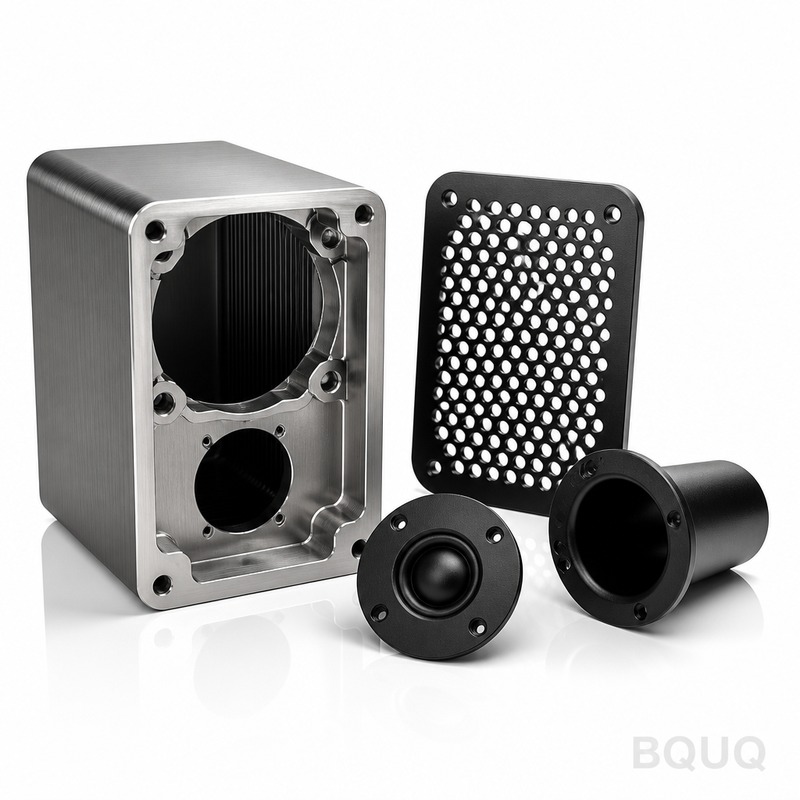
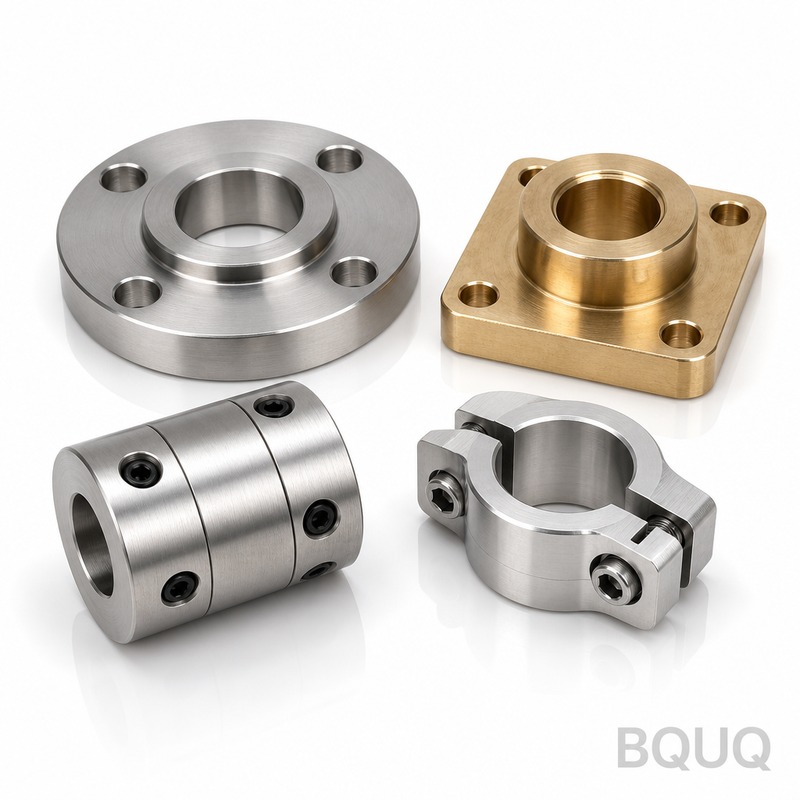
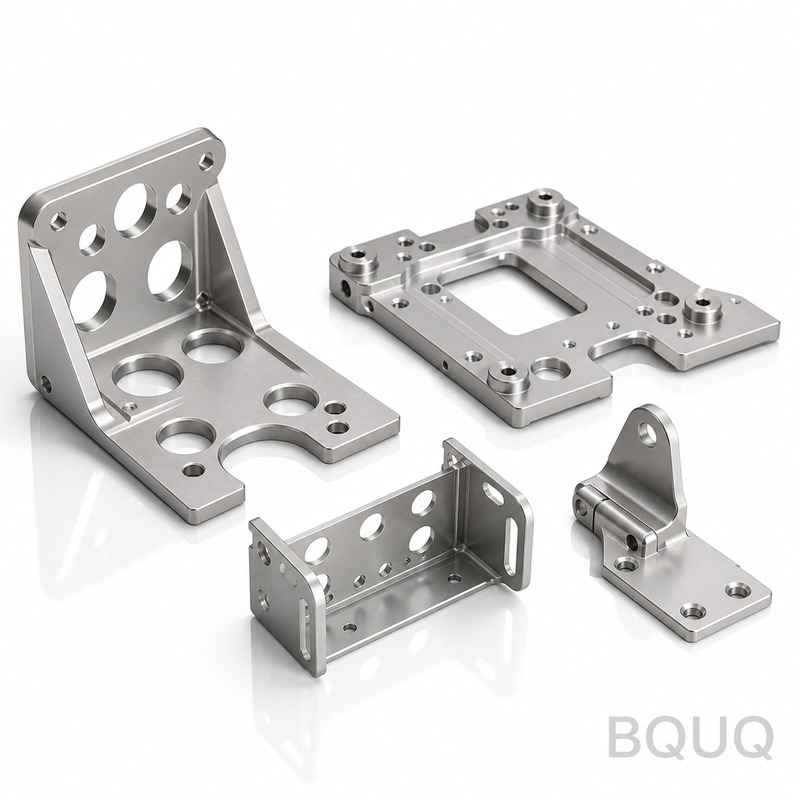
What This Housing Does Inside Your Loudspeaker This is a CNC machined enclosure component that holds the driver, crossover, and internal bracing in place. You get 0.005 mm positi
Cnc Machined Speaker Housing Parts | BQUQ Precision Manufacturing
What This Housing Does Inside Your Loudspeaker This is a CNC machined enclosure component that holds the driver, crossover, and internal bracing in place. You get ±0.005 mm positional tolerance, 0.01
Get a Fast Quote for This Part
Send us your drawing / quantity / material — reply within 24h.
This is a CNC machined enclosure component that holds the driver, crossover, and internal bracing in place. You get ±0.005 mm positional tolerance, 0.01 mm total runout on the driver seat, and surface finish down to Ra 0.4 µm. We machine from 6061-T6 or 7075-T6 aluminum, or 304/316 stainless steel, with hardness up to 45 HRC after heat treatment. Lead time for prototypes is 5 working days; production runs ship in 15 days. This is precision manufacturing from a 20-year Dongguan factory, made in China, with no MOQ for your first order.
Why the Driver Seat Needs 0.01 mm Runout, Not 0.05 mm
Speaker drivers are not round. They are cast frames with mounting holes that shift during cooling. If your CNC housing has a driver seat with more than 0.01 mm runout, the voice coil rubs against the magnet gap. That causes scratching, distortion, and early failure. We machine the driver seat in one setup — rough, semi-finish, finish — without releasing the part from the vise. This eliminates re-clamping error. We also use a 4th axis rotary table for the outer diameter, so the seat and the outer flange are concentric within 0.01 mm. You can hear the difference in the low end: no air leak, no mechanical noise.
Materials and Heat Treatment We Use for Speaker Housings
We stock 6061-T6 aluminum for weight-sensitive designs — it machines clean, anodizes well, and gives you 95 HB hardness. For high-power woofers that generate heat, we recommend 7075-T6: 150 HB, better fatigue resistance, still light. If you need corrosion resistance for marine or outdoor speakers, we machine 316L stainless steel — 25 HRC as-machined, 45 HRC after precipitation hardening. We do not use cast aluminum for these parts. Casting leaves porosity that creates air leaks in the enclosure. CNC machining from solid bar or plate gives you a void-free wall — you can pressure-test every unit to 0.5 bar without leakage. For damping, we can add a machined groove on the inner wall for a rubber O-ring. That groove is cut to ±0.02 mm width, so the O-ring stays seated during assembly.
How We Control Wall Thickness for Consistent Bass Response
Speaker tuning depends on internal volume. If your housing wall thickness varies by 0.5 mm, the effective volume shifts, and your bass tuning frequency drifts. We hold wall thickness to ±0.03 mm across the entire part. On a 200 mm diameter housing, that is a volume variation of less than 0.2%. We achieve this with a custom soft jaw that grips the part on the outer contour, not on a flat surface. Then we machine the internal bore with a boring bar that has a 0.01 mm digital readout. Every housing gets a wall thickness measurement at 8 points — we record it in the inspection report. If you need a specific internal volume for a bass reflex design, we can machine a stepped internal profile to fine-tune the volume without changing the outer dimensions.
Surface Finish Options: From Brushed to Anodized Black
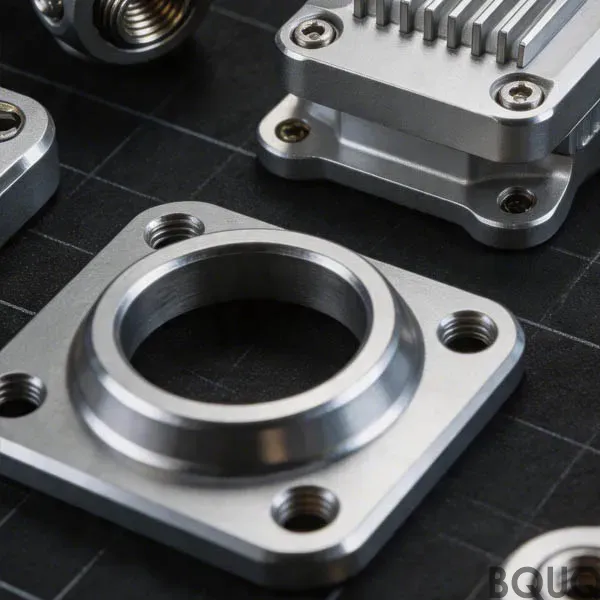
Raw machined surface is Ra 0.8 µm — good for internal surfaces that are hidden. For visible exterior, we offer Ra 0.4 µm with a brushed finish. That means we run a 400-grit belt over the outer diameter after machining. Then we anodize in clear, black, or silver — 18–20 µm coating thickness, which is enough for salt spray resistance per ASTM B117 for 200 hours. If you need a matte finish, we bead blast with 120 mesh glass beads at 4 bar pressure. That gives a uniform 0.8–1.2 µm Ra with no reflection. For stainless steel housings, we offer electropolishing — that brings Ra down to 0.2 µm and removes the passivation layer unevenness. All finishing is done in-house, so we do not ship parts to a third party. That keeps your lead time at 15 days, not 25.
Inspection Before Every Shipment: CMM and Air Gauge
We inspect 100% of critical dimensions on every housing, not just a sample. The driver seat runout is measured with a dial indicator on a precision mandrel — resolution 0.002 mm. The mounting hole positions are checked on a CMM with a probe accuracy of ±0.0015 mm. Wall thickness is measured with an ultrasonic gauge at 8 points. Surface finish is verified with a profilometer on the visible face. We send you a full inspection report with the shipment — PDF and CSV. If any dimension is out of spec, the part is scrapped, not reworked. Rework weakens the material structure. We do not gamble on that.
25 HRC as-machined, 45 HRC after precipitation hardening
Machining tolerance
±0.005 mm on critical features
Runout (driver seat)
0.01 mm total indicated runout
Surface finish (machined)
Ra 0.4 µm (optional Ra 0.2 µm electropolished)
Anodizing thickness
18–20 µm, clear/black/silver
Wall thickness control
±0.03 mm
Lead time (prototype)
5 working days
Lead time (production)
15 working days for 500 pcs
MOQ
No MOQ — 1 piece accepted
What Our CNC Tooling Does Differently for Thin-Walled Housings
Thin walls — 2 mm or less — vibrate during machining. That causes chatter marks and dimensional drift. We use a custom carbide boring bar with a 5:1 length-to-diameter ratio, not the standard 3:1. This reduces deflection by 40%. We also run a wiper insert on the finish pass. That wiper flat creates a smooth surface without increasing feed rate. The spindle speed is set to avoid the natural frequency of the part — we calculate that from the material modulus and wall thickness. If you are designing a thin-wall housing, read our CNC cutting tool selection guide — it has the exact formulas we use for tool deflection limits. And for setting your own tolerances, our CNC machining tolerances guide explains what ±0.005 mm really means on a production line.
Packing and Anti-Static Protection for Speaker Drivers
Speaker housings are heavy — a 200 mm aluminum housing weighs about 1.5 kg. We pack each housing in a separate foam insert cut to the exact contour. That prevents surface scratches during transit. For anodized parts, we add a layer of anti-static film on the outer surface — this prevents dust attraction, which is critical if you assemble drivers in a clean room. We use double-wall corrugated boxes with a crush strength of 200 kg per square meter. For international shipments, we put a desiccant bag inside each box — 20 grams of silica gel. That prevents condensation during air freight. Every box is labeled with the part number, revision, and quantity. No mixed batches in one box.
Cost Breakdown: Why CNC Machining Beats Die Casting for Prototypes
Die casting has a tooling cost of $8,000–$15,000 for a speaker housing. That is fine if you make 10,000 units. But for a new design, you do not know if the driver matches the enclosure until you test it. CNC machining has zero tooling cost. The first piece costs the same as the 500th piece. We quote a 50-piece prototype run at $18–$35 per piece for aluminum, depending on size and complexity. That includes inspection and anodizing. Compare that to die casting: $15,000 tooling + $6 per piece. You break even at 1,500 pieces. If your product changes after acoustic testing, CNC machining lets you modify the design for $50 in programming time. Die casting requires a new tool — another $15,000. This is why we see more engineers switching to CNC for speaker housings in the 100–2,000 unit range.
Do you accept a single prototype piece for testing?
Yes, no MOQ — we machine one piece for your acoustic test, and you pay only the machining cost plus material.
Can you add a custom mounting pattern for my specific driver?
Absolutely — we machine any hole pattern you specify, including countersunk holes for Torx or hex screws, within ±0.01 mm positional tolerance.
How do you verify the runout on the driver seat during production?
We measure 100% of parts with a dial indicator on a mandrel, and the measurement data is included in the inspection report for every batch.
What is the fastest lead time for a rush order of 100 pieces?
We can deliver 100 machined and anodized housings in 7 working days if you approve the drawing within 24 hours of the quote.
Get a Firm Quote Within 12 Hours — Send Your Drawing
Send us your 2D drawing or 3D STEP file. We will check the wall thickness, tool access, and tolerance stack-up. You get a firm quote — not a range — within 12 hours. The quote includes material cost, machining time, finishing, inspection, and freight. No hidden charges for setup or programming. Email your drawing to sc@bquq.com or message us on WhatsApp at +86 13713157787. We reply within the same working day, even on weekends. If you are unsure about a dimension, send the drawing anyway — we will flag problem areas for free.