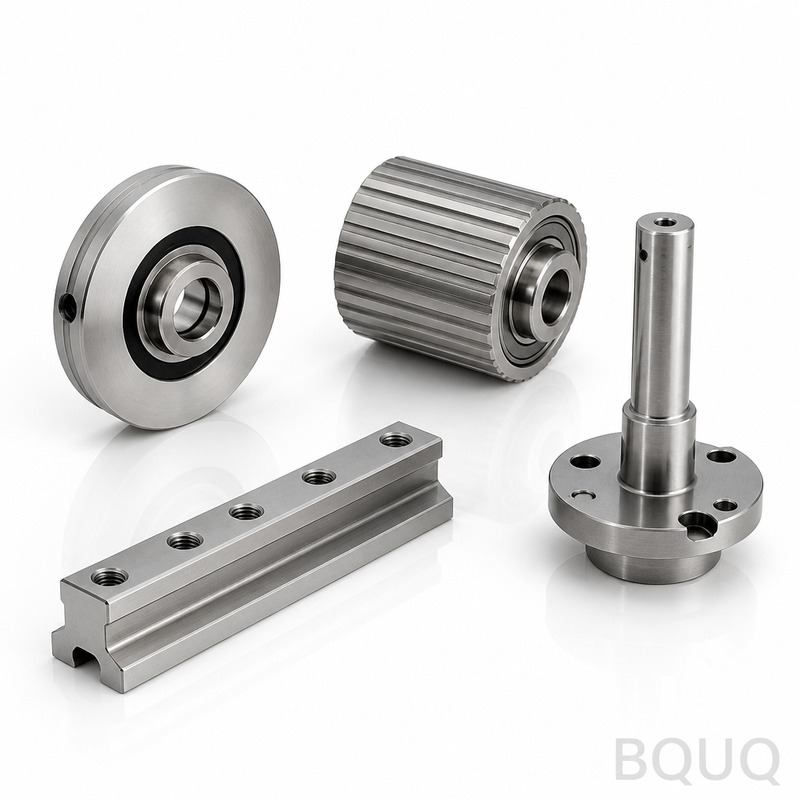
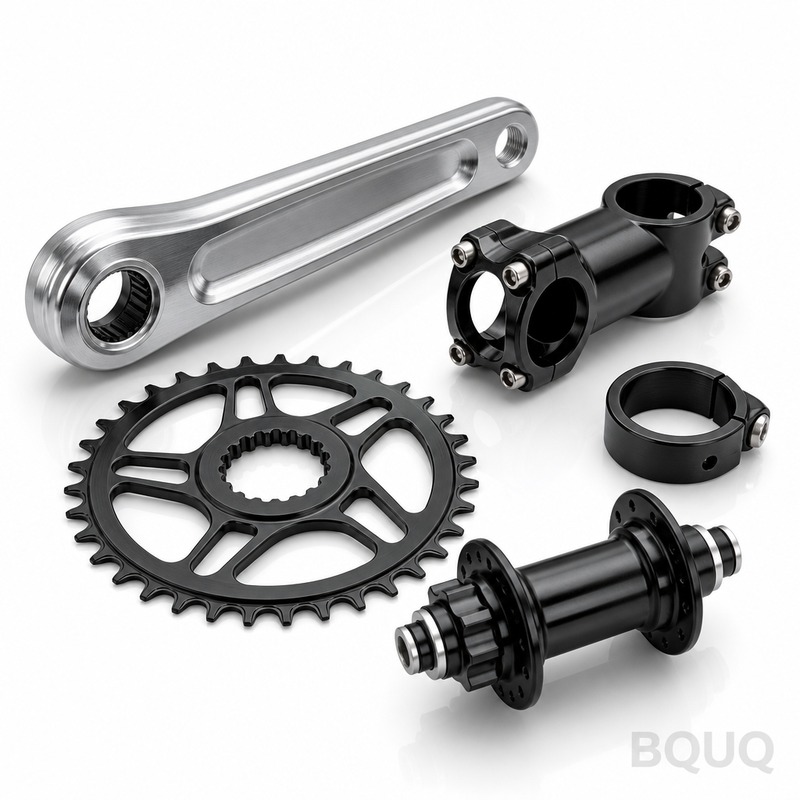
These are CNC machined textile machinery parts—brackets, rollers, guide rails, cam discs, and loom components—cut from bar stock or billet on 3- and 4-axis machining centers. You g
CNC Machined Textile Machinery Parts | BQUQ Precision Factory
These are CNC machined textile machinery parts—brackets, rollers, guide rails, cam discs, and loom components—cut from bar stock or billet on 3- and 4-axis machining centers. You get dimensional toler
Get a Fast Quote for This Part
Send us your drawing / quantity / material — reply within 24h.
These are CNC machined textile machinery parts—brackets, rollers, guide rails, cam discs, and loom components—cut from bar stock or billet on 3- and 4-axis machining centers. You get dimensional tolerance at ±0.005 mm, runout under 0.01 mm on rotating parts, surface finish down to Ra 0.4 µm, and hardness up to 58 HRC after heat treatment. Lead time is 10 days for standard batches, 20 days for complex multi-fixture jobs. This is precision manufacturing from a 20-year Dongguan factory, made in China to export quality—no MOQ on first trial orders.
How We Hold ±0.005 mm on Loom Cam Discs and Guide Rails
Textile machines run at 800–1200 picks per minute. A cam disc with 0.02 mm profile error causes thread tension spikes and fabric defects. We machine cam profiles on 4-axis centers with CBN inserts, then finish with a 0.5 mm ball nose at 12,000 RPM. For guide rails over 600 mm long, we use dual-zone clamping to prevent deflection—measured straightness stays within 0.008 mm per 300 mm. Every critical dimension is verified on a CMM with 0.001 mm resolution before the part leaves the floor.
Materials and Heat Treatment for High-Speed Loom Frames
We stock 4140, 42CrMo4, 1045, and 6061-T6 for textile frames and brackets. For wear parts like heald frames and latch needles, we use 9Cr18MoV or SKD11, hardened to 56–58 HRC with deep cryogenic treatment to stabilize grain structure. Surface treatments include black oxide for corrosion resistance, hard anodizing to 60 HRC equivalent on aluminum, and electroless nickel for chemical washdown zones. We do not use mystery alloys—every heat number is traceable to the mill certificate.
Inspection Before Every Shipment: CMM Reports and Runout Checks
Every batch gets a full inspection report, not a sampling sheet. We measure critical bore diameters with air gauges (repeatability ±0.001 mm), check runout on a dedicated mandrel for every rotating part, and verify surface finish with a profilometer. For orders above 500 pieces, we include process capability (Cpk) data on the top five dimensions. If a part fails, it does not ship—we re-machine or scrap it, and you see the deviation in the report.
Fixturing That Eliminates Distortion on Thin-Wall Textile Components
Thin-wall parts like aluminum guide channels (2 mm wall) warp easily. We use vacuum fixtures with 3D-printed soft jaws that support 100% of the part surface. For steel brackets with uneven geometry, we machine in two ops with a stress-relief anneal between ops—this cuts distortion by 70% compared to single-op machining. Our fixture library has 1,200+ custom pallets, so a new part shape rarely needs a new fixture design—saving you 3–5 days of setup time.
Batch Sizes from 1 Piece to 50,000: No MOQ for Prototypes
You can order a single replacement part for an older loom, or a production run of 50,000 for a new machine line. Our CNC cells switch from prototype to batch in under 15 minutes, so small orders do not get lost in scheduling. For orders over 1,000 pieces, we move to multi-pallet automation—this drops per-piece cost by 30% while holding the same tolerance. No MOQ means you validate the part with one unit before committing to volume.
How We Cut Tooling Cost for Short-Run Textile Replacement Parts
When you need 20 pieces of a discontinued part, tooling cost matters. We use standard tool holders and indexable inserts—no custom form tools for quantities under 500. For internal threads and keyways, we use thread mills and broaches that are already in our tool crib. This keeps setup cost under $80 for most prototype jobs. Compare that to wire EDM or grinding, which need custom electrodes or wheels—those add 2–3 days and $150–$400 per part. Our approach is faster and cheaper for CNC machined textile machinery parts.
Surface Finish Options for Yarn Contact and Sliding Surfaces
Yarn contact parts need low friction to avoid fiber breakage—we polish to Ra 0.2 µm on ceramic-coated rollers. For sliding surfaces like doffing combs, we specify Ra 0.8 µm with a crosshatch pattern that retains lubricant. Standard mill finish is Ra 1.6 µm, but you can choose bead blasting (Ra 3.2 µm) for grip areas or hard anodizing (Ra 0.4 µm) for wear resistance. We document the Ra value on the inspection report, so you know exactly what you are getting.
Real-World Lead Times: Prototype in 7 Days, Production in 15
Prototype (1–10 pcs, simple geometry, no heat treat): 7 days including shipping from Dongguan to Hong Kong airport. Production (100–5,000 pcs, hardened and ground): 15 days from drawing approval. Complex parts with multiple ops and tight runout (e.g., a 400 mm roller with 0.005 mm runout and 58 HRC): 20 days. We quote firm lead times at order confirmation, and we pay a 1% penalty per day if we ship late—that is in our terms.
Parameter
Value / Range
Materials
4140, 42CrMo4, 1045, 6061-T6, 9Cr18MoV, SKD11
Part size range
5 mm to 800 mm length, up to 300 mm diameter
Hardness (after heat treat)
28–58 HRC (as-specified)
Dimensional tolerance
±0.005 mm (CNC milled), ±0.01 mm (turned)
Runout (rotating parts)
≤0.01 mm TIR
Surface finish
Ra 0.2 µm (polished) to Ra 3.2 µm (bead blasted)
Lead time (prototype)
7 days
Lead time (production)
15–20 days
MOQ
No MOQ (1 piece accepted)
Inspection
100% critical dims, CMM report included
What is the minimum order quantity for CNC machined textile machinery parts?
No MOQ—you can order one piece for a prototype or a broken loom part, and we will machine it at the same tolerance as a 50,000-piece run.
Can you machine parts from my existing drawing with non-standard tolerances?
Yes, we accept drawings with tighter tolerances than standard (down to ±0.002 mm) if the geometry allows, and we will confirm feasibility and cost before quoting.
How do you handle quality control for a batch of 5,000 pieces?
We do first-article inspection on the first piece, then in-process checks every 50 pieces, and a final CMM audit on 5% of the batch, all documented in the shipment report.
What is the realistic lead time for 1,000 hardened parts?
Fifteen days from drawing approval, including heat treatment to 58 HRC and final grinding, with a firm quote that includes a late-delivery penalty clause.
Before you finalize your design, review our CNC cutting tool selection guide to understand how tool geometry affects surface finish on textile parts, and check our CNC machining tolerances guide to verify that your specified tolerances are cost-effective for production volumes.
Send your drawing today—DXF, STEP, or PDF—and get a firm quote with tolerance analysis within 12 hours. Email sc@bquq.com or WhatsApp +86 13713157787. We reply within one business hour, and we will point out any tolerance that adds cost without improving function.