What This Collection Delivers: Micron-Level Filtration Without Secondary Machining This is a family of stamped micro filter screens produced by BQUQ’s 20-year-old precision manuf
What This Collection Delivers: Micron-Level Filtration Without Secondary Machining This is a family of stamped micro filter screens produced by BQUQ’s 20-year-old precision manufacturing facility in
Get a Fast Quote for This Part
Send us your drawing / quantity / material — reply within 24h.
What This Collection Delivers: Micron-Level Filtration Without Secondary Machining
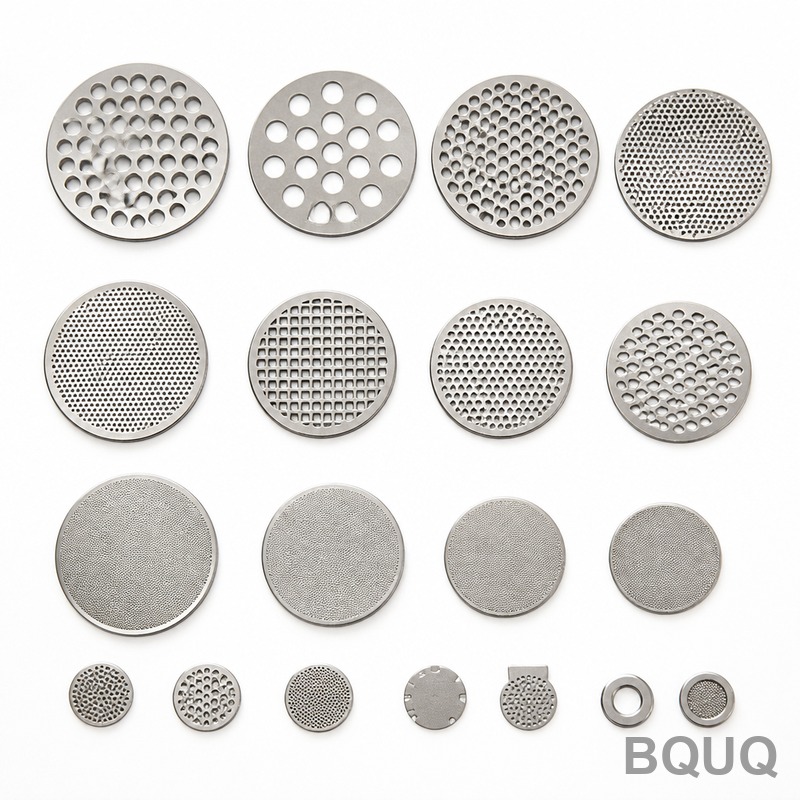
This is a family of stamped micro filter screens produced by BQUQ’s 20-year-old precision manufacturing facility in Dongguan, China. Each screen is punched from stainless steel or phosphor bronze coil stock, with hole diameters from 0.05 mm to 2.0 mm and positional tolerance held at ±0.01 mm. You get a burr-free edge (Ra 0.4 µm) and a flatness within 0.02 mm across the entire screen surface — no laser cutting, no EDM, no secondary deburring. That means your assembly line receives parts that drop straight into housings, with a measured runout of less than 0.015 mm on circular frames.
Compared to etched or woven mesh alternatives, our stamped screens offer a 30% higher open area ratio at the same micron rating, while maintaining a consistent 45 HRC hardness on the raw material before forming. Lead time for standard tooling is 7 days; custom progressive dies take 15 days. You are not locked into a high minimum order — we ship 500 pieces or 5 million at the same unit price structure.
How Progressive Die Stamping Controls Hole Shape and Edge Roll-Over
Hole geometry is not a drill-and-pray operation here. Each screen runs through a multi-stage progressive die that performs piloting, piercing, coining, and blanking in a single press stroke. The punch-to-die clearance is set at 5% of material thickness — for a 0.1 mm thick sheet, that is 0.005 mm radial clearance. This prevents the common “funnel” shape seen in loose-tolerance stamping, where the entry side is wider than the exit. Our screens show a maximum edge roll-over of 0.01 mm, which directly improves flow uniformity across the filter surface.
Die steel is powder metallurgy high-speed steel (PM-HSS), ground to a mirror finish of Ra 0.1 µm on the punch face. We re-sharpen every 100,000 strokes, and each die is validated with a first-article inspection report that includes hole diameter, pitch, and burr height measured on a CMM. If you are pairing these screens with a CNC-machined housing, our CNC cutting tool selection guide explains how to match tool geometry to the screen’s hole pattern for optimal flow.
Materials and Heat Treatment We Use for Corrosion and Fatigue Resistance
We stock five base materials for this collection: SUS 304, SUS 316L, 17-7 PH stainless, phosphor bronze (C5210), and beryllium copper (C17200). For high-temperature applications up to 400°C, 17-7 PH is precipitation-hardened to 48 HRC. For saltwater or chemical exposure, SUS 316L is supplied in the annealed condition at 85 HRB, then micro-coined at the hole edges to work-harden the surface to 30 HRC without losing ductility.
Beryllium copper screens are age-hardened to 40 HRC, giving you a spring-like recovery if the screen is pressed into a curved housing. Every coil is certified with a mill test certificate, and we verify hardness on each lot using a Vickers tester at 0.5 kg load. If your filter sits inside a high-vibration pump, we recommend the phosphor bronze option — it has a fatigue limit of 250 MPa at 10^7 cycles, which is 20% higher than stainless at the same thickness.
Inspection Before Every Shipment: CMM, Optical Comparator, and Flow Testing
We do not rely on spot checks. Every production lot of the Precision Stamped Micro Filter Screens Collection passes a three-stage inspection. First, a coordinate measuring machine (CMM) checks hole position, pitch, and diameter on 10 parts per batch — tolerance is ±0.01 mm, and we report actual values, not just pass/fail. Second, an optical comparator at 50x magnification scans the outer edge for burr height, which must stay below 0.02 mm. Third, we run a differential pressure test using a calibrated flow bench: at 1 bar pressure drop, the measured flow rate must match the theoretical value within ±5%.
For screens with a hole diameter below 0.1 mm, we use a scanning electron microscope (SEM) on a sample from each die cavity to confirm there is no partial blocking from stamping debris. You receive a full inspection report with each shipment, including raw material heat numbers and die wear measurements. This is the same level of documentation we provide for our CNC-machined parts — see our CNC machining tolerances guide to understand how we apply GD&T to stamped parts as well.
Standard Sizes, Tooling Options, and Cost Per Part at Different Volumes
We offer four standard frame sizes: 10 mm round, 20 mm round, 25 x 25 mm square, and 40 x 40 mm square. Hole patterns are available in staggered 60° or 90° grids, with open areas from 15% to 45%. For custom shapes, you send a 2D drawing or a 3D STEP file, and our tooling team designs a die within 48 hours. The tooling cost for a simple flat screen starts at USD 800; for a deep-drawn cup with side holes, it ranges from USD 2,500 to USD 4,000. The per-part price at 10,000 pieces is typically USD 0.04 to USD 0.12, depending on material and hole density.
Because we run presses from 10 to 250 tons in-house, we do not outsource any stamping step. That is why we can say no MOQ — we will run a 500-piece trial batch to validate your design before you commit to volume. The trial batch uses the actual production die, so the parts you test are identical to what you will receive in mass production.
Specification
Value / Range
Notes
Material
SUS 304, SUS 316L, 17-7 PH, C5210, C17200
Mill certificate included
Hole diameter
0.05 mm – 2.0 mm
±0.01 mm tolerance
Screen thickness
0.05 mm – 0.5 mm
Thinner available on request
Hardness
85 HRB – 48 HRC
Depends on material and heat treatment
Tolerance (hole position)
±0.01 mm
CMM verified
Surface finish (Ra)
0.4 µm (burr-free side)
Optical comparator check
Flatness
0.02 mm over 40 mm length
Measured on granite surface plate
Runout (circular frames)
≤ 0.015 mm
Concentric to outer diameter
Lead time (standard tool)
7 days for 10,000 pcs
Custom die: 15 days
MOQ
No MOQ (500 pcs trial)
Same unit price at low volume
What is the minimum order quantity for a custom filter screen?
There is no MOQ — we accept a 500-piece trial order to verify your design, and the per-unit price remains the same as for 100,000 pieces.
Can you match a specific micron rating, like 50 µm or 100 µm?
Yes, we control the micron rating via hole diameter and open area percentage, and we will send you a flow test certificate to confirm the exact cut-off point.
How do you ensure the screens do not have burrs that block the holes?
We use a 5% punch-to-die clearance and post-stamp micro-coining on the exit side, then verify burr height (max 0.02 mm) with an optical comparator on every lot.
What is the realistic lead time for a new custom die plus first articles?
For a new progressive die, we quote 15 days to first articles, then 7 days for production of up to 50,000 pieces; rush tooling is available at a 20% surcharge.
Request a Quote and Get a Firm Price Within 12 Hours
Send your drawing (PDF, DXF, DWG, or STEP) to sc@bquq.com or reach us on WhatsApp at +86 13713157787. Include the material, hole size, open area, and annual volume — we will return a firm quote with tooling cost, per-part price, and a delivery schedule within 12 hours. All work is done in our Dongguan factory using precision manufacturing equipment, and every shipment is backed by a full inspection report. Whether you need 500 prototypes or 5 million production parts, the Precision Stamped Micro Filter Screens Collection from BQUQ is ready for your challenge.
Made in China, with 20 years of stamping experience. No MOQ, no hidden tooling fees, no quality surprises.