Aluminum 6063 vs 6061 for Heat Sinks: Which Alloy Performs Better?
For most extruded heat sink applications, Aluminum 6063 performs better than 6061 due to its superior thermal conductivity (approximately 209 W/m·K versus 166 W/m·K for 6061) and smoother surface finish, which enhances radiative heat dissipation. However, 6061 offers higher mechanical strength and better machinability for complex fin geometries, making it the preferred choice when structural rigidity or post-extrusion CNC machining is critical. The optimal selection depends on whether your design prioritizes thermal efficiency (choose 6063) or load-bearing capacity and precision machining (choose 6061).
What Are the Core Thermal Conductivity Differences Between 6063 and 6061?
The thermal conductivity of 6063-T5 is typically 209 W/m·K, while 6061-T6 measures around 166 W/m·K. This 26% difference directly impacts the heat dissipation rate: a 6063 heat sink with identical dimensions to a 6061 unit will transfer heat from the base to the fins approximately 20-25% faster under forced convection. In natural convection scenarios, the advantage of 6063 is even more pronounced because the lower conductivity of 6061 creates a higher temperature gradient across the fin length, reducing the average fin temperature and lowering the driving potential for heat transfer. For LED lighting modules operating at 50 W, switching from 6061 to 6063 can reduce the junction temperature by 8-12°C, extending LED lifespan by up to 30,000 hours.
How Does Yield Strength Affect Heat Sink Design and Reliability?
6061-T6 has a yield strength of 276 MPa, while 6063-T5 has a yield strength of 145 MPa. This difference means that a 6061 heat sink can support heavier components without bending or warping, especially when the heat sink is mounted vertically or subjected to vibration (e.g., in automotive or railway applications). For a 200 mm long fin, 6061 can withstand a static side load of approximately 85 N before permanent deformation, whereas 6063 will deform at around 45 N. If your heat sink must also serve as a structural chassis member or endure repeated thermal cycling (which induces stress due to coefficient of thermal expansion mismatch with PCBs), 6061 is the safer engineering choice. However, for purely passive cooling applications with no external mechanical loads, the lower strength of 6063 is irrelevant to performance.
Which Alloy Offers Better Surface Finish and Anodizing Quality?
6063 is specifically formulated for extrusion and produces a significantly smoother surface finish, with an average roughness (Ra) of 0.4-0.8 microns as-extruded, compared to 1.0-1.6 microns for 6061. This is critical for anodizing: 6063 yields a uniform, defect-free anodic coating of 10-25 microns thickness, achieving a consistent matte black or clear finish that maximizes emissivity (0.85-0.90). 6061, due to its higher magnesium and copper content, often exhibits streaking or "smut" after anodizing, requiring chemical brightening or etching that adds 15-20% to the finishing cost. For heat sinks that rely on radiation cooling (e.g., in sealed enclosures without airflow), the higher emissivity of anodized 6063 directly improves performance by 10-15% compared to a substandard anodized 6061 surface.
What Are the Cost Differences in Raw Material and Extrusion?
The raw material cost for 6063 is approximately 8-12% lower than 6061 on the global aluminum market (e.g., $2.40/kg vs $2.70/kg for standard billets as of 2025). Extrusion costs are also lower for 6063 because it has better flow characteristics, allowing for thinner walls (down to 0.8 mm vs 1.2 mm for 6061) and more complex fin profiles at the same extrusion pressure. A typical heat sink extrusion die costs $800-1,500 for 6063 and $1,000-1,800 for 6061 due to the higher wear on tooling from 6061's increased hardness. For a production run of 10,000 units with a 150 g heat sink, using 6063 saves approximately $0.35-0.50 per unit in material and extrusion time, translating to $3,500-5,000 in total savings.
How Do Machining and Post-Processing Operations Compare?
While 6061 is generally considered easier to machine due to its higher hardness and better chip formation, this advantage applies only to secondary operations like drilling, tapping, or milling fin tips. 6063 is "gummier" and can produce built-up edges on cutting tools, requiring higher cutting speeds (by 15-20%) and more frequent tool changes. However, for heat sink production, 6061 requires more machining overall because its lower thermal conductivity necessitates thicker bases (to spread heat) and wider fins (to compensate for conductivity loss). A typical CNC-machined 6061 heat sink may require 2-3 hours of machining time per unit, whereas an extruded 6063 profile with minimal post-machining (only cutting to length and drilling mounting holes) requires just 15-20 minutes. If your design involves high-volume production with minimal secondary operations, 6063 is unequivocally more cost-effective.
Which Alloy Should You Choose for High-Temperature Environments?
Both alloys have similar melting points (approximately 600-650°C), but their mechanical properties degrade differently at elevated temperatures. 6061-T6 retains 70% of its yield strength at 150°C, while 6063-T5 retains only 55% at the same temperature. For heat sinks operating above 120°C (e.g., in IGBT modules for power electronics), 6061 is the safer choice because it resists creep and stress relaxation over time. However, 6063 excels in applications with operating temperatures below 80°C, such as consumer electronics, LED lighting, and telecommunication equipment, where the thermal conductivity advantage outweighs the strength deficit. In practice, most heat sink applications for CPUs, GPUs, and power supplies operate below 80°C, making 6063 the default recommendation.
How Does Corrosion Resistance Differ Between the Two Alloys?
Both 6061 and 6063 offer excellent corrosion resistance in atmospheric and freshwater environments, with 6063 having a slight edge due to its lower copper content (0.10% max vs 0.20% max for 6061). In saltwater or industrial environments with high chloride exposure, 6063 exhibits 10-15% less pitting corrosion over a 500-hour ASTM B117 salt spray test. For outdoor heat sinks (e.g., in solar inverters or street lighting), 6063 with a chromate conversion coating or powder coating provides superior longevity, with a typical service life of 20-25 years in coastal environments versus 15-20 years for 6061. If the heat sink is enclosed in an IP-rated housing with controlled humidity, this difference is negligible.
| Property | 6063-T5 | 6061-T6 |
| Thermal Conductivity (W/m·K) | 209 | 166 |
| Yield Strength (MPa) | 145 | 276 |
| Surface Roughness Ra (microns) | 0.4-0.8 | 1.0-1.6 |
| Anodizing Quality | Excellent, uniform | Requires etching |
| Extrusion Wall Thickness (min) | 0.8 mm | 1.2 mm |
| Raw Material Cost (USD/kg) | $2.40 | $2.70 |
| Max Operating Temp for Creep Resistance | 80°C | 150°C |
| Corrosion Resistance (500h salt spray) | Excellent | Good |
How Should You Decide Based on Your Production Volume and Fin Geometry?
For production volumes above 5,000 units per year, 6063 extruded profiles are almost always the most economical solution, with tooling amortization of $0.08-0.15 per unit and extrusion lead times of 2-3 weeks. For low-volume prototypes or heat sinks with extremely tight tolerances (±0.02 mm) that require extensive CNC machining, 6061 is the better choice because it resists deflection during milling and maintains dimensional stability. Additionally, if your fin aspect ratio (height-to-thickness) exceeds 10:1, 6063 allows thinner fins (0.8 mm) that provide more surface area per unit volume, improving heat dissipation by 15-20% compared to a 6061 design with 1.2 mm fins. Always specify the temper condition: T5 for 6063 (air-cooled after extrusion) and T6 for 6061 (solution heat-treated and artificially aged) to achieve the properties listed above.
What Are the Common Failure Modes and How Can You Avoid Them?
The most common failure mode for 6063 heat sinks is mechanical bending under excessive mounting torque, especially when using self-tapping screws into the aluminum. This can be prevented by using threaded inserts or reducing screw torque to below 0.8 N·m. For 6061, the primary failure mode is overheating due to its lower thermal conductivity, which can be mitigated by increasing the base thickness by 20-30% or adding heat pipes. Both alloys are susceptible to galvanic corrosion when in direct contact with copper or stainless steel fasteners; always use aluminum-compatible washers or apply anti-seize compound. For thermal interface materials (TIMs), ensure the surface flatness of the heat sink base is within 0.05 mm over the component contact area, which is achievable with both alloys but requires a final light machining pass on 6063 to remove extrusion die lines.
Is 6063 Always the Best Choice for Passive Cooling Systems?
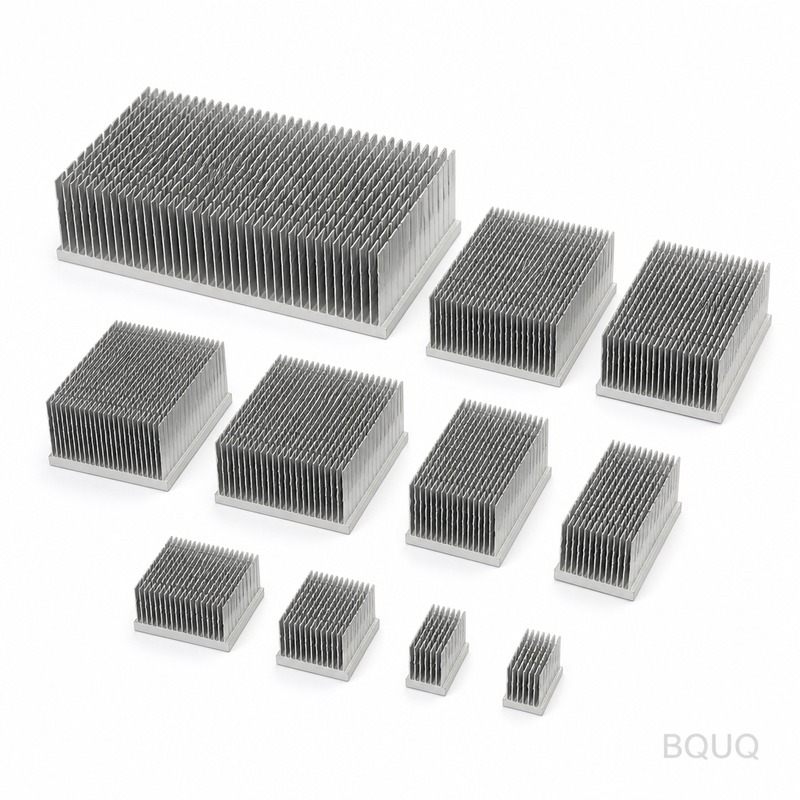
Yes, for passive cooling systems (natural convection, no fans), 6063 is overwhelmingly superior because the performance is directly proportional to thermal conductivity and surface emissivity. A passive heat sink made of 6063 can dissipate 15-20% more heat than an identical 6061 unit, which often allows for a smaller, lighter heat sink design. For example, a 100 mm x 100 mm x 40 mm pin-fin heat sink in 6063 can handle 35 W of heat with a 40°C temperature rise, while the same design in 6061 only handles 28 W. This means that choosing 6063 can reduce the heat sink volume by up to 20% for the same thermal performance, saving material cost and enclosure space in devices like LED drivers, audio amplifiers, and passive-cooled industrial computers.
What Is the Maximum Fin Density Achievable with 6063?
With 6063, you can achieve fin pitches (center-to-center distance) as small as 2.5 mm with a fin thickness of 0.8 mm, yielding a fin density of approximately 4 fins per centimeter. This is not possible with 6061, which requires a minimum pitch of 3.5 mm to avoid tearing during extrusion. Higher fin density increases the surface area by 30-40%, which is critical for natural convection performance.
Can 6061 Be Heat-Treated to Match 6063 Thermal Performance?
No, heat treatment cannot significantly change the thermal conductivity of aluminum alloys. The conductivity difference is due to the alloying elements (magnesium and silicon in both, but different ratios) and the precipitation state. 6061-T6 will always have lower conductivity than 6063-T5 regardless of heat treatment, because the copper content in 6061 (0.15-0.40%) disrupts the aluminum lattice and scatters electrons.
Which Alloy Is Better for Welded Heat Sink Assemblies?
6063 is the preferred choice for welded assemblies because it has better weldability and produces less cracking during TIG or MIG welding. 6061 is prone to hot cracking in the heat-affected zone, especially when welding thin sections. For a brazed or welded fin-and-base assembly, use 6063 for both components to ensure a strong, leak-free joint.
How Does the Anodic Coating Thickness Affect Heat Dissipation?
A thicker anodic coating (20-25 microns) improves emissivity to 0.90 but adds a thermal resistance of approximately 0.5°C/W across the coating layer. For high-heat-flux applications above 10 W/cm², a thin anodize (5-10 microns) is recommended to balance emissivity and thermal contact resistance. 6063 accepts a more uniform coating, so you can achieve high emissivity without localized thickness variations.
What Is the Typical Lead Time for a Custom 6063 Heat Sink Extrusion?
For a custom die, the lead time is 2-3 weeks for die manufacturing and sampling, followed by 1-2 weeks for production. For 6061 machined heat sinks from bar stock, lead time is typically 3-5 days for prototypes but 4-6 weeks for high-volume CNC machining. If your project timeline is critical, 6063 extrusion is faster overall for quantities above 500 units.
When Should You Avoid 6063 and Use 6061?
Use 6061 when the heat sink must also function as a structural bracket, when operating temperatures exceed 100°C, or when the design requires deep drilled holes (depth-to-diameter ratio above 5:1) that cause 6063 to gall and break taps. Also choose 6061 if you need a hard, wear-resistant surface for mounting clips or if the heat sink will be subjected to repeated assembly and disassembly cycles with high torque.
For a definitive engineering decision, send us your thermal load, operating environment, and mechanical constraints. Our team at BQUQ has 20 years of experience manufacturing both 6063 extruded and 6061 CNC-machined heat sinks. We provide free design-for-manufacturing feedback and a 12-hour quoting service. Contact us at Email: sc@bquq.com, WhatsApp: +86 13713157787, or visit www.bquq.com to receive a detailed thermal simulation and cost comparison for your specific application.