Aluminum vs Copper Heat Sink: Which Should You Choose for CNC Machining?
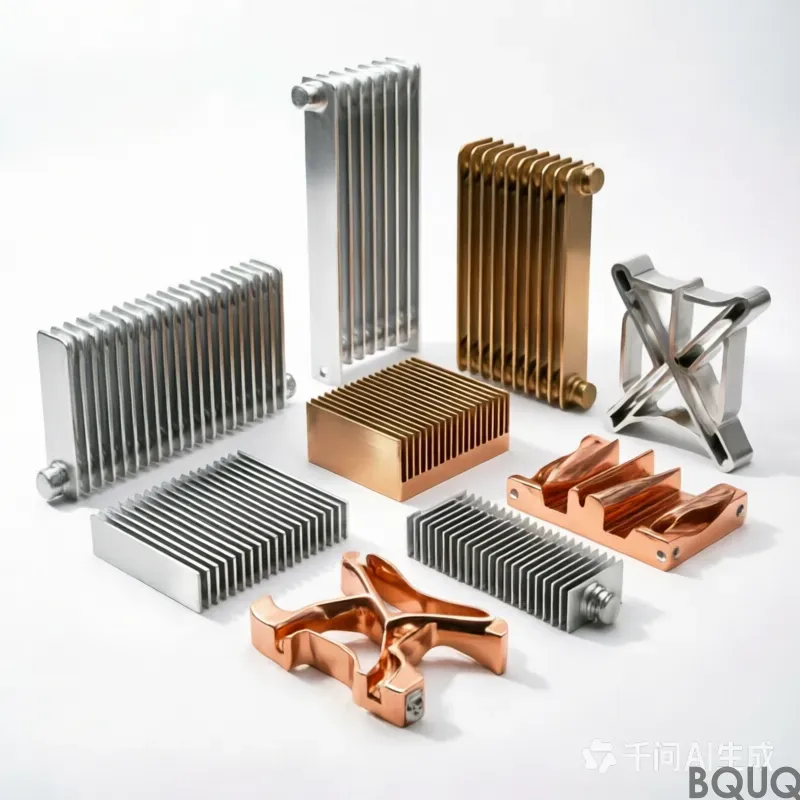
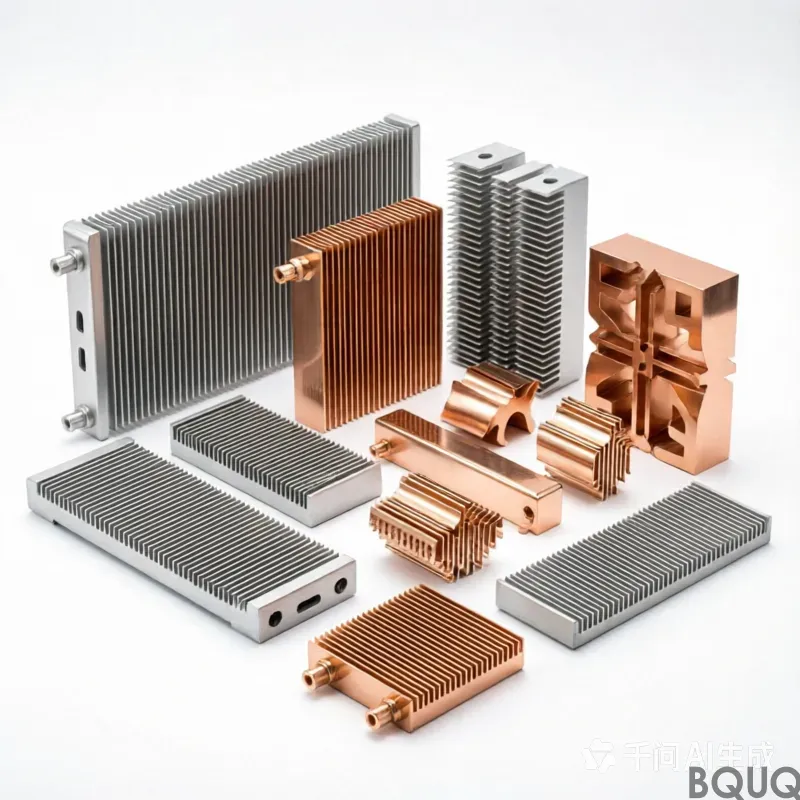
For most applications, aluminum heat sinks are the superior choice due to their lower cost, lighter weight, and adequate thermal conductivity, provided the power density is under 50 W/cm². Copper should only be selected when space constraints limit fin height to less than 10 mm or when the heat source exceeds 60 W/cm², where its 1.6x higher thermal conductivity justifies the 3-4x material cost increase. At BQUQ, we machine both materials daily, and the decision ultimately hinges on your specific thermal budget, weight limits, and environmental corrosion factors.
Thermal Conductivity and Real-World Performance
The theoretical thermal conductivity of pure copper is 401 W/m·K, while aluminum 6061-T6 offers 167 W/m·K and aluminum 6063-T5 provides 201 W/m·K. However, these values do not translate directly into heat sink performance because the limiting factor is typically the convective heat transfer coefficient (h) at the fin surface, which ranges from 5 to 25 W/m²·K for natural convection and 25 to 250 W/m²·K for forced air.
In practical CNC-machined heat sinks, the thermal resistance (Rth) is dominated by the fin geometry. A copper heat sink with 20 fins per inch can achieve a thermal resistance of 0.15 °C/W, whereas an identical aluminum design with the same fin density will have a thermal resistance of 0.28 °C/W. This 46% improvement in thermal performance means that for a 100 W heat source, the copper sink will maintain a 13 °C lower junction temperature.
The efficiency of a fin is defined as the ratio of actual heat dissipation to the theoretical maximum if the entire fin were at base temperature. For a 30 mm tall fin, aluminum fins have an efficiency of 82%, while copper fins achieve 95%. This efficiency advantage allows copper heat sinks to use 30-40% less surface area, which directly translates to smaller envelope sizes in compact electronic enclosures.
Cost Breakdown Comparison
The raw material price difference is substantial. As of Q3 2025, C11000 copper alloy costs between $9.50 and $11.00 per kilogram, while aluminum 6063-T5 costs between $2.80 and $3.20 per kilogram. For a typical CNC-machined heat sink weighing 500 g, the raw material cost for aluminum is $1.50, compared to $5.25 for copper.
Machining costs also diverge significantly. Copper has a machinability rating of 20% compared to aluminum's 100% (baseline for free-cutting brass). Copper requires slower spindle speeds (2,000-4,000 RPM versus 8,000-15,000 RPM for aluminum), generates more heat, and wears carbide tooling 3x faster. Our production data shows that a simple 100 mm x 100 mm x 25 mm finned heat sink costs $6.80 per unit in aluminum with a 10-minute cycle time, versus $18.50 per unit in copper with a 25-minute cycle time.
| Material | Raw Cost per kg | Machining Time per Unit | Tool Wear Index | Surface Finish Achievable | Thermal Conductivity (W/m·K) | Weight per 100x100x25mm Block |
| Aluminum 6063-T5 | $2.80-$3.20 | 10 minutes | 1.0 (baseline) | Ra 0.8 µm | 201 | 675 g |
| Aluminum 6061-T6 | $3.00-$3.50 | 11 minutes | 1.1 | Ra 1.6 µm | 167 | 675 g |
| Copper C11000 | $9.50-$11.00 | 25 minutes | 3.2 | Ra 0.4 µm | 401 | 2,440 g |
| Copper C10100 | $11.50-$13.00 | 28 minutes | 3.5 | Ra 0.2 µm | 391 | 2,440 g |
Weight and Mechanical Considerations
Copper has a density of 8.96 g/cm³, which is 3.3 times heavier than aluminum at 2.70 g/cm³. For a standard 100 mm x 100 mm x 25 mm heat sink with 5 mm fins and 5 mm base, the aluminum version weighs 675 g, while the identical copper geometry weighs 2,440 g. This weight penalty is critical for applications involving vibration, such as automotive electronics or aerospace avionics, where the mounting points must be reinforced.
The coefficient of thermal expansion (CTE) also differs: aluminum has a CTE of 23.1 ppm/°C, while copper is 16.5 ppm/°C. When mounting a copper heat sink to an aluminum IGBT module, the CTE mismatch can cause thermal fatigue at the interface, leading to delamination after 5,000-10,000 thermal cycles. Aluminum-to-aluminum interfaces have a lower mismatch, significantly extending the expected lifetime to 50,000+ cycles.
For vertical installations, the deflection under gravity is 3.5x greater for copper due to its higher density and similar modulus of elasticity. A 200 mm tall copper heat sink will bow 0.12 mm at the tip, whereas aluminum will bow only 0.035 mm. This can affect the air gap in tightly packaged electronics, reducing the convective cooling efficiency by up to 8%.
Corrosion and Environmental Durability
Aluminum forms a protective oxide layer that prevents further oxidation in normal atmospheric conditions. However, in high-humidity environments (above 80% RH) or in the presence of chloride ions, aluminum is susceptible to pitting corrosion. Copper, in contrast, forms a green patina but maintains structural integrity and thermal performance even after years of exposure. For outdoor telecommunications equipment, the expected service life of an aluminum heat sink is 10-15 years, while copper will last 25+ years.
Galvanic corrosion is a critical concern when mixing materials. If you mount an aluminum heat sink on a copper baseplate (or vice versa), the potential difference of 0.45 V will cause rapid corrosion of the aluminum at the junction. This requires the use of nickel-plated copper or anodized aluminum with a dielectric thermal pad. At BQUQ, we recommend a 200 µm nickel plating on copper for any application where it interfaces with aluminum components.
For automotive under-hood applications, the temperature range often spans from -40 °C to +125 °C. Aluminum's higher CTE means that bolted joints will experience greater stress fluctuations, potentially loosening over time. We recommend using Belleville washers or spring-loaded fasteners for aluminum heat sinks in this environment.
Manufacturing Tolerances and Surface Finish
CNC machining allows tight tolerances on both materials, but the practical limits differ. For aluminum heat sinks, we can maintain a flatness of 0.05 mm over a 200 mm length and a surface roughness of Ra 0.8 µm on the base, which is sufficient for most thermal interface material (TIM) applications. Copper, being softer and more ductile, allows a superior surface finish of Ra 0.2 µm, reducing the TIM layer thickness from 50 µm to 25 µm, which improves the interface thermal resistance by 30%.
The minimum fin thickness for CNC machining is 0.5 mm for aluminum and 0.8 mm for copper. Below these values, the cutting forces cause fin deflection and vibration, leading to poor dimensional accuracy. The maximum fin height-to-thickness ratio is 40:1 for aluminum and 30:1 for copper, meaning for a 1 mm thick fin, aluminum can go to 40 mm tall while copper is limited to 30 mm before chatter becomes a problem.
Hole tolerances also differ: aluminum can hold a ±0.02 mm positional tolerance for threaded holes, while copper requires ±0.05 mm due to its tendency to gall and smear during tapping. For press-fit applications, aluminum allows a tighter interference fit of 0.03 mm, whereas copper needs 0.08 mm to achieve the same retention force.
When to Choose Aluminum Over Copper
Choose aluminum heat sinks when the total heat dissipation is below 150 W, the heat flux is under 50 W/cm², and the available mounting footprint is larger than 100 mm x 100 mm. Aluminum is also the clear winner for weight-sensitive applications like drones, portable electronics, and LED lighting fixtures where the entire assembly must stay under 500 g.
Aluminum's lower cost per unit of thermal performance is compelling: for a 50 W dissipation requirement, an aluminum heat sink sized at 120 mm x 120 mm x 40 mm with a thermal resistance of 0.35 °C/W costs $8.50 per unit in quantities of 1,000. The equivalent copper heat sink with the same performance would only need to be 90 mm x 90 mm x 30 mm but would cost $22.00 per unit. The aluminum option saves 61% of the cost at the expense of a 33% larger footprint.
For production volumes exceeding 5,000 units per year, aluminum's faster machining cycle time (10 minutes versus 25 minutes) directly translates to higher throughput on the same CNC equipment. This can reduce the per-unit manufacturing overhead by $1.80 to $2.40, further widening the cost gap.
When Copper Is the Only Acceptable Choice
Copper becomes mandatory in three specific scenarios. First, when the heat source exceeds 60 W/cm², such as in high-power laser diodes or advanced IGBT modules, where the spreading resistance in the base plate must be minimized. A copper base plate reduces the spreading resistance by 60% compared to aluminum, preventing localized hot spots above 120 °C.
Second, when the heat sink height is severely constrained. In 1U server applications, the maximum heat sink height is 28 mm. A copper heat sink with 4 mm fins and a 5 mm base can achieve a thermal resistance of 0.12 °C/W, while an aluminum design with the same height will only reach 0.25 °C/W. The copper design allows a 150 W CPU to operate at 85 °C instead of 98 °C, which is the difference between acceptable and thermal throttling.
Third, when the heat sink must also serve as a structural or electrical conductor. Copper's high electrical conductivity (58 MS/m) allows the heat sink to double as a busbar for high-current applications, eliminating the need for a separate copper conductor and reducing the overall system weight.
Practical Recommendations and Design Tips
For most applications, we recommend starting with aluminum 6063-T5 because of its superior thermal conductivity (201 W/m·K) compared to 6061-T6 (167 W/m·K) and its excellent extrudability. Only switch to 6061-T6 if you need higher mechanical strength (yield strength of 276 MPa versus 214 MPa for 6063-T5).
When designing your heat sink, always specify the thermal resistance target (in °C/W), the maximum ambient temperature, and the allowable pressure drop for forced convection. For natural convection, keep the fin spacing between 6 mm and 12 mm, and for forced air, reduce this to 2 mm to 4 mm. Use a thermal simulation tool (such as FloTHERM or ANSYS Icepak) to verify your design before machining.
Surface treatment is critical: always specify clear anodizing for aluminum (increases emissivity to 0.85, improving radiative heat transfer by 30%) and nickel plating for copper (prevents oxidation and improves solderability). For maximum thermal performance, consider a heat pipe or vapor chamber embedded in either material, which can increase the effective thermal conductivity by 10x.
At BQUQ, we have 20 years of CNC machining experience with both aluminum and copper heat sinks, including complex geometries with over 100 fins, micro-channel designs with 0.3 mm slots, and hybrid aluminum-copper assemblies. Our quality control includes CMM inspection for flatness and parallelism, and thermal resistance testing on a calibrated test bench.
For a rapid comparison of your specific requirements, our engineering team can provide a thermal simulation and cost estimate within 12 hours of receiving your design files. We will recommend the optimal material and fin geometry based on your power dissipation, ambient temperature, and target cost.
To get your project started, send your drawings or STEP files with your thermal requirements to sc@bquq.com or contact us on WhatsApp at +86 13713157787. Visit our website at www.bquq.com to download our heat sink design guide and tolerance specifications. Our team will respond within 12 hours with a detailed quotation including material options, machining feasibility, and lead time, which is typically 7-10 business days for prototype quantities.
Related Articles
- Heat Sinks for Battery Packs: Prevent Thermal Runaway
- How to Attach a Heat Sink Without Screws: Thermal Adhesive Guide
- Best Copper Heat Sinks for CPU Overclocking in 2025
Frequently Asked Questions
When should I choose copper over aluminum for a heat sink?
Choose copper when space constraints limit fin height to less than 10 mm or when the heat source exceeds 60 W/cm². Copper's 1.6x higher thermal conductivity justifies its 3-4x material cost increase in these scenarios, though aluminum is preferred for power densities under 50 W/cm².
What is the actual thermal performance difference between copper and aluminum heat sinks?
For a CNC-machined heat sink with 20 fins per inch, copper achieves 0.15 °C/W thermal resistance versus 0.28 °C/W for aluminum—a 46% improvement. For a 100 W heat source, copper maintains a 13 °C lower junction temperature. Copper fins also have 95% efficiency versus 82% for aluminum at 30 mm fin height.
How much more expensive is a copper heat sink compared to aluminum?
A 100 mm x 100 mm x 25 mm finned heat sink costs $18.50 per unit in copper versus $6.80 in aluminum. Raw material for a 500 g sink is $5.25 for copper versus $1.50 for aluminum. Copper also requires 25-minute machining versus 10 minutes for aluminum, with 3x faster tool wear.
What are the thermal conductivity values for the materials you machine?
Pure copper offers 401 W/m·K, while aluminum 6063-T5 provides 201 W/m·K and aluminum 6061-T6 offers 167 W/m·K. However, real-world performance is limited by convective heat transfer coefficient (5-25 W/m²·K natural, 25-250 W/m²·K forced air), so fin geometry dominates thermal resistance.