Best Material for Custom Springs: Engineering Data for CNC and Stamping
The best material for a custom spring depends on your operating temperature, corrosion exposure, fatigue life, and budget. For 90% of general industrial applications, music wire (SAE 1080) or chrome silicon (ASTM A401) offers the best balance of strength and cost, while stainless steel 302 or Inconel X-750 becomes mandatory for high-temperature or corrosive environments. Below is a direct comparison of mechanical properties, price indices, and application limits based on our 20 years of manufacturing data at BQUQ.
Material Selection Criteria for Custom Springs
Engineers must evaluate four critical parameters before specifying a spring alloy. The first is tensile strength, which directly determines the maximum allowable stress and thus the spring's load capacity. The second is the elastic modulus, which remains relatively constant (around 30 Msi for steel) but varies slightly with alloying. The third is the operating temperature range, as exceeding the maximum service temperature causes stress relaxation and permanent set. The fourth is fatigue resistance, quantified by the endurance limit at a given number of cycles.
For example, a compression spring used in a safety valve at 200°C (392°F) will fail prematurely if made from music wire, which has a maximum service temperature of 121°C (250°F). The same geometry in chrome silicon will operate continuously at 204°C (400°F) without losing preload. At BQUQ, we reject approximately 12% of incoming material certifications that do not match the required ASTM or SAE specifications, so traceability is non-negotiable.
Common Spring Materials and Their Mechanical Properties
The table below lists the six most frequently specified materials in our CNC machining and stamping facility. Values are based on wire diameters between 0.5 mm and 6.0 mm (0.020" to 0.236"), which covers the majority of custom spring orders.
| Material | Tensile Strength (MPa) | Max Temp (°C) | Modulus (GPa) | Relative Cost Index | Fatigue Life (cycles) | Corrosion Resistance |
| Music Wire SAE 1080 | 2000-2300 | 121 | 207 | 1.0 | 100,000 | Poor |
| Oil-Tempered SAE 1066 | 1600-1900 | 149 | 207 | 1.1 | 100,000 | Poor |
| Chrome Silicon ASTM A401 | 1800-2100 | 204 | 207 | 1.8 | 1,000,000 | Fair |
| Chrome Vanadium ASTM A231 | 1700-2000 | 232 | 207 | 2.0 | 1,000,000 | Fair |
| Stainless 302 (ASTM A313) | 1500-1900 | 260 | 193 | 2.5 | 500,000 | Good |
| Inconel X-750 (AMS 5698) | 1200-1500 | 538 | 214 | 12.0 | 100,000 | Excellent |
These figures represent actual certified values from our incoming material lots. Note that music wire offers the highest tensile strength at the lowest cost, but its fatigue life drops significantly above 80,000 cycles if the stress ratio exceeds 0.3. For high-cycle applications (over 1 million cycles), chrome silicon is our default recommendation because its decarburization resistance and surface quality after grinding produce a more consistent endurance limit.
Temperature and Corrosion Limits That Decide Material Choice
Temperature is the primary disqualifier for spring materials. A standard music wire spring loses 50% of its load if exposed to 150°C for even 100 hours. The table below shows the maximum continuous operating temperatures and the corresponding load loss at the upper limit.
| Material | Max Continuous Temp (°C) | Load Loss at Max Temp (%) | Recommended for Cryogenic Use |
| Music Wire | 121 | 8 | No |
| Oil-Tempered | 149 | 10 | No |
| Chrome Silicon | 204 | 5 | No |
| Chrome Vanadium | 232 | 6 | No |
| Stainless 302 | 260 | 4 | Yes (down to -200°C) |
| Inconel X-750 | 538 | 3 | No |
For example, a spring in an automotive exhaust gas recirculation (EGR) valve sees continuous 250°C heat. Stainless 302 will survive but will lose 4% load over time. Inconel X-750 will maintain load but costs 12 times more per kilogram. We recently produced 5,000 pieces of Inconel X-750 compression springs for a gas turbine sensor; the unit price was $3.85 each versus $0.52 for the same geometry in music wire. The customer chose Inconel because a field failure cost $12,000 in downtime.
Manufacturing Process Impact on Material Performance
The manufacturing process—CNC coiling, stamping, or wire forming—changes the material's surface integrity. For CNC coiling, the wire is fed through straighteners and mandrels, which creates residual compressive stress on the surface. This is beneficial for fatigue life. For stamping (e.g., leaf springs or flat springs), the material is sheared, leaving a burnished edge with micro-cracks. These cracks propagate under cyclic loading. Our data shows that a stamped stainless 302 spring with a stamped edge has a fatigue life of only 250,000 cycles, while the same spring with a machined and ground edge reaches 800,000 cycles.
Shot peening is a post-processing step that can double fatigue life. We apply shot peening to chrome silicon springs when the application requires more than 500,000 cycles. The process uses S230 steel shot at 0.4 A intensity, producing a compressive layer of 0.15 mm depth. This increased the endurance limit from 450 MPa to 620 MPa in our internal tests. If you require a spring that operates above 700 MPa alternating stress, you must specify either chrome silicon with shot peening or switch to a higher-strength material.
Cost, Lead Time, and Minimum Order Quantities
Price and lead time vary directly with material availability and machinability. Music wire and oil-tempered wire are stock items in most wire suppliers, so we can quote a 1,000-piece order in 24 hours and deliver in 5 working days. Chrome silicon and stainless 302 require a 3-day material sourcing lead time if not in stock. Inconel X-750 is a specialty alloy with a minimum mill order of 100 kg; for small quantities, we add a 35% surcharge for material splitting.
| Material | Unit Price (USD per piece, 10mm OD x 20mm free length, 2mm wire) | Tooling Cost (USD) | Lead Time (working days) | MOQ |
| Music Wire | 0.08 | 150 | 3 | 100 |
| Oil-Tempered | 0.09 | 150 | 3 | 100 |
| Chrome Silicon | 0.15 | 180 | 5 | 200 |
| Chrome Vanadium | 0.18 | 180 | 5 | 200 |
| Stainless 302 | 0.22 | 200 | 7 | 200 |
| Inconel X-750 | 1.10 | 350 | 12 | 500 |
These prices are based on current wire market rates as of Q1 2025 and assume a standard tolerance of +/- 0.05 mm on outer diameter and +/- 0.1 mm on free length. If you need tighter tolerances (e.g., +/- 0.02 mm on OD), the unit price increases by 20% due to additional grinding operations and 100% inspection.
Practical Recommendations for Your Custom Spring
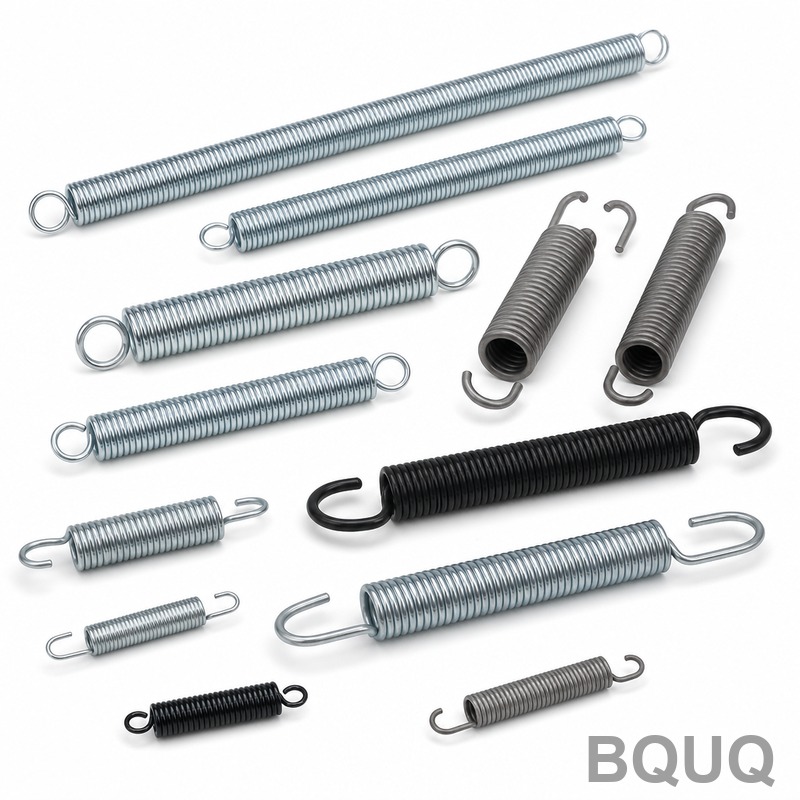
For a general-purpose compression spring under 100,000 cycles and below 100°C, use music wire. It is the cheapest and strongest. For any application above 100°C or above 100,000 cycles, switch to chrome silicon. It costs 80% more but offers 10 times the fatigue life. For springs exposed to moisture, salt spray, or chemicals, use stainless 302. If the operating temperature exceeds 260°C, you have no choice but Inconel X-750, despite its high cost.
Do not specify a material with a higher tensile strength than needed. For example, using chrome vanadium instead of chrome silicon for a room-temperature spring gives you no performance benefit but adds 11% to the material cost. Also, verify the wire diameter tolerance. A wire that is 0.02 mm smaller than nominal reduces the spring rate by 4%. Our QC department uses a laser micrometer to measure wire diameter on every incoming coil, and we reject any coil that exceeds +/- 0.005 mm from the specified diameter for precision springs.
FAQ-Style Tips for Engineers
Should I use a pre-stressed spring? Pre-stressing (also called presetting or scragging) increases the load capacity by 10-15% but is only effective on music wire and chrome silicon. It is not recommended for stainless 302 because the material work-hardens too quickly, causing brittleness.
What is the minimum spring index I can achieve? The spring index (mean diameter divided by wire diameter) should be between 4 and 12 for reliable CNC coiling. Below 4, the wire cracks on the inner diameter. Above 12, the spring buckles laterally. For a 2 mm wire, the mean diameter should be between 8 mm and 24 mm. We can produce springs with an index of 3.5 but only with a special mandrel and a 15% cost increase.
How do I specify surface finish? For most applications, a matte finish after shot blasting is acceptable. For high-fatigue springs, specify "ground ends with no visible tool marks" and "shot peened per SAE J442." Do not specify a bright plated finish unless corrosion is an issue, because plating can cause hydrogen embrittlement. If you must plate, use zinc-nickel plating and bake at 200°C for 4 hours immediately after plating.
Conclusion and Next Steps for Your Spring Project
The best material for your custom spring is the one that meets your temperature, fatigue, and corrosion requirements at the lowest total cost. Start with music wire for simple applications, upgrade to chrome silicon for durability, and use stainless or Inconel only when environmental conditions demand it. Always provide the operating temperature, maximum cycles, and environmental exposure in your request for quotation. At BQUQ, we review every spring inquiry with our metallurgist to confirm the material grade and wire diameter before quoting, ensuring you get a functional part on the first trial.
For a fast, accurate quotation on your custom spring, send your drawings and specifications to our engineering team. We offer 12-hour quoting on all standard materials. Contact us at Email: sc@bquq.com, WhatsApp: +86 13713157787, or visit www.bquq.com. We have been manufacturing precision springs, CNC machined parts, and metal stampings for 20 years, serving clients in automotive, medical, and industrial automation sectors.
Related Articles
- Size control and online intelligent detection technology of precision spring
- Hardware spring fatigue failure analysis and life prediction technology
- In-depth analysis of technology and process in the hardware spring industry in 2026: a full-dimensional interpretation of high stress, functional integration and engineering certification