Blanking vs Piercing vs Punching: Key Differences in Stamping
The direct answer is that blanking, piercing, and punching are three distinct shearing operations in metal stamping, differentiated by the fate of the removed material and the function of the resulting part. Blanking cuts a finished part (the blank) out of a larger sheet, where the blank is the product and the surrounding scrap is discarded. Piercing removes material to create a hole or opening, where the removed slug is scrap and the sheet with the hole is the product. Punching is a broader term that encompasses both operations, but in precision engineering, it is often used interchangeably with piercing for creating holes, while some contexts use it to describe a single-station process that combines multiple cutting actions.
Defining the Three Shearing Operations
In sheet metal stamping, all three processes rely on a punch and die set to induce fracture. The fundamental distinction lies in the workpiece outcome. For blanking, the punch diameter determines the outer contour of the final part. The die opening is slightly larger, and the blank is pushed into the die. For example, a 50 mm diameter blanking operation uses a punch of 50.00 mm and a die with an opening of 50.10 mm to achieve a clean shear zone. The blanked part will have a slight edge rollover and a burnish zone, typically 30-50% of the material thickness.
Piercing is the inverse. The die opening matches the desired hole size, and the punch is smaller. If you need a 10 mm hole in a 2 mm thick stainless steel plate, the punch is ground to 10.00 mm and the die to 10.06 mm. The slug falls through or is ejected, leaving a hole with a characteristic fracture zone on the underside. In our factory in Dongguan, we maintain piercing clearances of 5-10% of material thickness per side for mild steel, which yields holes with dimensional accuracy of plus or minus 0.05 mm.
Punching, as a general term, refers to any process where a punch forces material through a die. However, in high-volume production, punching often describes a multi-tool operation where a press performs blanking, piercing, and forming in a single stroke. A progressive die may have 12 stations: first piercing pilot holes, then blanking the outer profile, then bending. The key metric is the cost per stroke, which for a 250-ton press running at 60 strokes per minute is approximately 0.15 USD per part including tooling amortization.
Critical Differences in Tooling Geometry and Clearance
The clearance between the punch and die is the single most important variable separating these operations. For blanking, the clearance must be larger to reduce punch wear and produce a part with a higher ratio of burnish to fracture zone. Typical clearance for blanking 3 mm thick aluminum 5052 is 0.09 mm per side. For piercing the same material, the clearance is reduced to 0.06 mm per side to achieve a sharper hole edge and prevent excessive burr height.
Tool steel selection differs as well. Blanking punches experience high compressive loads on the cutting edge and are often made of D2 or M2 high-speed steel, hardened to 60-62 HRC. Piercing punches, especially for holes smaller than 6 mm, require higher toughness to resist breakage, so we use powdered metallurgy steel like ASP23 at 64-66 HRC. The die plates for blanking are frequently lined with tungsten carbide inserts, which can sustain 1 million strokes before resharpening.
The sheared edge quality also varies. In blanking, the desired outcome is a smooth edge on the outer perimeter, so we optimize the clearance to maximize the burnish zone. In piercing, the critical edge is the hole wall, and a slight rollover on the top edge is acceptable. For punching operations that combine both, the die spring pressure must be balanced to strip the sheet from the punch after retraction, typically requiring a stripping force of 10-15% of the cutting force.
Material Utilization and Scrap Economics
Material cost dominates stamping economics, often representing 60-70% of the total part cost. Blanking is the most material-intensive because the scrap skeleton around each blank is unavoidable. For a rectangular blank of 40 mm by 60 mm in a 1.5 mm sheet, the scrap percentage is 32% if nested with 5 mm spacing. Piercing adds scrap in the form of slugs, but these are small; a 8 mm hole in a 100 mm square part removes only 0.5% of the material. Punching with a progressive die can optimize nesting to reduce overall scrap to 25% or lower.
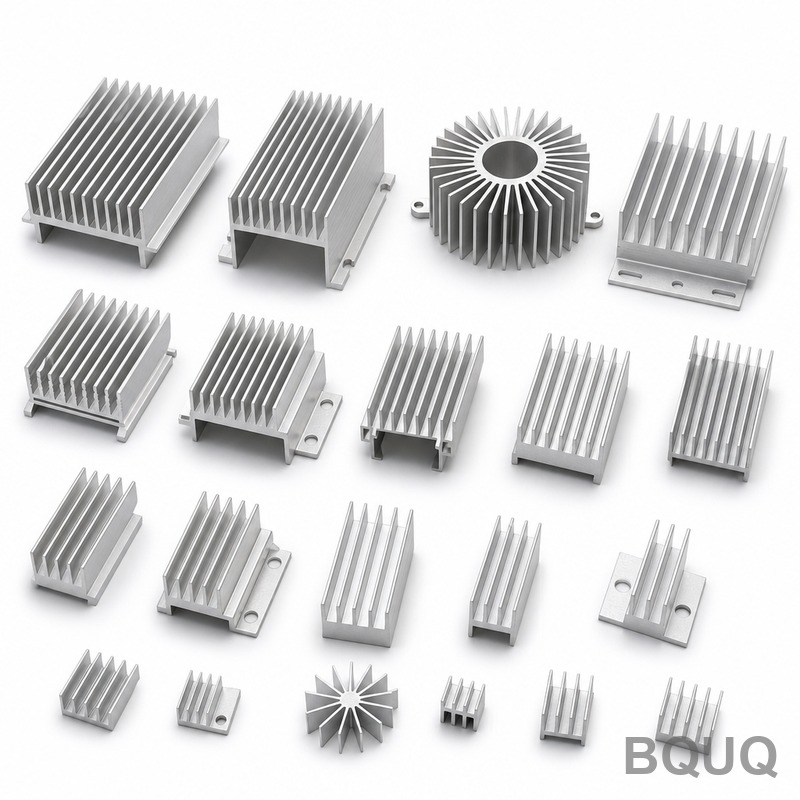
Scrap value differs. Blanking scrap is usually a clean skeleton that can be baled and sold at 80-85% of the primary metal price. Piercing slugs are often small enough to be collected in a bin under the die and can be recycled at the same rate, but they may be contaminated with lubricant. In our heat sink production, we use dry film lubricants to keep slugs clean, increasing their scrap value by 5%.
The press tonnage also varies. Blanking a 100 mm diameter circle from 2 mm thick stainless steel 304 requires a cutting force of approximately 28 tons, calculated using shear strength of 520 MPa. Piercing a 20 mm hole in the same sheet requires only 8 tons. Punching with a combination die may require 35-40 tons if multiple operations occur simultaneously, which increases the machine size and the energy cost per part from 0.02 USD to 0.05 USD.
Tolerances and Surface Finish Achievable
The achievable tolerances are a primary differentiator in engineering specifications. Blanking can hold the outer dimension to plus or minus 0.05 mm for parts up to 150 mm in size, with a flatness of 0.1 mm over the entire surface. Piercing holds hole diameter to plus or minus 0.03 mm, and hole position relative to a datum to plus or minus 0.05 mm. Punching with fine-blanking technology, where a V-ring is used to clamp the material, can achieve plus or minus 0.01 mm tolerances but requires a dedicated press and tooling cost that is 30% higher.
Surface finish on the sheared edge is measured by the percentage of burnish zone. For blanking, a good industrial standard is 50% burnish on the outer edge, meaning the top half is smooth and the bottom half has a fracture. For piercing, the hole wall should have 60% burnish to ensure good fatigue life for load-bearing holes. Burr height is another critical parameter. Blanking produces a burr of 0.05 mm on the die side, which may require a secondary deburring operation. Piercing creates a burr of 0.03 mm, but this can be reduced to 0.01 mm by using a punch with a slight shear angle.
Internal stresses also differ. Blanking leaves residual tensile stress around the cut edge, which can cause distortion in thin sheets. Piercing leaves compressive stress around the hole, which can be beneficial for hole expansion operations. For heat sinks, we often use punching to create louvered slots, where the material is not fully pierced but pushed to one side, creating a fin. This operation requires a clearance of 12% of material thickness to allow the material to bend without tearing.
Production Speed and Tool Life Comparison
Production rates are similar across all three operations because they are limited by press speed and material handling. A standard C-frame press of 110 tons can run at 80 strokes per minute for blanking small parts, but this drops to 60 strokes per minute for piercing due to the need for slug ejection. Progressive die punching can achieve 200-400 parts per minute for small connectors because the strip is fed continuously.
Tool life is where significant differences appear. Blanking tools typically last 150,000 to 300,000 strokes before requiring regrinding, depending on material. Piercing punches have a shorter life of 100,000 strokes for holes under 5 mm due to the high stress concentration at the cutting edge. Punching tools with combined operations, such as a lance and form, have the shortest life at 80,000 strokes because of the complex loading. The cost of regrinding is approximately 50 USD per tool set, and the downtime is 2 hours per regrind, which affects the total cost per part.
We have observed that using a stripper plate with a precision guide bushing can increase piercing punch life by 40%. For blanking, using an angled shear on the punch face reduces the peak force by 30% but increases the tool cost by 15%. In our experience, the optimal economic batch size for blanking is 5,000 parts, for piercing is 8,000 parts, and for progressive die punching is 50,000 parts, because of the higher initial tooling investment for the latter.
Cost and Lead Time Comparison
The cost structure for these operations is driven by tooling complexity and secondary operations. A simple blanking die for a single part costs 800 to 1,500 USD and has a lead time of 2 weeks. A piercing die with multiple holes costs 1,200 to 2,500 USD and takes 3 weeks. A progressive punching die with 8 stations costs 5,000 to 15,000 USD and requires 6-8 weeks to build. The per-part cost at 10,000 pieces is 0.35 USD for blanking, 0.28 USD for piercing (since it is often done in a die with multiple holes), and 0.18 USD for progressive punching due to the elimination of manual handling.
Secondary operations also differentiate the total cost. Blanked parts often need a deburring process, adding 0.02 USD per part. Pierced parts may need a reaming operation if the hole tolerance is tighter than plus or minus 0.02 mm, adding 0.05 USD per hole. Punched parts with fine blanking may not need any secondary finishing, which justifies the higher tooling cost for high volumes.
Material thickness limits also vary. Blanking is most economical for materials from 0.5 mm to 6 mm thick. Piercing is effective up to 12 mm thick, but the punch force increases linearly, and the slug ejection becomes problematic. Punching with a hydraulic press can handle up to 25 mm thick plates, but the sheared edge quality degrades significantly beyond 6 mm, requiring laser cutting for better accuracy.
| Operation | Material Thickness Range | Achievable Tolerance | Typical Burr Height | Tool Life (strokes) | Per-Part Cost at 10k pcs | Lead Time for Tooling |
| Blanking | 0.5 - 6.0 mm | plus or minus 0.05 mm | 0.05 mm | 200,000 | 0.35 USD | 2 weeks |
| Piercing | 0.5 - 12.0 mm | plus or minus 0.03 mm | 0.03 mm | 150,000 | 0.28 USD | 3 weeks |
| Punching (progressive) | 0.5 - 4.0 mm | plus or minus 0.01 mm | 0.02 mm | 80,000 | 0.18 USD | 6-8 weeks |
Practical Recommendations for Process Selection
For a part with a simple outer shape and no internal holes, use blanking. It is the fastest and least expensive way to produce a flat part. Ensure the sheet thickness is uniform and the material has a consistent grain direction to avoid cracking on the sheared edge.
For parts requiring multiple holes with tight positional accuracy, use piercing in a compound die. This allows all holes to be pierced in a single press stroke, holding the center-to-center distance to plus or minus 0.05 mm. Avoid piercing holes smaller than the material thickness, as this causes excessive punch wear and breakage.
For high-volume production of complex parts with holes, bends, and forms, invest in a progressive punching die. The initial tooling cost is higher, but the unit cost drops significantly above 50,000 parts. Ensure the strip width is calculated with a minimum of 2.5 times the material thickness between the blank edge and the strip edge to prevent distortion.
When specifying tolerances, always reference the stamping standard, such as DIN 6935 for general tolerances or ISO 2768-m for machining. Be aware that the sheared edge will always have a rollover radius of 10-15% of the material thickness, which may interfere with tight assembly fits. If a clean edge is required, specify a secondary operation like shaving or machining.
Final Engineering Considerations
Understanding the difference between blanking, piercing, and punching is not just semantic. It directly affects your tooling budget, achievable precision, and production speed. Correctly classifying the operation ensures that the die designer uses the proper clearance, the press operator selects the correct tonnage, and the quality inspector measures the right characteristics.
We encourage you to review your current stamping drawings and clarify the operation names with your supplier. A simple change from "punching" to "piercing" in your specification can reduce the tooling cost by 15% because the die design is simpler. Similarly, specifying blanking instead of laser cutting for simple shapes can reduce your part cost by 50% while maintaining adequate tolerances.
For your next project, send us your 3D model or 2D drawing. Our engineering team will analyze the part geometry and recommend the most economical stamping process. We have 20 years of experience in CNC machining, metal stamping, springs, and heat sinks, serving clients across North America and Europe. We respond to all inquiries within 12 hours with a preliminary quote and feasibility feedback.
Email your drawings to sc@bquq.com or contact us on WhatsApp at +86 13713157787. Visit our website www.bquq.com to see our capabilities and quality certifications. We look forward to optimizing your stamping production with our precision tooling and competitive pricing.