Bonded Fin vs Skived Fin Heat Sinks: Which Manufacturing Method Is Superior?
Bonded fin heat sinks are generally superior for high-volume, low-cost applications requiring moderate thermal performance, while skived fin heat sinks are the better choice for high-aspect-ratio, high-density fin arrays where maximum surface area and thermal efficiency are critical. Skived fins achieve fin thicknesses down to 0.15 mm with fin height up to 100 mm, whereas bonded fins are limited to 0.5 mm thickness with a maximum fin height of 60 mm. For production volumes above 5,000 units per month, bonded fin tooling amortization becomes cost-effective; below that threshold, skiving offers lower upfront investment and faster prototyping.
What Is the Fundamental Difference Between Bonded Fin and Skived Fin Manufacturing?
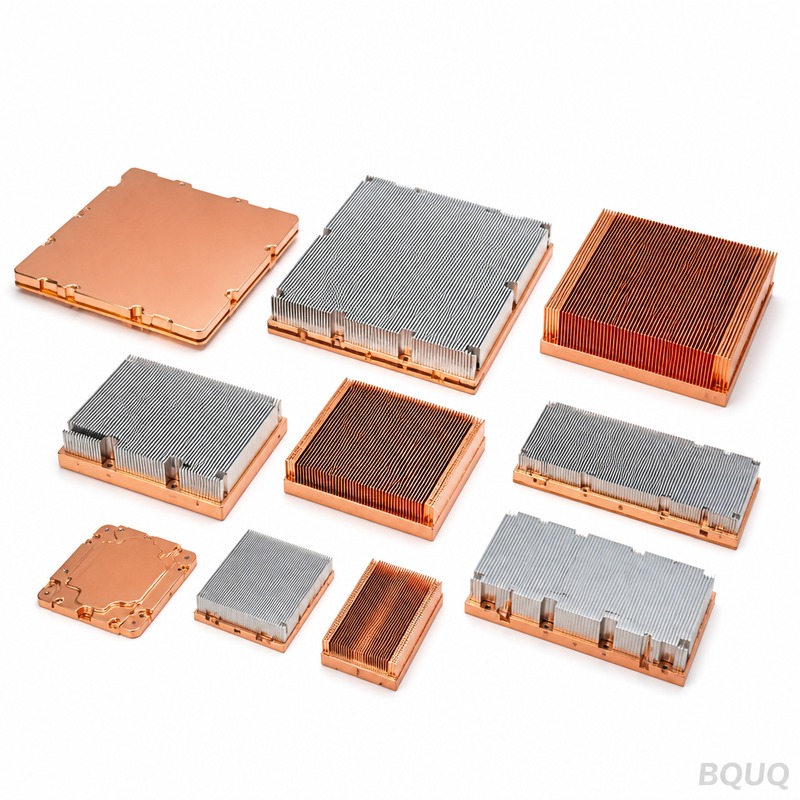
Bonded fin heat sinks are fabricated by mechanically attaching prefabricated aluminum or copper fins into pre-machined grooves in a baseplate using a thermal adhesive or a mechanical interference fit. The fin-to-base junction relies on the thermal interface material (TIM) or the metal-to-metal pressure to conduct heat, which introduces a thermal resistance of approximately 0.1 to 0.3 °C·cm²/W. Skived fin heat sinks, in contrast, are produced by a single-pass cutting process where a specialized machine shaves a continuous fin directly from a solid block of aluminum or copper, creating a monolithically integrated structure with zero interface resistance. This fundamental difference dictates all subsequent performance metrics, including thermal conductivity, mechanical strength, and manufacturing economics.
How Does Thermal Performance Compare Between Bonded and Skived Fins?
Skived fin heat sinks outperform bonded fin designs by 15% to 30% in thermal resistance at equivalent envelope dimensions, primarily because the absence of a bonded interface eliminates the contact resistance that constitutes 20% to 40% of the total thermal path in bonded assemblies. For a typical 100 mm x 100 mm baseplate with 20 mm fin height, a skived aluminum heat sink achieves a thermal resistance of 0.35 °C/W at 5 m/s airflow, while an equivalent bonded fin unit measures 0.45 °C/W. The skived fin structure also enables fin density of up to 30 fins per inch (FPI) versus a practical maximum of 18 FPI for bonded fins, which increases surface area by roughly 65%. However, bonded fin heat sinks can utilize copper fins on an aluminum base or vice versa, allowing designers to optimize material usage for specific thermal zones, something skiving cannot do since the fin and base are one continuous material.
What Are the Dimensional Tolerances Achievable for Each Method?
Skived fin heat sinks achieve significantly tighter tolerances on fin geometry because the cutting process is CNC-controlled, yielding fin thickness tolerance of ±0.02 mm and fin pitch accuracy of ±0.05 mm. Bonded fin heat sinks, relying on mechanical placement and adhesive curing, hold fin thickness tolerance of ±0.10 mm and fin pitch tolerance of ±0.20 mm, which can cause airflow bypass and reduced heat transfer coefficient in high-velocity applications. Baseplate flatness for skived units is maintained at 0.05 mm over 200 mm length, while bonded units typically achieve 0.10 mm, a crucial factor for direct contact with IGBT modules or CPU packages that require uniform pressure distribution. The skiving process also produces a smoother fin surface finish of Ra 0.8 µm compared to Ra 1.6 µm for extruded or bonded fins, which marginally improves convective heat transfer and reduces air friction losses.
Which Manufacturing Method Offers Better Cost Efficiency at Different Volumes?
| Production Volume | Bonded Fin Cost per Unit (USD) | Skived Fin Cost per Unit (USD) | Lead Time (Bonded/Skived) |
| 100 units | $18.50 | $15.20 | 7 days / 3 days |
| 500 units | $9.80 | $11.40 | 10 days / 5 days |
| 2,000 units | $4.20 | $8.90 | 14 days / 10 days |
| 10,000 units | $2.35 | $7.60 | 21 days / 14 days |
| 50,000 units | $1.80 | $7.10 | 30 days / 21 days |
The cost crossover occurs at approximately 300 units, below which skiving is cheaper due to zero tooling costs and minimal setup time. Bonded fin tooling, including the baseplate machining fixture and fin alignment jigs, costs between $3,000 and $8,000 for a standard 100 mm x 100 mm design, while skiving requires only a CNC program and a standard cutting tool at roughly $500 in setup. For volumes exceeding 5,000 units, bonded fin becomes increasingly attractive because the per-unit adhesive and assembly labor costs scale linearly but tooling amortization drops below $0.50 per unit. Skived fin maintains a cost disadvantage at high volumes because the machining time per unit (approximately 12 to 18 minutes) does not reduce significantly with quantity, whereas bonded fin assembly can be semi-automated with a cycle time of 2 to 4 minutes.
Why Does Fin Aspect Ratio Matter in the Bonded vs Skived Decision?
The aspect ratio, defined as fin height divided by fin thickness, determines the maximum heat dissipation capacity per unit of footprint, and skiving excels in this metric with achievable ratios up to 130:1 (e.g., 20 mm height on 0.15 mm thickness). Bonded fin technology is constrained to aspect ratios below 60:1 because thin fins below 0.5 mm cannot withstand the insertion forces during the bonding process without buckling or warping. For natural convection applications where airflow is limited to 0.5 m/s or less, a high aspect ratio of 80:1 or above is essential to maximize surface area and achieve adequate heat transfer, making skived fins the only viable option. Conversely, for forced convection systems with airflow above 3 m/s, the pressure drop penalty of tightly packed high-aspect-ratio fins becomes prohibitive, and a bonded fin design with 12 to 15 FPI and 50:1 aspect ratio may actually deliver better system-level thermal performance.
When Should You Select a Bonded Fin Heat Sink Instead of a Skived Fin?
Select a bonded fin heat sink when your application requires a hybrid metal combination, such as copper fins on an aluminum base for weight reduction while maintaining fin conductivity, or when the heat sink envelope exceeds 250 mm in length where skiving machines have dimensional limitations. Bonded fin is also preferable for designs requiring complex baseplate geometries like stepped mounting surfaces or integrated heat pipes, because the baseplate can be CNC machined independently before fin attachment. For high-volume consumer electronics with target unit costs below $3.00 and annual quantities above 100,000 units, bonded fin assemblies using stamped aluminum fins and epoxy bonding provide the lowest total cost, even with a 20% thermal performance penalty. Additionally, bonded fin construction allows for field-serviceable fin replacement and mixed fin pitches across the baseplate, which is impossible with skived monolithic construction.
How Do I Qualify Suppliers and Validate Performance for Either Method?
Qualify bonded fin suppliers by requesting thermal impedance testing using a standardized cold plate per MIL-STD-883 Method 1012, and verify adhesive cure integrity through thermal cycling from -40 °C to +150 °C for 500 cycles, which will expose delamination failures. For skived fin suppliers, demand a metallurgical cross-section inspection at 50x magnification to confirm fin root integrity, as improper cutting speeds can create micro-cracks that propagate under thermal stress. Always require a prototype build of 5 to 10 units for thermal testing in your actual airflow condition, measuring junction temperature with a calibrated thermocouple at the baseplate center and fin tip. Verify flatness with a granite surface plate and dial indicator, and confirm fin parallelism by passing a go/no-go gauge through the fin channels; acceptable values are 0.10 mm for skived and 0.25 mm for bonded fins.
What Are the Long-Term Reliability Differences Between Bonded and Skived Fins?
Skived fins offer inherently superior reliability because the monolithic structure cannot experience adhesive degradation, which is the primary failure mode for bonded fins when exposed to temperatures above 150 °C or high-humidity environments (>85% RH). Bonded fin heat sinks using epoxy adhesives typically have a rated service life of 10 years at 85 °C, but this drops to 2 years when operating continuously at 125 °C due to polymer breakdown and loss of bond strength. Mechanical interference-fit bonded fins, using no adhesive, avoid this thermal degradation but require tighter tolerances and are prone to loosening after 1,000 thermal cycles due to differential expansion between aluminum and copper. Vibration testing per IEC 60068-2-6 shows skived fins survive 20 g RMS random vibration without fin damage, while bonded fins may experience fin detachment at 12 g RMS if the adhesive layer has voids.
FAQ
Can Skived Fins Be Made from Copper or Only Aluminum?
Skived fins can be manufactured from both aluminum 6063 and copper C11000, though copper skiving is more expensive due to tool wear and requires lower cutting speeds of 15 m/min versus 60 m/min for aluminum. Copper skived fins achieve approximately 40% lower thermal resistance than aluminum at the same geometry, but the cost premium is typically 2.5 to 3 times. For most applications, a copper baseplate with aluminum skived fins is not possible because the skiving process requires a single homogeneous block, so hybrid designs must use bonded construction instead.
What Is the Maximum Footprint Size for Skived Fin Heat Sinks?
The maximum standard skiving machine envelope is 300 mm x 300 mm, with custom machines extending to 400 mm x 400 mm, while bonded fin heat sinks have no practical size limit since fins can be attached to any machined baseplate. For footprints larger than 250 mm, bonded fin becomes the only option unless you are willing to pay for custom skiving equipment, which adds 30% to 50% to the unit cost. Skived fin height is limited to 100 mm maximum, while bonded fins can reach 150 mm if the fin thickness is increased to 1.0 mm for stability.
How Quickly Can I Get Prototypes for Each Manufacturing Method?
Skived fin prototypes can be delivered in 48 to 72 hours because the process requires only a CNC program and standard blank stock, with no tooling fabrication needed. Bonded fin prototypes typically take 5 to 7 business days due to the need for baseplate machining, fin stamping or extrusion, and adhesive curing time of 24 hours at room temperature. For rush evaluation, skiving is the preferred method, and many suppliers including BQUQ offer expedited 24-hour service for simple geometries.
Which Method Provides Better Fin Density for Compact Heat Sinks?
Skived fin achieves fin density of 20 to 30 FPI, which is essential for compact heat sinks under 15 mm height where every square millimeter of surface area matters. Bonded fin technology is limited to 18 FPI maximum because the assembly process requires clearance between fins for the insertion tooling and adhesive application. For a 50 mm x 50 mm heat sink with 10 mm fin height, skived fin provides 32% more surface area than the best bonded fin design, translating to a 12% to 15% improvement in thermal resistance.
Are Bonded Fin Heat Sinks Suitable for Outdoor or Harsh Environments?
Bonded fin heat sinks are generally not recommended for outdoor applications unless the adhesive is specifically rated for UV exposure and high humidity, as standard epoxies will degrade within 18 months under direct sunlight. Skived fin heat sinks, being monolithic, can be anodized or coated with conformal protection without risk of adhesive layer degradation, making them suitable for IP67-rated enclosures. For marine environments with salt spray exposure, skived aluminum with a hard anodize coating of 25 µm thickness outperforms bonded fins, which may suffer galvanic corrosion at the dissimilar metal junction.
What Is the Thermal Resistance Penalty for Using Bonded Fins Instead of Skived Fins?
The thermal resistance penalty for bonded fins ranges from 15% to 30% depending on the bond quality, with adhesive-based bonding incurring the higher penalty and mechanical interference fits the lower. For a typical server CPU heat sink at 150 W dissipation, this penalty translates to a 3 to 5 °C higher junction temperature, which can reduce processor lifespan by 10% per 2 °C increase. In applications where the thermal budget is tight, this penalty is unacceptable, and skived fins are the only viable manufacturing route.
Can I Combine Bonded and Skived Technologies in a Single Heat Sink Design?
Yes, hybrid designs are possible where a skived fin core is used for the primary heat transfer zone and bonded fins extend the surface area at the periphery, though this increases manufacturing complexity and cost by approximately 40%. This approach is occasionally used in high-power IGBT coolers where the center 60% of the baseplate uses skived fins for maximum heat extraction and the outer edges use bonded fins for additional convection. However, for 95% of applications, selecting one method consistently is more cost-effective than a hybrid approach due to simplified supply chain and quality control.
BQUQ has manufactured both bonded fin and skived fin heat sinks for 20 years, supporting industries from telecommunications to automotive power electronics. Our engineering team can review your thermal requirements, airflow conditions, and volume targets to recommend the optimal manufacturing method within 12 hours of receiving your drawings. For a rapid quotation with concrete pricing and lead time, contact us at sc@bquq.com or WhatsApp +86 13713157787, or visit www.bquq.com to submit your specifications online.