CNC Machining Cost Per Hour and Per Part in 2026: Full Breakdown
CNC Machining Cost Per Hour and Per Part in 2026: Full Breakdown
For a 2026 production environment, the direct answer is this: standard 3-axis CNC machining costs between $65 and $95 per hour, while a simple aluminum part will cost between $8 and $35 per unit at low volume (1-10 pieces). The price per part drops dramatically with quantity—at 500+ pieces, the same geometry may cost only $3 to $9 per unit due to setup amortization and cycle time optimization. These figures reflect current market rates in China’s Pearl River Delta, including material, labor, and standard finishing.
Hourly Machine Rates: The 2026 Baseline
The "per hour" rate is the foundation of any quote. In Dongguan, where BQUQ operates, we benchmark against regional averages. The rate includes machine depreciation, tooling wear, coolant, electricity, and operator cost. It does not include material or post-processing unless specified.
| Machine Type | Hourly Rate (USD) | Typical Tolerance | Max Part Size (mm) | Spindle Speed (RPM) | :--- | :--- | :--- | :--- | :--- | 3-Axis VMC (Vertical Machining Center) | $65 - $85 | +/- 0.025 mm | 800 x 600 x 500 | 8,000 - 12,000 | 4-Axis VMC | $75 - $95 | +/- 0.020 mm | 600 x 500 x 400 | 10,000 - 15,000 | 5-Axis CNC (Simultaneous) | $95 - $130 | +/- 0.010 mm | 500 x 400 x 300 | 15,000 - 20,000 | CNC Lathe (Swiss/Sliding Head) | $60 - $80 | +/- 0.010 mm | Dia 20-50 mm | 6,000 - 10,000 |
|---|
**Key 2026 Drivers:** Energy costs in Guangdong have risen 6% year-over-year, pushing electricity to roughly $0.15/kWh for industrial use. Skilled CNC programmers now command $28-$35 per hour. However, automation (robotic pallet loading) has reduced idle time by 18%, keeping rates stable compared to 2024.
Per-Part Costing Formula: From Cycle Time to Unit Price
The per-part price is calculated using a simple formula: **(Cycle Time in Hours x Hourly Rate) + (Material Cost per Part) + (Setup Cost / Quantity) + (Finishing Cost)** .
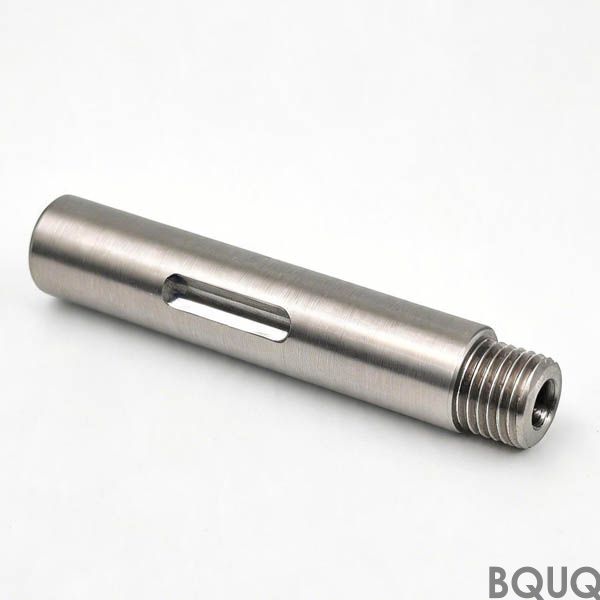
Let us use a practical example: A 6061-T6 aluminum bracket, dimensions 100mm x 80mm x 15mm, requiring 6 drilled holes and 2 tapped M6 threads.
- **Cycle Time:** 8 minutes (0.133 hours) for machining. - **Material Cost:** 0.5 kg of 6061-T6 at $4.20/kg = $2.10. - **Setup Cost:** One-off programming and fixturing = $45.00 (amortized over order quantity). - **Finishing:** Clear anodize (Type II) = $3.50 per part (batch pricing).
**Calculation for 10 Units:** (0.133 hrs x $75/hr) + $2.10 + ($45/10) + $3.50 = $9.98 + $2.10 + $4.50 + $3.50 = **$20.08 per part**.
**Calculation for 100 Units:** (0.133 x $75) + $2.10 + ($45/100) + $3.50 = $9.98 + $2.10 + $0.45 + $3.50 = **$16.03 per part**.
Notice the setup cost is the variable that shrinks fastest. At 500 units, the setup contribution drops to $0.09, making the part **$15.67**. This is why we always advise clients to consolidate annual demand into fewer, larger orders.
Material Impact on 2026 Pricing
Material cost is often 20-30% of the total piece price. In 2026, raw material prices have stabilized but remain high due to global supply chain diversification.
| Material | Price per kg (USD) | Machinability Rating | Typical Application | Surface Finish (Ra) | :--- | :--- | :--- | :--- | :--- | 6061-T6 Aluminum | $4.20 | Excellent | Enclosures, brackets | 0.8 - 1.6 µm | 7075-T6 Aluminum | $7.80 | Good | Aerospace, high-stress | 0.4 - 0.8 µm | 304 Stainless Steel | $5.90 | Fair | Food, marine, medical | 0.8 - 1.6 µm | 17-4 PH Stainless | $12.50 | Poor (hard) | High-strength fasteners | 0.4 - 0.8 µm | C36000 Brass | $11.00 | Excellent | Valves, fittings | 0.4 - 0.8 µm | P20 Tool Steel | $8.20 | Fair | Mold bases | 0.8 - 1.6 µm |
|---|
**Engineering Note:** Do not spec 7075-T6 if 6061-T6 is sufficient. The 7075 costs 85% more per kg and cuts 25% slower, increasing both material and machine time. For prototyping, we recommend 6061-T6 due to its predictable thermal expansion (23.6 µm/m-°C) during machining.
Tolerance and Complexity: The Hidden Cost Multiplier
The "standard" tolerance of +/- 0.025 mm is achievable on any VMC. However, tightening to +/- 0.010 mm increases cost by 30-40%. Tightening to +/- 0.005 mm requires 4-axis or 5-axis machines and increases cost by 80-100%.
This is due to **thermal growth**. A machine running for 4 hours generates heat that shifts the spindle centerline by up to 0.015 mm. To hold +/- 0.005 mm, we must run the machine at a constant temperature (24°C ± 1°C), use glass scale feedback, and perform in-process probing.
**Complexity Factors:** - **Number of Setups:** A part requiring 3 setups (flip operations) costs 25% more than a 1-setup part. - **Deep Pockets:** Depth-to-diameter ratio > 4:1 requires special tooling and slower feed rates (reduces speed by 40%). - **Thin Walls:** Walls under 0.5 mm thickness require rigid fixturing and may cause chatter, increasing cycle time by 50%.
**Real 2026 Data from BQUQ:** A medical device component (titanium, 20mm x 15mm x 8mm) with a 0.8 mm internal slot and +/- 0.008 mm tolerance took 22 minutes to machine on a 5-axis. The hourly rate was $115. The part cost was $42.18 in material plus $42.17 in machining = **$84.35 per unit** before inspection.
Lead Time vs. Cost: The 2026 Trade-off
Standard lead time in Dongguan is 7-10 business days for 10-100 parts. Rush service (48-hour turnaround) adds a 35-50% surcharge on the hourly rate.
| Order Quantity | Standard Lead Time (Days) | Rush Lead Time (Days) | Rush Surcharge | :--- | :--- | :--- | :--- | 1 - 10 | 5 - 7 | 2 | +50% | 11 - 50 | 7 - 10 | 3 | +45% | 51 - 200 | 10 - 14 | 5 | +40% | 201 - 1000 | 14 - 21 | 7 | +30% |
|---|
**Why Rush Costs More:** Overtime labor (1.5x standard rate) and machine re-prioritization (bumping other orders) disrupts the production queue. We recommend rush only for emergency repair parts, not for production ramps.
Practical Recommendations for Engineers
1. **Design for "2D" First:** Use standard 2.5D machining (pockets, holes, slots) whenever possible. This allows 3-axis machines to run at peak efficiency. Complex 3D surfacing increases cycle time by 40-60%. 2. **Specify Finish Wisely:** A standard Ra 1.6 µm finish is free. Specifying Ra 0.4 µm requires secondary polishing or a slower finishing pass, adding $5-$10 per part. 3. **Consolidate Vendors:** Shipping, customs, and compliance costs are fixed. Sending a combined order of 50 heat sinks and 20 brackets to one factory saves ~15% on logistics versus splitting orders. 4. **Avoid Extremes in Wall Thickness:** Keep wall thickness above 1.0 mm for aluminum and 1.5 mm for steel. Below these values, you risk vibration and increased scrap rates. 5. **Ask for DFM Feedback:** A good manufacturer will re-engineer your part to reduce cycle time. For example, adding a 0.5 mm radius to an internal corner allows a larger cutter, reducing machining time by 20%.
FAQ: Quick Cost-Saving Tips
**Q: Is it cheaper to machine aluminum or 3D print it in 2026?** A: For quantities above 5 units, CNC is cheaper. A 3D printed aluminum part costs $0.50-$1.00 per gram. A machined part costs $0.15-$0.30 per gram at volume. CNC also offers better mechanical properties (no porosity).
**Q: How much does a CNC machine operator cost in China?** A: A skilled operator in Dongguan earns $1,800 - $2,500 per month. This is already included in the hourly rate.
**Q: What is the cheapest way to get a single prototype?** A: Use a 3D printer for form-fit-check, then CNC for functional testing. Machining a single aluminum part costs $25-$50. It is rarely worth trying to optimize the setup cost for one unit.
Conclusion: Budgeting for 2026
In 2026, expect to pay between $70 and $100 per hour for reliable, high-precision CNC machining from a certified factory. Your per-part cost will be dominated by cycle time (50-60%) and material (20-30%). The most effective way to reduce cost is to increase order quantity to absorb setup fees and to select the most machinable material that still meets your design requirements. Avoid over-tolerancing and complex 3D surfaces unless absolutely necessary.
At BQUQ, we have been manufacturing precision parts in Dongguan since 2005. We operate 45 CNC machines, including 5-axis DMG MORI units. We provide free DFM analysis to identify cost savings before you commit to production.
For an accurate quote on your specific drawings, send us your 3D PDF or STEP file. We provide a 12-hour quoting service, including material sourcing and finish recommendations.
**Contact BQUQ:** Email: sc@bquq.com WhatsApp: +86 13713157787 Website: www.bquq.com
Related Articles
- CNC Machining Materials Guide 2025: Choosing Aluminum, Steel, Brass, and Plastics
- Custom Metal Stamping vs CNC Machining Cost Comparison
- Aluminum Heat Sink CNC Machining: Best Practices Guide
Frequently Asked Questions
What is the typical hourly rate for CNC machining in 2026, and what does it include?
Standard 3-axis CNC machining costs between $65 and $85 per hour in 2026. The rate includes machine depreciation, tooling wear, coolant, electricity, and operator cost. It does not include material or post-processing unless specified. 4-axis runs $75-$95/hr, 5-axis $95-$130/hr, and CNC lathe $60-$80/hr.
How much does a simple aluminum part cost per unit at low volume?
A simple aluminum part costs between $8 and $35 per unit at low volume (1-10 pieces). For example, a 6061-T6 aluminum bracket (100x80x15mm) with 6 holes and 2 tapped M6 threads costs $20.08 per part for 10 units, including clear anodize finishing.
How does order quantity affect the price per part?
Price per part drops dramatically with quantity. The same aluminum bracket costs $20.08 per unit at 10 pieces, $16.03 at 100 units, and $15.67 at 500 units. Setup cost amortization is the key driver—it shrinks from $4.50 per part at 10 units to $0.09 at 500 units.
What tolerances can I expect from different CNC machine types?
Tolerances vary by machine: 3-axis VMC offers +/- 0.025 mm, 4-axis VMC +/- 0.020 mm, 5-axis simultaneous +/- 0.010 mm, and CNC lathe (Swiss/sliding head) +/- 0.010 mm. Maximum part sizes range from 800x600x500 mm on 3-axis to 500x400x300 mm on 5-axis.