Compression Spring vs Torsion Spring vs Extension Spring: What Is the Difference?
The fundamental difference lies in how each spring absorbs and releases mechanical energy: compression springs resist axial pushing forces and shorten under load, extension springs resist axial pulling forces and lengthen under load, and torsion springs resist rotational or twisting forces around their axis. In practical terms, a compression spring is designed to be squeezed, an extension spring is designed to be stretched, and a torsion spring is designed to be wound or twisted. Selecting the wrong type for your application will lead to premature fatigue failure, incorrect force output, or a mechanism that simply does not function within its intended stroke or torque range.
How Do Compression Springs Differ in Load Direction and Design?
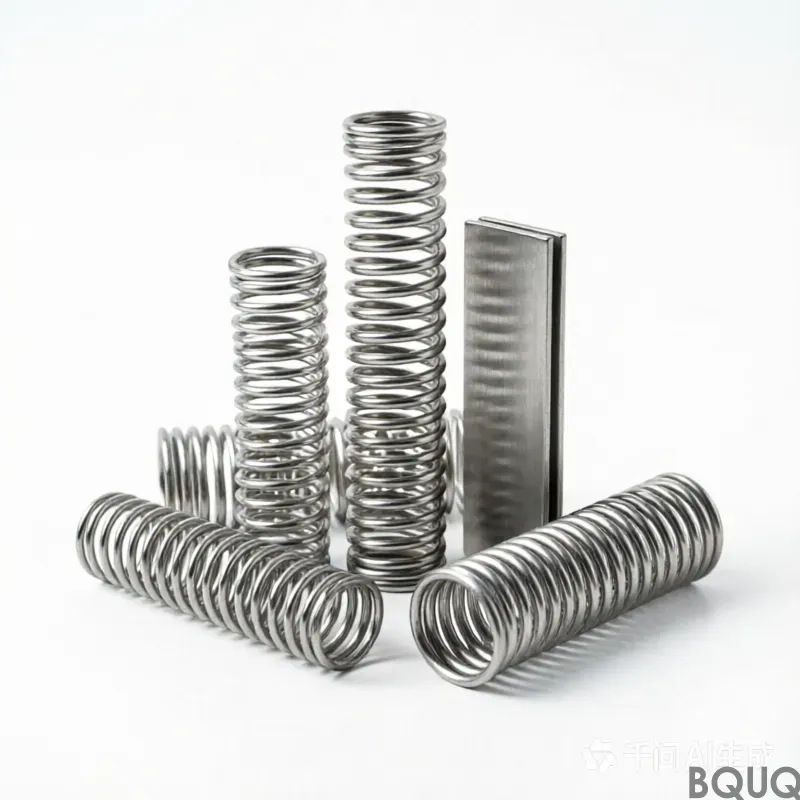
Compression springs are open-coil helical springs designed to provide force when pushed together along their longitudinal axis. They are the most common spring type in industrial applications, typically manufactured with a uniform pitch to allow the coils to touch (solid height) under maximum load. The wire is usually round, though square or rectangular wire is used when higher force density in a limited space is required. The critical design feature is the gap between adjacent coils, known as the pitch, which determines the maximum deflection before coil binding occurs.
In terms of load direction, compression springs produce an outward pushing force that opposes the applied compressive load. For example, a valve spring in an automotive engine operates at temperatures up to 150 degrees Celsius and must maintain a load tolerance of plus or minus 5 percent of the specified force at a given height. The free length, solid height, and spring rate (measured in Newtons per millimeter, N/mm) are the three primary specifications that engineers must define. A typical compression spring in a medical device might have a spring rate of 0.5 N/mm, while a heavy-duty die spring in a metal stamping press can exceed 200 N/mm.
How Do Extension Springs Handle Tensile Loads and Attachment Points?
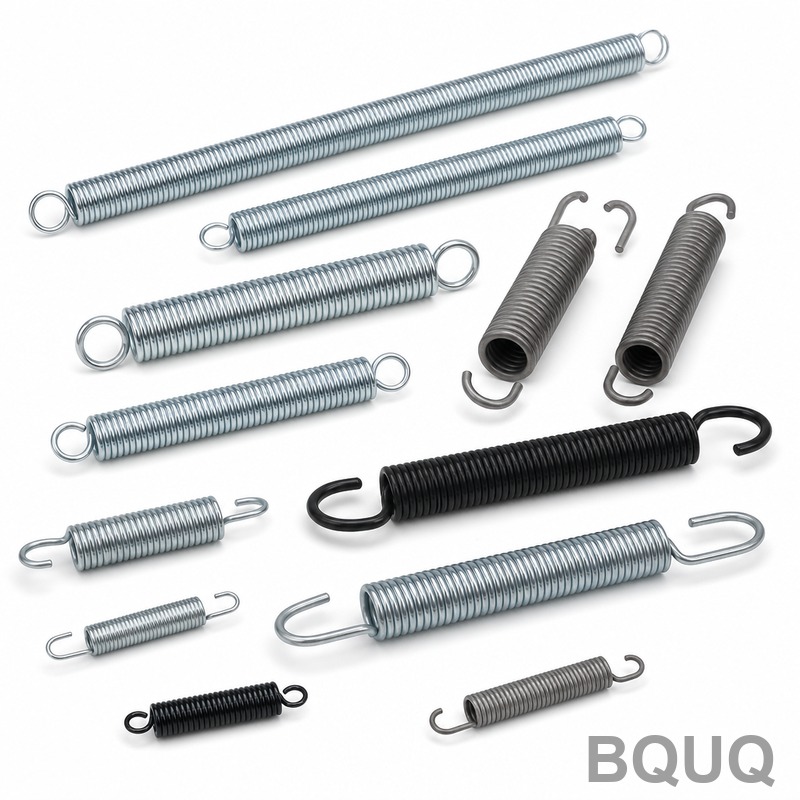
Extension springs are tightly wound coils that resist stretching forces, with adjacent coils usually touching each other in the free state. Unlike compression springs, they have initial tension, which is the force required to begin separating the coils. This initial tension, typically ranging from 5 to 15 percent of the maximum load, allows the spring to hold components together without external force. The most common end configurations are machine hooks, crossed hooks, and extended hooks, which serve as attachment points to other mechanism components.
The load direction for an extension spring is axial pulling, meaning the force acts to pull the two ends away from each other. When designing extension springs, engineers must account for hook stress concentration, which is often the failure point. The maximum allowable stress at the hook is typically 20 to 30 percent lower than the wire body stress. For example, a garage door counterbalance extension spring with a 0.192-inch wire diameter and 2-inch outer diameter can exert approximately 150 pounds of force at a stretched length of 24 inches, with a spring rate of 1.75 pounds per inch. Extension springs are also used in trampolines, agricultural equipment, and electrical switchgear where tension is required to return a mechanism to its original position.
How Do Torsion Springs Apply Torque and Rotational Force?
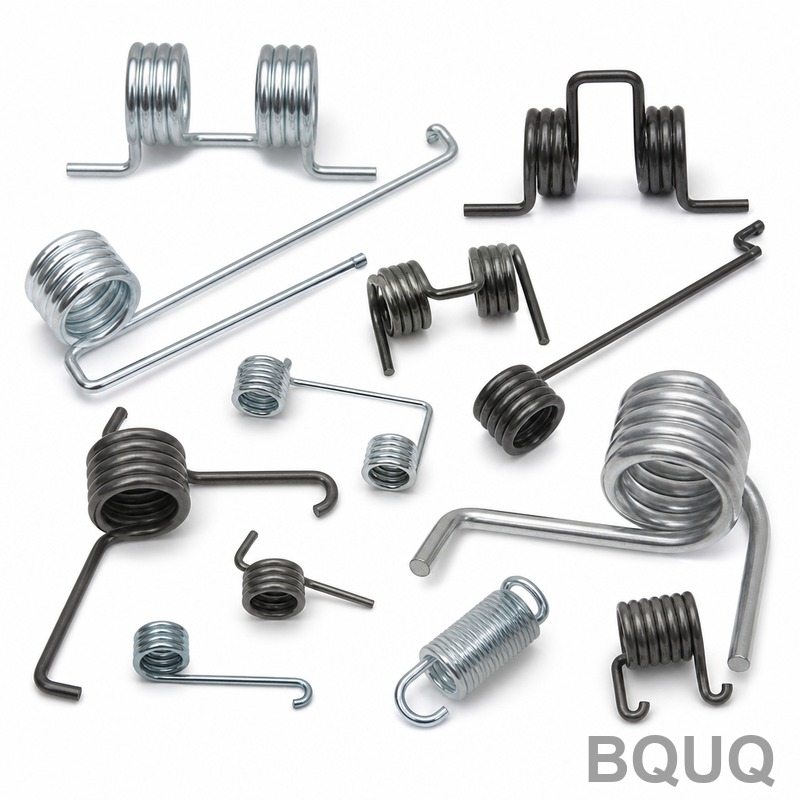
Torsion springs are helical coils that exert torque or rotational force when twisted around their axis. Unlike compression and extension springs, torsion springs have legs that rotate relative to each other, with the spring body acting as a torque transmitter. They are wound with a pitch that allows for friction between coils, which affects the torque characteristics. The primary design parameters are the leg length, leg angle, body length, and the direction of winding (right-hand or left-hand), which determines the direction of the applied torque.
The load in a torsion spring is applied as a bending moment, not as axial force. The stress in the wire is bending stress, which is different from the torsional stress in compression or extension springs. A typical torsion spring in a mousetrap mechanism might have a wire diameter of 0.8 mm, an outer diameter of 8 mm, and provide a torque of 0.05 Newton-meters at a deflection angle of 90 degrees. In industrial door hinges, torsion springs with a 6 mm wire diameter can deliver up to 80 Newton-meters of torque. The maximum recommended operating temperature for standard music wire torsion springs is 120 degrees Celsius, while stainless steel 302 versions can operate up to 260 degrees Celsius without significant loss of torque.
Which Spring Type Offers the Best Fatigue Life and Cycle Performance?
Fatigue life depends on the stress level relative to the material's tensile strength, the surface finish, and the operating environment. Compression springs generally offer the best fatigue life because the stress is distributed uniformly across the wire cross-section and there are no stress risers such as hooks or legs. A well-designed compression spring can achieve 10 million cycles if the maximum stress is kept below 45 percent of the material's ultimate tensile strength. Shot peening, a surface treatment that induces compressive residual stress, can increase fatigue life by up to 50 percent.
Extension springs have the shortest fatigue life of the three types due to the stress concentration at the hook ends. The hook bend radius creates localized stress that is often 2 to 3 times higher than the nominal wire stress. For high-cycle applications exceeding 100,000 cycles, extension springs should be redesigned with reduced hook stress or replaced with a compression spring with a mechanical linkage. Torsion springs fall in between, with fatigue life primarily governed by the bending stress in the wire. For torsion springs operating at stress levels below 50 percent of tensile strength, a fatigue life of 1 million cycles is achievable. However, residual stresses from the winding process and friction between coils can reduce this significantly in applications with rapid cycling.
How Do Manufacturing Processes and Costs Compare Across the Three Types?
Compression springs are the most economical to manufacture because they can be produced on high-speed automatic coiling machines at rates up to 100 pieces per minute. The tooling cost is minimal since the process involves feeding wire, bending it around a mandrel, and cutting to length. For a standard compression spring with a wire diameter between 0.5 mm and 10 mm, the unit cost ranges from 0.02 to 0.50 USD depending on quantity. Extension springs require additional operations for hook forming, which adds 10 to 20 percent to the manufacturing cost. The hook forming process can be done on the same machine but requires additional tooling and slower cycle times.
Torsion springs are the most expensive to manufacture because they require precise leg bending and often secondary operations for stress relieving and leg forming. The production rate for torsion springs is typically 30 to 60 pieces per minute, and the unit cost is 20 to 40 percent higher than compression springs of equivalent size. Additionally, torsion springs often require special mandrels and complex tooling for leg configurations, increasing the initial tooling cost by 500 to 2,000 USD per part number. For low-volume production runs of 1,000 pieces, torsion springs may cost 1.50 to 3.00 USD per piece, while compression springs in the same quantity might cost 0.50 to 1.00 USD.
What Are the Key Dimensional Tolerances for Each Spring Type?
Dimensional tolerances are critical for ensuring that springs fit correctly within an assembly and produce the required force or torque. The table below provides typical manufacturing tolerances for each spring type based on wire diameter and application class.
| Spring Parameter | Compression Spring Tolerance | Extension Spring Tolerance | Torsion Spring Tolerance |
| Wire Diameter (0.5-1.0 mm) | plus or minus 0.01 mm | plus or minus 0.01 mm | plus or minus 0.01 mm |
| Wire Diameter (1.0-5.0 mm) | plus or minus 0.02 mm | plus or minus 0.02 mm | plus or minus 0.02 mm |
| Outer Diameter (up to 20 mm) | plus or minus 0.10 mm | plus or minus 0.15 mm | plus or minus 0.15 mm |
| Free Length (up to 50 mm) | plus or minus 0.30 mm | plus or minus 0.50 mm | plus or minus 0.50 mm |
| Spring Rate | plus or minus 5 percent | plus or minus 7 percent | plus or minus 5 percent |
| Initial Tension | Not applicable | plus or minus 10 percent | Not applicable |
| Torque at Deflection | Not applicable | Not applicable | plus or minus 8 percent |
These tolerances are achievable with standard CNC coiling equipment and are suitable for most industrial applications. For high-precision applications, such as aerospace fuel injectors, tighter tolerances of plus or minus 0.005 mm on wire diameter and plus or minus 0.05 mm on free length can be held with grinding and additional inspection steps, but these increase cost by 30 to 50 percent.
When Should You Select a Compression Spring Over an Extension or Torsion Spring?
You should select a compression spring when your application requires axial pushback force, has space for the spring to compress, and does not need attachment hooks. Compression springs are ideal for applications where the spring can be guided by a rod or housed in a bore, preventing buckling. They are the preferred choice for high-cycle applications such as engine valves, safety valves, and electrical contacts because of their superior fatigue life and predictable force-deflection characteristics. If the mechanism requires a pulling force to return to a home position, an extension spring is more appropriate, but consider redesigning for compression if cycle life exceeds 500,000 cycles.
Select a torsion spring when the mechanism requires rotational torque, such as in hinges, ratchets, or return-to-center mechanisms. Torsion springs are also the correct choice when space is limited in the axial direction but available in the radial direction. One practical example is a spring-loaded latch in a cabinet, where a torsion spring with a 0.5 Nm torque at 45 degrees of rotation provides the closing force. For applications combining axial and rotational forces, a custom spring design may be necessary, and consulting with a manufacturer during the design phase is recommended to avoid costly iterations.
What Are the Common Failure Modes and How Can You Prevent Them?
The most common failure mode for compression springs is buckling, which occurs when the free length is more than 4 times the mean diameter and the spring is not guided. Buckling causes lateral deflection and can lead to coil-to-coil contact and premature wear. For extension springs, the primary failure is hook breakage due to stress concentration, especially when the hook is bent too tightly. To prevent this, specify a larger hook radius (at least 1.5 times the wire diameter) and use a lower working stress. Torsion springs commonly fail due to coil interference, where adjacent coils rub against each other during deflection, causing wear and generating heat. This can be mitigated by increasing the pitch to provide clearance between coils at maximum deflection.
Another critical failure mode is stress relaxation, which occurs when springs are exposed to temperatures above their design limit for extended periods. For music wire, stress relaxation becomes significant above 120 degrees Celsius, while chrome silicon wire can operate up to 230 degrees Celsius. In high-temperature environments, specify stainless steel 302 or Inconel X-750, which retain their mechanical properties up to 300 and 650 degrees Celsius respectively. Finally, corrosion can reduce fatigue life by 50 percent or more; for outdoor or corrosive environments, use stainless steel, phosphor bronze, or apply a protective coating such as zinc plating or powder coating.
FAQ
Can Compression Springs Be Used for Tension Applications?
No, compression springs cannot be used for tension applications because they provide force only when compressed. Attempting to pull a compression spring apart would simply separate the coils without generating any restoring force. If you need tension, use an extension spring or redesign the mechanism to apply a compressive load to the spring.
What Is the Maximum Operating Temperature for Standard Spring Materials?
Music wire (ASTM A228) can operate up to 120 degrees Celsius, while oil-tempered wire (ASTM A229) handles up to 150 degrees Celsius. Stainless steel 302 (ASTM A313) is rated for 260 degrees Celsius, and chrome silicon (ASTM A401) can operate up to 230 degrees Celsius. For temperatures above 300 degrees Celsius, use Inconel X-750 or Nimonic 90.
Which Spring Type Has the Highest Spring Rate for a Given Size?
Compression springs generally achieve the highest spring rate for a given diameter and wire size because the entire coil cross-section is loaded in torsion. For example, a compression spring with a 2 mm wire and 20 mm outer diameter can achieve a rate of 25 N/mm, while an equivalent extension spring would be limited by hook stress and a torsion spring by bending stress. Compression springs also allow for multiple parallel springs to increase the total rate.
How Do I Measure the Initial Tension of an Extension Spring?
Initial tension is measured by applying a gradually increasing axial load until the coils begin to separate. The force at the point of separation is the initial tension. For a typical extension spring, initial tension ranges from 5 to 15 percent of the maximum load, and it can be adjusted during manufacturing by controlling the coil winding tension.
Can Torsion Springs Be Wound in Either Direction?
Yes, torsion springs can be wound in either right-hand or left-hand direction. The winding direction determines the direction of the applied torque when the legs are deflected. Right-hand wound springs exert torque in a clockwise direction when the legs are compressed, and left-hand wound springs exert counterclockwise torque. For applications requiring torque in both directions, use two torsion springs wound in opposite directions.
What Is the Minimum Number of Coils Recommended for a Compression Spring?
The minimum recommended number of active coils for a compression spring is 3, but 4 to 6 coils are preferred for stability and predictable force output. Fewer than 3 coils can lead to excessive lateral instability and inconsistent spring rates. For torsion springs, the minimum is typically 3 coils, and for extension springs, the body must have at least 2 coils in contact with each other.
How Does Shot Peening Affect Spring Performance?
Shot peening induces compressive residual stresses on the spring surface, which prevents crack initiation and propagation. This surface treatment can increase fatigue life by 30 to 50 percent and allows the spring to operate at higher stress levels without failure. Shot peening is recommended for compression springs operating above 100,000 cycles or where the maximum stress exceeds 50 percent of the material's tensile strength.
At BQUQ, we have manufactured precision springs for over 20 years, serving industries from automotive to medical devices. Our CNC coiling machines achieve tolerances of plus or minus 0.01 mm on wire diameter, and our in-house stress relieving and shot peening lines ensure optimal fatigue life. For a rapid quotation on compression, extension, or torsion springs, send us your drawings or specifications. We provide 12-hour quoting and free design consultation. Contact us at sc@bquq.com or WhatsApp at +86 13713157787, or visit www.bquq.com to submit your inquiry.
Related Articles
- Where to Buy Custom Metal Springs Online: Top 7 Suppliers
- Lightweight Design and Material Upgrade of New Energy and Automobile Chassis Spring
- In-depth analysis of technology and process in the hardware spring industry in 2026: a full-dimensional interpretation of high stress, functional integration and engineering certification