Compression vs Torsion vs Extension Springs: Key Differences Explained
Direct Answer
The fundamental difference between compression, torsion, and extension springs lies in how they absorb and release mechanical energy. Compression springs resist axial pushing forces and shorten under load, torsion springs resist rotational or twisting forces, and extension springs resist axial pulling forces and lengthen under load. For precision engineering, selecting the correct type dictates load capacity, fatigue life, and system reliability; choosing the wrong spring can cause premature failure within 10,000 cycles in high-stress applications.
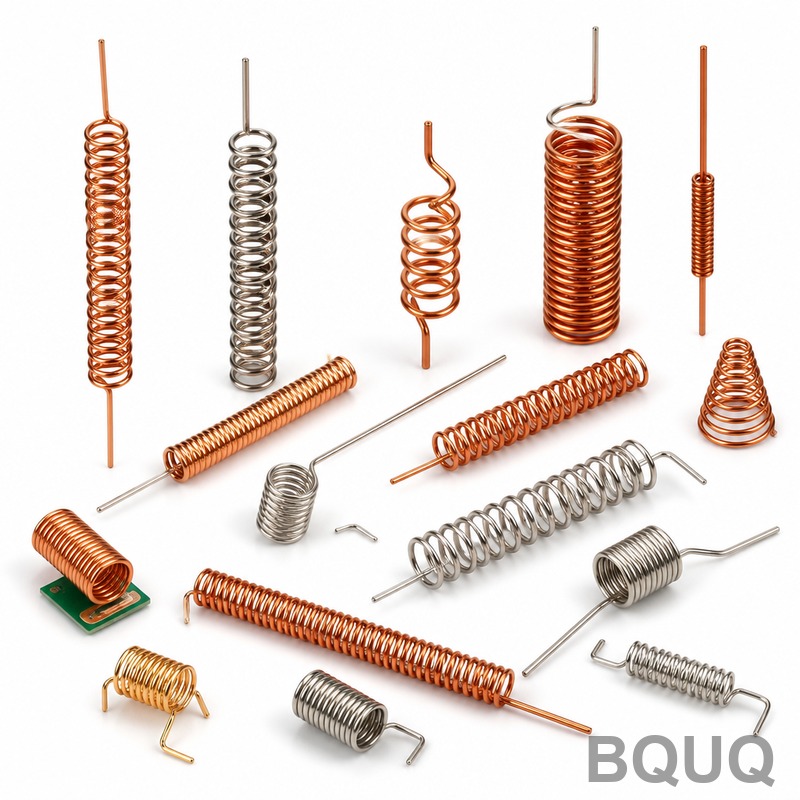
Working Principle and Force Application
Each spring type converts mechanical work into potential energy through elastic deformation, but the vector of applied force is unique.
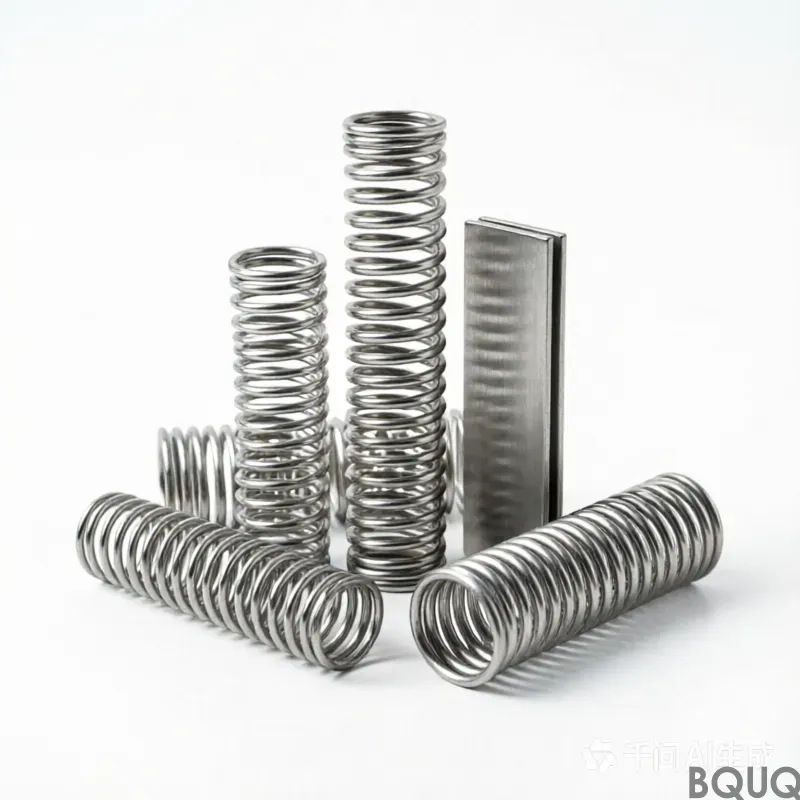
Compression springs are helical coils designed with an air gap between adjacent coils. When an axial compressive load is applied, the coils are pushed together, storing energy. They are the most common spring type, used in valve trains, suspension systems, and mechanical seals. BQUQ manufactures compression springs with a pitch tolerance of ±0.05 mm and free length tolerance of ±0.5 mm for diameters up to 50 mm.
Torsion springs are helical coils with legs extending from the ends. They operate by applying torque around the spring axis, causing the coils to wind tighter or unwind. The stress is primarily bending stress in the wire, not torsional stress as the name implies. These springs are critical in hinges, counterbalance mechanisms, and ratchets. Our torsional springs achieve angular deflection accuracy of ±1.5 degrees at 90 degrees of travel.
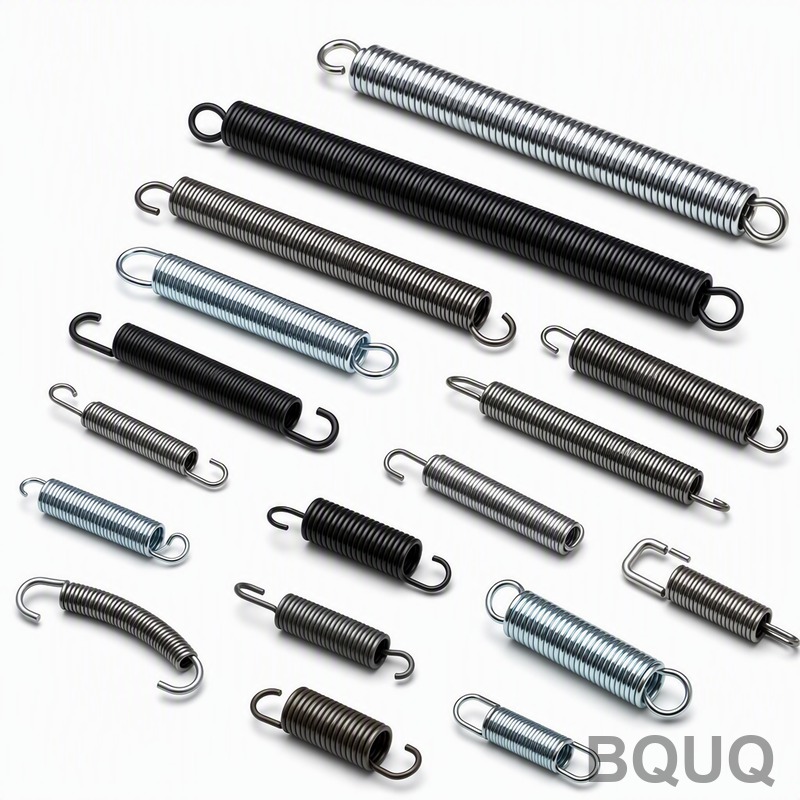
Extension springs are tightly wound coils with adjacent coils touching in the free state. They resist axial tension, with hooks, loops, or threaded ends for attachment. They store energy by stretching, with initial tension built into the coil. BQUQ controls initial tension within ±5% of specified values, which is essential for consistent preload in conveyor systems and garage door mechanisms.
Material and Manufacturing Comparison
Material selection directly impacts maximum operating temperature, corrosion resistance, and cost. BQUQ uses the following materials across all three spring types:
| Spring Type | Common Material | Max Operating Temp | Typical Wire Diameter | Relative Cost per Unit | Standard Tolerance |
| Compression | EN 10270-1 DH Spring Steel | 120 °C | 0.5 - 12.0 mm | $0.05 - $2.50 | Load ±10%, Free Length ±0.5 mm |
| Torsion | EN 10270-1 SH Oil Tempered | 150 °C | 0.3 - 8.0 mm | $0.08 - $3.80 | Angular Deflection ±1.5 degrees |
| Extension | AISI 302 Stainless Steel | 250 °C | 0.2 - 10.0 mm | $0.10 - $4.20 | Initial Tension ±5%, Load ±10% |
| Compression | AISI 316 Stainless Steel | 300 °C | 0.5 - 10.0 mm | $0.15 - $5.00 | Rate ±5% |
| Torsion | AISI 316 Stainless Steel | 300 °C | 0.3 - 6.0 mm | $0.20 - $6.50 | Rate ±5%, Leg Position ±1 mm |
| Extension | EN 10270-1 DH Spring Steel | 120 °C | 0.5 - 8.0 mm | $0.06 - $3.00 | Free Length ±1.0 mm |
For high-temperature environments above 200 °C, BQUQ recommends Inconel X-750 for all three types, though this increases raw material cost by approximately 8 to 12 times compared to standard spring steel. Shot peening is available for compression and torsion springs to improve fatigue life by up to 40 percent, but it is not practical for extension springs below 3 mm wire diameter due to distortion risk.
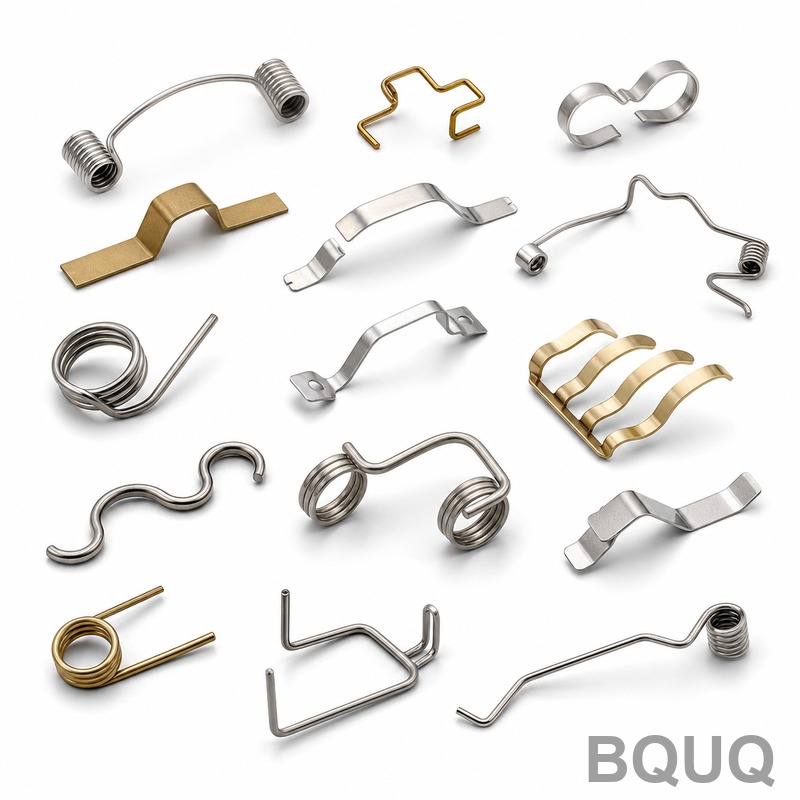
Load Capacity and Deflection Characteristics
The spring rate, measured in Newtons per millimeter for compression and extension springs, or Newton-millimeters per degree for torsion springs, defines the force-deflection relationship.
Compression springs exhibit a linear load-deflection curve until solid height is reached. The maximum allowable deflection should not exceed 80 percent of the available travel to prevent coil binding. For example, a compression spring with a free length of 50 mm and a solid height of 30 mm has a maximum working deflection of 16 mm at 80 percent. BQUQ recommends a design stress of 45 percent of the ultimate tensile strength for dynamic applications, and 60 percent for static applications.
Extension springs also show linear behavior after overcoming initial tension. The initial tension is critical; it typically ranges from 5 to 15 percent of the full load capacity. If the required initial tension is too high, the spring may yield at the hooks. We recommend specifying extension springs with a maximum hook stress of 75 percent of the wire material yield strength.
Torsion springs have a linear torque versus angular deflection relationship. The stress concentration at the inner diameter of the coil is significant; for a spring index of 4, the stress is 1.35 times higher than the nominal bending stress. For a spring index of 8, this factor drops to 1.15. BQUQ advises maintaining a spring index between 5 and 9 for torsion springs to balance stress and manufacturability. The maximum recommended deflection is 45 degrees per coil for hard-drawn wire.
Dimensional and Tolerance Specifications
Precision tolerances vary significantly among the three types. For compression springs, the critical dimensions are free length, outside diameter, and wire diameter. BQUQ holds outside diameter tolerances to ±0.1 mm for springs under 25 mm OD. For extension springs, free length and hook alignment are the most challenging to control. Hook alignment tolerance is ±2 degrees for standard production, achievable with CNC coiling and forming equipment.
Torsion springs require precise control of leg angles and leg lengths. The angular relationship between the two legs is held to ±1 degree for wire diameters under 4 mm. For larger wire diameters, the tolerance loosens to ±2 degrees due to springback variations in the forming process.
| Parameter | Compression Spring | Torsion Spring | Extension Spring |
| Critical Dimension | Free Length | Leg Angle | Initial Tension |
| Typical Tolerance | ±0.5 mm | ±1.5 degrees | ±5% of value |
| Surface Finish Ra | 0.8 - 1.6 µm | 0.8 - 1.6 µm | 0.8 - 1.6 µm |
| End Type | Closed and Ground | Straight Off | Full Loop, Extended Hook |
| Fatigue Life (Dynamic) | 1,000,000 cycles | 500,000 cycles | 300,000 cycles |
| Typical Lead Time | 3 - 5 days | 5 - 7 days | 4 - 6 days |
Surface finishing is applied uniformly. Electroplating zinc or nickel provides corrosion resistance up to 96 hours in salt spray testing per ASTM B117. For extension springs with tight hooks, electroless nickel plating is preferred over electroplating to avoid hydrogen embrittlement, which can cause sudden fracture under sustained load.
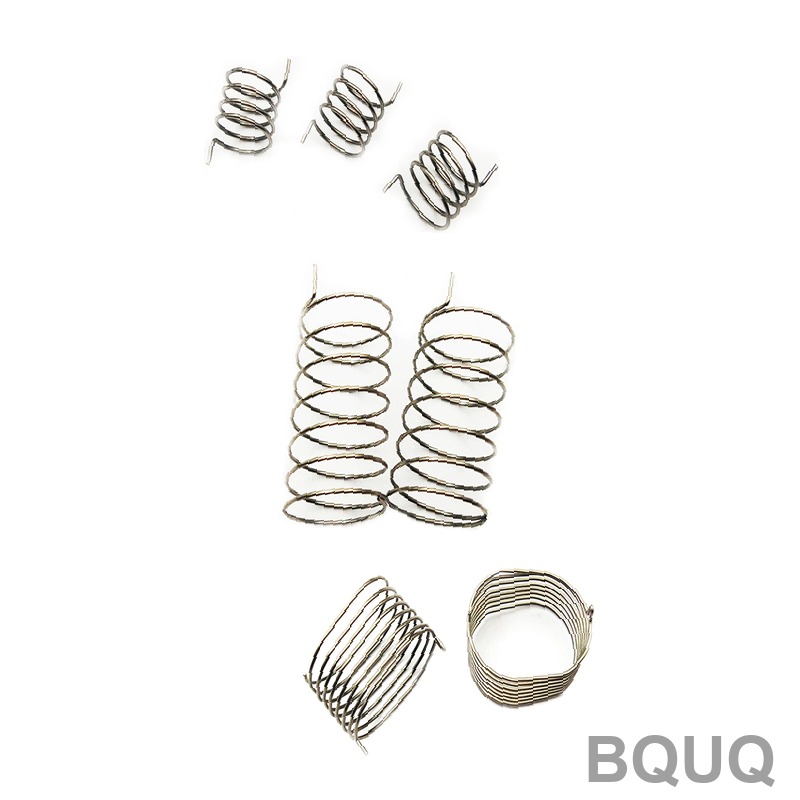
Practical Selection Criteria and Engineering Recommendations
Select the spring type based on the direction of the applied force in your assembly. If the component experiences pushing force, use a compression spring. For pulling force, use an extension spring. For rotational torque, use a torsion spring. This seems obvious, but many failures occur when designers attempt to use a compression spring in a tension application by adding end adapters.
For dynamic applications with more than 100,000 cycles, consider the following BQUQ engineering rules:
For compression springs, use closed and ground ends to ensure perpendicularity and even load distribution. Specify a spring index above 4 to avoid excessive stress concentration. For high-speed applications above 10 m/s, consider spring surge; adding a non-linear pitch or using a spring damper reduces resonant vibration.
For torsion springs, the direction of winding matters. Right-hand wound springs with clockwise torque are standard. The legs must be properly supported to prevent buckling under load. We recommend a mandrel diameter that is 10 percent larger than the spring OD to guide the spring during deflection.
For extension springs, avoid designs where the spring operates above 85 percent of its elastic limit. The hooks are the weakest point; failure occurs at the hook bend radius. Specify a larger hook radius of at least 1.5 times the wire diameter to distribute stress. Use a full loop end style for heavy loads above 500 N, as it provides a larger stress-bearing area than a cross-over loop.
FAQ-Style Tips for Engineers
How do I measure spring rate correctly for each type? For compression and extension springs, measure load at two different deflections, subtract the loads, and divide by the deflection difference. For torsion springs, measure torque at two different angular positions and divide the torque difference by the angle difference in radians.
Can I convert a compression spring into an extension spring? No. The end configurations, initial tension, and stress distribution are fundamentally different. A compression spring has no initial tension and will collapse under its own weight if oriented vertically.
What is the minimum order quantity at BQUQ? Standard sizes start at 500 pieces. Custom precision springs with tight tolerances require a minimum of 2,000 pieces for economical production. Prototype quantities of 50 pieces are available with a 5-day lead time.
How does temperature affect spring performance? The modulus of elasticity of spring steel decreases by approximately 3 percent from 20 °C to 200 °C. This reduces the spring rate proportionally. At 250 °C, standard chrome-vanadium steel loses 10 percent of its load capacity. For temperatures above 300 °C, use Inconel or a nickel-based superalloy.
Conclusion and Technical Support
Selecting between compression, torsion, and extension springs requires a clear understanding of the force vector, space constraints, and fatigue requirements. Compression springs handle axial push loads with high linearity, torsion springs manage rotational torque with precise angular control, and extension springs provide consistent pull force with initial tension. For demanding applications above 200,000 cycles or with operating temperatures beyond 120 °C, consult a spring manufacturer with material and process expertise. BQUQ provides free design review and failure analysis for all spring applications.
BQUQ offers 12-hour quoting on custom compression, torsion, and extension springs. Send your drawings, specifications, or sample parts to sc@bquq.com. For immediate technical consultation, contact our engineering team on WhatsApp at +86 13713157787. Visit www.bquq.com to download our spring design handbook and tolerance chart. We respond to all inquiries within one business day, with production lead times starting at 3 days for standard compression springs.
Related Articles
- Where to Buy Custom Metal Springs Online: Top 7 Suppliers
- Hardware spring fatigue failure analysis and life prediction technology
- In-depth analysis of technology and process in the hardware spring industry in 2026: a full-dimensional interpretation of high stress, functional integration and engineering certification